

This story focuses on the examination of possible ecological, demographic, and social-cultural influences that may explain the lack of identified subclades (YDNA ancestors) in the migratory path of the Griffis genetic paternal line that lived in the Meuse Rhine watershed area. The story discusses possible social and cultural groups that may have been associated with the generations of ancestors of the Griff(is)(es)(ith) that may have lived during and after the bronze age, up to approximately 500 BCE.
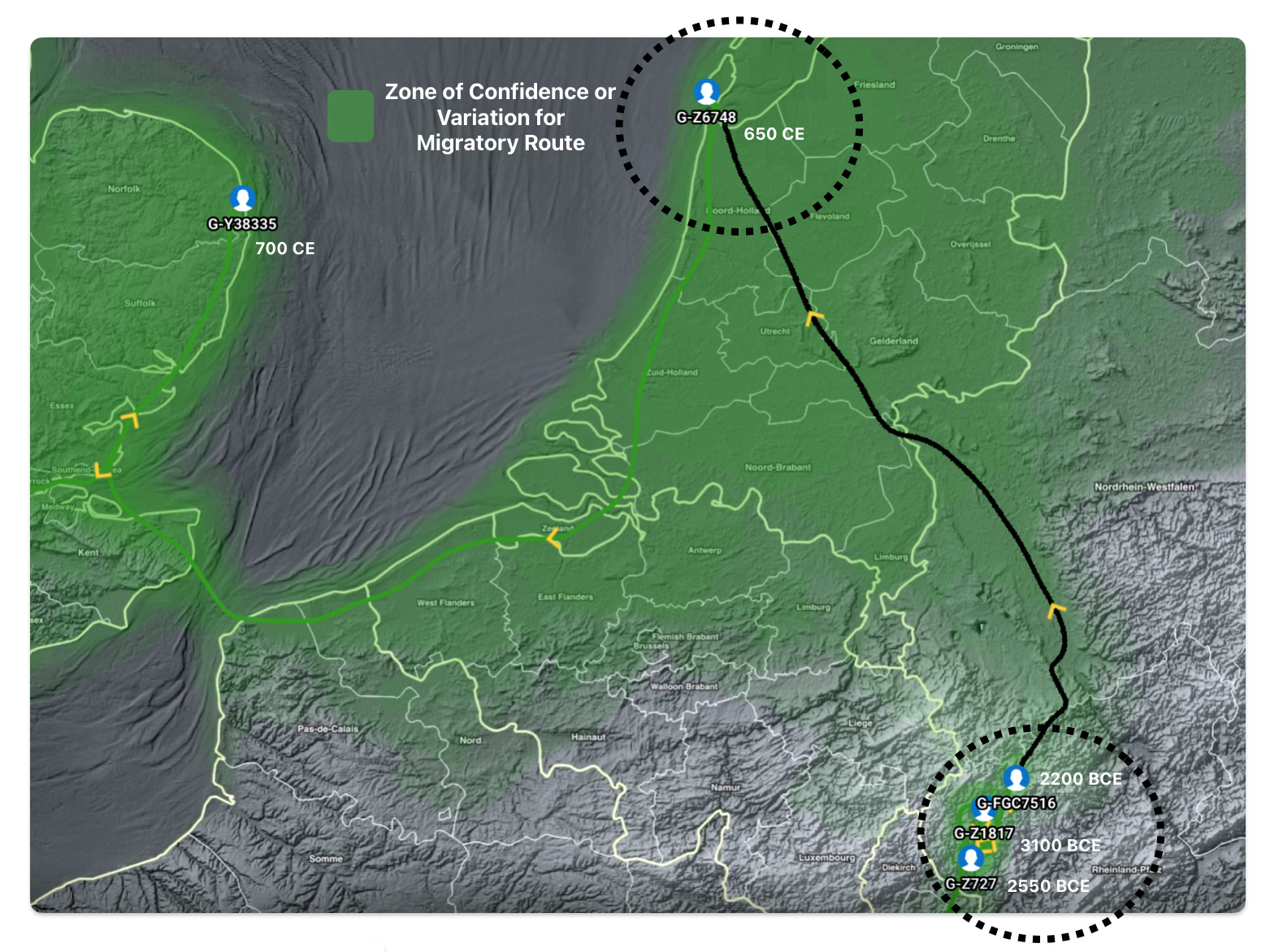
The 2,850 year Gap between G-FGC7516 and G-Z6748: The most common recent ancestor associated with G-FGC7516 was born around 2200 BCE. The next genetic ancestor on the Griff(is)(es)(ith) YDNA line was associated with the genetic SNP mutation defining the G-Z6748 haplogroup, 2,850 years later. This gap of undocumented YDNA ancestors represents about 95 generations.
The absence of identified subclades between haplogroups G-FGC716 (c. 2200 BCE) and G-Z6748 (c. 650 CE) in the Meuse-Rhine watershed area are likely the results from interconnected social, demographic, and environmental factors and their successive effects over generations . Some of the factors that may have influenced the lack of identified haplogroups along this migratory path are:
- Environmenal factors as well as targeted and genetic sampling strategies; .
- The persistant interaction between social and cultural groups within the watershed area; and
- The long term effects of social and cultural diversity in the watershed area.
Environmental and Methodological Factors
The retrieval of ancient DNA (aDNA) in the Meuse Rhine watershed area is highly contingent on environmental factors such as flooding and sediment dynamics, soil chemistry, climate cycles, and human land use, as well as targeted archaeological and genetic sampling strategies that mitigate adverse preservation conditions. Archaeological sites that are well preserved will yield promising evidence to reconstruct ancient social and cultural practices as depicted in illustration one.
Illustration One: Example of an Archaeological Site and aDNA Retrieval and Analysis

(A) Map showing geographical locations of samples. (B) Estimated age of death and haplogroup information of the individuals. (C) Pedigree plots showing kin relationships between the individuals. (D) Pedigree plots showing the genomic component of steppe-related and Late Neolithic ancestries.
The Meuse and Rhine delta regions, acting both as a conservator and genetic crossroad, provides a broader spectrum of recoverable lineages, including indigenous and incoming populations. The upland and interior Rhine and Meuse sites are more prone to genetic bottlenecks and loss due to environmental barriers and patchy skeletal survival.
Illustration Two: Migratory Path and the Meuse and Rhine Rivers

Illustration Three: The Meuse and Rhine Watersheds

The region’s humid and waterlogged conditions, driven by fluctuating river regimes and frequent flooding, generally accelerate the degradation of skeletal remains and ancient DNA (aDNA) through microbial activity, hydrolysis, and oxidation. This results in poor long-term preservation. These processes could either bury remains in anoxic, sediment-rich environments conducive to preservation or expose them to further decay. Upland settlement patterns influenced DNA retrieval potential. Archaeological sites located in upland sandy soils were more likely to yield degraded samples due to acidity while delta wetlands offered better DNA survival prospects due to waterlogging and reduced oxygen. [1]
Human environmenal activities through this particular historical period had impacts on the preservation of aDNA. Major land use changes, such as deforestation, agricultural practices, the historical layering of land use practices, and Roman-medieval infrastructure changes (e.g. ditches, embankments), altered erosion rates and sedimentation. This sometimes created sealed burial contexts that were beneficial for DNA preservation but could also disturb existing archaeological layers and lead to destruction or mixing of deposits. Increased flooding events, especially from the Iron Age onward and during the Roman and early Medieval periods, redistributed sediments, alternately exposing and sealing archaeological contexts. [2]
Table One: Environmenal Factors Affecting DNA Retrieval in the Meuse Rhine Watershed Area
| Factor | Effect on DNA |
|---|---|
| Humidity & Waterlogging | Accelerates decay |
| Flooding & Sediment Dynamics | Burial or exposure |
| Soil pH (Alkaline vs. Acidic) | Preserves vs. degrades DNA |
| Climate Oscillations | Cooling preserves, warming degrades |
| Land Use Changes (Deforestation, Ditches) | Mixed impact |
The Rhine-Meuse delta’s flood-prone geography disrupted settlement continuity. Repeated flooding could isolate populations, causing local extinctions of lineages. Prolonged reliance on localized wetland resources limited population mobility and genetic exchange.
The Barbed Wire Beaker Culture and the Archaeological Concept of Cultural Change (~ 2100 – 1800 BCE)
The beginning of this phylogenetic gap of YDNA haplogroups in the Griff(is)(es)(ith YDNA line of descent begins with an individual who had a 68 percent chance of being born between 2533 BCE and 1853 BCE. Based on inferences from YDNA mapping data [3] , I have suggested that this most common recent ancestor of haplogroup G-FGC7516 lived in a general area that is now Aachen, Germany. Aachen is located west of the Rhine river and is part of the Meuse-Rhine watershed area. (see illustration one). The city sits on the Wurm River, a tributary of the Rur River, which flows into the Meuse river system. [4]
Illustration One: Location of Aachen Germany

Our most recent common ancestor could have lived in a community that, in contemporary times, would be labeled by achaeologists as part of the Barb Wire Beaker or Bell Beaker culture.
The Barbed Wire Beaker culture was a local development of the Bell Beaker phenomenon in the Meuse-Rhine watershed area, specifically around 2100–1800 BCE. The Barbed Wire Beaker culture arose locally from the Bell Beaker culture and is archaeologically documented specifically in the lower Rhine and Meuse river areas, which today comprise the southern Netherlands and adjacent western Germany. [5]
This time period in the Meuse Rhine watershed area was a period of cultural transition. Social and cultural characteristics of the Barbed Wire Beaker included a distinctive pottery style, continued pastoralist and agricultural traditions, and the use of burial mounds, reflecting both continuity with Late Neolithic practices and early Bronze Age innovations. The continued use of burial mounds (barrows) for the interment of individuals was a key feature, with evidence for both inhumation and, to a lesser extent, cremation, hinting at social differentiation based on grave goods and monument size. [6]

- Looking at the Griff(is)(es)(ith) Y-DNA Phylogenetic Gap Associated with the Meuse and Rhine River Watershed from the Bronze Age Onward – Part Four September 21, 2025
- Looking at the Griff(is)(es)(ith) Y-DNA Phylogenetic Gap Associated with the Meuse and Rhine River Watershed – Part Three August 29, 2025
- Looking at the Griff(is)(es)(ith) Y-DNA Phylogenetic Gap Associated with the Meuse and Rhine River Watershed – Part Two July 29, 2025
- Looking at the Griff(is)(es)(ith) Y-DNA Phylogenetic Gap Associated with the Meuse and Rhine River Watershed – Part One June 30, 2025
- Understanding the Phylogenetic ‘Gap’ Associated with the Continental Migratory Route – Part Three May 6, 2025
- Looking at the Two Phylogenetic ‘Gaps’ – Part Two April 29, 2025
- Looking at the Griff(is)(es)(ith) Patrilineal Line of Descent Through the YDNA G Haplogroup Phylogenetic Tree – Part One April 15, 2025
“As in neighbouring countries, the period between 2000 and 1800 BC shows continuity with the Late Neolithic Beaker Cultures. . . . Bell Beaker forms and decorative patterns continued in Barbed Wire Beaker pottery . . . , even in the characteristic large beaker pots. The only difference with Bell Beakers appears to be the decrative technique. Instead of using a spatula, barbed wire decoration is made using a flexible or sturdy stamp with a piece of string wrapped around it which is pressed into the wet clay. The distribution of Barbed Wire pottery also resembles that of late Bell Beaker closely to the extent that it is not found in the higher parts of Belgium and Germany. It extends into the higher regions only along the river valleys of the Rhine and the Meuse. “ [7]
Harry Fokkens critically analyzes long-standing assumptions about the origins of the Bell Beaker phenomenon in the Netherlands. He challenges the typological and chronological sequence that underpins the so-called ‘Dutch Model’ in archaeology. The Dutch Model argues for a local, continuous development from Single Grave Beakers culture into Bell Beakers culture, positioning the Rhine-Meuse delta as a key formative region. Fokkens scrutinizes the reliance on pottery typology and 14C carbon dating as primary evidence for cultural continuity. He argues that these are insufficient markers for true cultural identity and for explaining the dynamics of change.
He points out that settlement data do not fully support the Dutch Model. There are signs of regional cultural diversity and discontinuity, especially when considering earlier traditions like the Vlaardingen and Funnel Beaker cultures. He calls for moving beyond typological sequence and grave goods, advocating for the study of how beaker practices were incorporated into existing local traditions, a shift toward exploring the diffusion of innovations rather than migration as the sole explanatory frame. [8]
Illustration Two: Model of Adoption of Innovations [9]

Color intensity indicates archaeological visibility of objects & features. (A) Visibility of subsequent cultural traditions; (B) Shows how introduction trajectory of innovations may cause differential visibility & subsequent archaeological perception of abrupt change.
Harry Fokkens defines cultural change not simply as a typological sequence in material culture or as abrupt migration, but as a process that must be interpreted through a wider lens—including settlement data, local background, and context-driven adoption of practices. He emphasizes moving beyond static models, arguing that culture change requires understanding the social and historical processes that drive adoption and transformation—settlement archaeology, agency, and local adaptation are key (see illustration two). Cultural change should be studied by examining how new practices fit into everyday life, ritual, and economy, not just as visible shifts in craft or burial customs.
Cultural change, for Fokkens, is defined by how innovations (such as Bell Beakers) are adopted, adapted, and integrated into local traditions across different regional contexts. This can include diffusion, selective adoption, or hybridization, making each region’s trajectory unique.
“Major change only develops when the critical mass is reached and the rate of adoption changes (see illustration two) . . . . This is the point where so many people have already adopted an innovation that non-adopters run the risk not to belong to the ‘mainstream’ any longer. . . . I have suggested that this is the phase that innovations become archaeologically visible and that we may ‘see’ culture change. In my view this transition phase, the period of adoption before the critical mass is reached, can be recognised in many regions of Europe. This is characterised as a period in which new (Bell Beaker) elements are incorporated in regional traditions without changing them. . . . So regionalisation may well have started 2400 cal BC or earlier, but had developed around 2300 cal BC.” [10]
The map in illustration three visually depicts the cultural landscape of the Netherlands between 2500-2000 BCE as a period of transition. The map depicts different variants of the Bell Beaker cultures that may have existed simultaneously and overlapped over time.
A period that our common YDNA ancestor and susequent generations could have existed. In illustration three, known, discovered Bell Beaker sites are presented along with other cultural sites. The map depicts the distribution of barrow grave sites, Veluvian Bell Beaker sites and Notheast Dutch/German Beaker sites. The map also depicts the distribution of maritime Bell Beaker type archaelogical sites.
Illustration Three: The cultural landscape of the Netherlands c. 2500-2000

Fokkens contends that determining the characteristics of archaeological culture and cultural change are better understood through the exploration of local settlement contexts rather than just burial typology or other singular changes in artifacts. He encourages a multidisciplinary approach: looking at settlement archaeology, regional interactions, and innovations in local contexts to reinterpret the rise and spread of Bell Beaker culture in the Netherlands.
Illustration four provides two maps of Bell Beaker and Barbed Wire cultural sites and burial grounds. The comparison of the two maps highlight the overlap of the two archaeological cultures and their location on waterways in the Meuse Rhine watershed.
Illustration Four: Bell Beaker and Barb Wire Culture Sites

Community and family units in the Dutch Beaker cultures appear to have been based in small, dispersed settlements with some degree of sedentism, engaging in mixed farming, pastoralism, and hunting as indicated by archaeological settlement finds and faunal remains. Domestic sites show continuity in housing forms from the Late Neolithic, with initial persistence of two-aisled houses before a transition to three-aisled “longhouse” structures in the following centuries. [11]
Throughout the 20th century, scholars debated whether the Beaker phenomenon in northwestern Europe was best explained by waves of migrating peoples (possibly a small elite or specialists) or by the widespread adoption of ideas and artifacts across existing societies. The migrationist perspective dominated early on, but after the 1960s, archaeologists increasingly favored diffusionist models, seeing migration as a last resort explanation. Renewed attention to migration has emerged in recent decades with the advent of aDNA studies, which have provided new insights into population movements. [12]
Migrationists argued that significant cultural transformations, like the appearance of the Beaker culture’s characteristic pottery and burial customs, reflected the arrival or influx of new populations. In the Beaker context, this could mean the movement of groups such as warriors, craftsmen, or traders, who settled in new regions and brought their traditions, technologies, and genetic lineages with them.
Diffusionists emphasized that similar artifacts or cultural traits could spread via contact, trade, or imitation without mass population movement. For the Beaker culture, this meant that local populations could adopt Beaker pottery styles, burial rites, or metalworking techniques through networks of exchange and social influence, rather than as a result of being replaced or displaced by newcomers.
Recent studies combining archaeology and ancient DNA analysis have led to nuanced conclusions regarding the migrationism versus diffusionism debate about the Beaker culture in northwestern Europe. The general consensus is that both migration and diffusion played significant but contextually distinct roles. [13]
The Bell Beaker-associated populations in the Meuse–Rhine region (including the Netherlands, Belgium, and western Germany) emerged through a mixture of local inhabitants and Corded Ware-associated migrants. As indicated in previous parts of this story, the Meuse–Rhine region stands out due to its long persistence of hunter-gatherer and early European farmer genetic ancestry—up to three millennia longer than neighboring continental areas, as wetlands and riverine ecology limited gene flow and farming adoption. The first appearance of Bell Beakers in this region marked a rapid shift in genetic makeup and cultural practices, distinct from earlier local continuity. [14]
The Barbed-Wire Beaker culture marks the beginning of the Bronze Age in the Dutch river area. Metalworking (especially the introduction of bronze items) is evident but limited, suggesting access via long-distance exchange rather than local production. Prestige items (e.g. axes, daggers) entered the region as exotic goods. The Netherlands lacked the natural copper and tin resources needed to produce bronze. Consequently, all bronze objects were either imported or created from imported alloys, demonstrating the region’s connection to larger European trade networks. This timing aligns with the initiation of Bronze Age settlement and metallurgy in the broader Dutch river area, including both the Meuse and the lower Rhine valleys. [15]
“Bell Beaker people took advantage of transport by sea and rivers, creating a cultural spread extending from Ireland to the Carpathian Basin and south along the Atlantic coast and along the Rhône valley to Portugal, North Africa, and Sicily, even penetrating northern and central Italy.“ [16]
Barbed Wire Beaker communities participated in extensive riverine trade and communication networks, which would almost certainly have required effective watercraft such as logboats. The spread of beaker styles and goods along major waterways (Rhine, Meuse, IJssel) is consistent with an environment where logboats were in routine use, facilitating cultural exchange. [17]
“ . . . (I)nstead of with ‘cultures’, we are dealing with different communities of practice that through regular communication were structured around learned practices. This notion shifts the focus of study from objects to communication networks and different way of ‘doing things’. Many of the sites excavated the last 15 years and before were located in dynamic landscapes and near rivers or lakes, even near the sea . Therefore we expect water ways to have structured the cultural palette and the transmission of ideas. From that perspective we predict that river deltas and upstream their catchment areas constituted the natural routes for transport of objects and people and the foremost connections in the communication networks. Land-based connections should of course not be ignored, but they may not have been of primary importance for structuring and maintaining local communities.“ [18]
“. . . (T)he location of many settlement in the dynamic landscapes and on the borders of wetlands may also imply that transport and travel by boats and canoes was far more important than with land-based vehicles. Wheels and carts were known, but long-distance communication over land seems unviable because these burdens were probably too heavy We suggest that instead waterways were by far the most important means of transport and communication. This directly influences our ideas about the constitution of regional groups as communities of practice.“ [19] (Emphasis is mine.)
Logboats, also known as dugout canoes or monoxylons, are simple watercraft made by hollowing out the trunk of a single tree. They are among the oldest known types of boats, with archaeological examples dating back over 8,000 years to the Neolithic era. [20] Logboats represent a key technological innovation in early water transport. The Meuse-Rhine system formed a natural corridor for movement and exchange stretching from the interior of Europe to the North Sea, and logboats provided the practical technology to exploit these routes.
Archaeological evidence suggests that some of the earliest regional trade networks, including the distribution of pottery styles, flint, and metal objects, relied on water transport made possible by logboats. Logboats were essential for fishing, hunting, and gathering in wetland zones, as well as for accessing and transporting timber, peat, and other bulk resources typically found along watercourses. Radiocarbon-dated finds show that logboats were used continuously from the Mesolithic into the Bronze Age and later periods in the Meuse-Rhine watershed, highlighting their enduring relevance. The region’s dynamic fluvial landscape—with frequent avulsions, flooding, and marsh formation—made watercraft indispensable for everyday life. [21]
“The Pesse canoe is the world’s oldest – known boat. Carbon dating indicates that the boat was constructed during the early Mesolithic period between 8040 BC and 7510 BC.” [22]
Illustration Five: Pesse Logboat

Settlement clusters frequently appear along major rivers and tributaries, with evidence that logboats enabled frequent movement and social ties among dispersed communities. Some prehistoric villages in the Rhine-Meuse delta are interpreted as trading posts or hubs precisely because of their strategic waterfront locations and the availability of logboat transport.
An interesting study by Lanting presents the largest radiocarbon and dendrochronological dataset for European logboats. It covers more than 600 directly dated specimens across Europe with additional meta-analysis of over 3,500 archaeological finds of logboats. The study establishes a clear chronological and geographic set of diffusion patterns associated with one form of water transportation. (see illustration six). [23]
Illustration Six: Diffusion of Log Boats

“When working with the dates of the logboats . . . some patterns in distribution both in space and time are noticeable. To visualize these patterns Continental Europe north of the Alps and the Pyrenees, and west of the Russian border has been divided in two zones . . . . Zone l comprises Denmark, northwestern Germany (i.e. Schleswig-Holstein, Hamburg, Niedersachsen, Bremen and Nordrhein-Westfalen), Netherlands, Belgium and northwestern France (i.e. the regions Nord-Pas-de-Calais, Picardie, Hauteand Basse-Normandie, Ile-de-France, ChampagneArdenne and the departments Eure-et-Loir and Meuse). Zone 2 comprises the rest of France and Germany, Switzerland, Austria, the Czech Republic and Poland.” [24]
Robert Van de Noort’s article, “Exploring Agency Behind the Beaker Phenomenon”, emphasizes the central role of individual agents, particularly navigators, in creating and maintaining the long-distance exchange networks that underpinned the spread of the Bell Beaker phenomenon across Europe and North Africa. Instead of focusing on migration or simple diffusion models, Van de Noort highlights the active social practices and ritualized journeys of ‘elite travelers’ as key drivers of Beaker cultural expansion and transformation. Van de Noort draws on Mary Helms’s anthropological work, proposing that travel was a significant empowering activity giving travelers esoteric knowledge and access to exotic goods, which in turn conferred social power. His work reframes the Beaker phenomenon as a dynamic process shaped by individual agency, social networks, and long-distance travel practices, rather than mere migration or material diffusion. [25]
There is currently no evidence that logboats were a major feature or symbolic object of the Barbed Wire Beaker culture. They appear in the archaeological record as practical watercraft rather than cultural markers. The distribution of Barbed Wire Beaker settlements shows a preference for river valleys, lakes, and wetlands, possibly implying the routine use of logboats for transport, fishing, and access to dispersed settlements. Organic objects such as logboats rarely survive in grave or habitation contexts attributed explicitly to Barbed Wire Beaker sites, so direct association is difficult to prove archaeologically. [26]
The Elp and Hilversum Cultures (~ 1870 – 650 BCE)
In the Bronze Age, several regional cultures existed within the Meuse-Rhine watershed area, generally falling under broader classifications like the Elp culture and the Hilversum culture, in what is now the Netherlands and neighboring regions. These cultures inherited and further developed material traditions and social practices from the late Bell Beaker period, marking the beginning of the regional Bronze Age (see illustration seven).
Illustration Seven: Map of the Hilversum and Elp Cultures [27]

The Elp Culture was located primarily in the Netherlands and Northwestern Germany. It existed during the Middle and Late Bronze Age, roughly 1800-800 BCE. It is characterized by several distinctive archaeological features, especially in pottery, burial customs, settlement architecture, and subsistence strategies. The Elp culture is identified by its low-quality earthenware pottery known as “Kümmerkeramik” or “Grobkeramik,” which is considered an archaeological marker of the culture. This pottery style reflects an utilitarian approach, with little decorative emphasis. [28]
Elp settlements focused heavily on cattle raising, particularly for milk and milk products. Archaeological evidence suggests social importance and possibly ritual aspects tied to cattle, such as stacks of cowhides in graves and animal offerings. The stalling of cattle also points to adaptations to climatic conditions affecting milk production, as well as a potential response to social pressures like cattle raiding. [29]
Geographically, the Elp culture was part of the Nordwestblock, situated north and east of the Rhine and IJssel rivers and bordered by the Hilversum and Hoogkarspel cultures. These cultures, including Elp, are believed to have derived from the earlier Bell Beaker culture, thus placing the Elp culture at the cultural and ecological interface between North Sea (Atlantic) and Northern (Nordic) horizons. [30]
Based on archaeological study, the Elp culture is distinguished within the context of Middle and Late Bronze Age northwestern Europe. The early phase (1800–1200 BCE) is characterized by Tumuli burials, two to three-aisled longhouses (see illustrations eight and nine), and strong links to Tumulus culture. [31] The late phase (1200–800 BCE) is characterized by the transition to Urnfield culture, increased collective cremations, material and settlement continuity into the Early Iron Age. [32]
Illustration Eight: Two and Three Aisle House Construction in the Meuse Rhine Watershed Area
Longhouses were typically multifunctional, serving as both living quarters for humans and stalls for livestock, often with a central space for work. [33]
Structural elements of a house and their names A: a two-aisled construction; B: a three-aisled construction

Illustration Nine: Reconstruction drawing of a Late Bronze Age Longhouse

The Hilversum Culture dominated the southern region of the Netherlands during the Middle Bronze Age (1800-800 BCE). Centered in the southern Netherlands and parts of northern Belgium, with archaeological influence extending into northern France, it also appears to have maintained cultural ties with the Wessex culture in Britain. [34]
Current studies suggest that the Hilversum Culture was characterized by extended family (possibly patrilocal and patrilineal) households centered in large longhouses, with evidence of kinship-based organization typical of northwest European Bronze Age societies. The social structure appears to have revolved around extended kin groups occupying substantial farmsteads, combining people and livestock under a single roof, which provided both economic and social cohesion. [35]
Archaeological evidence indicates a trend toward large and even very large farmhouses, likely hosting extended families (kin groups spanning multiple generations). Although direct ancient DNA from the Hilversum region is limited, regional analogs and house organization suggest married daughters often left their natal homes to join their husband’s family group, supporting a patrilocal system; inheritance and lineage may have been patrilineal, as seen elsewhere in contemporary northwestern Europe. [36]
The centrality of kinship and the presence of large houses imply that rights to land, resources, and the leadership of family units were inherited, probably following male lines. The inclusion of cattle within the domestic sphere, both economically and ideologically, reinforced the importance of kin-based labor and resource management, further binding family units together. [37]
Patrilineal and patrilocal practices may have had a continued negative impact on subclade proliferation on minority lineages such as the Griff(is)(es)(ith) line. Based on the time period associated with the Hilversum culture and the estimated migratory path (see ilustration ten), it is likely that undocumented generations of the YDNA lineage of the Griff(is)(es)(ith) paternal line were part of this culture.
Illustration Ten: The Netherlands as a Border Zone Belween the Atlantic and Nordic Worlds – Griff(is)(es)(ith) paternal YDNA migratory path ~1850 – 1650 BCE

“The distribution of the cultural differences in the Bronze Age shows that the boundary between the Nordic and the Atlantic worlds runs slightly erratically through the Netherlands (illustration ten above). It does not follow the courses of the Meuse and the Rhine when they start to flow westward near Nijmegen, but the river IJssel, a northern branch of the Rhine. So in many respects the eastern Netherlands are part of the Nordic world, whereas the Veluwe – the ice-pushed hilly area north of the Rhine and west of the IJssel – is still part of the Atlantic world. On the other hand, the coastal zone north of the Rhine and Meuse, including West Friesland, seems to be part of the Nordic world in some respects . . . and of the Atlantic world in others, e.g. pottery . . . . Here probably navigation form the north along the coast played a role in the maintenance of contacts.” [38]
The Tumulus Culture (~ 1600 – 1200 BCE)
Based on the migratoy path of the roughly 94 undocumented generations of the Griff(is)(es)(ith) YDNA line, some of the generations may have been part of the Tumulus culture. The Tumulus culture was the dominant material culture in Central Europe during the Middle Bronze Age, around 1600 to 1300 BCE. It was the descendant of the Unetice culture. Its heartland was the area previously occupied by the Unetice culture, and its territory included parts of Germany, the Czech Republic, Austria, Switzerland, the Carpathian Basin, Poland and France. [39]
The Tumulus culture was present in the eastern parts of the Meuse-Rhine watershed area during the Middle Bronze Age, though it was not its core territory (see illustration eleven). The Tumulus culture spread from its origins in central Europe to include the upper and middle Rhine valleys. The culture’s main heartland was farther east, centered in southern Germany, and expanded westwards, reaching as far as Alsace, France.
Illustration Eleven: The Tumulus Culture and the Phylogenetic Gap

Excavations have confirmed the existence of Tumulus culture sites in areas like the Ardennes Crest, which separates the Meuse and Rhine drainage basins. For example, one 1969 expedition worked on a tumulus (burial mound) at Ebly, located just within the Rhine’s drainage area. [40]
The Tumulus culture was fundamentally a warrior society, with social hierarchies centered on powerful chiefdoms and elite groups. These elites displayed status through weapon grave goods (such as swords, spears, and daggers) and the construction of monumental burial mounds, indicating the rise of a military aristocracy and decentralized kin-based groups. [41]
Illustration Twelve: Rendition of Individual from Tumulus Culture

The Tumulus culture helped shape a pan-European martial tradition, stimulated technological innovation in weapons, and made warfare a central feature of social and political life through the institutionalization of a warrior elite and advances in fortification architecture. Armament burial and iconography (such as grave steles and rock carvings) suggest that warfare became an integral part of male identity and community structure. Archaeological evidence, including skeletal trauma, weapons embedded in remains, and mass grave sites, points to an increase in violence and the normalization of warfare in social life. [42]
In the Meuse-Rhine area, archaeological evidence exists that lends credence to some forms of social stratification conveyed through artifacts of funerary rituals and burial mounds, with community constructed mounds as territorial markers and symbols of power. [43]
Tumulus culture communities were involved in extensive trade across central Europe, exporting items like amber and bronze goods and importing good from the Mediterranean area. Social status and identity were archaeologically reflected not only by individual grave goods but also by the organization of settlements and ritual landscapes, such as fortified hilltops or large necropoleis. Symbolism related to solar cults and ancestor veneration is inferred from grave architecture, metal objects, and ritual practices, suggesting ideological innovation and the transmission of new cultic beliefs. [44]
Based on acrchaaelogical studies, the Tumulus culture had an influence in the Meuse-Rhine watershed—especially in burial customs and elite symbolism—mainly through cultural diffusion along river routes rather than full-scale migration. This influence is documented in specialized archaeological and radiocarbon dating studies focused on Bronze Age barrow graves in the region. [45]
Based on archaeological evidence, the influence of Tumulus culture influence was likely less pronounced in the Meuse-Rhine delta than in the culture’s core regions (e.g., southern Germany and Bohemia), resulting in a mixture of local and intrusive burial and social patterns. [46] Overviews such as in the Oxford Handbook of the European Bronze Age describe a “northern branch” of the Tumulus phenomenon, which encompassed the lower Rhine and possibly parts of the Meuse watershed. [47] General comments can also be found regarding pan-European processes that highlight the Tumulus culture’s role in propagating warrior elite symbolism and funerary customs that reshaped the societies along the North-West European river systems during the Bronze Age. [48]
Archaeological evidence from Belgium and the southern Netherlands document the spread of Tumulus burial mounds (tumuli) during the Middle Bronze Age into areas bordering the Meuse-Rhine watershed, especially the eastern and southern edges of the Nordwestblock and adjacent Scheldt basin. [49]
Some of the undocumented generations and subclades of the Griff(is)(es)(ith) paternal line may have been part of this culture. Since the Tumulus culture was patrilineal and patrilocal and warlike, it is likely that the diversity of YDNA subclades was further reduced, creating a clear genetic signature of the kinship groupings and the reducing of subclades from minority groups. The concentration of men within their natal lineages and communities may have lead to a decrease in the overall variety of Y-chromosomes within those groups.
While genomic studies have analyzed remains from Tumulus culture in Central Europe, such as southern Germany and northeastern France, at the time of writing this story, the studies do not include sampled burials found directly from the Lower Rhine, Netherlands, or adjacent Western German regions within the Meuse–Rhine drainage. Existing overviews reference the Tumulus culture’s archaeological expansion into northwest Europe, but ancient Y-DNA results from these westernmost areas remain absent in current literature. [50]
The Broader Urnfield Culture and the Lower Rhine Urnfield Culture (~ 1300 – 750 BCE)
The Tumulus culture in this region, as in much of Central Europe, was succeeded by the Late Bronze Age Urnfield culture, which also encompassed the area. The broader Urnfield culture continued to expand westward, bringing Proto-Celtic elements to the area. [51] Recent genomic studies propose that populations associated with Central European Urnfield culture contributed ancestry to later proto-Celtic groups across Europe, though the mechanism may have been centuries of gradual admixture rather than sudden mass movement. [52]
Illustration Thirteen: The Urnfield Culture Around 1300 BCE

Generations of the the Griff(is)(es)(ith) paternal YDNA line may have been associated with the Lower Rhine Urnfield culture. The Urnfield Culture, while not strictly a regional culture specific to the Meuse-Rhine area, did spread throughout central and western Europe during the Late Bronze Age and influenced customs in the region, particularly in the southern Netherlands, see illustration ten.
“(U)rnfelds in the southwestern part of the Lower‑Rhine‑Basin are believed to fall under different cultural spheres of infuence: The so‑called ‘Atlantic Group’ orientated on the Belgian, French and English coast . . . and the ‘groupe Rhin-Suisse-France orientale’ that shows some cultural infuences of Central European urnfeld groups . . . . Clearly, the Lower‑ Rhine‑Basin at the time of the urnfelds is considered to have been a patchwork of small cultural entities (see illustration fourteen). “[53]
Illustration Fourteen: A Patchwork of ‘Small Cultural Entities’ Associated with the Urnfield Culture

Illustration Eleven shows the approximate migratory path of the Griff(is)(es)ith) paternal line in context of the distribution areas of the so-called ‘Ems-Group’ (North) and the ‘Niederrheinische Grabhügel Kultur’ (South) and their division into subgroups according to Verlinde and Hulst (2010). The black arrows represent the ‘cultural spread’ of the urnfelds from the presumed core areas near Münster and Rhineland in modern Germany. 1.) ‘Brabant-group’; 2.) ‘Niers-group’; 3.) ‘Veluwe-Utrecht-Gooi-group’; 4.) ‘Achterhoek-group’; 5.) ‘North-Netherlands- group’; 6z+n.) ‘Ems-group’ North (n) and South (z).
The Lower Rhine Urnfield culture (LRU) was a local variety of the broader Urnfield tradition, prominent in the Lower Rhine and Dutch river Delta regions during the Late Bronze Age (c. 1300–750 BCE). This culture is known for, among other things, its characteristic practice of cremating the dead and placing their ashes in pots (urns), which were then buried collectively in large fields—hence the term “Urnfield”.
The Lower Rhine Urnfield culture originated along the Rhine River and its delta, covering present-day regions in western Germany and the eastern Netherlands. Unlike other local groups, its cemeteries continued into the Early Iron Age.
“In most parts of continental Europe, the first appearance of urnfields marks the beginning of a new archaeological period: the Late Bronze Age. The development of large cemeteries, often with hundreds of cremation graves, signified a fundamental break with the burial practice of the earlier period: a single inhumation or cremation grave covered by an earthen burial mound. At the same time many new types of pottery were introduced which in fabric, form and decoration differed completely from their Middle Bronze Age predecessors.” [54]
Illustration Fifteen: Features of Urnfield Burials

Urnfield-type burials refers to a Bronze Age burial practice, primarily in Central Europe, where the dead were cremated and their ashes were placed into ceramic urns, which were then interred in flat cemeteries. Named after the discovery of such urns in field-like burial grounds, this practice was characteristic of the Urnfield Culture and involved placing personal items or offerings with the cremains. The practice signifies a shift in beliefs, with cremation suggesting the physical form of the body was less relevant for the afterlife. This practice was a hallmark of the Urnfield culture, which emerged in the late Bronze Age and spread across much of Europe, influencing other cultures and lasting until the early Iron Age. [56]
The Urnfield cultures in central Europe are identified primarily from their burial sites, fortified settlements, advancements in metallurgy, and evidence of a stratified society. These sources of material evidence reflect a major cultural and ideological transformation that occurred throughout much of Central and Western Europe. By 1300 BCE, the Urnfield culture had established itself across much of central Europe, including the Rhine River valley. [57]
The latest theories on Urnfield culture migration patterns reflect a shift away from grand narratives of mass migration and instead emphasize complex, regionally diverse dynamics, supported by genetic, isotopic, and archaeological evidence. Isotopic and genomic studies indicate that most Urnfield communities, from Central Europe to the periphery, drew the bulk of their populations locally, rather than through large-scale migrations or abrupt population replacements. [58]
Although mass migration is downplayed, some archaeological sites suggest that individuals of high status (often interpreted as elites or outsiders) could have been highly mobile, reflected both in burials and isotopic, genetic analysis. This suggests the networked movement of select individuals or families rather than wholesale group movements. [59]
The rapid spread of urnfield-type cremation and burial rituals across Europe is now linked to processes of cultural adoption, elite emulation, and regional exchange networks, enabling widespread ideological and cultural shifts without major population turnovers. [60] Studies from Italy, Hungary, and the Carpathian Basin highlight extremely low migration rates within many local urnfield cemeteries, confirming that communities mostly maintained regional genetic continuity with only gradual infiltration from neighbors. [61]
Characteristics of the LRU are documented in the Meuse-Rhine watershed area, especially during the Late Bronze Age. The Urnfield culture was widely distributed across Central and Western Europe, including parts of present-day Netherlands, western Germany, and Belgium, regions that overlap with the Meuse-Rhine watershed. The Lower Rhine urnfield culture developed regional expressions in pottery, burial customs, and settlement patterns, distinguishing it within the broader Urnfield cultural complex.
Intensive mapping projects and archaeological surveys confirm numerous urnfield cemeteries and related settlements in the Dutch, German, and Belgian parts of the eastern Netherlands and the Lower Rhine area. (See sidebar discussion on archaeological mapping). Local densities of urnfields have been recorded along river valleys such as the IJssel, Berkel, and Oude IJssel (tributaries connected to the Meuse-Rhine drainage). The high density of urnfields found along the river valleys highlights the importance of these waterways for the prehistoric communities that lived there. [62]
The concentration of sites suggests that river valleys were a significant feature in the landscape organization and settlement patterns of the urnfield culture. Landscape and settlement analyses indicate that urnfield burial grounds often cluster along sandy ridges, river valleys, and elevated plateaus within the Meuse-Rhine region. [63]
Settlements in the Meuse–Rhine watershed were typically small-scale, with a relatively dispersed pattern and close connections between burial and habitation sites. Elite hillforts, large fortified settlements, and urban-like centers were more common in southern and eastern Central Europe. Based on archaeological research, the Meuse–Rhine urnfields reflect a transition to smaller, single-family farmsteads, while central European counterparts sometimes maintained larger communal arrangements until later in the period. [64]
The Urnfield culture in the Meuse–Rhine watershed area differs notably from the general Central European Urnfield tradition in burial customs, settlement patterns, cultural boundaries, and socioeconomic dynamics. Drawing on work by Fokkens and later regional studies, these distinctions have been clarified through archaeological, typological, and environmental analyses (re: table two).
Illustration Sixteen: Insights from Archaeological Mapping and Surveys [65]

- Intensive surveys: This archaeological method involves ‘high-resolution’ fieldwork, with archaeologists systematically walking across a landscape to document all archaeological data, from individual artifacts to architectural remains. This approach is crucial for understanding the finer details of settlement and burial sites.
- Extensive surveys: In contrast, extensive surveys cover large areas at a ‘lower resolution’ to identify general patterns. These help define the broad distribution of urnfields and other archaeological features, such as the regional concentration along river valleys.
- Environmental factors: Modern agricultural practices and erosion have significantly impacted urnfield sites. Intensive mapping projects are necessary to identify and protect the remaining evidence, which includes shallow cremation graves and surviving urns.
- Revealing community structure: By examining the spatial relationship between numerous settlements and the fixed urnfield cemeteries, archaeologists can learn about the social organization and territorial boundaries of Late Bronze and Early Iron Age communities. The discoveries suggest the dissolution of earlier large-scale societal structures into smaller, more autonomous social units.
Table Two: Comparison of Urnfield Archaeological Characteristics
| Archaeological Feature | Unfieldd Culture in Meuse Rhine Watershed Area | Unfield Culture in General Central Europe |
|---|---|---|
| Burial Practice | Hybrid, varied forms; democratized cremation | More standardized, elite and communal cremation |
| Pottery Styles | Mixed northern/southern, micro-regional | Regional “core” types (e.g. Danuban Lusatian, Bavarian) |
| Settlement Pattern | Small, dispersed, few hillforts | Major hillforts, cities, concentrated settlements |
| Cultural Boundaries | Sharp, micro-regional, pottery-defined | Pan-regional cultural blocks (pottery/metalwork) |
| Landscape Impact | Intensive forest clearance, meadow creation | Regionally variable, less meadow expansion |
| Socioeconomic Unit | Smaller farms, flexible strategies | Larger communal, persistent settlements |
| Stratification (buriel evidence) | Tribal society divided into autonomous segments led by elders of kin based groups. | Rise of warrior elites and class differentiation |
The Urnfield phenomena and their local variants in the Meuse-Rhine area are predominantly associated with Y-DNA haplogroup R1b, particularly its branches R1b-L151, R1b-P312, and in some contexts R1b-U106, reflecting the genetic legacy of earlier Bell Beaker and Corded Ware populations in this region. Ancient DNA from the Meuse-Rhine area (including adjacent Dutch and Belgian urnfield sites) shows a predominance of R1b-L151 lineages, which were already present in the earlier Bell Beaker populations and continued to dominate through the Late Bronze Age and Urnfield period. Subclades such as R1b-P312 (and its further branches DF27, DF19) are well represented, as are R1b-U106, especially toward the Lower Rhine and coastal regions. [66]
Other haplogroups (I2, G2a, R1a) are present at low levels, but none are as characteristic of the Urnfield burial grounds as R1b-L151-derived types. Most earlier Neolithic haplogroups (like G2a) had largely disappeared from the region’s male gene pool by the Urnfield phase. The Urnfield culture and its local Lower Rhine variant are viewed as carrying forward the patrilineal legacy established by Corded Ware and Bell Beaker expansions, with only minor resurgence of more ancient lineages. The archaeological transition to Urnfield cultural modes in the Meuse-Rhine area shows strong genetic continuity with preceding R1b-dominated groups rather than input from radically new paternal lineages. [67]
Based on genetic studies of ancient DNA, several Y-DNA haplogroups have been associated with the Urnfield culture (1300–750 BCE), primarily identified through archaeological remains in Central Europe. The I2a2b haplogrup dominance suggests continuity from earlier Central European populations, while R1a and R1b subclades reflect Indo-European influences. [68]
“From the perspective of ancient DNA, a major challenge in characterizing the Iron Age in Europe has always been cremation’s widespread prevalence. Unlike burials, cremations first destroy most DNA wholesale and then scatter what precious few intact strands might survive.” [68a]
Halstatt Culture (~ 800 – 450 BCE)
After the Lower-Rhine Urnfield culture, the Meuse Rhine Watershed area was influenced by the Hallstatt culture during the Early Iron Age (c. 800–450 BCE). The Hallstatt culture is notable for its burial customs, advancements in iron technology and links to early ‘Proto-Celtic’ cultures.
The culture was named after a village in Austria where a significant amount of archaeological remains were discovered. It was a collective set of regional cultures of farmers and metalworkers known for advanced iron and salt production, long-range trade, and elaborate elite burials with unique grave goods that where characterized as having a hierarchical social structure. The Hallstatt culture expanded across wide territories, laid the foundation for later Celtic cultures, and was eventually succeeded by the La Tène culture. [69]
Illustration Seventeen: Map of the Hallstatt Culture

“The culture was based on farming, but metal-working was considerably advanced, and by the end of the period long-range trade within the area and with Mediterranean cultures was economically significant. Social distinctions became increasingly important, with emerging elite classes of chieftains and warriors, and perhaps those with other skills. Society is thought to have been organized on a tribal basis, though very little is known about this. Settlement size was generally small, although a few of the largest settlements, like Heuneburg in the south of Germany, evolved into towns rather than villages by modern standards. However, at the end of the period these seem to have been overthrown or abandoned.” [70]
The Hallstatt culture is archaeologically divided into four distinct periods known as Hallstatt A, B, C, and D. The four archaeological periods of the Hallstatt culture represent a transition from Late Bronze Age cremation urnfield traditions toward an Early Iron Age Celtic society with evolving burial customs and metalworking technologies.
Hallstatt A and B (c. 1200–800 BCE) are considered part of the Late Bronze Age Urnfield culture. This phase is characterized mainly by cremation burials, with ashes placed in urns, and simple graves. Hallstatt B saw the rise of tumulus (barrow or kurgan) burials becoming common, cremation predominating, and pottery of high craftsmanship. [71]
Hallstatt C and D (c. 800–500 BCE) mark the transition into the Early Iron Age and are traditionally considered the “Hallstatt period” proper and linked with early Celtic culture. Hallstatt C is notable for the first widespread use of iron, with iron swords appearing alongside bronze ones. Both cremation and inhumation occur in this phase. Hallstatt D features mostly inhumation burials, often with daggers instead of swords in western zone graves and changes in pottery and brooch styles. Hallstatt D can be further divided into sub-phases D1–D3 in the western areas, linked mainly to brooch typology differences. Hallstatt D ends around 500 BCE and is succeeded by the La Tène culture. [72]
Table Three: The Four Archaelogical Phases of the General Halstatt Culture [73]
Compared to the Alpine core, the Meuse-Rhine Hallstatt region was characterized by more dispersed, rural settlement patterns, lacking centralized fortified hilltop “princely” sites, but still participating in broader cultural traditions through localized elite burial practices and regional economic networks.
The Hallstatt culture was distinguished by a unique combination of social and cultural characteristics which shaped its local and regional identity during the Early Iron Age. Based on archaeological evidence, the core Hallstatt societies exhibited strong social differentiation, with clear evidence of an emerging aristocracy or elite class. Elite burials—often large tumuli with lavish grave goods—signaled the presence of ‘powerful chieftains’ who likely controlled important hilltop settlements and local trade. These hierarchical patterns are reflected in both settlement size and the distribution of grave goods, which indicate a warrior-based leadership and connections between local elites and long-distance networks. [75]
The culture operated within a thriving trade network, exchanging local resources, especially salt, amber, textiles, and agricultural products, for prestige goods such as Mediterranean pottery, wine, and jewelry. This active exchange system transformed both social hierarchies and craft practices and likely linked Meuse-Rhine communities to wider economic and cultural trends of Hallstatt Europe. [76]
Art and traditions shared within the Hallstatt cultural group are considered a foundational, early stage of Celtic culture. The characteristic geometric and linear art style of the Hallstatt period laid the groundwork for later Celtic art. Religious practices, reconstructed from archaeological finds, suggestis nature-oriented beliefs, ritual deposits, and possible ancestor veneration, with customs sometimes differing from central Hallstatt norms. [77]
While sharing core Hallstatt features, societies in the Meuse-Rhine watershed maintained distinct burial customs and patterns of elite display, with strong regional organization and interaction. Studies highlight both integration with wider trade and unique social structures formed through local choices in burial, material culture, and settlement. [78]
Settlement patterns in the Meuse-Rhine Hallstatt region differed markedly from those in the central Alpine Hallstatt core. In the central Alpine heartland, Hallstatt societies featured dense population clusters anchored by fortified hilltop settlements known as “princely seats” or Fürstensitze, such as Heuneburg and Mont Lassois. These sites displayed monumental architecture, richly furnished elite residences, craft workshops, and extensive fortifications, sometimes forming proto-urban agglomerations that could be considered early forms of urbanism north of the Alps. [79]
In contrast, the Meuse-Rhine watershed lacked monumental “princely seats.” Settlements tended to be smaller, less densely clustered, and more dispersed across the landscape. Most communities consisted of rural farmsteads, open villages, or modest hillforts without the same scale of fortification or centralized elite presence found in the Alps. Elite status in the Meuse-Rhine area was showcased more through exceptionally furnished elite burials—often unrelated to any single dominant settlement—rather than through massive settlements or enduring centralized sites. While core Hallstatt sites had significant economic specialization (for example, salt mining at Hallstatt itself and trade-related craft activity at Heuneburg), the Meuse-Rhine zone’s settlements showed less evidence of economic centralization, operating as hubs in more locally oriented agricultural and exchange networks. [80]
The Hallstatt culture eventually declined around 500 BCE, possibly due to the depletion of local salt resources, the emergence of rival trading centers, and shifts in long-range trade routes away from the traditional Hallstatt area. The succeeding La Tène culture became dominant in regional importance.
Sources:
Feature Banner: The banner at the top of the story features a map of the Meuse and Rhine River watersheds. Overlayed on the map is estimated migratory path of the Griff(is)(es)(ith) paternal YDNA line that is associated with this phylogenetic gap. In addition, various cultures that might have been associated with the generations of ancesors associated with this gap are provided as well as their approximate time periods .
[1] See for example: Peng, Fei (2020). A 13,000-year record of climate- and human-impact-induced flooding in the Lower Meuse. PhD-Thesis – Research and graduation internal, Vrije Universiteit Amsterdam.
Iñigo Olalde, et al., Long-term hunter-gatherer continuity in the Rhine-Meuse region was disrupted by local formation of expansive Bell Beaker groups,25 Mar 2025, bioRxiv, https://www.biorxiv.org/content/biorxiv/early/2025/03/25/2025.03.24.644985.full.pdf
[2] See for example: Olson, K. , Krug, E. and Chernyanskii, S. (2025) Natural and Anthropic Environmental Risks to the Rhine River and Delta. Open Journal of Soil Science, 15, 235-267. doi: 10.4236/ojss.2025.154012.
[3] Scientific Details for haplogroup G-FGC7516:

The Phylogenetic Gap between G-FGC7516 and G-Z6748 based on images geenrated by the FamilyTreeDNA Globetrekker program.
[4] See the first part of this story Looking at the Griff(is)(es)(ith) Y-DNA Phylogenetic Gap Associated with the Meuse and Rhine River Watershed – Part OneJ, une 30, 2025.
[5] Fokkens, Harry, The Periodisation of the Dutch Bronze Age: a critical review, in Metz, W.H. Beek, B.L. van Steegstra, H (ed.), Essays presented to Jay Jordan Butler on the occasion of his 80th birthday (pp.241-262) Metz, Van Beek & Steegstra , 2001, uploaded to ResearchGate by Harry Fokkens on 14 October 2015, https://www.researchgate.net/publication/28646850_The_periodisation_of_the_Dutch_Bronze_Age_a_critical_review
Prehistory of the Netherlands, Wikipedia This page was last edited on 9 July 2025, https://en.wikipedia.org/wiki/Prehistory_of_the_Netherlands
[6] Fokkens, Harry, The Periodisation of the Dutch Bronze Age: a critical review, https://www.researchgate.net/publication/28646850_The_periodisation_of_the_Dutch_Bronze_Age_a_critical_review
Harry Fokkens, Background to Dutch Beakers A Critical Review in Fokkens, Harry & Franco Nicolis, (eds), Background to Beakers Inquiries into Regional Cultural Backgrounds of the Bell Beaker Complex, Leiden: Sidestone Press, 2012, 9-36
[7] Fokkens, Harry, The Periodisation of the Dutch Bronze Age: a critical review, https://www.researchgate.net/publication/28646850_The_periodisation_of_the_Dutch_Bronze_Age_a_critical_review
[8] Harry Fokkens, Background to Dutch Beakers A Critical Review in Fokkens, Harry & Franco Nicolis, (eds), Background to Beakers Inquiries into Regional Cultural Backgrounds of the Bell Beaker Complex, Leiden: Sidestone Press, 2012, 9-36, https://www.sidestone.com/openaccess/9789088900846.pdf
For a similar view, see:
Kliejne, Jos, Embracing Bell Beaker Adopting New Ideas and Objects across Europe during the later 3rd millenium BC (c.2600-200 BC), Lieden: Sidestone Press, 2019
Similar to Fokken, Jos Kleijne’s Embracing Bell Beaker: Adopting New Ideas and Objects across Europe during the later 3rd millennium BC (c. 2600–2000 BC) uses concepts from the archaeology of innovation—like the S-curve, network analysis, and availability models—to explore how social landscapes and mechanisms (including the mobility of objects, people, and ideas) enabled the spread and adaptation of the Bell Beaker phenomenon.
Kliejne includes a comprehensive re-evaluation of how the Bell Beaker phenomenon was adopted and transformed across various European regions. Kleijne analyzes a wide variety of data—including settlement archaeology—to produce a more nuanced view of cultural change, innovation, and local agency during this period. Kleijne
[9] Harry Fokkens, Background to Dutch Beakers A Critical Review, Figure 8, Page 25, https://www.sidestone.com/openaccess/9789088900846.pdf
[10] Harry Fokkens, Background to Dutch Beakers A Critical Review, Pages 24 – 26, https://www.sidestone.com/openaccess/9789088900846.pdf
[11] Fokkens, Harry, The Periodisation of the Dutch Bronze Age: a critical review, https://www.researchgate.net/publication/28646850_The_periodisation_of_the_Dutch_Bronze_Age_a_critical_review
[12] Migrationism and diffusionism, Wikipedia, This page was last edited on 3 September 2025, https://en.wikipedia.org/wiki/Migrationism_and_diffusionism
[13] Armit I, Reich D. The return of the Beaker Folk? Rethinking migration and population change in British prehistory. Antiquity. 2021 Dec;95(384):1464-1477. doi: 10.15184/aqy.2021.129. Epub 2021 Aug 31. PMID: 39524147; PMCID: PMC11550864 (PubMed) https://pmc.ncbi.nlm.nih.gov/articles/PMC11550864/
Ancient DNA Reveals Impact of the “Beaker Phenomenon” on Prehistoric Europeans, 21 February 2018, Max Planck Institute of Geoanthropology, https://www.shh.mpg.de/842458/beaker-phenomenon
Copper Age Iberians ‘exported’ their culture- but not their genes- all over Europe, 23 Feb 2018, Institute de Biologia Evolutivia, https://www.ibe.upf-csic.es/news/-/asset_publisher/PXTgqZXxlocA/content/id/161929902/maximized#161929902
Olalde, I., Brace, S., Allentoft, M. et al. The Beaker phenomenon and the genomic transformation of northwest Europe. Nature 555, 190–196 (2018). https://doi.org/10.1038/nature25738
Hansen, Victor Davis, Prehistoric pop culture: Deciphering the DNA of the Bell Beaker Complex, 5 Apr 2018, Current Anthropology, https://archaeology.co.uk/articles/features/prehistoric-pop-culture-deciphering-the-dna-of-the-bell-beaker-complex.htm
[14] Olalde I, Altena E, Bourgeois Q, Fokkens H, Amkreutz L, Deguilloux MF, Fichera A, Flas D, Gandini F, Kegler JF, Kootker LM, Leijnse K, Kooijmans LL, Lauwerier R, Miller R, Molthof H, Noiret P, Raemaekers DCM, Rivollat M, Smits L, Stewart JR, Anscher TT, Toussaint M, Callan K, Cheronet O, Frost T, Iliev L, Mah M, Micco A, Oppenheimer J, Patterson I, Qiu L, Soos G, Workman JN, Edwards CJ, Lazaridis I, Mallick S, Patterson N, Rohland N, Richards MB, Pinhasi R, Haak W, Pala M, Reich D. Long-term hunter-gatherer continuity in the Rhine-Meuse region was disrupted by local formation of expansive Bell Beaker groups. bioRxiv [Preprint]. 2025 Mar 25:2025.03.24.644985. doi: 10.1101/2025.03.24.644985. PMID: 40196638; PMCID: PMC11974744. (PubMed) https://pubmed.ncbi.nlm.nih.gov/40196638/
[15] S. Arnoldussen, D.J. Huisman, B. van Os, B. Steffens, L. Theunissen, L. Amkreutz, A not so isolated fringe: Dutch later prehistoric (c. 2200 BCE-AD 0) bronze alloy networks from compositional analyses on metals and corrosion layers, Journal of Archaeological Science: Reports, Volume 46, 2022, 103684, ISSN 2352-409X,
https://doi.org/10.1016/j.jasrep.2022.103684 .
(https://www.sciencedirect.com/science/article/pii/S2352409X22003479 )
[16] Bell Beaker Culture, Wikipedia, This page was last edited on 15 September 2025, https://en.wikipedia.org/wiki/Bell_Beaker_culture
See also : Cunliffe, Barry W., The Oxford illustrated prehistory of Europe, Oxford ; New York : Oxford University Press, 1994, 250 – 254, https://archive.org/details/isbn_9780198143857/page/249/mode/2up
[17] Van de Noort, Robert, Exploring Agency Behind the Beaker Phenomenon The navigator’s tale, in Harry Fokkens & Franco Nicolis, eds, Background to Beakers Inquiries in Regional Cultural Backgrounds of the Bell Beaker Complex, Leiden: Slidestone Press, 2012, 61-80, https://www.sidestone.com/books/background-to-beakers
Lanting, J.N. 1997/98, Dates of origin and diffusion of the European logboat, Palaehistoria 39/40, 627-50, https://ugp.rug.nl/Palaeohistoria/article/view/25107/22563 ; also https://www.ancientportsantiques.com/wp-content/uploads/Documents/ETUDESarchivees/Navires/Documents/Lanting2000-Logboats.pdf
See also : Lanting J.N. and Van der Waals, J. D. 1976 Beaker culture relations in the Lower Rhine Basin, in Lanting J.N. and Van der Waals, J.D. (eds. Glockenbecher Symosium Oberried 1974, Bussum: Fibula – Van Dishoech, 1-80
[18] Fokens, H. , B.J.W. Steffens & S.F.M. van As, Farmers, fishers, fowlers, hunters Knowledge generated by development-led archaeology about the Late Neothithic, the Early Bronze Age and the start of the Middle Bronze Age (2850 – 1500 cal BC) in the Netherlands, Amersfoort: Rijksdienst voor het Cultureel Erfgoed, 2016, Page 288 , https://cultureelerfgoed.info/download/pdf/NAR053_Farmers_fishers_fowlers_hunters.pdf
[19] Fokens, H. , B.J.W. Steffens & S.F.M. van As, Farmers, fishers, fowlers, hunters Knowledge generated by development-led archaeology about the Late Neothithic, the Early Bronze Age and the start of the Middle Bronze Age (2850 – 1500 cal BC) in the Netherlands, Amersfoort: Rijksdienst voor het Cultureel Erfgoed, 2016, Page 292, https://cultureelerfgoed.info/download/pdf/NAR053_Farmers_fishers_fowlers_hunters.pdf
[20] Dugout canoe, Wikipedia, This page was last edited on 15 June 2025, https://en.wikipedia.org/wiki/Dugout_canoe
Pesse canoe, Wikipedia, This page was last edited on 5 September 2025, https://en.wikipedia.org/wiki/Pesse_canoe
[21] Henk J.A Berendsen, Esther Stouthamer, Late Weichselian and Holocene palaeogeography of the Rhine–Meuse delta, The Netherlands, Palaeogeography, Palaeoclimatology, Palaeoecology, Volume 161, Issues 3–4, 2000, Pages 311-335, ISSN 0031-0182, https://doi.org/10.1016/S0031-0182(00)00073-0 .
(https://www.sciencedirect.com/science/article/pii/S0031018200000730 )
Lanting, J.N. 1997/98, Dates of origin and diffusion of the European logboat, Palaehistoria 39/40, 627-50, https://ugp.rug.nl/Palaeohistoria/article/view/25107/22563 ; also https://www.ancientportsantiques.com/wp-content/uploads/Documents/ETUDESarchivees/Navires/Documents/Lanting2000-Logboats.pdf
Gouw, M. J. P. and Hijma, M. P.: From apex to shoreline: fluvio-deltaic architecture for the Holocene Rhine–Meuse delta, the Netherlands, Earth Surf. Dynam., 10, 43–64, https://doi.org/10.5194/esurf-10-43-2022 , 2022
[22] Pesse canoe, Wikipedia, This page was last edited on 5 September 2025, https://en.wikipedia.org/wiki/Pesse_canoe
[23] Lanting, J.N. 1997/98, Dates of origin and diffusion of the European logboat, Palaehistoria 39/40, 627-50, https://ugp.rug.nl/Palaeohistoria/article/view/25107/22563 ; also https://www.ancientportsantiques.com/wp-content/uploads/Documents/ETUDESarchivees/Navires/Documents/Lanting2000-Logboats.pdf
[24] Lanting, J.N. 1997/98, Dates of origin and diffusion of the European logboat, Palaehistoria 39/40, 627-50, https://ugp.rug.nl/Palaeohistoria/article/view/25107/22563 ; also https://www.ancientportsantiques.com/wp-content/uploads/Documents/ETUDESarchivees/Navires/Documents/Lanting2000-Logboats.pdf
[25] Van de Noort, Robert, Exploring Agency Behind the Beaker Phenomenon The navigator’s tale, in Harry Fokkens & Franco Nicolis, eds, Background to Beakers Inquiries in Regional Cultural Backgrounds of the Bell Beaker Complex, Leiden: Slidestone Press, 2012, 61-80, https://www.sidestone.com/books/background-to-beakers
[26] Harry Fokkens, Background to Dutch Beakers A Critical Review in Fokkens, Harry & Franco Nicolis, (eds), Background to Beakers Inquiries into Regional Cultural Backgrounds of the Bell Beaker Complex, Leiden: Sidestone Press, 2012, 9-36
Kliejne, Jos, Embracing Bell Beaker Adopting New Ideas and Objects across Europe during the later 3rd millenium BC (c.2600-200 BC), Lieden: Sidestone Press, 2019
Dunkley, Mark Travelling by water: A chronology of prehistoric boat archaeology/mobility in England, no date, Ancient Coastal Settlements, Ports and Harbours, https://www.ancientportsantiques.com/wp-content/uploads/Documents/ETUDESarchivees/Navires/Documents/Dunkley2013-PrehistoricBoats.pdf
Van de Noort, Robert, Exploring Agency Behind the Beaker Phenomenon The navigator’s tale, in Harry Fokkens & Franco Nicolis, eds, Background to Beakers Inquiries in Regional Cultural Backgrounds of the Bell Beaker Complex, Leiden: Slidestone Press, 2012, 61-80, https://www.sidestone.com/books/background-to-beakers
Quentin P. J. Bourgeois et al. Spatiotemporal reconstruction of Corded Ware and Bell Beaker burial rituals reveals complex dynamics divergent from steppe ancestry. Sci. Adv. 11, eadx2262 (2025) DOI:10.1126/sciadv.adx2262
[27] Modification of a map originally in Harry Fokkens, The Periodisation of the Dutch Bronze Age: a critical review, in Metz, W.H. Beek, B.L. van Steegstra, H (ed.), Essays presented to Jay Jordan Butler on the occasion of his 80th birthday (pp.241-262) Metz, Van Beek & Steegstra , 2001, uploaded to ResearchGate by Harry Fokkens on 14 October 2015, https://www.researchgate.net/publication/28646850_The_periodisation_of_the_Dutch_Bronze_Age_a_critical_review
[28] Elp Culture, Wikipedia, This page was last edited on 17 October 2024, https://en.wikipedia.org/wiki/Elp_culture
Fokkens, Harry, The Periodisation of the Dutch Bronze Age: a critical review, in Metz, W.H. Beek, B.L. van Steegstra, H (ed.), Essays presented to Jay Jordan Butler on the occasion of his 80th birthday (pp.241-262) Metz, Van Beek & Steegstra , 2001, uploaded to ResearchGate by Harry Fokkens on 14 October 2015, https://www.researchgate.net/publication/28646850_The_periodisation_of_the_Dutch_Bronze_Age_a_critical_review
[29] Elp Culture, Wikipedia, This page was last edited on 17 October 2024, https://en.wikipedia.org/wiki/Elp_culture
Fokkens, Harry, The Periodisation of the Dutch Bronze Age: a critical review, in Metz, W.H. Beek, B.L. van Steegstra, H (ed.), Essays presented to Jay Jordan Butler on the occasion of his 80th birthday (pp.241-262) Metz, Van Beek & Steegstra , 2001, uploaded to ResearchGate by Harry Fokkens on 14 October 2015, https://www.researchgate.net/publication/28646850_The_periodisation_of_the_Dutch_Bronze_Age_a_critical_review
[30] Elp Culture, Wikipedia, This page was last edited on 17 October 2024, https://en.wikipedia.org/wiki/Elp_culture
[31] The Tumulus Culture ” was the descendant of the Unetice culture. Its heartland was the area previously occupied by the Unetice culture, and its territory included parts of Germany, the Czech Republic, Austria, Switzerland, the Carpathian Basin, Poland and France. It was succeeded by the Late Bronze Age Urnfield culture and part of the origin of the Italic and Celtic cultures.”
Tumulus Culture, Wikipedia, This page was last edited on 2 July 2025, https://en.wikipedia.org/wiki/Tumulus_culture
[32] Fokkens, Harry, The Periodisation of the Dutch Bronze Age: a critical review, in Metz, W.H. Beek, B.L. van Steegstra, H (ed.), Essays presented to Jay Jordan Butler on the occasion of his 80th birthday (pp.241-262) Metz, Van Beek & Steegstra , 2001, uploaded to ResearchGate by Harry Fokkens on 14 October 2015, https://www.researchgate.net/publication/28646850_The_periodisation_of_the_Dutch_Bronze_Age_a_critical_review
Elp Culture, Wikipedia, This page was last edited on 17 October 2024, https://en.wikipedia.org/wiki/Elp_culture
Tumulus Culture, Wikipedia, This page was last edited on 2 July 2025, https://en.wikipedia.org/wiki/Tumulus_culture
[33] Fokkens, Harry, The Periodisation of the Dutch Bronze Age: a critical review, in Metz, W.H. Beek, B.L. van Steegstra, H (ed.), Essays presented to Jay Jordan Butler on the occasion of his 80th birthday (pp.241-262) Metz, Van Beek & Steegstra , 2001, uploaded to ResearchGate by Harry Fokkens on 14 October 2015, https://www.researchgate.net/publication/28646850_The_periodisation_of_the_Dutch_Bronze_Age_a_critical_review
Fokens, H. , B.J.W. Steffens & S.F.M. van As, Farmers, fishers, fowlers, hunters Knowledge generated by development-led archaeology about the Late Neothithic, the Early Bronze Age and the start of the Middle Bronze Age (2850 – 1500 cal BC) in the Netherlands, Amersfoort: Rijksdienst voor het Cultureel Erfgoed, 2016, Page 38 , https://collectie.huisvanhilde.nl/pdf/rce_nar-053_farmers_fishers_fowlers_hunters.pdf
Nicolay, J. (2010). “Settlement research and material culture in the northern Netherlands: Herrenhöfe and other evidence of socio-political differentiation.” Settlement and Coastal Research in the Southern North Sea Region, 33, 119-132.
Meier, D. (2013). “Settlements and sediments: The cultural landscape of the North Sea coastal zone.” The Oxford Handbook of Wetland Archaeology, Oxford University Press, 473-489.
Zimmermann, W. H., “Why was cattle-stalling introduced in prehistory? The significance of byre and stable.” Charlottee Fabech & Jytte Ringtved, eds, Settlement and Landscape, Aarhus University Press, 1999, 301-318. https://www.researchgate.net/publication/264478571_Why_was_cattle-stalling_introduced_in_prehistory_The_significance_of_byre_and_stable_and_of_outwintering
Armstrong Oma, K. (2013). “Human-animal relationships: Mutual becomings in the household of Scandinavia and Sicily 900-500 BC.” Anthropology & Archaeology, 2013, Oslo Academic Press.
[34] Hilversum Culture, Wikipedia This page was last edited on 8 July 2025, https://en.wikipedia.org/wiki/Hilversum_culture
Patterson, N. et al. Large-scale migration into Britain during the Middle to Late Bronze Age. Nature, 601(7894), 2002, pp. 588-594. (doi: 10.1038/s41586-021-04287-4), https://eprints.gla.ac.uk/263057/2/263057.pdf
Högberg, Anders. (2011). Peter Clark, ed., Bronze Age Connections: Cultural Contact in Prehistoric Europe. European Journal of Archaeology. 14. 304-306. 10.1179/eja.2011.14.1-2.304
Morris, Francis Michael, Cross-North Sea Contacts in the Roman Period, OXFORD Journal of Archaeology 34(4) 415–438 2015, 415- 438, https://www.researchgate.net/publication/282844822_Cross-North_Sea_Contacts_in_the_Roman_Period
[35] Fokkens, Harry, The longhouse as a central element in Bronze Age daily life. In J. Bourgeois, I. Bourgeois, & B. Charetté (Eds.), Bronze Age and Iron Age communities in North-Western Europe , 2005, pp. 9-38. Brussels. Retrieved from https://hdl.handle.net/1887/19826
Arnoldusse, Stijn, A Living Landscape Bronze Age Settlement Sites in the Dutch River area (c 2000-800 BC), Lieden: Sidestone Press, 2008, https://www.sidestone.com/openaccess/9789088900105.pdf
[36] Fokkens, H. The longhouse as a central element in Bronze Age daily life. In J. Bourgeois, I. Bourgeois, & B. Charetté (Eds.), Bronze Age and Iron Age communities in North-Western Europe (pp. 9-38). Brussels. Retrieved from https://hdl.handle.net/1887/19826
[37] Fokkens, H. The longhouse as a central element in Bronze Age daily life. In J. Bourgeois, I. Bourgeois, & B. Charetté (Eds.), Bronze Age and Iron Age communities in North-Western Europe (pp. 9-38). Brussels. Retrieved from https://hdl.handle.net/1887/19826
Arnoldusse, Stijn, A Living Landscape Bronze Age Settlement Sites in the Dutch River area (c 2000-800 BC), Lieden: Sidestone Press, 2008, https://www.sidestone.com/openaccess/9789088900105.pdf
[38] Fokkens, Harry, The Periodisation of the Dutch Bronze Age: a critical review, in Metz, W.H. Beek, B.L. van Steegstra, H (ed.), Essays presented to Jay Jordan Butler on the occasion of his 80th birthday (pp.241-262) Metz, Van Beek & Steegstra , 2001, uploaded to ResearchGate by Harry Fokkens on 14 October 2015, https://www.researchgate.net/publication/28646850_The_periodisation_of_the_Dutch_Bronze_Age_a_critical_review
[39] Tumulus Culture, Wikipedia, This page was last edited on 2 July 2025, https://en.wikipedia.org/wiki/Tumulus_culture
[40] Arnoldussen Stijn and Harry Fokkens, Bronze Age settlements in the Low Countries: an overview, Chapter Two, in Arnoldussen, Stijn and Harry Fokkens, eds, Bronze Age Settlements in the Low Countries, Oxford, UK: Oxbow Books, 2008, 17-40, https://www.researchgate.net/publication/349414629_Bronze_Age_settlements_in_the_Low_Countries_an_overview#:~:text=German%20Urnfield%20Culture.-,In%20the,showing%20influence%20of%20the%20Southern
Tumulus Culture, Wikipedia, This page was last edited on 2 July 2025, https://en.wikipedia.org/wiki/Tumulus_culture
Rowlett, Elsebeth and Ralph, Champagne and the Ardennes During the Bronze and Iron Ages, MSSE Annual of the Museum of Art and Archeology, Number 5, 1971 University of Missouri-Columbia, 23 – 25 , https://maa.missouri.edu/sites/default/files/file-uploads/2021-12/muse_1971_-_vol._5_optimized.pdf
Quiles, Carlos, The origins of the Tumulus culture: Proto-Lusatian and potential Proto-Balto-Slavic origins, 29 Mar 2019, Indo-European.eu, https://indo-european.eu/2018/03/the-origins-of-the-tumulus-culture-proto-lusatian-and-potential-proto-balto-slavic-origins/
[41] Tumulus Culture, Wikipedia, This page was last edited on 2 July 2025, https://en.wikipedia.org/wiki/Tumulus_culture
Quiles, Carlos, The origins of the Tumulus culture: Proto-Lusatian and potential Proto-Balto-Slavic origins, 29 Mar 2019, Indo-European.eu, https://indo-european.eu/2018/03/the-origins-of-the-tumulus-culture-proto-lusatian-and-potential-proto-balto-slavic-origins/
Harding A. Bronze Age Encounters: Violent or Peaceful? In: Horn C, Kristiansen K, eds. Warfare in Bronze Age Society. Cambridge University Press; 2018: 16-22.
LP Louw e Kooijmans, An Early/Middle Bronze Age multiple burial at Wassenaar, the Netherlands, Analecta Praehisotorica Leidensia, 26, 1 – 20, https://scholarlypublications.universiteitleiden.nl/access/item%3A2732058/view
Fontijn, D. and Fokkens, H., ‘The emergence of Early Iron Age “chieftains’ graves” in the southern Netherlands. Reconsidering transformations in burial and depositional practices’, in Haselgrove, C. and Pope, R. (eds.), The Earlier Iron Age in Britain and the Near Continent (Oxford: Oxbow Books, 2007), pp. 354–373 , https://www.researchgate.net/publication/333124942_The_emergence_of_Early_Iron_Age_%27chieftains%27_graves%27_in_the_southern_Netherlands_reconsidering_transformations_in_burial_and_depositional_practices
[42] Fontijn, D. and Fokkens, H., ‘The emergence of Early Iron Age “chieftains’ graves” in the southern Netherlands. Reconsidering transformations in burial and depositional practices’, in Haselgrove, C. and Pope, R. (eds.), The Earlier Iron Age in Britain and the Near Continent (Oxford: Oxbow Books, 2007), pp. 354–373 , https://www.researchgate.net/publication/333124942_The_emergence_of_Early_Iron_Age_%27chieftains%27_graves%27_in_the_southern_Netherlands_reconsidering_transformations_in_burial_and_depositional_practices
Pope, Rachael, and Colin Haselgrove, The Earlier Iron Age in Britain and the Near Continent, Oxford: Oxbrow, 2006
Warming, Rolf Fabricius ,ed, Violence and Warfare in Social Context Archaeological and Historical Studies, Stockholm: Stockholm University, 2025 https://www.diva-portal.org/smash/get/diva2:1947235/FULLTEXT01.pdf
For warfare in the Neolithic, see:
Christensen , Jonas, Warfare in the Neolithic , Acta Archaeologica vol. 75, 2004, pp. 129–156 , https://faculty.uml.edu/ethan_spanier/Teaching/documents/WarfareintheNeolithic.pdf
[43] Gerritsen, Fokke, Local Identities : Landscape and Community in the Late Prehistoric Meuse-Demer-Scheldt Region, Amersterdam Archaeological Studies, 9, Amsterdam: Amsterdam University Press, 2003, https://www.academia.edu/451425/Local_Identities_Landscape_and_Community_in_the_Late_Prehistoric_Meuse_Demer_Scheldt_Region
Quiles, Carlos, The origins of the Tumulus culture: Proto-Lusatian and potential Proto-Balto-Slavic origins, 29 Mar 2019, Indo-European.eu, https://indo-european.eu/2018/03/the-origins-of-the-tumulus-culture-proto-lusatian-and-potential-proto-balto-slavic-origins/
[44] Tumulus Culture, Wikipedia, This page was last edited on 2 July 2025, https://en.wikipedia.org/wiki/Tumulus_culture
Quiles, Carlos, The origins of the Tumulus culture: Proto-Lusatian and potential Proto-Balto-Slavic origins, 29 Mar 2019, Indo-European.eu, https://indo-european.eu/2018/03/the-origins-of-the-tumulus-culture-proto-lusatian-and-potential-proto-balto-slavic-origins/
Gerritsen, Fokke, Local Identities : Landscape and Community in the Late Prehistoric Meuse-Demer-Scheldt Region, Amersterdam Archaeological Studies, 9, Amsterdam: Amsterdam University Press, 2003, https://www.academia.edu/451425/Local_Identities_Landscape_and_Community_in_the_Late_Prehistoric_Meuse_Demer_Scheldt_Region
Falkenstein, Frank, The Development of Burial Rites from the Tumulus to the Urnfield Culture in Southern Central Europe, 2011, E. Borgna/S. Müller-Celka (eds.), Ancestral Landscapes. Burial Mounds in the Copper and Bronze Ages (Central and Eastern Europe – Balkans – Adriatic – Aegean, 4th-2nd millenium B.C.). Proceedings of the International Conference held in Udine, May 5th-18th 2008, https://www.academia.edu/5438219/The_Development_of_Burial_Rites_from_the_Tumulus_to_the_Urnfield_Culture_in_Southern_Central_Europe
Schnieder, Seth , Ancestor Veneration and Ceramic Curation: An Analysis from Speckhau Tumulus 17, Southwest Germany, Masters Thesis, University of Wisconsin, 2003, https://www.academia.edu/731220/Ancestor_Veneration_and_Ceramic_Curation_An_Analysis_from_Speckhau_Tumulus_17_Southwest_Germany
Sasjavdv, Early Iron Age (800–500 BC) elite burials in the Low Countries, 17 Dec 2019, Fragmenting the Chieftain, http://vandervaart-verschoof.com/fragmenting-the-chieftain-the-elite-burials-of-the-early-iron-age-800-500-bc-in-the-low-countries/
[45] Capuzzo G, De Mulder G, Sabaux C, et al. Final Neolithic and Bronze Age Funerary Practices and Population Dynamics in Belgium, The Impact of Radiocarbon Dating Cremated Bones, Radiocarbon. 2023;65(1):51-80. doi: https://10.1017/RDC.2022.94
Holst, Mads Kähler, ‘Burials’, in Harry Fokkens, and Anthony Harding (eds), The Oxford Handbook of the European Bronze Age (2013; online edn, Oxford Academic, 5 Sept. 2013), https://doi.org/10.1093/oxfordhb/9780199572861.013.0006
Faukenstein, Frank, The Development of Burial Rites from the Tumulus to the Urnfield Culture in Sourthern Central Europe, in Elisabetta Borgna and Sylvie Mülle Celka, Ancestral Landscapes. Lyon: Maison de l’orient et de la Méditerranée, 2011, 229 – 340, https://www.academia.edu/5438219/The_Development_of_Burial_Rites_from_the_Tumulus_to_the_Urnfield_Culture_in_Southern_Central_Europe
De Mulder G, van Strydonck M, Boudin M. The Impact of Cremated Bone Dating on the Archaeological Chronology of the Low Countries. Radiocarbon. 2009;51(2):579-600. doi: https://10.1017/S0033822200055946
De Mulder G, van Strydonck M, De Clercq W. 14C Dating of “Brandgrubengräber” from the Bronze Age to the Roman Period in Western Flanders (Belgium). Radiocarbon. 2013;55(3):1233-1245. doi: https://10.1017/S0033822200048141
[46] Faukenstein, Frank, The Development of Burial Rites from the Tumulus to the Urnfield Culture in Sourthern Central Europe, in Elisabetta Borgna and Sylvie Mülle Celka, Ancestral Landscapes. Lyon: Maison de l’orient et de la Méditerranée, 2011, 229 – 340, https://www.academia.edu/5438219/The_Development_of_Burial_Rites_from_the_Tumulus_to_the_Urnfield_Culture_in_Southern_Central_Europe
[47] Holst, Mads Kähler, ‘Burials’, in Harry Fokkens, and Anthony Harding (eds), The Oxford Handbook of the European Bronze Age (2013; online edn, Oxford Academic, 5 Sept. 2013), https://doi.org/10.1093/oxfordhb/9780199572861.013.0006
[47] Tumulus culture, Wikipedia, https://en.wikipedia.org/wiki/Tumulus_culture
Quiles, Carlos, The origins of the Tumulus culture: Proto-Lusatian and potential Proto-Balto-Slavic origins, 29 Mar 2018, Indo-European.eu, https://indo-european.eu/2018/03/the-origins-of-the-tumulus-culture-proto-lusatian-and-potential-proto-balto-slavic-origins/
[48] Falkenstein, The Development of Burial Rites from the Tumulus to the Urnfield Culture in Southern Central Europe
Capuzzo G, De Mulder G, Sabaux C, et al. Final Neolithic and Bronze Age Funerary Practices and Population Dynaics in Belgium, The Ipact of Radiocarbon Dating Cremated Bones, Radiocarbon. 2023;65(1):51-80. doi: https://10.1017/RDC.2022.94
Holst, Mads Kähler, ‘Burials’, in Harry Fokkens, and Anthony Harding (eds), The Oxford Handbook of the European Bronze Age (2013; online edn, Oxford Academic, 5 Sept. 2013), https://doi.org/10.1093/oxfordhb/9780199572861.013.0006
[49] See for example Cavazzuti, C., Horváth, A., Gémes, A. et al. Isotope and archaeobotanical analysis reveal radical changes in mobility, diet and inequalities around 1500 BCE at the core of Europe.Sci Rep 15, 17494 (2025). https://doi.org/10.1038/s41598-025-01113-z
[50] Urnfield culture, Wikipedia, This page was last edited on 4 April 2025,, https://en.wikipedia.org/wiki/Urnfield_culture
Riedinger, Edward A., Urnfield Culture, 2022, EBSCO, https://www.ebsco.com/research-starters/anthropology/urnfield-culture
Urnfield culture, Distributed Wikipedia, May 2016, https://nzt-eth.ipns.dweb.link/wiki/Urnfield_culture.html
Smith, M. A., A Study in Urnfield Interpretations in Middle Europe. Zephyrvs, 8. 2009, https://revistas.usal.es/uno/index.php/0514-7336/article/view/3640MÁS
[51] Hugh McColl, Guus Kroonen, Thomaz Pinotti, William Barrie, John Koch, Johan Ling, Jean-Paul Demoule, Kristian Kristiansen, Martin Sikora, Eske Willerslev, Tracing the spread of Celtic languages using ancient genomics, bioRxiv 2025.02.28.640770; doi: https://doi.org/10.1101/2025.02.28.640770
Bretos Ezcurra, M., Rohrlach, A.B., Papac, L. et al. Genomic insights from a final Bronze Age community buried in a collective tumulus in an Urnfield settlement in Northeastern Iberia. Commun Biol 8, 1299 (2025). https://doi.org/10.1038/s42003-025-08668-7
[52] Fokkens, Harry, The genesis of urnfields: Economic crisis or ideological change?, June 1997, Antiquity, 71 (272), DOI:10.1017/S0003598X00084970 , https://www.researchgate.net/publication/28646976_The_genesis_of_urnfields_Economic_crisis_or_ideological_change
[53] Arjan Louwen, Breaking and Making the Ancestors: Piecing together the urnfield mortuary process in the Lower-Rhine-Basin, ca. 1300 – 400 BC, Leiden, Slidestone Press, 2021, Page 12, https://www.academia.edu/66691895/Breaking_and_Making_the_Ancestors_Piecing_together_the_urnfield_mortuary_process_in_the_Lower_Rhine_Basin_ca_1300_400_BC?uc-g-sw=23584249
[54] Fokkens, Harry, The genesis of urnfields: Economic crisis or ideological change?, June 1997, Antiquity, 71 (272), DOI:10.1017/S0003598X00084970 , https://www.researchgate.net/publication/28646976_The_genesis_of_urnfields_Economic_crisis_or_ideological_change
[55] Hand drawn figure is from Fig. 3.11: Schematic overview of the types of archaeological features associated with urnfield graves and their terminology Page 61 in A.J. Louwen, Breaking and making the ancestors. piecing together the urnfield
mortuary process in the Lower-Rhine-Basin, ca. 1300–400 BC, 17 Aug 2021, PhD Thesis, Leiden: Sidestone Press, https://hdl.handle.net/1887/3185517
[56] Prior to the Urnfield-type cremation practices of the Late Bronze Age, burial practices in Europe varied significantly by region and time period, though many centered on inhumation under burial mounds or in communal tombs. A shift from these inhumation practices to widespread cremation defines the start of the Urnfield period in many areas. In the Neolithic period, burial customs across Europe were diverse and often involved collective burials in large monuments rather than individual graves.
Unlike the collective burials of the Neolithic, the Middle Bronze Age is characterized by the widespread use of single burials. The dead were buried in barrows, or tumuli—mounds of earth and stones raised over one or more graves. Some of these mounds were initially built for a primary, often high-status, burial and then reused for subsequent interments.
During the later Tumulus culture, cremation began to appear alongside inhumation. In some instances, cremated remains were interred in barrows as secondary burials, foreshadowing the later Urnfield practices.
See:
Fowler, Chris, and Chris Scarre, ‘Mortuary Practices and Bodily Representations in North-West Europe’,in Chris Fowler, Jan Harding, and Daniela Hofmann (eds), The Oxford Handbook of Neolithic Europe(2015; online edn, Oxford Academic, 5 Dec. 2014), https://doi.org/10.1093/oxfordhb/9780199545841.013.054
Tumulus Clture, Wikipedia, This page was last edited on 2 July 2025, https://en.wikipedia.org/wiki/Tumulus_culture
Riedinger, Edward A., Urnfield Culture, EBSCO Knowledge advantage, , 2022, https://www.ebsco.com/research-starters/anthropology/urnfield-culture
“Late Bronze Age Urnfields of Central Europe .” Ancient Europe, 8000 B.C. to A.D. 1000: Encyclopedia of the Barbarian World. . Encyclopedia.com. (September 2, 2025). https://www.encyclopedia.com/humanities/encyclopedias-almanacs-transcripts-and-maps/late-bronze-age-urnfields-central-europe
[57] Urnfield culture, Wikipedia, This page was last edited on 4 April 2025,, https://en.wikipedia.org/wiki/Urnfield_culture
Riedinger, Edward A., Urnfield Culture, 2022, EBSCO, https://www.ebsco.com/research-starters/anthropology/urnfield-culture
Urnfield culture, Distributed Wikipedia, May 2016, https://nzt-eth.ipns.dweb.link/wiki/Urnfield_culture.html
[58] Giacomo Capuzzo, Elisavet Stamataki, Michael Allen Beck De Lotto, Silvia Pettarin, Philippe Claeys, Nadine Mattielli, Giovanni Tasca, Christophe Snoeck, A multi-proxy approach to reconstruct chronology, human mobility, and funerary practices at the Late Bronze-Early Iron Age urnfield of San Valentino (San Vito al Tagliamento, Italy), November 7, 2024, PLOS https://doi.org/10.1371/journal.pone.0309649 , https://journals.plos.org/plosone/article?id=10.1371%2Fjournal.pone.0309649
Claudio Cavazzuti, Tamás Hajdu, Federico Lugli, Alessandra Sperduti, Magdolna Vicze, Aniko Horváth, István Major, Mihály Molnár, László Palcsu, Viktória Kiss, Human mobility in a Bronze Age Vatya ‘urnfield’ and the life history of a high-status woman, July 28, 2021, PLOS, https://doi.org/10.1371/journal.pone.0254360, https://journals.plos.org/plosone/article?id=10.1371%2Fjournal.pone.0254360
[59] Claudio Cavazzuti, et al, Human mobility in a Bronze Age Vatya ‘urnfield’ and the life history of a high-status woman, July 28, 2021, PLOS, https://doi.org/10.1371/journal.pone.0254360, https://journals.plos.org/plosone/article?id=10.1371%2Fjournal.pone.0254360
Frank AB, May J, Sabatini S, Schopper F, Frei R, Kaul F, Storch S, Hansen S, Kristiansen K, Frei KM. A Late Bronze Age foreign elite? Investigating mobility patterns at Seddin, Germany. PLoS One. 2025 Sep 10;20(9):e0330390. doi: 10.1371/journal.pone.0330390. PMID: 40929027; PMCID: PMC12422465 (PubMed) https://pmc.ncbi.nlm.nih.gov/articles/PMC12422465/
[60] Renan Falcheti Peixoto and Francesco Iacono, Urnfield Bronze Connections: Rethinking Late Bronze Age Mobility, Ocnus 30 (2022): 149-172; doi: 10.12876/OCNUS3010; ISSN 1122-6315; 149-165, https://www.academia.edu/97794355/Urnfield_Bronze_Connections_Rethinking_Late_Bronze_Age_Mobility
Giacomo Capuzzo, et al, A multi-proxy approach to reconstruct chronology, human mobility, and funerary practices at the Late Bronze-Early Iron Age urnfield of San Valentino (San Vito al Tagliamento, Italy), November 7, 2024, PLOS https://doi.org/10.1371/journal.pone.0309649 , https://journals.plos.org/plosone/article?id=10.1371%2Fjournal.pone.0309649
Van Beek, Roy and Arjan Louwen, Urnfields on the Move: Testing Burial Site-Settlement Relations in the Eastern Netherlands (c. 1100-500 BC), Archäologisches Korrespondenzblatt 42, 2012, 41-61, https://www.researchgate.net/publication/259801388_Beek_R_vanA_Louwen_2012_Urnfields_on_the_move_Testing_burial-site_settlement_relations_in_the_eastern_Netherlands_c_1100-500_BC_Archaologisches_Korrespondenzblatt_42-1_41-60
[61] This picture of stability is often reconstructed by combining genetic data with isotopic analysis, which reveals the geographical origins of individuals based on the chemical composition of their remains. These genetic and isotopic findings indicate that the spread of the Urnfield cultural “package,” which included cremation burial in urns, does not necessarily correlate with large-scale population migration. Instead, it suggests a process of cultural transmission where the burial custom was adopted by existing local communities across Europe.
San Valentino: Research on the Urnfield cemetery at San Valentino in northeastern Italy, published in 2024, used strontium isotope analysis to conclude that the people buried there were a local community who exploited nearby resources.
Northern vs. Central/Southern Italy: Studies on Celtic migrations in the Iron Age found that, while northern Italy experienced biological admixture with new groups, central and southern Italy showed a strong, “pre-Iron Age” genetic background. This indicates that the local substrate YDNA composition remained very stable through the end of the Bronze Age and into the Iron Age in some areas.
See:
Piccirilli E, Sorrentino R, Lugli F, Bortolini E, Silvestrini S, Cavazzuti C, Conti S, Czifra S, Gyenesei K, Köhler K, Tankó K, Vazzana A, Jerem E, Cipriani A, Gottarelli A, Belcastro MG, Hajdu T, Benazzi S. New insights on Celtic migration in Hungary and Italy through the analysis of non-metric dental traits. PLoS One. 2023 Oct 18;18(10):e0293090. doi: 10.1371/journal.pone.0293090. Erratum in: PLoS One. 2024 Dec 26;19(12):e0316684. doi: 10.1371/journal.pone.0316684. PMID: 37851635; PMCID: PMC10584115, https://pmc.ncbi.nlm.nih.gov/articles/PMC10584115/
Capuzzo G, Stamataki E, Beck De Lotto MA, Pettarin S, Claeys P, Mattielli N, Tasca G, Snoeck C. A multi-proxy approach to reconstruct chronology, human mobility, and funerary practices at the Late Bronze-Early Iron Age urnfield of San Valentino (San Vito al Tagliamento, Italy). PLoS One. 2024 Nov 7;19(11):e0309649. doi: 10.1371/journal.pone.0309649. PMID: 39509443; PMCID: PMC11542862 (PubMed) https://pmc.ncbi.nlm.nih.gov/articles/PMC11542862/; also https://journals.plos.org/plosone/article?id=10.1371%2Fjournal.pone.0309649
Cavazzuti, C., Horváth, A., Gémes, A. et al. Isotope and archaeobotanical analysis reveal radical changes in mobility, diet and inequalities around 1500 BCE at the core of Europe.Sci Rep 15, 17494 (2025). https://doi.org/10.1038/s41598-025-01113-z
Carpathian Basin: Research on populations from the Bronze Age through the Early Copper Age in the Carpathian Basin revealed a high degree of genetic continuity, despite changes in material culture and burial practices. Some contemporaneous communities showed radically different social structures, ranging from genetically diverse and open to more homogenous and closed.
Western Hungary: A 2023 study focusing on Bronze Age communities in western Hungary used ancient DNA to confirm the genetic continuity of some groups, such as the Kisapostag population, which contributed to the genetic basis of the succeeding Encrusted Pottery culture. The findings also highlighted evidence of patrilocality and social stability.
Archaeogenetic limitations: Scholars note that cremation, the defining Urnfield burial rite, destroys DNA, which makes direct genetic analysis of cremated individuals extremely difficult. As a result, many conclusions about Urnfield population genetics are based on isotopic data from cremated remains and genetic analysis of coeval inhumation burials.
See:
Capuzzo G, Stamataki E, Beck De Lotto MA, Pettarin S, Claeys P, Mattielli N, Tasca G, Snoeck C. A multi-proxy approach to reconstruct chronology, human mobility, and funerary practices at the Late Bronze-Early Iron Age urnfield of San Valentino (San Vito al Tagliamento, Italy). PLoS One. 2024 Nov 7;19(11):e0309649. doi: 10.1371/journal.pone.0309649. PMID: 39509443; PMCID: PMC11542862 (PubMed) https://pmc.ncbi.nlm.nih.gov/articles/PMC11542862/; also https://journals.plos.org/plosone/article?id=10.1371%2Fjournal.pone.0309649
Cavazzuti, C., Arena, A., Cardarelli, A. et al. The First ‘Urnfields’ in the Plains of the Danube and the Po. J World Prehist 35, 45–86 (2022). https://doi.org/10.1007/s10963-022-09164-0
Gerber D, Szeifert B, Székely O, Egyed B, Gyuris B, Giblin JI, Horváth A, Köhler K, Kulcsár G, Kustár Á, Major I, Molnár M, Palcsu L, Szeverényi V, Fábián S, Mende BG, Bondár M, Ari E, Kiss V, Szécsényi-Nagy A. Interdisciplinary Analyses of Bronze Age Communities from Western Hungary Reveal Complex Population Histories. Mol Biol Evol. 2023 Sep 1;40(9):msad182. doi: 10.1093/molbev/msad182. PMID: 37562011; PMCID: PMC10473862., https://pmc.ncbi.nlm.nih.gov/articles/PMC10473862/
[62] Van Beek, Roy and Arjan Louwen, Urnfields on the Move: Testing Burial Site-Settlement Relations in the Eastern Netherlands (c. 1100-500 BC), Archäologisches Korrespondenzblatt 42, 2012, 41-61, https://www.researchgate.net/publication/259801388_Beek_R_vanA_Louwen_2012_Urnfields_on_the_move_Testing_burial-site_settlement_relations_in_the_eastern_Netherlands_c_1100-500_BC_Archaologisches_Korrespondenzblatt_42-1_41-60
Riedinger, Edward A., Urnfield Culture, EBSCO Knowledge advantage, 2022, urnfield-culture
Theuws, Frans, and Nico Roymans, eds. Land and Ancestors: Cultural Dynamics in the Urnfield Period and the Middle Age in the Southern Netherlands. Amsterdam: University Press, 1999. Several chapters in this work deal with Urnfield culture in the late Bronze and early Iron Ages at its further extensions in northwestern Europe.
Urnfield Culture, Wikipedia, This page was last edited on 2 September 2025, https://en.wikipedia.org/wiki/Urnfield_culture
Roymans, N.G.A.M. ; Kortlang, F.P. / Urnfield symbolism, ancestors and the land in the Lower Rhine Region. Land and ancestors. Cultural dynamics in the Urnfield period and the Middle Ages in the Southern Netherlands. editor / F. Theuws ; N.G.A.M. Roymans. Amsterdam, 1999. pp. 33-62 (Amsterdam archaeological studies; 4).
Fokkens, H., & Arnoldussen, S. (2008). Towards new models. In F. H. Arnoldussen A. (Ed.), Bronze Age settlements in the Low Countries (pp. 1-16). Oxford: Oxbow books. Retrieved from https://hdl.handle.net/1887/13819
Fokkens H. The genesis of urnfields: economic crisis or ideological change? Antiquity. 1997;71(272):360-373. doi:10.1017/S0003598X00084970, https://www.researchgate.net/publication/28646976_The_genesis_of_urnfields_Economic_crisis_or_ideological_change
Helene Agerskov Rose, Lisbeth Christensen and Arjan Louwen, eds, Beyond Urnfields New Perspectives on Late Bronze Age – Early Iron Age Funerary Practices in Northwest Europe, Keil: Verlag Ludwig 2003 , https://doi.org/10.2369/9783869354439.19-louwen , https://www.verlag-ludwig.de/files/10_2369_9783869354439_19_louwen.pdf
[63] Fokkens H. The genesis of urnfields: economic crisis or ideological change? Antiquity. 1997;71(272):360-373. doi:10.1017/S0003598X00084970, https://www.researchgate.net/publication/28646976_The_genesis_of_urnfields_Economic_crisis_or_ideological_change
Fokkens, H., & Arnoldussen, S. (2008). Towards new models. In F. H. Arnoldussen A. (Ed.), Bronze Age settlements in the Low Countries (pp. 1-16). Oxford: Oxbow books. Retrieved from https://hdl.handle.net/1887/13819
Roy van Beek and Arjan Louwen, The centrality of urnfields. Second thoughts on structure and stability of Late Bronze Age and Early Iron Age cultural landscapes in the Low Countries, Fontijn, D., A.J. Louwen, S. van der Vaart & K. Wentink (eds) 2013: Beyond Barrows. Current research on the structuration and perception of the Prehistoric Landscape through Monuments. Leiden: Sidestone Press, 2013, https://www.academia.edu/3160119/Beek_R_van_A_Louwen_2013_The_centrality_of_urnfields_Second_thoughts_on_structure_and_stability_of_Late_Bronze_Age_and_Early_Iron_Age_cultural_landscapes_in_the_Low_Countries_in_Fontijn_D_A_J_Louwen_S_van_der_Vaart_K_Wentink_eds_Beyond_Barrows_Leiden_81_112
Roymans, N.G.A.M. ; Kortlang, F.P. / Urnfield symbolism, ancestors and the land in the Lower Rhine Region. Land and ancestors. Cultural dynamics in the Urnfield period and the Middle Ages in the Southern Netherlands. editor / F. Theuws ; N.G.A.M. Roymans. Amsterdam, 1999. pp. 33-62 (Amsterdam archaeological studies; 4).
Stijn Arnoldussen and Richard Jansen,Iron Age habitation patterns on the southern and northern Dutch Pleistoce coversand soils: The process of settlement nucleation, in: M. Meyer (eds.), Haus – Gehoft – Weiler – Dorf. Siedlungen der Vorromischen Eisenzeit im nordlichen Mitteleuropa, (Berliner Archaologische Forschungen 8), Berlin, 279-297, https://www.academia.edu/1091725/Arnoldussen_S_and_R_Jansen_2010_Iron_Age_habitation_patterns_on_the_southern_and_northern_Dutch_Pleistocene_coversand_soils_the_process_of_settlement_nucleation_in_M_Meyer_eds_Haus_Gehoft_Weiler_Dorf_Siedlungen_der_Vorromischen_Eisenzeit_im_nordlichen_Mitteleuropa_Berliner_Archaologische_Forschungen_8_Berlin_279_297
[64] Van Beek, Roy and Arjan Louwen, Urnfields on the Move: Testing Burial Site-Settlement Relations in the Eastern Netherlands (c. 1100-500 BC), Archäologisches Korrespondenzblatt 42, 2012, 41-61, https://www.researchgate.net/publication/259801388_Beek_R_vanA_Louwen_2012_Urnfields_on_the_move_Testing_burial-site_settlement_relations_in_the_eastern_Netherlands_c_1100-500_BC_Archaologisches_Korrespondenzblatt_42-1_41-60
De Mulder, Guy, and Jean Bourgeois, ‘Shifting Centres of Power and Changing Elite Symbolism in the Scheldt Fluvial Basin during the Late Bronze Age and the Iron Age’, in Tom Moore, and Xosê-Lois Armada (eds), Atlantic Europe in the First Millennium BC: Crossing the Divide (Oxford , 2012; online edn, Oxford Academic, 16 Mar. 2015), https://doi.org/10.1093/acprof:osobl/9780199567959.003.0013
Sørensen MLS, Rebay-Salisbury K. A Brief History of Urns, Urnfields, and Burial in the Urnfield Culture. In: Death and the Body in Bronze Age Europe: From Inhumation to Cremation. Cambridge University Press; 2023:15-35. https://www.cambridge.org/core/books/abs/death-and-the-body-in-bronze-age-europe/brief-history-of-urns-urnfields-and-burial-in-the-urnfield-culture/C971ED11A10E95B2E07F3E4C214F7015
[65] Survey (archaeology), Wikipedia, This page was last edited on 24 October 2024, https://en.wikipedia.org/wiki/Survey_(archaeology)
Archaeological Surveys: Methods, Importance, and Challenges, 7 May 2025, JOUAV, https://www.jouav.com/blog/archaeological-survey.html
[66] Olalde I, et al. Long-term hunter-gatherer continuity in the Rhine-Meuse region was disrupted by local formation of expansive Bell Beaker groups. bioRxiv [Preprint]. 2025 Mar 25:2025.03.24.644985. doi: 10.1101/2025.03.24.644985. PMID: 40196638; PMCID: PMC11974744 (PubMed) https://pmc.ncbi.nlm.nih.gov/articles/PMC11974744/
[67] Fire Haired, I2a2b, R1a L664, and R1b S21 from 3,000 ybp German Urnfield culture, 3 Sep 2013, Eupedia Forum, https://www.eupedia.com/forum/threads/i2a2b-r1a-l664-and-r1b-s21-from-3-000ybp-german-urnfield-culture.29038/
Quiles, Carlos, Haplogroup R1b-M167/SRY2627 linked to Celts expanding with the Urnfield culture, 16 Mar 2019, Indo-European.eu , https://indo-european.eu/2019/03/haplogroup-r1b-m167-sry2627-linked-to-celts-expanding-with-the-urnfield-culture/
[68] Prehistory of the Netherlands, Wikipedia, This page was last edited on 9 July 2025, https://en.wikipedia.org/wiki/Prehistory_of_the_Netherlands
Mallory, J.P., In Search of the Indo-Europeans: Language, Archaeology and Myth, London: Thames & Hudson, 1989, p. 87
[68a] Khan, Razib, Where Queens Ruled: ancient DNA confirms legendary Matrilineal Celts were no exception, 10 Mar 2025, Razib Khan’s Unsupervised Learning, https://www.razibkhan.com/p/where-queens-ruled-ancient-dna-confirms
[69] Halstatt Culture, Wikipedia, This page was last edited on 6 October 2025, https://en.wikipedia.org/wiki/Hallstatt_culture
[70] Halstatt Culture, Wikipedia, This page was last edited on 6 October 2025, https://en.wikipedia.org/wiki/Hallstatt_culture
[71] Sienkewicz, Thomas J., Halstatt Culture, 2022, EBSCO Knowledge Advantage, https://www.ebsco.com/research-starters/anthropology/hallstatt-culture
Hodson, Frank Roy. Hallstatt: Dry Bones and Flesh. Oxford, England: Oxford University Press, 1986.
Halstatt Culture, Wikipedia, This page was last edited on 6 October 2025, https://en.wikipedia.org/wiki/Hallstatt_culture
[72] Sienkewicz, Thomas J., Halstatt Culture, 2022, EBSCO Knowledge Advantage, https://www.ebsco.com/research-starters/anthropology/hallstatt-culture
Hodson, Frank Roy. Hallstatt: Dry Bones and Flesh. Oxford, England: Oxford University Press, 1986.
Halstatt Culture, Wikipedia, This page was last edited on 6 October 2025, https://en.wikipedia.org/wiki/Hallstatt_culture
[73] Halstatt Culture, Wikipedia, This page was last edited on 6 October 2025, https://en.wikipedia.org/wiki/Hallstatt_culture
Sienkewicz, Thomas J., Halstatt Culture, EBSCO Knowledge Advantage, 2022, https://www.ebsco.com/research-starters/anthropology/hallstatt-culture
[74] Cremation involves incinerating the body to ash, inhumation is the burial of the body intact, and a tumulus is a burial mound that can contain an inhumation or cremation within it. The primary difference is the method of body disposal: cremation uses heat, inhumation uses burial, and a tumulus is a physical structure for either method.
| Burial Type | Process | Remains | Timing |
|---|---|---|---|
| Cremation | The body is, incinerated, leaving behind bone fragments (ashes) | Ashes are preserved in an urn, scattered, or buried. | A service can happen anytime around the death, allowing for more flexible scheduling. |
| Inhumation | The body is buried intact in a cemetery or mausoleum. | The body remains whole and is placed in a coffin or casket. | Usually happens relatively quickly after death. |
| Tumulus | A burial mound, also called a barrow, is constructed over the deceased’s remains. | A tumulus can house either an inhumation (buried intact) or the ashes from a cremation. | It is an ancient structure and historical monument for commemorating and honoring the dead |
[75] Sasja van der Vaart-Verschoof , Fragmenting the Chieftain: Late Bronze and Early Iron Age elite burials in the Low Countries Catalogue, Leiden: Sldestone Press, 2017, https://www.sidestone.com/openaccess/9789088905148.pdf
Fontijn, David & Fokkens, Harry. (2006). The emergence of Early Iron Age ‘chieftains’ graves’ in the southern Netherlands: reconsidering transformations in burial and depositional practices, Pages 354 – 373 in Colin Haselgrove and Rachel Pope, eds, The earlier Iron Age in Britain and the Near Continent, Oxford: Oxbow Books, 2007, https://www.researchgate.net/publication/333124942_The_emergence_of_Early_Iron_Age_’chieftains’_graves’_in_the_southern_Netherlands_reconsidering_transformations_in_burial_and_depositional_practices
Sasja van der Vaart-Verschoof and Robert Schumann, Differentiation and globalization in Early Iron Age Europe, 9- 28, in Robert Schumann & Sasja van der Vaart-Verschoof, eds, Connecting Elites and Regions Perspectives on contacts, relations and differentiation during theEarly Iron Age Hallstatt C period in Northwest and Central Europe, Leiden: Sidestone Press, 2017, https://www.sidestone.com/openaccess/9789088904424.pdf
Richard Jansen and Sasja van der Vaart-Verschoof, A cluster of chieftains’ graves in the Netherlands?, 127-144, in Robert Schumann & Sasja van der Vaart-Verschoof, eds, Connecting Elites and Regions Perspectives on contacts, relations and differentiation during theEarly Iron Age Hallstatt C period in Northwest and Central Europe, Leiden: Sidestone Press, 2017, https://www.sidestone.com/openaccess/9789088904424.pdf
Eugène Warmenbol, The Early Iron Age in Belgium, 201- 220, in Robert Schumann & Sasja van der Vaart-Verschoof, eds, Connecting Elites and Regions Perspectives on contacts, relations and differentiation during theEarly Iron Age Hallstatt C period in Northwest and Central Europe, Leiden: Sidestone Press, 2017, https://www.sidestone.com/openaccess/9789088904424.pdf
van der Vaart-Verschoof Sasja, Schumann Robert. Connected by More Than Exceptional Imports: Performance and Identity in Hallstatt C/D Elite Burials of the Low Countries. European Journal of Archaeology. 2020;23(1):22-42. doi:10.1017/eaa.2019.44, https://www.cambridge.org/core/journals/european-journal-of-archaeology/article/abs/connected-by-more-than-exceptional-imports-performance-and-identity-in-hallstatt-cd-elite-burials-of-the-low-countries/B30CD513E70AAC974511533326A07E12
Wolfram Schier, Princes, Chiefs or Big Men? Burial Mounds as Reflections of Social Structure in the Hallstatt Period in Thomas Knopf, Werner Steinhaus and Shin’ya Fukunaga, eds, Burial Mounds in Europe and Japan Comparative and Contextual Perspectives, Oxford: Archeopress Archaeology 2018, https://www.academia.edu/44796727/Princes_Chiefs_or_Big_Men_Burial_Mounds_as_Reflections_of_Social_Structure_in_the_Hallstatt_Period
[76] Olson, Gary A., Hallstatt Culture Dominates Northern Europe, EBSCO Knowledge Advantage, 2022, https://www.ebsco.com/research-starters/anthropology/hallstatt-culture-dominates-northern-europe
Sasja van der Vaart-Verschoof and Robert Schumann, Differentiation and globalization in Early Iron Age Europe, 9- 28, in Robert Schumann & Sasja van der Vaart-Verschoof, eds, Connecting Elites and Regions Perspectives on contacts, relations and differentiation during theEarly Iron Age Hallstatt C period in Northwest and Central Europe, Leiden: Sidestone Press, 2017, https://www.sidestone.com/openaccess/9789088904424.pdf
van der Vaart-Verschoof Sasja, Schumann Robert. Connected by More Than Exceptional Imports: Performance and Identity in Hallstatt C/D Elite Burials of the Low Countries. European Journal of Archaeology. 2020;23(1):22-42. doi:10.1017/eaa.2019.44, https://www.cambridge.org/core/journals/european-journal-of-archaeology/article/abs/connected-by-more-than-exceptional-imports-performance-and-identity-in-hallstatt-cd-elite-burials-of-the-low-countries/B30CD513E70AAC974511533326A07E12
Fontijn, D. and Fokkens, H., ‘The emergence of Early Iron Age “chieftains’ graves” in the southern Netherlands. Reconsidering transformations in burial and depositional practices’, in Haselgrove, C. and Pope, R. (eds.), The Earlier Iron Age in Britain and the Near Continent (Oxford: Oxbow Books, 2007), pp. 354–373 , https://www.researchgate.net/publication/333124942_The_emergence_of_Early_Iron_Age_%27chieftains%27_graves%27_in_the_southern_Netherlands_reconsidering_transformations_in_burial_and_depositional_practices
[77] Hugh McColl, Guus Kroonen, Thomaz Pinotti, John Koch, Johan Ling, Jean-PaulDemoule, Kristian Kristiansen, Martin Sikora, Eske Willerslev, Tracing the Spread of Celtic Languages using Ancient Genomics, bioRxiv, 28 Feb 2025, 640770; doi: https://doi.org/10.1101/2025.02.28.640770 , https://www.biorxiv.org/content/10.1101/2025.02.28.640770v1
Sasja van der Vaart-Verschoof , Fragmenting the Chieftain: Late Bronze and Early Iron Age elite
burials in the Low Countries Catalogue, Leiden: Sldestone Press, 2017, https://www.sidestone.com/openaccess/9789088905148.pdf
Fontijn, David & Fokkens, Harry. (2006). The emergence of Early Iron Age ‘chieftains’ graves’ in the southern Netherlands: reconsidering transformations in burial and depositional practices, Pages 354 – 373 in Colin Haselgrove and Rachel Pope, eds, The earlier Iron Age in Britain and the Near Continent, Oxford: Oxbow Books, 2007, https://www.researchgate.net/publication/333124942_The_emergence_of_Early_Iron_Age_’chieftains’_graves’_in_the_southern_Netherlands_reconsidering_transformations_in_burial_and_depositional_practices
Sasja van der Vaart-Verschoof and Robert Schumann, Differentiation and globalization in Early Iron Age Europe, 9- 28, in Robert Schumann & Sasja van der Vaart-Verschoof, eds, Connecting Elites and Regions Perspectives on contacts, relations and differentiation during theEarly Iron Age Hallstatt C period in Northwest and Central Europe, Leiden: Sidestone Press, 2017, https://www.sidestone.com/openaccess/9789088904424.pdf
Richard Jansen and Sasja van der Vaart-Verschoof, A cluster of chieftains’ graves in the Netherlands?, 127-144, in Robert Schumann & Sasja van der Vaart-Verschoof, eds, Connecting Elites and Regions Perspectives on contacts, relations and differentiation during theEarly Iron Age Hallstatt C period in Northwest and Central Europe, Leiden: Sidestone Press, 2017, https://www.sidestone.com/openaccess/9789088904424.pdf
Eugène Warmenbol, The Early Iron Age in Belgium, 201- 220, in Robert Schumann & Sasja van der Vaart-Verschoof, eds, Connecting Elites and Regions Perspectives on contacts, relations and differentiation during the Early Iron Age Hallstatt C period in Northwest and Central Europe, Leiden: Sidestone Press, 2017, https://www.sidestone.com/openaccess/9789088904424.pdf
van der Vaart-Verschoof Sasja, Schumann Robert. Connected by More Than Exceptional Imports: Performance and Identity in Hallstatt C/D Elite Burials of the Low Countries. European Journal of Archaeology. 2020;23(1):22-42. doi:10.1017/eaa.2019.44, https://www.cambridge.org/core/journals/european-journal-of-archaeology/article/abs/connected-by-more-than-exceptional-imports-performance-and-identity-in-hallstatt-cd-elite-burials-of-the-low-countries/B30CD513E70AAC974511533326A07E12
[78] van der Vaart-Verschoof S, Schumann R. Connected by More Than Exceptional Imports: Performance and Identity in Hallstatt C/D Elite Burials of the Low Countries. European Journal of Archaeology. 2020;23(1):22-42. doi:10.1017/eaa.2019.44
Fontijn, David & Fokkens, Harry. (2006). The emergence of Early Iron Age ‘chieftains’ graves’ in the southern Netherlands: reconsidering transformations in burial and depositional practices, Pages 354 – 373 in Colin Haselgrove and Rachel Pope, eds, The earlier Iron Age in Britain and the Near Continent, Oxford: Oxbow Books, 2007, https://www.researchgate.net/publication/333124942_The_emergence_of_Early_Iron_Age_’chieftains’_graves’_in_the_southern_Netherlands_reconsidering_transformations_in_burial_and_depositional_practices
Eugène Warmenbol, The Early Iron Age in Belgium, 201- 220, in Robert Schumann & Sasja van der Vaart-Verschoof, eds, Connecting Elites and Regions Perspectives on contacts, relations and differentiation during the Early Iron Age Hallstatt C period in Northwest and Central Europe, Leiden: Sidestone Press, 2017, https://www.sidestone.com/openaccess/9789088904424.pdf
Richard Jansen and Sasja van der Vaart-Verschoof, A cluster of chieftains’ graves in the Netherlands?, 127-144, in Robert Schumann & Sasja van der Vaart-Verschoof, eds, Connecting Elites and Regions Perspectives on contacts, relations and differentiation during theEarly Iron Age Hallstatt C period in Northwest and Central Europe, Leiden: Sidestone Press, 2017, https://www.sidestone.com/openaccess/9789088904424.pdf
Van Beek, Roy and Arjan Louwen, Urnfields on the Move: Testing Burial Site-Settlement Relations in the Eastern Netherlands (c. 1100-500 BC), Archäologisches Korrespondenzblatt 42, 2012, 41-61, https://www.researchgate.net/publication/259801388_Beek_R_vanA_Louwen_2012_Urnfields_on_the_move_Testing_burial-site_settlement_relations_in_the_eastern_Netherlands_c_1100-500_BC_Archaologisches_Korrespondenzblatt_42-1_41-60
Roymans, N.G.A.M. ; Kortlang, F.P. / Urnfield symbolism, ancestors and the land in the Lower Rhine Region. Land and ancestors. Cultural dynamics in the Urnfield period and the Middle Ages in the Southern Netherlands. editor / F. Theuws ; N.G.A.M. Roymans. Amsterdam, 1999. pp. 33-62 (Amsterdam archaeological studies; 4).
[79] Fernández-Götz, M. Urbanization in Iron Age Europe: Trajectories, Patterns, and Social Dynamics. J Archaeol Res 26, 117–162 (2018). https://doi.org/10.1007/s10814-017-9107-1 , https://www.pure.ed.ac.uk/ws/portalfiles/portal/42324611/Fernandez_Gotz_Urbanization_in_Iron_Age_Europe_Journal_of_Archaeological_Research.pdf
Halstatt Culture, Wikipedia, This page was last edited on 6 October 2025, https://en.wikipedia.org/wiki/Hallstatt_culture
[80] Fokkens H. The genesis of urnfields: economic crisis or ideological change? Antiquity. 1997;71(272):360-373. doi:10.1017/S0003598X00084970, https://www.researchgate.net/publication/28646976_The_genesis_of_urnfields_Economic_crisis_or_ideological_change
Heinrich G.H. Härke, Settlement Types and Settlement Patterns in the West Hallstatt Province: An Evaluation of evidence from Excavated Sites, BAR International Series 57 1979, https://www.academia.edu/477674/Settlement_types_and_settlement_patterns_in_the_West_Hallstatt_province_British_Archaeological_Reports_S57_Oxford_BAR_1979
Härke, Heinrich G. H.. Settlement Types and Settlement Patterns in the West Hallstatt Province: An Evaluation of Evidence from Excavated Sites. United Kingdom: British Archaeological Reports, 1979
Robert Schumann & Sasja van der Vaart-Verschoof, eds, Connecting Elites and Regions Perspectives on contacts, relations and differentiation during theEarly Iron Age Hallstatt C period in Northwest and Central Europe, Leiden: Sidestone Press, 2017, https://www.sidestone.com/openaccess/9789088904424.pdf
van der Vaart-Verschoof S, Schumann R. Connected by More Than Exceptional Imports: Performance and Identity in Hallstatt C/D Elite Burials of the Low Countries. European Journal of Archaeology. 2020;23(1):22-42. doi:10.1017/eaa.2019.44 , https://www.cambridge.org/core/journals/european-journal-of-archaeology/article/abs/connected-by-more-than-exceptional-imports-performance-and-identity-in-hallstatt-cd-elite-burials-of-the-low-countries/B30CD513E70AAC974511533326A07E12
Fernandez-Gotz, M 2018, ‘Urbanization in Iron Age Europe: Trajectories, patterns, and social dynamics’,
Journal of Archaeological Research, vol. 26, no. 2, pp. 117–162. https://doi.org/10.1007/s10814-017-9107-1


