
This story is the second of a four part story focusing on the second major gap in haplogroup subclades in the G Haplogroup phylogenetic tree of the Griff(is)(es)(ith) patrilineal line of descent. The first part of this story focused on the unique nature of the Meuse – Rhine River watershed and possible environmental influences on the lack of subclades in this phylogenetic gap.
This second part of the story focuses on:
- the three haplogroups between the two major phylogenetic gaps;
- the unique nature of the Mesuse and Rhine River watershed on haplogroup migration; and
- examining possible social-cultural influences in the neolithic age that may explain the lack of identified subclades (ancestors) in the migratory path of the Griffis genetic paternal line during this time period.
The 2,850 year Gap between G-FGC7516 and G-Z6748: This phylogenetic gap was associated with haplogroup G-FGC7516. This common ancestor was born around 2200 BCE. The next genetic ancestor on the Griff(is)(es)(ith) YDNA line was associated with the genetic SNP mutation defining the G-Z6748 haplogroup, 2,850 years later. This gap represents about 95 generations.
There are a number of social, cultural and demographic factors that may have contributed to conditions that either limited the proliferation of G haplogroup subclades or were unfavorable for the preservation or detection of intermediate lineages over nearly three millennia. The convergence of bronze age male bottlenecks, social kinship structures that hindered G haplogroup proliferation, possible border conflicts between social groups along the Rhine River, late-Roman demographic collapse, female-biased assimilation practices, environmental instability in the delta landscape, and ‘just simply basic’ research sampling gaps can collectively explain the missing subclades.
The Migratory Path of Genetic Ancestors and Socio-Cultural Associations
The ancestors that are associated with the beginning of this phylogenetic gap may have lived when the Michelsberg culture, Funnelbeaker culture, the Corded Ware or Bell Beaker cultures existed. The ancestor associated with the G-FGC477 haplogroup may have lived when local bronze-Iron age tribes in the Meuse-Rhine watershed were predominate (see table one).
Haplogroups that precede the phylogenetic gap discussed in this part of the story are identified in italicized purple in table one.
Table One: Most Recent Common Ancestors (MCRA) and Possible Cultural Associations
| Haplogroup | MRCA Birth Date | MRCA Birth Date Range 68 % Confidence Interval | Possible Cultural Associations Based on Birth Range & Geographic Location |
|---|---|---|---|
| G-Z1900 | 4600 BCE | 5129 – 4191 BCE | Linear Pottery, Cortaillod, Pfyn, Lake-Dwelling (Pile Dweller), Stein Group, Funnelbeaker |
| G-Z6901 | 3950 BCE | 4420 – 3572 BCE | Horgen, Michelsberg, Funnelbeaker |
| G-Z1817 | 3100 BCE | 3470 – 2743 BCE | Funnelbeaker, Corded Ware |
| G-Z727 | 2550 BCE | 2882 – 2229 BCE | Funnelbeaker, Corded Ware, Unetice |
| G-FGC477 | 2250 BCE | 2615 – 1929 BCE | Corded Ware, Bell Beaker, Unetice |
| G-FGC7516 | 2200 BCE | 2555 – 1876 BCE | Corded Ware, Bell Beaker, Unetice, Hilversum |
| Missing Haplogroups | Hilversum, Unetice, Tumulus, Urnfield, Hallstatt, La Tène, Mediomatrici | ||
| G-Z6748 | 650 CE | 519 – 788 CE | German and Celtic Tirbal cultures: Hallstatt, La Tène, Mediomatrici |
The missing genetic generations associated within the phylogenetic gap may have lived during the presence of the Hilversum culture (1850-1650 BCE), Unetice culture (2,300-1,600 BCE), the Tumulus culture (1,600-1,200 BCE), and the Urnfield culture (1,300-750 BCE).
Many of the missing genetic generations within the phylogenetic gap could have been part of Celtic cultures, with the Hallstatt culture (800-450 BCE) giving way to the La Tène culture (450-50 BCE) and the Mediomatrici, from the Hallstatt tradition, moved in the 9th century BCE to settle west of the Rhine, with their territory extending to Speyer in the Rhineland-Palatinate.
The ancestor associated with the haplogroup G-Z6748 at end of the gap could have been associated with Roman or post Roman transitions or German tribal societies or post Roman tribal cultures.
Avoiding Ecological Fallacies
While I discuss various cultural groups that may have existed and coincided with the estimated migratory path of the Griff(is)(es)(ith) genetic paternal line, one should be cautious about making claims about individuals or characteristics of the migratory path based on group-level trends. One needs to always consider the possibility of exceptions and diversity when analyzing individual genealogical data and placing that data within the context of larger historical groups.
Illustration One: Ecological Fallacy

This level of caution avoids the pitfalls of an ecological fallacy. An ecological fallacy is a logical and statistical error that occurs when conclusions about individuals are drawn from group-level data. In genetics, this means assuming that patterns or characteristics observed in large populations or cultural groups necessarily apply to each individual within those groups. [1]
When analyzing individual YDNA migration patterns using broad geographical or historical data associated with ancient cultural groups, the ecological fallacy can arise in several ways:
- Attributing Group Trends to Individuals: Macro-level data (e.g., the prevalence of a YDNA haplogroup in an ancient population) may not reflect the ancestry or migration history of a specific individual. For example, just because a haplogroup is common in a region historically associated with a particular culture does not mean every individual with that haplogroup shares the same cultural or migratory background.
- Overlooking Genetic Diversity: Ancient populations were often genetically diverse, and cultural boundaries rarely matched genetic ones. Inferring that an individual’s YDNA reflects the migration or history of an entire cultural group ignores this diversity and the possibility of admixture, founder effects, or population bottlenecks.
- Ignoring Subgroup Variation: Macro-level data can mask important substructures within populations. For instance, two individuals from the same region and time period may have very different YDNA lineages due to local migrations, social structure, or random genetic drift.
Migration of Known Haplogroups in between the Two Phylogenetic Gaps
It is interesting to discuss information related to the three known genetic paternal ancestors that are documented between the two phylogentic gaps: haplogroups G-CTS9737, G-Z1900 and G-Z6901. The three haplogrops are between haplogroup G-L497, the endpoint of the first phylogenetic gap, and the begining of the second phylogenetic gap which is represented by a pair of haplogroups G-Z7648 and G-Z727 (see illustration two). The haplogroup G-Z6901 is not depicted in illustration two. There is not enough reported geographical information to estimate its ancestral location.
Illustration Two: Haplogroups in between the Two Phylogenetic Gaps

As reflected in column two in table two below, the three haplogroups are relatively close to each other based on the estimated birth of the ancestor associated with each haplogroup. The time elapsed in red italicized type represent the two major phylogenetic gaps
Table Two: Haplogroups in between the Two Phylogenetic Gaps
| Haplogroup | Estimated Birth Date (BCE) | Time Elapsed from prior Haplogroup (Years) | Immediate Descendants (No. of Subclades) | Ancient Samples * |
|---|---|---|---|---|
| G-Z6748 | 650 (CE) | 2,850 | 2 | – – |
| G-FGC477 | 2250 | 300 | 2 | 6 |
| G-Z727 | 2550 | 550 | 3 | 59 |
| G-Z1817 | 3100 | 850 | 2 | 62 |
| G-6901 | 3950 | 700 | 1 | 66 |
| G-Z1900 | 4650 | 250 | 2 | 72 |
| G-CTS9737 | 4900 | 600 | 1 | 76 |
| G-L497 | 5500 | 3,450 | 2 | 84 |
As the Griff(is)(es)(ith) patrilineal ancestors migrated westward from the eastern areas of the Danube river, the influences of the of the Linear Pottery culture (LBK) were more evident. The name LBK derives from an abbreviation of the German Linienbandkeramik. [2] The LBK was prominent along the Danube River from approximately 5500 BC to 4500 BC. The culture originated on the middle Danube, particularly in regions of western Hungary, and spread westward along the Danube valley into Central Europe, including present-day Austria, Slovakia, and Germany. This period marks the initial spread of agriculture in Europe, with the LBK representing a major Neolithic horizon in the region. The earliest phase began around 5500 BC, and the culture persisted in various local forms until about 4500 BC. [3]
The first phylogenetic gap in the migratory path of the Griff(is)(es)(ith) family line mirrored the general migratory path of the Early European Farmers along the Danube river valley. As depicted in illustration three, the generations that were part of the tail end of the first phylogentic gap probably were part of the Western Linear Pottery culture.
(The LBK) “began in regions of densest occupation on the middle Danube (Bohemia, Moravia, Hungary) and spread over about 1,500 km (930 mi) along the rivers in 360 years. The rate of expansion was therefore about 4 km (2.5 mi) per year“. [4]
Illustration Three: European Cultures in the Middle Neolithic ( 5500 — 4500 BCE) and the Migratory Path of the Griff(is)(es)(ith) Paternal Famly Line


As discussed in the first part of this story, there is strong archaeological evidence that the LBK culture practiced patrilocality (males remaining in their birth communities) and patrilineal wealth inheritance. This pattern aligns with a patrilocal kinship system. [5] Genetic analyses of LBK populations show Y-chromosome haplogroups (e.g., G2a and I2) passed through male lines, consistent with patrilineal descent. Conversely, there is archealogical evidence of mitochondrial DNA diversity which suggests female exogamy. Female exogamy refers to the social practice where women marry outside of their own social group or community. [6]
Archaelogical evidence collectively underscores a society where male lineages dictated resource access and social standing, with women integrating into new communities through marriage. The incremental impact over successive generations of these cultural practices may have resulted in a phylogenetic tree for the Griff(is)es)(ith) paternal line characterized by long, narrow branches during this transformative historical period, reflecting limited genetic diversity despite the geographical and population expansion of the G haplogroup into central and western Europe. The implication of this observation is that the male ancestors of the Griff(s)(es)(ith) genetic line were likely not in positions or in kinship groups of power in various historical cultural contexts.
The most recent common ancestor (MRCA) that is at the end of the first phylogenetic gap is associated with the G-L497 haplogroup. It is estimated that the MRCA of G-L497 resided in the Tyrolean Alps. [7] As indicated in illustration four, based on a 68 percent confidence interval, it is likely that the common ancestor associated with the G-L497 haplogroup was born between 6087 BCE and 5028 BCE. It is estimated that he was born around 5522 BCE.
Illustration Four: Scientific Details for Birth for the Most Recent Common Ancestor Associated with Haplogroup G-L497

G-L497 is a significant Y-chromosome haplogroup. It represents one of the major European branches of haplogroup G. [8] The earliest ancient DNA samples bearing G-L497 have been found in Baden, Řivnáč, and Únětice cultures (Central Europe), as well as in Copper Age northern Italy and Bronze Age southeastern France. [9] Haplogroup G-L497 shows a distinct European concentration, particularly along the Rhine River and in alpine regions. The haplogroup reaches its highest frequencies in the Tyrolean Alps, where some valleys show concentrations above 40 percent. [10]
Perhaps when the most recent common ancestor associated with the G-L497 haplogroup was part of early waves or groups of early european farmers that lived in the Tyrolean region. During 6000–5100 BCE this region sat at a crossroads of Mesolithic and Neolithic traditions. The earliest communities were semi-nomadic hunters, gradually replaced or assimilated by incoming farming groups associated with the Impressed Ware/Cardial and Linear Pottery cultures. This transition laid the foundations for permanent settlement and more complex societies in the Alpine area by the late Neolithic period.
Table Three: Phases and Cultures in the Tyrolean Area Around 6000 and 5000 BCE
Between 6000 BCE and 5000 BCE, the Tyrolean region (encompassing present-day North and South Tyrol in the Alps) experienced a significant transition from Mesolithic hunter-gatherer lifestyles to early Neolithic farming communities. Evidence from archaeology and genetics reveals two primary cultural phases during this era. [11] Illustration five indicates the approximate area where the common ancestor associated with the G-L497 haplogroup may have lived during this expansion.
Illustration Five: Expansion of Farming in Western Eurasia

As indicated in table two above, the documented haplogroups between the two phylogenetic gaps were relatively close together in terms of chronological time. In addition there are relatively more ancient DNA samples associated with the three haplogroups. The migratory movement of the Griff(is)(es)(ith) genetic paternal line may have slowed down a bit during this time period. The estimated birthdates of the MRCA subclades for CTS9737, Z1900 and Z6901 are 4900 BCE, 4650 BCE and 3950 BCE respectively. The statistical 68 percent confidence intervals for when they were likely born overlap. (see illustrations six through eight).
Illustration Six: Scientific Details for Birth for the Most Recent Common Ancestor Associated with Haplogroup G-CTS9737

Illustration Seven: Scientific Details for Birth for the Most Recent Common Ancestor Associated with Haplogroup G-Z1900

Illustration Eight: Scientific Details for Birth for the Most Recent Common Ancestor Associated with Haplogroup G-Z6901

During the period roughy between 5000 and 3000 BCE, present-day Switzerland was home to a range of Neolithic cultures characterized by settled farming, animal husbandry, and village life. The archaeological evidence reveals several key cultural groups and settlement types that shaped the region’s prehistory. Based on when the haplogroups G-CTS9737 and G-Z1900 lived in the Austrian – Swiss area, they may have lived in areas inhabited by the Linear Pottery, Cortailod, Pfyn, or Lake-Dwelling cultures.
Table Four: Cultural Groups in Neolithic Swtzerland
| Possible Griff(is)(es)(ith) Haplogroup | Culture/Group | Date (BCE) | Area | Key Features |
|---|---|---|---|---|
| G-CTS9737 G-Z1900 | Linear Pottery | ~ 5500–4500 | Swiss Plateau | Early farming, pottery |
| G-Z1900 | Cortaillod | ~ 4300–3500 | West/Central | Advanced pottery, lake dwellings |
| G-Z1900 | Pfyn | ~ 3900–3500 | East | Incised pottery, villages |
| G-Z1900 | Lake-Dwelling | ~ 5000 onward | Lakeshore regions | Stilt houses, agro-pastoralism |
| – – – | Horgen | ~ 3500-2850 | North Switzerland | Simple pottery, robust tools, lakeshore villages |
| – – – | Schnurkeramik | ~ 2700 – 2400 | Lowlands | Distinctive battle axes, wodden wheels, use of copper, small grave mounds |
The Cortailod culture flourished approximately between 4300 and 3500 BCE, primarily in western and central Switzerland. It was known for lakeside settlements (pile dwellings), distinctive pottery styles, and specialized bone and stone tools. Archaeological finds are notably concentrated around Lake Neuchâtel. [12]
“As archaeological methods and understanding progressed, this single, large culture complex was broken down into four key phases: the Cortaillod, the Pfyn, the Horgen, and the Schnurkeramik. Each was particular to a different region of Switzerland, and while there was some overlap between one culture and the next, each represents a particular time period, region, and culture.” [13]
Table Five: Evidence of Patrilocaliy and Patrilinealty in Neolithic Swiss Cultures
The Pfyn culture was a contemporary with the Cortaillod culture, mainly in eastern Switzerland, dating to roughly 3900–3500 BCE. It was characterized by pottery with incised and impressed decoration, small-scale settlements, and farming communities. [14]
The lake dwelling pile dweller communities were Neolithic societies that built wooden stilt houses along lakeshores and marshlands. These pile dwellings are especially well-preserved around Lake Zurich, Lake Geneva, and Lake Constance. The archeological evidence asociated with these communities offer deep clues of their technology and social organization. [15]
As previously mentioned, genetic and isotopic studies of individuals from Linear Pottery (LBK) cemeteries across Central Europe—including the western reaches into Switzerland—consistently show that males generally had local isotopic signatures while females exhibited more variation. This pattern indicates that men tended to stay in their birthplace while women married into outside groups from other regions, which is strong evidence for patrilocal residence customs. [16]
Genetic analyses revealed that kinship groups within settlements were centered around paternal lines. In particular, there is significantly less variance in geographic origin among males than females, and often males buried with indicative items (such as axes or adzes) were related, supporting a tendency toward patrilineal descent and inheritance. [17]
Direct evidence for the internal kinship or residence structures (patrilocal or otherwise) for the Cortailod culture is sparse, largely due to the very limited data on funerary practices and the absence of detailed genetic studies. Archaeological literature repeatedly highlights the major gap in our understanding of family and burial customs for the Cortaillod, making it difficult to confirm their social organization. While there is robust evidence for patrilocality from both earlier (LBK) and later (Pfyn and Corded Ware) Neolithic phases in the wider region, confirmation for the social patters associated with the Cortaillod culture remains indirect and unproven.
Genomic and isotopic research covering the Middle and Late Neolithic, including the Pfyn culture (c. 3900–3500 BCE), suggest ongoing patterns of patrilocal residence. Studies of ancient genomes from Swiss sites reveal male individuals clustered by kin group over several generations, while females typically came from a broader geographic range. These findings are interpreted as evidence that society at this time was organized such that women wed into an external community while men remained local or within their community. Although less directly addressed than patrilocality, the continuity of kin groups along the male line, as shown by Y-chromosomal data and the presence of father-son-grandson relationships, is strongly indicative of at least partial patrilineal kin organization within these farming groups. [18]
The migratory path between haplogroup G-Z1900 and the haplogroups associated with the beginning of the Muese – Rhine Watershed phylogenetic gap (e.g. G-FGC7516 and G-Z727) followed the general contours of the middle and high portions of the Rhine River as shown in illustration nine.
Illustration Nine: Migratory Path between G-Z1900 and G-Z1817

Effects of the Neolithic Decline
A possible contributing factor to the limited number of subsclades in the Griff(is)(es)(ith) phylogenetic tree is the impact of the Neolithic decline. Between roughly 3450 BCE and 3000 BCE, the population of many Neolithic societies declined throughout western Eurasia due to a combination of factors that are still largely debated. [19] This decline has been referred to as the Neolithic decline. The Neolithic decline may have occurred during the time when ancestors associated with the G-Z1900 haplogroup lived or impacted the undocumented generations that lived between G-Z1900 and G-Z1817.
Prior to this decline, the Eurasian population increased between 4000 to 3600 BCE, catalyzed by the introduction of agriculture. [20] Other factors associated with the population increase was the spread of technologies such as the production of pottery, the wheel, and animal husbandry practices. [21]
Scientific studies have identified several possible causes for the Neolithic population decline: infectious disease (plague), agricultural crises and environmental degradation, the rise in communicable diseases, nutritional stress and health decline, and social and societal stress. [22]
Recent genomic studies reveal that, unlike surrounding regions that experienced dramatic population replacement and apparent decline, the Meuse-Rhine watershed did not undergo the dramatic Neolithic population collapse seen elsewhere in western Eurasia. Instead, it featured a regionally distinct pattern of demographic persistence and gradual shifts in settlement and subsistence. [23]
While northwest Europe overall saw a marked Neolithic “population crash” associated with agricultural crisis and environmental stress, this did not manifest as a sharp decline in the Meuse-Rhine region. Instead, genetic, archaeological, and ecological evidence suggests a slower, more complex process of change with substantial continuity of indigenous groups until the major influx of Bell Beaker populations.
The Muese-Rhine Watershed in the Neolithic Era
Much of the gentic research associated with the first phase of the ancient DNA European migration between 6500 – 4000 BCE depict Early European Farmers ( EEF), which includes the genetic ancestors of the G haplogroup, migrating from western Anatolia and, in varying degrees, mixing with indigenous Western Hunter-Gatherers (WHG) in Europe. This resulted in a massive genetic turnover of YDNA composition, ranging from 70 to 100 percent, of regional populations. [24] Then a second wave between 3000-2500 BCE of Yamnaya pastoral Western Steppe Herders (WSH), from the Pontic-Caspian region, associated with the Corded Ware cultural complex, spread steppe ancestry into north-central Europe. [25]
The Meuse and Rhine River watersheds played a critical and unique role in shaping Neolithic migration and cultural dynamics in northwestern Europe, particularly through ecological, genetic, and cultural influences. The unique nature of this area may have limited the proliferation of subclades in the Griff(is)(es)(ith) genetic paternal line during this time period.
An intriguing study by Iñigo Olalde and other researchers documented in the wider Rhine-Meuse area an exception to the general pattern European haplogroup migration. The communities in this watershed area existed in the wetlands, riverine areas, and coastal areas of what is currently part of the western and central Netherlands, Belgium and western Germany. [26]
The Rhine-Meuse region showed a unique pattern compared to the rest of continental Europe. Here, a population with approximately fifty percent hunter-gatherer ancestry persisted for up to three millennia longer than elsewhere, lasting from 8500 BCE to 1700 BCE (see illustration ten). This continuity was due to the limited incorporation of Early European Farmer (EEF) ancestry, particularly females, into local communities.
Illustration Ten: Hunter-Gatherer Ancestry Proportions across Europe between 4500-2500 BCE

This prolonged genetic continuity of hunter-gatherer ancestry likely limited diversification within haplogroup G lineages during the ‘first phase or wave’ of migration. Limited Neolithic farmer influx (only about a thirty percent ancestry shift) until the Bell Beaker period reduced external genetic contributions that might have driven subclade formation. This may have contributed to the lack of documented subclades for the Griff(is)(es)(ith) paternal genetic line. [27]
“A striking finding in our study is that the long-term persistence of high hunter-gatherer ancestry was not limited to the core wetlands of the Netherlands, but was also a feature of inland regions of the Rhine (Blatterhöhle cave and Wartberg culture) and Meuse (Belgian Neolithic sites).” [28]
During the ‘second wave’ of migration into the western Netherlands area, the adoption of Corded Ware pottery culture and social practices did not coincide with a significant influx of YDNA R haplogroup steppe ancestry. Individuals in these settlements exhibited Corded Ware Y-chromosome lineages but with minimal steppe genetic input. This contrasts with other parts of Europe, where Corded Ware expansion brought substantial steppe ancestry and changes in haplogroup composition.
Communities in Rhine -Meuse region maintained a semi-agrarian lifestyle combining hunting, fishing, foraging, and limited animal husbandry-crop cultivation. This “extended broad spectrum” subsistence strategy contrasted with the intensive farming of neighboring loess zones [29], reduced the reliance on immigrant agricultural knowledge and allowed the persistence and influence of hunter-gatherer genetic ancestry for 3,000 years longer than in continental Europe. This may have had an tenuating impact on the development of early agrarian communities that were associated with the G haplogroup and the Griff(is)(es)(ith) paternal line. [30]
“(L)arge rivers such as the Scheldt, Meuse and Rhine created a dynamic landscape that included fertile soils favored by farmers, alongside coastlines, beach barriers, river delta wetlands and forested river dunes that continued to support hunting, gathering and fishing practices after 4200 BCE. . . .
“In the Rhine-Meuse area, the wetland communities of the Swifterbant (5th millennium BCE) and Hazendonk cultures (4000-3500 BCE) settled on elevated areas (river and coastal dunes, crevasse splays, and river levees) in a region dominated by water courses and peat bogs. They relied mostly on hunting, gathering, and fishing, but also practiced farming. . . .
“The Swifterbant, Hazendonk and Vlaardingen cultures were all located near water streams, while TRB (Funnelbeaker culture) farmers settled mostly on forested sandy plateaus and their fringes, as did the Michelsberg communities to the south.” [31]
Cultures in the Neolithic Era in the Muese Rhine Watershed
The Rhine-Meuse delta itself was primarily inhabited by the Vlaardingen culture during the Late Neolithic [32] , but the adjacent uplands—especially the Friesian-Drenthian plateau [33] and surrounding sandy regions—were settled by Funnelbeaker communities. These groups established settlements and burial sites distinct from those of the lowland Vlaardingen culture. [34]
Table Six: Cultural Presence in the Meuse-Rhine Watershed in the Neolithic Period
Studies examining the archaeological cultures of the Swifterbant, Hazendonk [35], Vlaardingen, and Funnelbeaker have produced varying degrees of direct evidence that correlate specific haplogroups with these cultures. As of this writing, there are no published, peer-reviewed studies that provide direct, ancient Y-DNA results from individuals ascribed specifically to these Dutch Neolithic and Chalcolithic cultures. Broader Y-DNA studies in the Netherlands (using modern samples) reveal population structure and some continuity, but they do not directly link present-day Y-haplogroups with these archaeological cultures. Some forum and blog discussions mention these cultures in relation to prehistoric Y-DNA, but no direct ancient DNA (aDNA) evidence is available in the scientific literature that conclusively ties a specific haplogroup to Swifterbant, Hazendonk, or Vlaardingen cultures [36]
There are published ancient Y-DNA results that discuss correlations between the Funnelbeaker culture and aDNA haplogroups. Multiple studies, including a summary by Wikipedia and genetic studies referenced there, indicate that most Y-DNA from Funnelbeaker sites belongs to haplogroup I2. A smaller number of samples belong to R1b-V88, Q-FTF30, and G2a. The genetics of this culture show a clear affinity to Neolithic European farmers, with some limited admixture from local hunter-gatherers. [37]
The YDNA genetic ancestors of the Griff(is)(es)(ith) family line may have been part of the Stein Group, Funnelbeaker or Michelsberg cultures. Illustration eleven provides a general depiction of where the Vlaardingen culture and Stein Group culture existed in the delta area and the southern area of the watershed respectively. The Stein group is closely related to the Vlaardingen culture. There is an ongoing debate in Dutch Neolithic archaeology concerning the exact distinction between the Vlaardingen culture and the Stein group, as they are sometimes difficult to differentiate from a typological perspective. [38]
Illustration Eleven: Distribution of the Vlaardingen Culture and Stein Group

The “Stein culture”, or more specifically, the area and archeological site of Stein, is closely associated with the Linear Pottery culture (LBK), a major archaeological group of the European Neolithic. The LBK flourished from approximately 5500 to 4500 BCE. The Stein group is mostly located in the Limburg area. Specific excavation reports place the Stein site in Limburg, in the southern Netherlands. Other LBK settlements in the Netherlands have been found elsewhere in South Limburg, including Elsloo. Interestingly, newer discoveries of sites associated with the Vlaardingen Culture, which is culturally linked to the Stein group, are located in the eastern Netherlands, in the area of Nijmegen. [39]
The Griff(is)(es)(ith) ancestors may have lived in areas where the Michelsberg culture existed. The Michelsberg existed in the Neolithic era in parts of Belgium, the Netherlands, and from central Germany to the Paris Basin in northwestern France. The culture developed between 6000 and 4800 years ago, beginning in the Rhineland and Northern France, and is named after the archaeological site of Michelsberg in Baden-Württemberg, Germany. [40]
The Michelsberg people practiced cereal cultivation, but with a reduced crop spectrum compared to earlier Neolithic groups. There was a notable emphasis on stock farming, particularly cattle and pigs, with less reliance on hunting. Organic residue analysis of pottery indicates limited use of ruminant dairy products, suggesting regional variations in diet and food processing. [41]
In the Belgian area, archaeological evidence and scholarly consensus place the existence of the Michelsberg culture approximately between 4400 and 3500 BCE. The Michelsberg culture marks a significant phase in the Neolithic development of Belgium, introducing new technologies and social structures that influenced subsequent cultures in the region. [42]
Michelsberg communities constructed ditched enclosures, sometimes on hilltops, which may have served as communal, defensive, or ceremonial spaces. Archaeological finds include well-preserved domed ovens which may indicate communal food processing or adaptation to local climate conditions. Evidence suggests both enclosed and open settlements, with some sites showing rows of small houses or sunken-floor buildings. [43]
The widespread distribution of flint tools and axes among the Michelsberg sites, as well as the presence of exotic materials like jade and variscite, points to extensive trade networks connecting areas presently known as Belgium with regions as far as modern day Italy and Spain. [44]
There is currently no direct archaeological or anthropological evidence specifically indicating patrilocality (post-marital residence with the husband’s group) or patrilineal (descent and inheritance through the male line) practices in the Vlaardingen, Hazendonk, or Stein Group cultures in the Rhine–Meuse–Scheldt delta region during the Neolithic period. Without DNA kinship analyses, specific burial clustering, or other direct archaeological markers, any statements about their kinship or residence patterns remain speculative and unsupported by present data. [45]
Another cultural group that may have been associated with the haplogroups is the Funnelbeaker culture. Archaeological evidence confirms that the Funnelbeaker culture was present in the uplands of the central, northern, and eastern Netherlands, which are part of the Rhine and Meuse watershed. These areas were characterized by sandy plateaus and higher grounds suitable for early farming and settlement.
Illustration twelve depicts some level of contact or exchange between the Vlaadingen, Funnelbeaker and Stein cultures in the watershed area based on archeaological sites. The Funnelbeaker culture is associated with megalithic tombs and collective burials, which are found in the upland regions north of the Rhine and Meuse rivers, further supporting their presence in the broader watershed. [46]
Illustration Twelve: The Cultural Landscape of the Netherlands 3400 – 2850 BCE

Harry Fokkens and Franco Nicolis, eds, Background to Beakers, van Woerdekom: Sidestone Press, 2012,
https://www.sidestone.com/openaccess/9789088900846.pdf
A study conducted by Julia Menne and Mirco Brunner investigated the transition from the late Swifterbant culture to the Funnelbeaker Westgroup (TRB) culture, an early cultural manifestation of the Early European Farmers (EEF), in northwestern Europe. They focused on the shift from Mesolithic hunter-gatherer societies to fully Neolithic communities. (See illustration thirteen)
Illustration Thirteen: Transition from and Relationship Between Hunter Gatherer (Swifterbant) and Early Farmer (Funnelbeaker) Cultural Sites

https://www.researchgate.net/publication/355466641_Transition_from_Swifterbant_to_Funnelbeaker_A_Bayesian_Chronological_Model
The study area covers northwestern Germany and the north/northeast Netherlands, spanning from 6000 to 2600 (radio-carbon calibrated) BCE. Their goal was to clarify whether there were cultural discontinuities (hiatuses) or gradual transitions between these archaeological phases. Their study points to evidence of overlap and continuity between the transition from the Late Swifterbant sites to Funnelbeaker culture. The transition to the Neolithic era in this region was a ‘mosaic process’, involving both coexistence and transition between the two groups. [47]
The Funnelbeaker culture along with hunter gatherer cultures were precursor cultures to the Corded Ware culture in the Rhine-Meuse watershed area, both chronologically and in terms of population continuity. However, rather than a simple linear succession, the transition involved a mix of cultural replacement, intermarriage, and local adaptation, with the Rhine-Meuse region showing particularly strong evidence for local cultural persistence and a gradual incorporation of Corded Ware cultural elements. [48]
There is strong evidence that the Funnelbeaker culture (also known as TRB) practiced both patrilocality and patrilineal kinship practices. Genetic analysis of individuals buried in Funnelbeaker megalithic tombs, such as the Frälsegården passage grave in Sweden, demonstrates that the vast majority of males in these graves were descended from a single male ancestor. In contrast, the women buried alongside them were predominantly unrelated, suggesting they had married into the group. This pattern is a hallmark of patrilineal descent, where inheritance and group membership are traced through the male line. [49]
Studies of mitochondrial DNA and Y-chromosome DNA from Funnelbeaker graves show higher mitochondrial diversity compared to Y-chromosome diversity. This indicates that women frequently came from outside the local group—supporting the idea that, after marriage, women moved to live with their husband’s group (patrilocality). [50]
The presence of collective burials containing related males, as well as the structure of passage graves and dolmens [51] , further supports a patrilineal and patrilocal framework in the Funnelbeaker culture. This social organization is consistent with other Middle Neolithic European farming populations, where collective burials often comprised males related by descent and unrelated incoming females.
The Funnelbeaker culture dominated much of north-central Europe, including the Rhine-Meuse region, from roughly 4300–2800 BCE. The Corded Ware culture appeared in the early third millennium BCE (around 2900–2650 BCE), eventually replacing the Funnelbeaker culture in this area. [52] (See table seven)
Table Seven: Funnelbeaker vs. Corded Ware in the Rhine-Meuse Watershed
| Aspect | Funnelbeaker Culture (TRB) | Corded Ware Culture (CWC) |
|---|---|---|
| Timeframe | ~4300–2800 BCE | ~2900–2300 BCE |
| Population ancestry | Early European Farmer + hunter-gatherer | Steppe ancestry (male), EEF (female) |
| Cultural transition | Gradually replaced by CWC | Adopted some TRB practices, reused sites |
| Genetic interaction | Maternal lines persist in CWC | Intermarriage with local TRB women |
| Regional dynamics | Strong local continuity in Rhine-Meuse | Initial low steppe ancestry in region |
In some regions, the transition from Funnelbeaker to Corded Ware showed signs of continuity, with Corded Ware adopting and adapting local practices and even reusing Funnelbeaker megalithic tombs. [53] Genetic studies indicate that women from the Funnelbeaker culture were incorporated into the Corded Ware population, suggesting intermarriage and some degree of population continuity, especially on the maternal side. [54]
The two cultures coexisted for several centuries in the Rhine-Meuse area, with indigenous Funnelbeaker communities maintaining their practices even after the arrival of Corded Ware groups. Rather than a rapid or violent replacement, the transition involved ongoing interaction and gradual blending of cultural elements. [55]
Source:
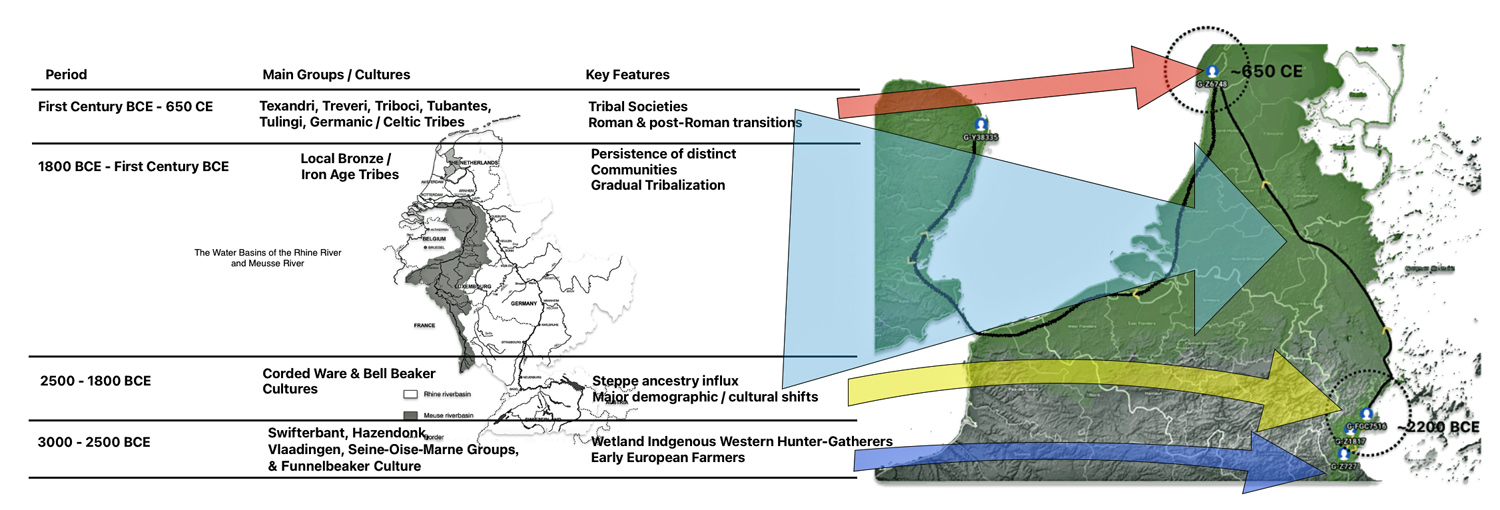
Feature Banner: The banner at the top of the story features a map of the phylogenetic gaps discussed in the story. The maps was generated by taking a snapshop from the FamilyTreeDNA GlobetrekkerTM video of the migratory path of my YDNA descendants over time. The map shows the migratory path of selected most common recent ancestors and their respective estimated dates of birth. Another map in the banner depicts the Muesse and Rhine River watershed that is associated with this phylogenetic gap. . In addition, various cultures and features associated with time periods within this period of time are depicted.
[1] Ingram, Owen, What is Ecological Fallacy – Causes & Examples, Rev 5 Jan 2025, ResearchProspect, https://www.researchprospect.com/what-is-ecological-fallacy/
Nikolopoulou, Kassiani, What Is Ecological Fallacy? | Definition & Example, 7 Jan 2023, Scribbr, https://www.scribbr.com/fallacies/ecological-fallacy/
For a practical examples, see:
K.N. Lala, & M.W. Feldman, Genes, culture, and scientific racism, Proc. Natl. Acad. Sci. U.S.A. 121 (48) e2322874121,https://doi.org/10.1073/pnas.2322874121 (2024).
Foley RA, Lahr MM. The evolution of the diversity of cultures. Philos Trans R Soc Lond B Biol Sci. 2011 Apr 12;366(1567):1080-9. doi: 10.1098/rstb.2010.0370. PMID: 21357230; PMCID: PMC3049104 PubMed https://pmc.ncbi.nlm.nih.gov/articles/PMC3049104/
Aaron P Ragsdale, Kevin R Thornton, Multiple Sources of Uncertainty Confound Inference of Historical Human Generation Times, Molecular Biology and Evolution, Volume 40, Issue 8, August 2023, msad160, https://doi.org/10.1093/molbev/msad160
[2] Linear Pottery Culture (jan 1, 5500 BC – jan 1, 4500 BC), Public TimeLines, Time Graphics, https://time.graphics/period/3613007
Linear Pottery culture, Wikipedia, This page was last edited on 3 April 2025, https://en.wikipedia.org/wiki/Linear_Pottery_culture
Danubian Culture, Wikipedia, This page was last edited on 15 June 2024, https://en.wikipedia.org/wiki/Danubian_culture
[3] Linear Pottery culture, Wikipedia, This page was last edited on 3 April 2025,, https://en.wikipedia.org/wiki/Linear_Pottery_culture
Danubian Culture, Wikipedia, This page was last edited on 15 June 2024, https://en.wikipedia.org/wiki/Danubian_culture
[4] Linear Pottery Culture, Wikipedia, This page was last edited on 18 July 2025, https://en.wikipedia.org/wiki/Linear_Pottery_culture
Dolukhanov, Pavel; Shukurov, A; Gronenborn, D; Sokoloff, D; Timofeev, V; Zaitseva, G; et al. (2005). “The Chronology of Neolithic Dispersal in Central and Eastern Europe” (PDF). Journal of Archaeological Science. 32 (10): 1441–1458. Bibcode:2005JArSc..32.1441D. doi:10.1016/j.jas.2005.03.02
Dolukhanov, Pavel; Shukurov, Anvar (2003). “Modelling the Neolithic Dispersal in Northern Eurasia” , Documenta Praehistorica XXXI. Department of Archaeology, Faculty of Arts, University of Ljubljana. Archived from the original (PDF) on 27 September 2007, https://web.archive.org/web/20070927045407/http://arheologija.ff.uni-lj.si/documenta/pdf31/31dolukhanov.pdf
[5] Linear Pottery Culture (Jan 1, 5500 BC – Jan 1, 4500 BC), Public TimeLines, Time Graphics, https://time.graphics/period/3613007
Linear Pottery culture, Wikipedia, This page was last edited on 3 April 2025,, https://en.wikipedia.org/wiki/Linear_Pottery_culture
Danubian Culture, Wikipedia, This page was last edited on 15 June 2024, https://en.wikipedia.org/wiki/Danubian_culture
David M, An Introduction to the Neolithic Linearbandkeramik Culture, 6 Dec 2013,These Bones of Mine, https://thesebonesofmine.wordpress.com/2013/12/06/an-introduction-to-the-neolithic-linearbandkeramik-culture/
Bickle P. Thinking Gender Differently: New Approaches to Identity Difference in the Central European Neolithic. Cambridge Archaeological Journal. 2020;30(2):201-218. doi:10.1017/S0959774319000453
[6] Linear Pottery culture, Wikipedia, This page was last edited on 3 April 2025,, https://en.wikipedia.org/wiki/Linear_Pottery_culture
[7] The Tyrolean Alps are a mountain range located primarily in the Tyrol region of Austria and the South Tyrol region of Italy. They form part of the larger Eastern Alps.
Griff(is)(es)(ith) Haplogroups in Context of the Tyrolean Alps

Tyrol, Wikipedia, This page was last edited on 3 July 2025, https://en.wikipedia.org/wiki/Tyrol
Tyrol (state, Wikipedia, This page was last edited on 18 July 2025, https://en.wikipedia.org/wiki/Tyrol_(state)
[8] The spread of G-L497 can be traced through several major population movements:
Regional Expansion: G-L497 lineages are also tied to the Etruscans and Germanic groups such as the Goths and Franks. Notable hotspots today include the Tyrolean Alps, Switzerland, Northern Italy, southwestern Germany, and eastern France
Neolithic Migration: Early agriculturalists carrying G-L497 expanded from Anatolia into Europe, mainly via the Balkans and up the Danube River into Central Europe. This established the haplogroup in areas like Germany, Austria, Switzerland, and Northern Italy.
Bronze Age Dispersal: During the Bronze Age (c. 1800 BCE), G-L497 moved from Italy northwards into Central and Northern Europe.
Celtic Expansion: The haplogroup is associated with the Hallstatt and La Tène Celtic cultures, which further spread G-L497 throughout the Alpine regions, France, and into the British Isles. Elite burials from the Hallstatt period have yielded G-L497, indicating its prominence among early Celts.
G-L497 is closely linked to the following historical cultures::
- Neolithic and Chalcolithic agricultural societies;
- Hallstatt and La Tène Celts;
- Italic tribes and the Etruscans in Italy; and
- Early Germanic tribes, such as the Suebi and Franks, especially in southern Germany and the Rhine region.
Hay, Maciamo, New map of Y-gaplogroup G2a-L497, 22 May 2017, Eupedia, https://www.eupedia.com/forum/threads/new-map-of-y-gaplogroup-g2a-l497.34104/
G-L497 Y-DNA Project, FamilyTreeDNA, https://www.familytreedna.com/groups/g-ydna/about
Rootsi S, Myres NM, Lin AA, Järve M, King RJ, Kutuev I, Cabrera VM, Khusnutdinova EK, Varendi K, Sahakyan H, Behar DM, Khusainova R, Balanovsky O, Balanovska E, Rudan P, Yepiskoposyan L, Bahmanimehr A, Farjadian S, Kushniarevich A, Herrera RJ, Grugni V, Battaglia V, Nici C, Crobu F, Karachanak S, Hooshiar Kashani B, Houshmand M, Sanati MH, Toncheva D, Lisa A, Semino O, Chiaroni J, Di Cristofaro J, Villems R, Kivisild T, Underhill PA. Distinguishing the co-ancestries of haplogroup G Y-chromosomes in the populations of Europe and the Caucasus. Eur J Hum Genet. 2012 Dec;20(12):1275-82. doi: 10.1038/ejhg.2012.86. Epub 2012 May 16. PMID: 22588667; PMCID: PMC3499744. (PubMed) https://pmc.ncbi.nlm.nih.gov/articles/PMC3499744/
Berger B, Niederstätter H, Erhart D, Gassner C, Schennach H, Parson W. Reprint of: high resolution mapping of Y haplogroup G in Tyrol (Austria). Forensic Sci Int Genet. 2013 Dec;7(6):624-631. doi: 10.1016/j.fsigen.2013.09.006. Epub 2013 Sep 27. Erratum in: Forensic Sci Int Genet. 2014 Mar;9:191. PMID: 24099688. (PubMed) https://pubmed.ncbi.nlm.nih.gov/24099688/ see also https://www.researchgate.net/publication/291505390_High_resolution_mapping_of_Y_haplogroup_G_in_Tyrol_Austria_Reprinted_from_Forensic_Science_International_Genetics_vol_7_pg_529-536_2013
[9] G-L497 Y-DNA Project, FamilyTreeDNA, https://www.familytreedna.com/groups/g-ydna/about
Rootsi S, et al., Distinguishing the co-ancestries of haplogroup G Y-chromosomes in the populations of Europe and the Caucasus. Eur J Hum Genet. 2012 Dec;20(12):1275-82. doi: 10.1038/ejhg.2012.86. Epub 2012 May 16. PMID: 22588667; PMCID: PMC3499744. (PubMed) https://pmc.ncbi.nlm.nih.gov/articles/PMC3499744/
Hay, Maciamo, New map of Y-gaplogroup G2a-L497, 22 May 2017, Eupedia, https://www.eupedia.com/forum/threads/new-map-of-y-gaplogroup-g2a-l497.34104/
[10] Berger B, et al., Reprint of: high resolution mapping of Y haplogroup G in Tyrol (Austria). Forensic Sci Int Genet. 2013 Dec;7(6):624-631. doi: 10.1016/j.fsigen.2013.09.006. Epub 2013 Sep 27. Erratum in: Forensic Sci Int Genet. 2014 Mar;9:191. PMID: 24099688. (PubMed) https://pubmed.ncbi.nlm.nih.gov/24099688/
Hay, Maciamo, Haplogroup G2a (Y-DNA), Jul 2023, Eupedia, https://www.eupedia.com/europe/Haplogroup_G2a_Y-DNA.shtml
[11] Andreas Putzer, Daniela Festi, Sophie Edlmair , Klaus Oeggl, The development of human activity in the high altitudes of the Schnals Valley (South Tyrol/Italy) from the Mesolithic to modern periods, Journal of Archeological Science: Reports, 21 Jan 2016, 6, 136-147, https://www.academia.edu/30556244/The_development_of_human_activity_in_the_high_altitudes_of_the_Schnals_Valley_South_Tyrol_Italy_from_the_Mesolithic_to_modern_periods
History of Tyrol, Wikipedia, This page was last edited on 16 February 2025, https://en.wikipedia.org/wiki/History_of_Tyrol
Neolithic Italy, Wikipedia, This page was last edited on 23 March 2025, https://en.wikipedia.org/wiki/Neolithic_Italy
Stevenson, Joan C., Neolithic Age Europe, 2022, EBSCO, https://www.ebsco.com/research-starters/anthropology/neolithic-age-europe
Mathieson I, Alpaslan-Roodenberg S, Posth C, Szécsényi-Nagy A, Rohland N, Mallick S, Olalde I, Broomandkhoshbacht N, Candilio F, Cheronet O, Fernandes D, Ferry M, Gamarra B, Fortes GG, Haak W, Harney E, Jones E, Keating D, Krause-Kyora B, Kucukkalipci I, Michel M, Mittnik A, Nägele K, Novak M, Oppenheimer J, Patterson N, Pfrengle S, Sirak K, Stewardson K, Vai S, Alexandrov S, Alt KW, Andreescu R, Antonović D, Ash A, Atanassova N, Bacvarov K, Gusztáv MB, Bocherens H, Bolus M, Boroneanţ A, Boyadzhiev Y, Budnik A, Burmaz J, Chohadzhiev S, Conard NJ, Cottiaux R, Čuka M, Cupillard C, Drucker DG, Elenski N, Francken M, Galabova B, Ganetsovski G, Gély B, Hajdu T, Handzhyiska V, Harvati K, Higham T, Iliev S, Janković I, Karavanić I, Kennett DJ, Komšo D, Kozak A, Labuda D, Lari M, Lazar C, Leppek M, Leshtakov K, Vetro DL, Los D, Lozanov I, Malina M, Martini F, McSweeney K, Meller H, Menđušić M, Mirea P, Moiseyev V, Petrova V, Price TD, Simalcsik A, Sineo L, Šlaus M, Slavchev V, Stanev P, Starović A, Szeniczey T, Talamo S, Teschler-Nicola M, Thevenet C, Valchev I, Valentin F, Vasilyev S, Veljanovska F, Venelinova S, Veselovskaya E, Viola B, Virag C, Zaninović J, Zäuner S, Stockhammer PW, Catalano G, Krauß R, Caramelli D, Zariņa G, Gaydarska B, Lillie M, Nikitin AG, Potekhina I, Papathanasiou A, Borić D, Bonsall C, Krause J, Pinhasi R, Reich D. The genomic history of southeastern Europe. Nature. 2018 Mar 8;555(7695):197-203. doi: 10.1038/nature25778. Epub 2018 Feb 21. PMID: 29466330; PMCID: PMC6091220. (PubMed) https://pmc.ncbi.nlm.nih.gov/articles/PMC6091220/
Neolithic, Wikipedia, This page was last edited on 22 July 2025, https://en.wikipedia.org/wiki/Neolithic
6th millennium BC, Wikipedia, This page was last edited on 22 July 2025, https://en.wikipedia.org/wiki/6th_millennium_BC
Detlef Gronenborn, Migration, acculturation and culture change in western temperate Eurasia, 6500–5000 cal BC, Documenta Praehistorica XXX, 79-91, https://pdfs.semanticscholar.org/4c78/ed1587f5f471fd5209b8fedfd7ec42ec6e56.pdf
[12] Neolithic Europe, Wikipedia, This page was last edited on 19 July 2025, https://en.wikipedia.org/wiki/Neolithic_Europe
See also:
Swiss Pile Dwellings, Milwaulkee Public Museum, https://www.mpm.edu/research-collections/anthropology/online-collections-research/robenhausen-site/culture
Cortaillod culture, Wikipeda, This page was last edited on 27 May 2025, https://en.wikipedia.org/wiki/Cortaillod_culture
Pfyn – Pre-Roman Era in German (http://www.hls-dhs-dss.ch/textes/d/D1982.php), French (http://www.hls-dhs-dss.ch/textes/f/F1982.php) and Italian (http://www.hls-dhs-dss.ch/textes/i/I1982.php) in the online Historical Dictionary of Switzerland
Francesco Menotti, Living on the lake in prehistoric Europe: 150 years of lake-dwelling research (https://books.google.com/books?id=OEK5PyQUtegC&pg=PA154). Routledge, 2004, pg. 57.
Culture | Milwaukee Public Museum. (n.d.). https://www.mpm.edu/research-collections/anthropology/online-collections-research/robenhausen-site/culture
Rainer Berger; Hans Eduard Suess (1979). Radiocarbon dating: proceedings of the ninth international conference, Los Angeles and La Jolla, 1976 (https://books.google.com/books?id=YupA6DrPQJIC&pg=PA104 ). University of California Press. pg. 104–107.
Schibler, J. 2006. “The economy and environment of the 4th and 3rd millennia BC in the northern Alpine foreland based on studies of animal bones”. Environmental Archaeology 11(1):
49-65
[13] Swiss Pile Dwellings, Milwaulkee Public Museum, https://www.mpm.edu/research-collections/anthropology/online-collections-research/robenhausen-site/culture
[14] Neolithic Europe, Wikipedia, This page was last edited on 19 July 2025, https://en.wikipedia.org/wiki/Neolithic_Europe
Swiss Pile Dwellings, Milwaulkee Public Museum, https://www.mpm.edu/research-collections/anthropology/online-collections-research/robenhausen-site/culture
[15] Prehistoric pile dwellings around Lake Zurich, Wikipedia, This page was last edited on 27 April 2025, https://en.wikipedia.org/wiki/Prehistoric_pile_dwellings_around_Lake_Zurich
Prehistoric Pile Dwellings around the Alps, Experience Hauterive, https://www.myswitzerland.com/en-ch/experiences/pile-dwellings-around-the-alps/
[16] David M. , An Introduction to the Neolithic Linearbandkeramik Culture, 6 Dec, 2013, These Bones of Mine, https://thesebonesofmine.wordpress.com/2013/12/06/an-introduction-to-the-neolithic-linearbandkeramik-culture/
[17] Ibid
[18] Furtwängler, A., Rohrlach, A.B., Lamnidis, T.C. et al. Ancient genomes reveal social and genetic structure of Late Neolithic Switzerland. Nat Commun 11, 1915 (2020). https://doi.org/10.1038/s41467-020-15560-x
Furtwängler, A., et al , Neolithic Genomes From Modern-Day Switzerland Indicate Parallel Ancient Societies, 20 Apr 2020, Max Planck Institute of Geoanthropology, https://www.shh.mpg.de/1671901/neolithic-genomes-from-modern-day-switzerland
[19] Rascovan, Nicolas; Sjögren, Karl-Göran; Kristiansen, Kristian; Nielsen, Rasmus; Willerslev, Eske; Desnues, Cristelle; Rasmussen, Simon (10 January 2019), “Emergence and Spread of Basal Lineages of Yersinia pestis during the Neolithic Decline”. Cell. 176(2): 295–305. doi:10.1016/j.cell.2018.11.005. PMID 30528431. S2CID 54447284 https://www.cell.com/cell/fulltext/S0092-8674(18)31464-8
Zhang, Sarah (6 December 2018). “An Ancient Case of the Plague Could Rewrite History”. The Atlantic. Retrieved 13 November 2019. https://www.theatlantic.com/science/archive/2018/12/4900-year-old-case-plague-sweden/577315/
[20] Zhang, Sarah (6 December 2018). “An Ancient Case of the Plague Could Rewrite History”. The Atlantic. Retrieved 13 November 2019. https://www.theatlantic.com/science/archive/2018/12/4900-year-old-case-plague-sweden/577315/
Colledge, Sue; Conolly, James; Crema, Enrico; Shennan, Stephen (2019-01-10). “Neolithic population crash in northwest Europe associated with agricultural crisis”. Quaternary Research. 92 (3): 686–707. Bibcode:2019QuRes..92..686C. doi:10.1017/qua.2019.42. ISSN 0033-5894. S2CID 202186375, https://www.cambridge.org/core/journals/quaternary-research/article/abs/neolithic-population-crash-in-northwest-europe-associated-with-agricultural-crisis/11F405EB351C8A86020C17A647C1C001
[21] Rascovan, Nicolas; et al., (10 January 2019), “Emergence and Spread of Basal Lineages of Yersinia pestis during the Neolithic Decline”. Cell. 176(2): 295–305. doi:10.1016/j.cell.2018.11.005. PMID 30528431. S2CID 54447284 https://www.cell.com/cell/fulltext/S0092-8674(18)31464-8
[22] The following are the primary causes proposed and supported by recent archaeological and genetic research:
Infectious Disease (Plague): Recent ancient DNA analyses reveal that ancestral forms of the plague bacterium (Yersinia pestis) were present among Neolithic populations in Europe, especially in Scandinavia and Northwestern Europe. These studies suggest that repeated plague epidemics could have caused drastic reductions in population size, in a manner similar to the later Black Death epidemics. This finding has shifted considerable support toward disease, particularly plague,as a major factor in the Neolithic decline, although it does not exclude other contributory factors.
Seersholm, F.V., Sjögren, KG., Koelman, J. et al. Repeated plague infections across six generations of Neolithic Farmers. Nature 632, 114–121 (2024). https://doi.org/10.1038/s41586-024-07651-2
Univeristy of Copenhagen, DNA analyses show the plague may have caused the downfall of Stone Age farmers, 10 Jul 2024, , Phys.Org, https://phys.org/news/2024-07-dna-analyses-plague-downfall-stone.html
Molinek, Rudy, Did Plague Cause the Mysterious Collapse of Europe’s Early Farmers 5,000 Years Ago?, Smithsonian Magazine, https://www.smithsonianmag.com/smart-news/did-plague-cause-the-mysterious-collapse-of-europes-early-farmers-5000-years-ago-180984688/
Agricultural Crisis and Environmental Degradation: The Neolithic decline is also associated with evidence of worsening agricultural conditions. Environmental factors such as declining cereal yields, soil exhaustion from intensive agriculture, and possibly adverse climate changes are linked to the abandonment of settlements and regrowth of forests in formerly cultivated areas. These factors could have resulted in food shortages, malnutrition, and increased vulnerability to disease.
Neolithic Decline, Wikipedia, This page was last edited on 24 June 2025, https://en.wikipedia.org/wiki/Neolithic_decline#cite_note-atlantic-3
Sean S. Downey, W. Randall Haas Jr., and Stephen J. Shennan, European Neolithic societies showed early warning signals of population collapse, August 29, 2016, PNAS, 113 (35) 9751-9756, https://www.pnas.org/doi/10.1073/pnas.1602504113
Colledge S, Conolly J, Crema E, Shennan S. Neolithic population crash in northwest Europe associated with agricultural crisis. Quaternary Research. 2019;92(3):686-707. doi:10.1017/qua.2019.42 https://www.cambridge.org/core/journals/quaternary-research/article/abs/neolithic-population-crash-in-northwest-europe-associated-with-agricultural-crisis/11F405EB351C8A86020C17A647C1C001
Rise in Communicable Diseases: The transition to settled, farming-based societies led to higher population densities and close cohabitation with domesticated animals. This new lifestyle increased the risk of zoonotic (animal-derived) and waterborne diseases, elevating general mortality rates alongside disease outbreaks.
Neolithic demographic transition, Wikipedia, This page was last edited on 28 May 2025, https://en.wikipedia.org/wiki/Neolithic_demographic_transition
Marko Porčić, Tamara Blagojević, Jugoslav Pendić and Sofija Stefanović, The Neolithic Demographic Transition in the Central Balkans: population dynamics reconstruction based on new radiocarbon evidence, 30 November 2020, Philosophical Transations of the Royal Society B Biological Sciences, https://royalsocietypublishing.org/doi/10.1098/rstb.2019.0712
Bocquet-Appel JP. Explaining the Neolithic Demographic Transition. The Neolithic Demographic Transition and its Consequences. 2008:35–55. doi: 10.1007/978-1-4020-8539-0_3. PMCID: PMC7120555. (PubMed) https://pmc.ncbi.nlm.nih.gov/articles/PMC7120555/
Nutritional Stress and Health Decline: The shift from diverse wild food sources to a carbohydrate-heavy agricultural diet, often lacking in essential nutrients, may have led to poorer health, contributing to increased mortality from both malnutrition and infectious disease.
Bocquet-Appel JP. Explaining the Neolithic Demographic Transition. The Neolithic Demographic Transition and its Consequences. 2008:35–55. doi: 10.1007/978-1-4020-8539-0_3. PMCID: PMC7120555. (PubMed) https://pmc.ncbi.nlm.nih.gov/articles/PMC7120555/
Social and Societal Stress: Archaeological evidence hints at possible societal destabilization, including population pressures, conflict, and the collapse of traditional cultural practices (such as the cessation of megalith building), potentially exacerbating demographic decline.
Neolithic Decline, Wikipedia, This page was last edited on 24 June 2025, https://en.wikipedia.org/wiki/Neolithic_decline#cite_note-atlantic-3
Sean S. Downey, W. Randall Haas Jr., and Stephen J. Shennan, European Neolithic societies showed early warning signals of population collapse, August 29, 2016, PNAS, 113 (35) 9751-9756, https://www.pnas.org/doi/10.1073/pnas.1602504113
Adrian Timpson, Sue Colledge, Enrico Crema, Kevan Edinborough, Tim Kerig, Katie Manning, Mark G. Thomas, Stephen Shennan, Reconstructing regional population fluctuations in the European Neolithic using radiocarbon dates: a new case-study using an improved method, Journal of Archaeological Science, Volume 52, 2014, Pages 549-557, ISSN 0305-4403, https://doi.org/10.1016/j.jas.2014.08.011.
(https://www.sciencedirect.com/science/article/pii/S0305440314002982 )
[23] Iñigo Olalde, et al, Long-term hunter-gatherer continuity in the Rhine-Meuse region was disrupted by local formation of expansive Bell Beaker groups, bioRxiv, 25 Mar 2025, page 19, doi: https://doi.org/10.1101/2025.03.24.644985 , https://www.biorxiv.org/content/10.1101/2025.03.24.644985v1.full.pdf
[24] See for example:
Curry, Andrew, The First Europeans Weren’t Who Your Might Think, National Geographic Magazine, August 2019, online: https://www.nationalgeographic.com/culture/article/first-europeans-immigrants-genetic-testing-feature
Reich, David (2018). Who We are and how We Got Here: Ancient DNA and the New Science of the Human Past. Oxford University Press.
Haak, W. et al. Massive migration from the steppe was a source for Indo-European languages in Europe. Nature 522, 207–211 (2015).
Allentoft, M. E. et al. Population genomics of Bronze Age Eurasia. Nature 522, 167–172 (2015).
Olalde, I. et al. The Beaker phenomenon and the genomic transformation of northwest Europe. Nature 555, 190–196 (2018).
Papac, L. et al. Dynamic changes in genomic and social structures in third millennium BCE central Europe. Sci. Adv. 7, (2021).
Brandt, G. et al. Ancient DNA reveals key stages in the formation of Central European mitochondrial genetic diversity. Science 342, 257–261 (2013).
[25] Iñigo Olalde, et al, Long-term hunter-gatherer continuity in the Rhine-Meuse region was disrupted by local formation of expansive Bell Beaker groups, bioRxiv, 25 Mar 2025, doi: https://doi.org/10.1101/2025.03.24.644985 , https://www.biorxiv.org/content/10.1101/2025.03.24.644985v1.full.pdf
Olalde I, et al , Long-term hunter-gatherer continuity in the Rhine-Meuse region was disrupted by local formation of expansive Bell Beaker groups. bioRxiv [Preprint]. 2025 Mar 25:2025.03.24.644985. doi: 10.1101/2025.03.24.644985. PMID: 40196638; PMCID: PMC11974744 (PubMed) https://pubmed.ncbi.nlm.nih.gov/40196638/
Fernández-Götz, Manuel, and others (eds), Rethinking Migrations in Late Prehistoric Eurasia (London, 2022; online edn, British Academy Scholarship Online, 18 May 2023), https://doi.org/10.5871/bacad/9780197267356.001.0001
Khan, Razib, Facing Facts, even fraught ones: the quest for proto-Indo-Europeans in 2023: How genetics illuminates the rise of Eurasian steppe pastoralism, 23 Sep 2023, Unsupervised Learning, https://www.razibkhan.com/p/facing-facts-even-fraught-ones-the
[26] Iñigo Olalde, et al, Long-term hunter-gatherer continuity in the Rhine-Meuse region was disrupted by local formation of expansive Bell Beaker groups, bioRxiv, 25 Mar 2025, doi: https://doi.org/10.1101/2025.03.24.644985 , https://www.biorxiv.org/content/10.1101/2025.03.24.644985v1.full.pdf
Allentoft ME et al., Population genomics of Bronze Age Eurasia. Nature 2015; 522: 167–172. https://doi.org/10.1038/nature14507 PMID: 26062507
HaakWet al., Massive migration from the steppe was a source for Indo-European languages in Europe. Nature 2015; 522: 207–211. https://doi.org/10.1038/nature14317 PMID: 25731166
Olalde I et al., The Beaker Phenomenon and the Genomic Transformation of Northwest Europe. Nature 2018; 555: 190–196. https://doi.org/10.1038/nature25738 PMID: 29466337
[27] Iñigo Olalde, et al, Long-term hunter-gatherer continuity in the Rhine-Meuse region was disrupted by local formation of expansive Bell Beaker groups, bioRxiv, 25 Mar 2025, doi: https://doi.org/10.1101/2025.03.24.644985 , https://www.biorxiv.org/content/10.1101/2025.03.24.644985v1.full.pdf
Olalde I, et al , Long-term hunter-gatherer continuity in the Rhine-Meuse region was disrupted by local formation of expansive Bell Beaker groups. bioRxiv [Preprint]. 2025 Mar 25:2025.03.24.644985. doi: 10.1101/2025.03.24.644985. PMID: 40196638; PMCID: PMC11974744 (PubMed) https://pubmed.ncbi.nlm.nih.gov/40196638/
[28] Iñigo Olalde, et al, Long-term hunter-gatherer continuity in the Rhine-Meuse region was disrupted by local formation of expansive Bell Beaker groups, bioRxiv, 25 Mar 2025, Page 2-3, doi: https://doi.org/10.1101/2025.03.24.644985 , https://www.biorxiv.org/content/10.1101/2025.03.24.644985v1.full.pdf
[29] Loess tends to develop into very rich soils. Under appropriate climatic conditions, it is some of the most agriculturally productive terrain in the world.
Loess zones, also known as loess plains or loess hills, are areas characterized by extensive deposits of wind-blown silt called loess. These deposits are typically yellowish-gray in color and can be quite thick, forming relatively flat or gently rolling landscapes
Getis, Arthur; Judith Getis and Jerome D. Fellmann (2000). Introduction to Geography, Seventh Edition. Boston: McGraw Hill. p. 99 https://archive.org/details/introductiontoge00geti
[30] Iñigo Olalde et al, Long-term hunter-gatherer continuity in the Rhine-Meuse region was disrupted by local formation of expansive Bell Beaker groups, bioRxiv, 25 Mar 2025, doi: https://doi.org/10.1101/2025.03.24.644985 , https://www.biorxiv.org/content/10.1101/2025.03.24.644985v1.full.pdf
Olalde I, et al, Long-term hunter-gatherer continuity in the Rhine-Meuse region was disrupted by local formation of expansive Bell Beaker groups. bioRxiv [Preprint]. 2025 Mar 25:2025.03.24.644985. doi: 10.1101/2025.03.24.644985. PMID: 40196638; PMCID: PMC11974744 (PubMed) https://pubmed.ncbi.nlm.nih.gov/40196638/
[31] Quote:
Iñigo Olalde et al, Long-term hunter-gatherer continuity in the Rhine-Meuse region was disrupted by local formation of expansive Bell Beaker groups, bioRxiv, 25 Mar 2025, doi: https://doi.org/10.1101/2025.03.24.644985 , https://www.biorxiv.org/content/10.1101/2025.03.24.644985v1.full.pdf, Page 2-3
See also:
Cohen, Kim, Sediment History, Utrecht University, https://www.uu.nl/en/research/water-climate-and-future-deltas/storylines/sediments-matter/follow-the-sediment/sediment-history
[32] “This hunting and fishing culture was sedentary and semi-nomadic. In the old dunes at the then much further east lying coastline the remains of some peasant settlements were found. From these findings it can be deduced that animal husbandry (sheep and goats) and agriculture (wheat and barley) had been practised on a small scale. Vlaardingen culture also had traits of a Mesolithichunter-gatherer society because agriculture in much of the Wadden Sea area and the Rhine–Meuse–Scheldt delta was difficult. Hunting and fishing were important means of livelihood.“
Vlaardingen culture, Wikipedia, This page was last edited on 21 June 2025, https://en.wikipedia.org/wiki/Vlaardingen_culture
See also:
Brinkkemper, Otto, Erik Drenth, Jørn Zeiler, An outline of the subsistence of the Vlaardingen culture from the Netherlands Révue Archéologique de Picardi, 1 Jan 2011, Reviews in Aquaculture Spécial 28:207-220, 10.3406/pica.2011.3331, https://www.researchgate.net/publication/248391480_An_outline_of_the_subsistence_of_the_Vlaardingen_culture_from_the_Netherlands_Revue_Archeologique_de_Picardi or https://www.persee.fr/doc/pica_1272-6117_2011_hos_28_1_3331
Welmoed, A. Out, Walter Dörfler, The best of both worlds: Human impact and plant subsistence at the Middle and Late Neolithic semi-agricultural site of Hekelingen III (2900–2500 BC), Quaternary International, Vol 426, Part B, May 2017, 41-63, https://www.sciencedirect.com/science/article/abs/pii/S1040618215012070
Prehistory of the Netherlands, Wikipedia, This page was last edited on 9 July 2025, https://en.wikipedia.org/wiki/Prehistory_of_the_Netherlands
[33] The Friesian-Drenthe Plateau is a landscape feature in the northern Netherlands, encompassing large parts of the provinces of Drenthe and Friesland, the northwestern part of the province of Overijssel, and a small part of Groningen. This plateau has existed since the Pleistocene era.

Fokkens, Harry, Drowned Landscape, The Occupation of the Western Part of the Frisian-Drentian Plateau, 4400BC – AD 500, Netherlands: Assen: Van Gorcum & Comp, 1998 https://scholarlypublications.universiteitleiden.nl/handle/1887/11705
M.J.L.Th. Niekus, R.T. van Balen, J.M.G. Bongers, J.H.A. Bosch, D.C. Brinkhuizen, H. Huisman, J. Jelsma, L. Johansen, C. Kasse, S.J. Kluiving, H. Paas, E. Schrijer, D. Stapert, News from the north: A late Middle Palaeolithic site rich in handaxes on the Drenthe–Frisian till plateau near Assen, the Netherlands; first results of a trial excavation, Quaternary International, Volume 411, Part A, 2016, Pages 284-304, ISSN 1040-6182,
https://doi.org/10.1016/j.quaint.2015.06.034
(https://www.sciencedirect.com/science/article/pii/S1040618215006345 )
[34] Folkens, Harry, Background to Dutch Beakers. A Critical Review of the Dutch Model, Pages 9 – 36 in Harry Fokkens and Franco Nicolis, eds, Background to Beakers, van Woerdekom: Sidestone Press, 2012, https://www.sidestone.com/openaccess/9789088900846.pdf
Fokkens, Harry, Drowned Landscape, The Occupation of the Western Part of the Frisian-Drentian Plateau, 4400BC – AD 500, Netherlands: Assen: Van Gorcum & Comp, 1998 https://scholarlypublications.universiteitleiden.nl/handle/1887/11705
Funnelbeaker culture, Wikipedia, This page was last edited on 2 July 2025, https://en.wikipedia.org/wiki/Funnelbeaker_culture
Corded Ware culture, Wikipedia, This page was last edited on 23 June 2025, https://en.wikipedia.org/wiki/Corded_Ware_culture
Olalde I, et al , Long-term hunter-gatherer continuity in the Rhine-Meuse region was disrupted by local formation of expansive Bell Beaker groups. bioRxiv [Preprint]. 2025 Mar 25:2025.03.24.644985. doi: 10.1101/2025.03.24.644985. PMID: 40196638; PMCID: PMC11974744 (PubMed) https://pubmed.ncbi.nlm.nih.gov/40196638/
Funnelbeaker culture, Wikiwand, Updated 2 Jul 2025, https://www.wikiwand.com/en/articles/Funnelbeaker_culture
Corded Ware Culture – Origins and Development, Liquidsearch, https://www.liquisearch.com/corded_ware_culture/origins_and_development
[35] Out, Welmoed, The scale of human impact at the Hazendonk, the Netherlands, during the Late Neolithic, 153-165 in Harry Fokkens, Bryopny J. Coles, Annelou L. Van Gijn Jos P Kleijne, Hedwig H. Ponjee and Corijanne G. Slappendel, (eds) Between Foraging and Farming, Leiden: Leiden University 2008, https://www.researchgate.net/publication/236142152_The_scale_of_human_impact_at_the_Hazendonk_the_Netherlands_during_the_Late_Neolithic
[36] Altena E, Smeding R, van der Gaag KJ, Larmuseau MHD, Decorte R, Lao O, Kayser M, Kraaijenbrink T, de Knijff P. The Dutch Y-chromosomal landscape. Eur J Hum Genet. 2020 Mar;28(3):287-299. doi: 10.1038/s41431-019-0496-0. Epub 2019 Sep 5. Erratum in: Eur J Hum Genet. 2020 Mar;28(3):399. doi: 10.1038/s41431-019-0528-9. PMID: 31488894; PMCID: PMC7029002. (PubMed) https://pmc.ncbi.nlm.nih.gov/articles/PMC7029002/
Welmoed A. Out, Integrated archaeobotanical analysis: Human impact at the Dutch Neolithic wetland site the Hazendonk, Journal of Archaeological Science, Volume 37, Issue7, 2010, Pages 1521-1531, ISSN 0305-4403, https://doi.org/10.1016/j.jas.2010.01.012.
(https://www.sciencedirect.com/science/article/pii/S0305440310000178 )
Luc Amkreutz, Leo Verhart, Milco Wansleeben, Hazendonk layers over and over again, 139-151, in Harry Fokkens, Bryopny J. Coles, Annelou L. Van Gijn Jos P Kleijne, Hedwig H. Ponjee and Corijanne G. Slappendel, (eds) Between Foraging and Farming, Leiden: Leiden University 2008, https://www.academia.edu/7731906/Hazendonk_layers_over_and_over_again
Erik Drenth, Otto Brinkkemper and Roel C. G. M. Lauwerier, Amersfoort, Single Grave Culture Settlements in the Netherlands: the state of affairs anno 2006, in W.Dörfler, J. Müller, eds, Wirtshaft – Sied lung en im dritte n vorc hris tlic hen Ja hr-tauase nd Mitteleur opas und Süd skandinavi ens, Offa-Bücher 84 (Neum ünster 200 8) 149 -181, https://www.researchgate.net/publication/292249638_Umwelt-Wirtschaft-Siedlungen_im_dritten_vorchristlichen_Jahrtausend_Mitteleuropas_und_Sudskandinaviens
[37] Funnelbeaker Culture, Wikipedia, This page was last edited on 15 July 2025, https://en.wikipedia.org/wiki/Funnelbeaker_culture
Lipson M, Szécsényi-Nagy A, Mallick S, Pósa A, Stégmár B, Keerl V, Rohland N, Stewardson K, Ferry M, Michel M, Oppenheimer J, Broomandkhoshbacht N, Harney E, Nordenfelt S, Llamas B, Gusztáv Mende B, Köhler K, Oross K, Bondár M, Marton T, Osztás A, Jakucs J, Paluch T, Horváth F, Csengeri P, Koós J, Sebők K, Anders A, Raczky P, Regenye J, Barna JP, Fábián S, Serlegi G, Toldi Z, Gyöngyvér Nagy E, Dani J, Molnár E, Pálfi G, Márk L, Melegh B, Bánfai Z, Domboróczki L, Fernández-Eraso J, Antonio Mujika-Alustiza J, Alonso Fernández C, Jiménez Echevarría J, Bollongino R, Orschiedt J, Schierhold K, Meller H, Cooper A, Burger J, Bánffy E, Alt KW, Lalueza-Fox C, Haak W, Reich D. Parallel palaeogenomic transects reveal complex genetic history of early European farmers. Nature. 2017 Nov 16;551(7680):368-372. doi: 10.1038/nature24476. Epub 2017 Nov 8. PMID: 29144465; PMCID: PMC5973800. (PubMed) https://pmc.ncbi.nlm.nih.gov/articles/PMC5973800/
Olalde I, et al , Long-term hunter-gatherer continuity in the Rhine-Meuse region was disrupted by local formation of expansive Bell Beaker groups. bioRxiv [Preprint]. 2025 Mar 25:2025.03.24.644985. doi: 10.1101/2025.03.24.644985. PMID: 40196638; PMCID: PMC11974744 (PubMed) https://pubmed.ncbi.nlm.nih.gov/40196638
Erik Drenth, Otto Brinkkemper and Roel C. G. M. Lauwerier, Amersfoort, Single Grave Culture Settlements in the Netherlands: the state of affairs anno 2006, in W.Dörfler, J. Müller, eds, Wirtshaft – Sied lung en im dritte n vorc hris tlic hen Ja hr-tauase nd Mitteleur opas und Süd skandinavi ens, Offa-Bücher 84 (Neum ünster 200 8) 149 -181, https://www.researchgate.net/publication/292249638_Umwelt-Wirtschaft-Siedlungen_im_dritten_vorchristlichen_Jahrtausend_Mitteleuropas_und_Sudskandinaviens
[38] van den Dikkenberg, Lasse, Vlaardingen culture or Stein group? From object biographies to communities of practice, in: Verbaas, A., Langejans, G., Little, A. and Chan, B. (eds). Artefact Biographies from Mesolithic and Neolithic Europe and Beyond. Papers in honour of Professor Annelou van Gijn. Analecta Praehistorica Leidensia 52. Leiden: Sidestone Press, pp. 63-72, 6 Jun 2024, DOI: 10.59641/pp090sb https://www.researchgate.net/publication/381409197_Vlaardingen_culture_or_Stein_group_From_object_biographies_to_communities_of_practice_in_Verbaas_A_Langejans_G_Little_A_and_Chan_B_eds_Artefact_Biographies_from_Mesolithic_and_Neolithic_Europe_and_Bey
Van Den Dikkenberg, Lasse and Alex Brandsen, Using Text Mining to Search for Neolithic Vlaardingen Culture Sites in the Rhine-Meuse-Scheldt Delta, Journal of Computer Applications in Archaeology, 8(1): 110–124. DOI: https://doi.org/10.5334/jcaa.205 , https://journal.caa-international.org/articles/205/files/67e14353e173f.pdf
Erik Drenth, Otto Brinkkemper and Roel C. G. M. Lauwerier, Amersfoort, Single Grave Culture Settlements in the Netherlands: the state of affairs anno 2006, in W.Dörfler, J. Müller, eds, Wirtshaft – Sied lung en im dritte n vorc hris tlic hen Ja hr-tauase nd Mitteleur opas und Süd skandinavi ens, Offa-Bücher 84 (Neum ünster 200 8) 149 -181, https://www.researchgate.net/publication/292249638_Umwelt-Wirtschaft-Siedlungen_im_dritten_vorchristlichen_Jahrtausend_Mitteleuropas_und_Sudskandinaviens
[39] van den Dikkenberg, Lasse, Vlaardingen culture or Stein group? From object biographies to communities of practice, in: Verbaas, A., Langejans, G., Little, A. and Chan, B. (eds). Artefact Biographies from Mesolithic and Neolithic Europe and Beyond. Papers in honour of Professor Annelou van Gijn. Analecta Praehistorica Leidensia 52. Leiden: Sidestone Press, 6 Jun 2024, pp. 63-72. DOI: 10.59641/pp090sb https://www.researchgate.net/publication/381409197_Vlaardingen_culture_or_Stein_group_From_object_biographies_to_communities_of_practice_in_Verbaas_A_Langejans_G_Little_A_and_Chan_B_eds_Artefact_Biographies_from_Mesolithic_and_Neolithic_Europe_and_Bey
Amkreutz, Luc, Funerary Practices on the Fringe, 21-33, in Daniela Hofman, Vicki Cummongs, Mathias Bjørnevad-Ahlqvist and Rune Iversen, eds, The Early Neolithic of Northern Europe, Leiden: Sidestone Press Academics, 2025 https://www.sidestone.com/books/the-early-neolithic-of-northern-europe
Brinkkemper, Otto, Erik Drenth and Jørn Zeiler, An outline of the subsistence of the Vlaardingen culture from the Netherlands, Revue archéologique de Picardie, Année 2011 NS 28 pp. 207-220, https://www.persee.fr/doc/pica_1272-6117_2011_hos_28_1_3331
Limburg (Netherlands), Wikipedia, This page was last edited on 7 June 2025, https://en.wikipedia.org/wiki/Limburg_(Netherlands)
Erik Drenth, Otto Brinkkemper and Roel C. G. M. Lauwerier, Amersfoort, Single Grave Culture Settlements in the Netherlands: the state of affairs anno 2006, in W.Dörfler, J. Müller, eds, Wirtshaft – Sied lung en im dritte n vorc hris tlic hen Ja hr-tauase nd Mitteleur opas und Süd skandinavi ens, Offa-Bücher 84 (Neum ünster 200 8) 149 -181, https://www.researchgate.net/publication/292249638_Umwelt-Wirtschaft-Siedlungen_im_dritten_vorchristlichen_Jahrtausend_Mitteleuropas_und_Sudskandinaviens
[40] Cassen, Serge (2019). “Real and ideal European maritime transfers along the Atlantic coast during the Neolithic” (https://www.academia.edu/54283882). Documenta Praehistorica. 46. doi:10.4312/dp.46 (https://doi.org/10.4312%2Fdp.46)
Michelsberg culture (4400 to 3500bc) is characterized by undecorated pointy based tulip beakers, https://neolithicarch.com/michelsberg-culture-4400-to-3500bc-is-characterized-by-undecorated-pointy-based-tulip-beakers/
Darvill, Timothy, ed. (2009). “Michelsberg Culture”. The Concise Oxford Dictionary of Archaeology (3 ed.). Oxford University Press. ISBN9780191727139.
Michelberg Culture, Wikipedia, This page was last edited on 24 December 2024, https://en.wikipedia.org/wiki/Michelsberg_culture
Funnelbeaker culture, Wikiwand, Updated 2 Jul 2025, https://www.wikiwand.com/en/articles/Funnelbeaker_culture
Folkens, Harry, Background to Dutch Beakers. A Critical Review of the Dutch Model, Pages 9 – 36 in Harry Fokkens and Franco Nicolis, eds, Background to Beakers, van Woerdekom: Sidestone Press, 2012,
https://www.sidestone.com/openaccess/9789088900846.pdf
[41] Michelberg Culture, Wikipedia, This page was last edited on 24 December 2024, https://en.wikipedia.org/wiki/Michelsberg_culture
Funnelbeaker culture, Wikiwand, Updated 2 Jul 2025, https://www.wikiwand.com/en/articles/Funnelbeaker_culture
Folkens, Harry, Background to Dutch Beakers. A Critical Review of the Dutch Model, Pages 9 – 36 in Harry Fokkens and Franco Nicolis, eds, Background to Beakers, van Woerdekom: Sidestone Press, 2012,
https://www.sidestone.com/openaccess/9789088900846.pdf
[42] Tanja Zerl, Manfred Rösch, and Elena Marinova, The Late Neolithic Michelsberg culture – just ramparts and ditches? A supraregional comparison of agricultural and environmental data, Prähistorische Zeitschrift 89(1), 2014, https://doi.org/10.1515/PZ-2014-0006
Crombé, P., Aluwé, K., Boudin, M. et al. New evidence on the earliest domesticated animals and possible small-scale husbandry in Atlantic NW Europe. Sci Rep 10, 20083 (2020). https://doi.org/10.1038/s41598-020-77002-4
[43] Michelberg Culture, Wikipedia, This page was last edited on 24 December 2024, https://en.wikipedia.org/wiki/Michelsberg_culture
[44] Tanja Zerl, Manfred Rösch, and Elena Marinova, The Late Neolithic Michelsberg culture – just ramparts and ditches? A supraregional comparison of agricultural and environmental data, Prähistorische Zeitschrift 89(1), 2014, https://doi.org/10.1515/PZ-2014-0006
Michelberg Culture, Wikipedia, This page was last edited on 24 December 2024, https://en.wikipedia.org/wiki/Michelsberg_culture
Teetaert D, Baeyens N, Perdaen Y, et al. A well-preserved Michelsberg Culture domed oven from Kortrijk, Belgium. Antiquity. 2019;93(368):342-358. doi:10.15184/aqy.2018.181 https://www.cambridge.org/core/journals/antiquity/article/abs/wellpreserved-michelsberg-culture-domed-oven-from-kortrijk-belgium/36403BAC5E60E0CE807C840BB7F6BF43
[45] Vlaardingen culture, Wikipedia, This page was last edited on 21 June 2025, https://en.wikipedia.org/wiki/Vlaardingen_culture
Van Den Dikkenberg, Lasse and Alex Brandsen, Using Text Mining to Search for Neolithic Vlaardingen Culture Sites in the Rhine-Meuse-Scheldt Delta, Journal of Computer Applications in Archaeology, 8(1): 110–124. DOI: https://doi.org/10.5334/jcaa.205 , https://journal.caa-international.org/articles/205/files/67e14353e173f.pdf
[46] Folkens, Harry, Background to Dutch Beakers. A Critical Review of the Dutch Model, Figure 5 The Cultural Landscape of the Netherlands c. 3400-2850 cal BC, Pages 9 – 36 in
Harry Fokkens and Franco Nicolis, eds, Background to Beakers, van Woerdekom: Sidestone Press, 2012,
https://www.sidestone.com/openaccess/9789088900846.pdf
[47] Menne, Julia and Mirco Brunner, Transition from Swifterbant to Funnelbeaker: A Bayesian Chronological Model, Open Archeology, Oct 2021 7(1): 1235-1243 DOI:10.1515/opar-2020-0191
https://www.researchgate.net/publication/355466641_Transition_from_Swifterbant_to_Funnelbeaker_A_Bayesian_Chronological_Model
[48] Funnelbeaker culture, Wikipedia, This page was last edited on 2 July 2025, https://en.wikipedia.org/wiki/Funnelbeaker_culture
Corded Ware culture, Wikipedia, This page was last edited on 23 June 2025, https://en.wikipedia.org/wiki/Corded_Ware_culture
Olalde I, et al , Long-term hunter-gatherer continuity in the Rhine-Meuse region was disrupted by local formation of expansive Bell Beaker groups. bioRxiv [Preprint]. 2025 Mar 25:2025.03.24.644985. doi: 10.1101/2025.03.24.644985. PMID: 40196638; PMCID: PMC11974744 (PubMed) https://pubmed.ncbi.nlm.nih.gov/40196638/
Funnelbeaker culture, Wikiwand, Updated 2 Jul 2025, https://www.wikiwand.com/en/articles/Funnelbeaker_culture
Corded Ware Culture – Origins and Development, Liquidsearch, https://www.liquisearch.com/corded_ware_culture/origins_and_development
[49] Sánchez-Quinto F, Malmström H, Fraser M, Girdland-Flink L, Svensson EM, Simões LG, George R, Hollfelder N, Burenhult G, Noble G, Britton K, Talamo S, Curtis N, Brzobohata H, Sumberova R, Götherström A, Storå J, Jakobsson M. Megalithic tombs in western and northern Neolithic Europe were linked to a kindred society. Proc Natl Acad Sci U S A. 2019 May 7;116(19):9469-9474. doi: 10.1073/pnas.1818037116. Epub 2019 Apr 15. PMID: 30988179; PMCID: PMC6511028. (PubMed) https://pmc.ncbi.nlm.nih.gov/articles/PMC6511028/
[50] Chyleński, M., Makarowicz, P., Juras, A. et al. Patrilocality and hunter-gatherer-related ancestry of populations in East-Central Europe during the Middle Bronze Age. Nat Commun 14, 4395 (2023). https://doi.org/10.1038/s41467-023-40072-9 https://www.nature.com/articles/s41467-023-40072-9
[51] Dolmens are ancient megalithic structures typically consisting of two or more large upright stones supporting a massive horizontal stone slab, often interpreted as tombs.
Dolmens, Wikipedia, This page was last edited on 19 July 2025, https://en.wikipedia.org/wiki/Dolmen
[52] Funnelbeaker culture, Wikiwand, Updated 2 Jul 2025, https://www.wikiwand.com/en/articles/Funnelbeaker_culture
Funnelbeaker culture, Wikipedia, This page was last edited on 2 July 2025, https://en.wikipedia.org/wiki/Funnelbeaker_culture
Corded Ware culture, Wikipedia, This page was last edited on 23 June 2025, https://en.wikipedia.org/wiki/Corded_Ware_culture
[53] Funnelbeaker culture, Wikiwand, Updated 2 Jul 2025, https://www.wikiwand.com/en/articles/Funnelbeaker_culture
Funnelbeaker culture, Wikipedia, This page was last edited on 2 July 2025, https://en.wikipedia.org/wiki/Funnelbeaker_culture
Sánchez-Quinto F, Malmström H, Fraser M, Girdland-Flink L, Svensson EM, Simões LG, George R, Hollfelder N, Burenhult G, Noble G, Britton K, Talamo S, Curtis N, Brzobohata H, Sumberova R, Götherström A, Storå J, Jakobsson M. Megalithic tombs in western and northern Neolithic Europe were linked to a kindred society. Proc Natl Acad Sci U S A. 2019 May 7;116(19):9469-9474. doi: 10.1073/pnas.1818037116. Epub 2019 Apr 15. PMID: 30988179; PMCID: PMC6511028. (PubMed) https://pmc.ncbi.nlm.nih.gov/articles/PMC6511028/
[54] Funnelbeaker culture, Wikiwand, Updated 2 Jul 2025, https://www.wikiwand.com/en/articles/Funnelbeaker_culture
Corded Ware culture, Wikipedia, This page was last edited on 23 June 2025, https://en.wikipedia.org/wiki/Corded_Ware_culture
[55] Kroon, E. J., Serial learners: interactions between Funnel Beaker West and Corded Ware communities in the Netherlands during the third millennium BCE from the perspective of ceramic technology. Sidestone Press, Leiden. 18 Sep 2024 Retrieved from https://hdl.handle.net/1887/4092578 ; https://scholarlypublications.universiteitleiden.nl/access/item:4092595/view
Olalde I, et al Brace S, Allentoft ME, Armit I, Kristiansen K, Booth T, Rohland N, Mallick S, Szécsényi-Nagy A, Mittnik A, Altena E, Lipson M, Lazaridis I, Harper TK, Patterson N, Broomandkhoshbacht N, Diekmann Y, Faltyskova Z, Fernandes D, Ferry M, Harney E, de Knijff P, Michel M, Oppenheimer J, Stewardson K, Barclay A, Alt KW, Liesau C, Ríos P, Blasco C, Miguel JV, García RM, Fernández AA, Bánffy E, Bernabò-Brea M, Billoin D, Bonsall C, Bonsall L, Allen T, Büster L, Carver S, Navarro LC, Craig OE, Cook GT, Cunliffe B, Denaire A, Dinwiddy KE, Dodwell N, Ernée M, Evans C, Kuchařík M, Farré JF, Fowler C, Gazenbeek M, Pena RG, Haber-Uriarte M, Haduch E, Hey G, Jowett N, Knowles T, Massy K, Pfrengle S, Lefranc P, Lemercier O, Lefebvre A, Martínez CH, Olmo VG, Ramírez AB, Maurandi JL, Majó T, McKinley JI, McSweeney K, Mende BG, Modi A, Kulcsár G, Kiss V, Czene A, Patay R, Endrődi A, Köhler K, Hajdu T, Szeniczey T, Dani J, Bernert Z, Hoole M, Cheronet O, Keating D, Velemínský P, Dobeš M, Candilio F, Brown F, Fernández RF, Herrero-Corral AM, Tusa S, Carnieri E, Lentini L, Valenti A, Zanini A, Waddington C, Delibes G, Guerra-Doce E, Neil B, Brittain M, Luke M, Mortimer R, Desideri J, Besse M, Brücken G, Furmanek M, Hałuszko A, Mackiewicz M, Rapiński A, Leach S, Soriano I, Lillios KT, Cardoso JL, Pearson MP, Włodarczak P, Price TD, Prieto P, Rey PJ, Risch R, Rojo Guerra MA, Schmitt A, Serralongue J, Silva AM, Smrčka V, Vergnaud L, Zilhão J, Caramelli D, Higham T, Thomas MG, Kennett DJ, Fokkens H, Heyd V, Sheridan A, Sjögren KG, Stockhammer PW, Krause J, Pinhasi R, Haak W, Barnes I, Lalueza-Fox C, Reich D. The Beaker phenomenon and the genomic transformation of northwest Europe. Nature. 2018 Mar 8;555(7695):190-196. doi: 10.1038/nature25738. Epub 2018 Feb 21. Erratum in: Nature. 2018 Mar 21;555(7697):543. doi: 10.1038/nature26164. PMID: 29466337; PMCID: PMC5973796 (PubMed) https://pmc.ncbi.nlm.nih.gov/articles/PMC5973796/