
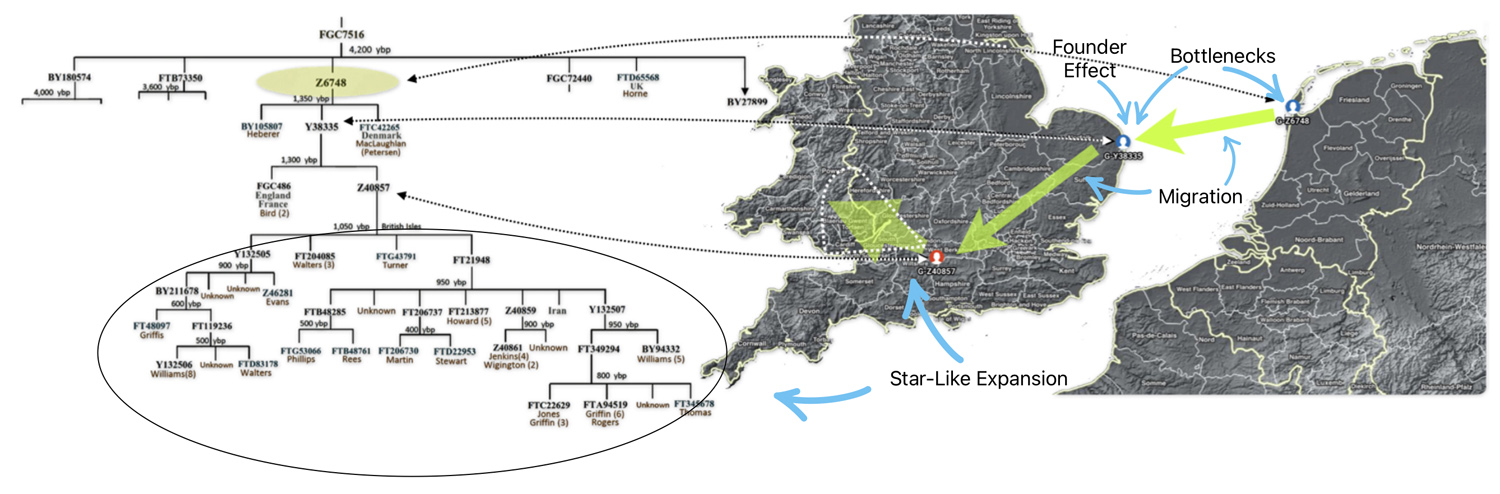
The most recent common ancestor (MRCA) of the G-Z6748 haplogroup [1] and its descendants presents a compelling case study in the interplay between population bottlenecks, migration and the proliferation of generations. Specifically, the ancestor of G-Z6748 and his descendents provide examples of historic demographic bottlenecks, the migration across the North Sea to the English Island in the early medieval Northwestern Europe, and the subsequent founder-effect population expansion of this YDNA genetic lineage around the time of the Norman invasion.
This story focuses on this YDNA path through the view of the changes in the phylogenetic tree structure [2] of the paternal descendants, the subcludes or branches of this haplogroup and its connection with the Griff(is)(es)(ith) lineage. [3] This is a challenging but intellectually productive story — one that requires integrating Y-DNA phylogenetics, population genetics theory, medieval social history, and landscape archaeology. Because this YDNA genetic line is a deep subclade without dedicated academic research, the scenario developed below is explicitly inferential and heuristic, built from convergent lines of evidence. It should be treated as a working hypothesis amenable to refinement as more BigY-tested descendants are added to the FamilyTreeDNA G-Z6748 haplogroup project. [4]
The MRCA associated with this YDNA haplogroup has a special significance for the Griff(is)(es)(ith) genetic paternal line as a direct paternal ancestor. In addtion, a small group of roughly 150 FamilyTreeDNA (FTDNA) YDNA testers can trace their paternal lines to this ancestor. [5]
A Comment on Phylogenetic Trees and Explaining Social Context
While I introduce and discuss socio -historical information to provide context to the changes in the phylogenetic tree structure of the descendants of G-Z6748, this merely provides a descriptive historical association between the two; and not necessarily inferences of causation.
“(G)eneticists are interested in ancestry, while archaeologists are interested in ethnicity: it is the bones, not the burial rites, which are important in the present context.” [6]
Geneticists are tracking ancestry, while archaeologists and historians often talk about ethnicity or other types of social groups. The two do not map one‑to‑one, which makes the analysis of changing social groups and phylogenetic genetic trees over time particularly vulnerable to mis-interpretation when translated directly into population ‑ genetic models. While I attempt to provide historical social and cultural contexts and possible associations with the changing structure of phylogenetic trees, it is important not to assume causal relationships necessarily between the two.
Another significant fact associated with this most recent common ancestor of G-Z6748 is that one of his genetic descendants is the first to migrate from continental Europe to the eastern coast of East Angles on the British Isle (see illustration one). [7] This is a classic example of a founder effect for a lineage based on migration. Other descendants may have migrated to Denmark and possibly the coastal areas of what are now Belgium or France. [8]
Illustration One: Estimated Migratory Path for Most Recent Common Ancestors of G-Z6748, G-Y38335 and G-Z40857

Bottlenecks, Founder Effects, and Star Like Expansions
In Y-DNA phylogenetics, ‘bottlenecks‘, ‘founder effects‘, and ‘star-like expansions‘ are interconnected phenomena that describe how paternal lineages lose diversity and then rapidly multiply, often reflecting or coinciding with major social or demographic shifts. Table one below provides a comparison of defining aspects for each of these macroscopic demographic genetic patterns with examples associated with haplogroup G-Z6748.
Table One: Demographic Bottlenecks, Founder Effects and Star-Like Expansion
Genetic drift is the overarching evolutionary mechanism, while genetic bottlenecks and founder effects are specific scenarios that dramatically amplify its impact. The fundamental difference between these phenomena lies in their triggering mechanisms rather than their genetic consequences. Bottlenecks result from environmental, social or cultural causes that reduce an existing population while founder effects arise from migration, colonization or isolation events – separating a portion of a population from the main population..
Both create the small population conditions that make genetic drift a dominant evolutionary force, leading to reduced genetic diversity and the potential for greater vulnerability to extinction or genetic disorders. Demographic genetic bottlenecks and founder effect expansions are both situations where a population or genetic group passes through a phase of very small size, so chance (genetic drift) strongly reshapes its genetic variation, often leaving lasting, highly distinctive signatures in the descendant population. [10]
Genetic drift is a mechanism of evolution characterized by random, chance fluctuations in genetic composition (allele frequencies or base pairs in the YDNA chromosome) within a population over generations. [11] Unlike natural selection, it is not driven by environmental adaptation but by sampling error, often causing certain genes to become more common or disappear entirely. It affects all populations but has the strongest impact on small groups. [12]
A genetic bottleneck is a sharp reduction in the number of reproducing males in a population, drastically reducing YDNA diversity. [13] A founder effect occurs when a small subgroup or a male individual breaks off from a larger group to establish a new community, carrying only a fraction of the original genetic diversity. [14]
A genetic bottleneck reduces genetic haplotype diversity by drastically decreasing population size, leading to the random loss of rare haplotypes and fixing a small subset of the original genetic variation. This process increases genetic homogeneity and can result in a new population with unique haplotype frequencies compared to the original population. A Y-DNA haplotype is a set of numerical values (alleles or base pairs of chromosomes) representing specific markers on a male’s Y-chromosome—primarily Short Tandem Repeats (STRs)—that form a “genetic signature” inherited from father to son (see illustration two). [15]
A star-like expansion is a phylogenetic tree pattern where many descendant haplotypes ‘radiate’ from a single ancestor with very few mutations between them, thus forming a “star” shape on the phylogenetic tree. In reality, it may not look literally like a star shape when depicted as a phylogenetic tree and when adding geographical locations of the newly formed branches of the tree. These expansions often appear during or after bottlenecks, as the few surviving lineages rapidly multiply to fill ecological / social niches. (see illustration two below). [16]
The typical pattern of this process involves:
- A bottleneck that reduces most or specific YDNA male lineages;
- The few surviving males act as founders for subsequent populations or population subgroups;
- If one founder or group of founders has a social/ reproductive advantage (e.g., elite status, territorial expansion, periods of prosperity), his lineage or specific lineages undergo a star-like expansion; and
- This may result in the proliferation of closely related subclades radiating from a recent common ancestor.
Illustration Two: Process Outcomes of Genetic Bottleneck, Founder Effects and Statr-Like Expansion

This pattern may provide telltale evidence of cultural hitchhiking—where YDNA lineages spread not just through biology but through effects of social structures like patrilocality, polygyny, or warrior elites. Cultural hitchhiking in genetic research refers to the process by which culturally or genetically neutral traits — ones that offer no inherent advantage on their own — spread through a population simply because they are carried alongside advantageous traits or successful groups. An example of a ‘culltural neutral trait’ is a beneficial technology or a superior subsistence strategy (e.g. farming) or a powerful social organizational practice such as patrilineal marriage practices. [17]
G-Z6748: A Minority Lineage with an History of Successive Genetic Bottlenecks
Haplogroup G-Z6748 is a relatively rare, minority Y-DNA lineage characterized by a series of significant evolutionary bottlenecks. The haplogroup descends from the broader YDNA G-L497 branch. The Y-DNA haplogroup branch G-L497 (also known as G2a3b1c) is heavily concentrated in Central and Western Europe, with its deepest historical roots pointing to the Eastern Alps and the Danube Basin. Geneticists often associate G-L497 with the initial spread of agriculture from the Balkans into Central Europe, notably linked to the Linear Pottery culture (LBK). During the Bronze and Iron ages, the branch is strongly tied to Alpine and Central European populations. Ancient samples have been identified in the Hallstatt and La Tène Celtic cultures, as well as Etruscan and subsequent Germanic groups. [18]
“In Europe west of the Black Sea, Haplogroup G is found at about 5% of the population on average throughout most of the continent. The concentration of G falls below this average in Scandinavia, the westernmost former Soviet republics and Poland, as well as in Iceland and the British Isles. There are seeming pockets of unusual concentrations within Europe. In Wales, a distinctive G2a3b1 (Haplogroup G-P15) type (DYS388=13 and DYS594=11) dominates there and pushes the G percentage of the population higher than in England.” [19]
“Haplogroup G-P303 (G2a2b2a, formerly G2a3b1) is a Y-chromosome haplogroup. . . . This haplogroup represents the majority of haplogroup G men in most areas of Europe. . . .” [20]
The genetic descendants of Haplogroup G‑Z6748 are considered ‘rare’ or a minority genetic YDNA group because of their representation today and in the last 1,300 years. It represents a small, very geographically concentrated descendant cluster with a relatively few known sub-branches and YDNA testers. [21]
As discussed in prior stories, there is roughly a 2,850‑year phylogenetic gap (about 95 generations) between the MRCA of G-Z6748 and its most recent documented ancestor associated with haplogroup G-FGC7516. (See illustration three below). There are no documented surviving intermediate branches. The gap implies strong bottlenecking or loss of parallel lineages, leaving only a very narrow path into the present (see table one, rows 3 and four). [22]
Table One: YDNA Ancestral Path between G-PF3345 and G-Z40857
| Haplogroup | Estimate of when MRCA was born | Time Passed from Prior Haplogroup | Immediate Documented Descendants | Number of FTDNA Tested Modern Descendants |
|---|---|---|---|---|
| G-Z40857 | 950 CE | 250 years | 4 | 60 |
| G-Y38335 | 700 CE | <100 years | 2 | 62 |
| G-Z6748 | 650 CE | 2,850 years | 2 | 153 |
| G-FGC7516 | 2200 BCE | <100 years | 6 | 292 |
| G-FGC447 | 2250 BCE | 250 years | 2 | 312 |
| G-Z727 | 2500 BCE | 550 years | 3 | 5,478 |
| G-Z1817 | 3050 BCE | 900 Years | 2 | 5,551 |
| G-Z6901 | 3950 BCE | 700 years | 1 | 5,620 |
| G-Z1900 | 4650 BCE | 300 years | 2 | 5,806 |
| G-CTS9737 | 4950 BCE | 600 years | 1 | 5,906 |
| G-L497 | 5550 BCE | 3,500 years | 2 | 6,063 |
| G-PF3345 | 9050 BCE | <100 years | 11 | 10,943 |
As reflected in table one, column four, the number of documented immediate genetic descendants for many of the haplogroups descending from the MRCA of G-L497 are few. With the exception of six documented haplogroup branches descending from G-FGC7526, the number of phylogenetic branches are limited to three or fewer descendants. Many of these haplogroups have gaps between them that are over 600 years or over 20 generations (see column four in table one).
The MRCA of haplogroup G-FGC7516 is estimated to have been born around 2200 BCE (row four in table one) with six documented genetic descendants. Around 2200 BCE, the Rhine River valley was dominated by communities of the Bell Beaker culture, which were rapidly transitioning into the early Únětice culture. This period marked a major shift across Europe, bringing an emphasis on bronze metallurgy and wide-ranging trade networks. It is an area that descendants of G-FGC7516 may have lived (see illustration three).
The Bell Beaker Culture operated as highly mobile networks rather than a single unified civilization, focusing heavily on the trade of copper, tin, and gold across the river valleys. Emerging around 2200 BCE, the Únětice culture represented the dawn of the Central European Early Bronze Age. The Únětice people were the first highly stratified societies in the region. They controlled highly profitable trade routes, using the Rhine to transport raw metals and manufactured goods across the continent. [23]
Ancient DNA studies in the Lower Rhine region have shown that this era featured a major shift in the population’s genetic makeup, with newcomers from the east bringing significant steppe ancestry (predominantly YDNA R- haplogroup influence) into local communities. [24]
Illustration Three: Estimated Migratory Path from G-FGC7516 to G-Z6748

The tail end of this 2,850‑year phylogenetic gap reflected the repressive effects of the subjugation of indigienous social groups by the Roman Empire. This undoubtably further impacted the limited growth of the YDNA generations associated with this lineage. [25]
In Y-DNA phylogenetics, a tree characterized by three or fewer subclades branching off in successive generations over long periods suggests a prolonged, severe population bottleneck or a prolonged period of extremely low effective population size for the direct patrilineal lineage. When a lineage survives but its population numbers collapse—or stay critically low for a millennia—the amount of surviving male-line diversity drops sharply. Instead of a bush-like tree (where one father has many sons who all leave surviving lineages), you get a “rake-like” or ladder-like structure. Only one or two surviving lines proceed into the next generation. This linear sequence rules out sudden, explosive population expansions, pointing instead to steady, isolated survival. [26]
Migration to East Anglia, Founder Effects and Continuation of Constrained YDNA Lineages
As indicated in a prior story, a plausible narrative is that a male individual and possibly his family, who was a most recent common ancestor associated with haplogroup G-Z6748, living in the Wadden Sea–Texel zone around the late seventh century, utilized established Anglo-Saxon-Frisian dominated North Sea trading networks to migrate to East Anglia. The individual or small group moved by sea along established routes from the Dutch/North Frisian islands to the eastern shoreline of the island and ultimately settled in East Angles. [27]
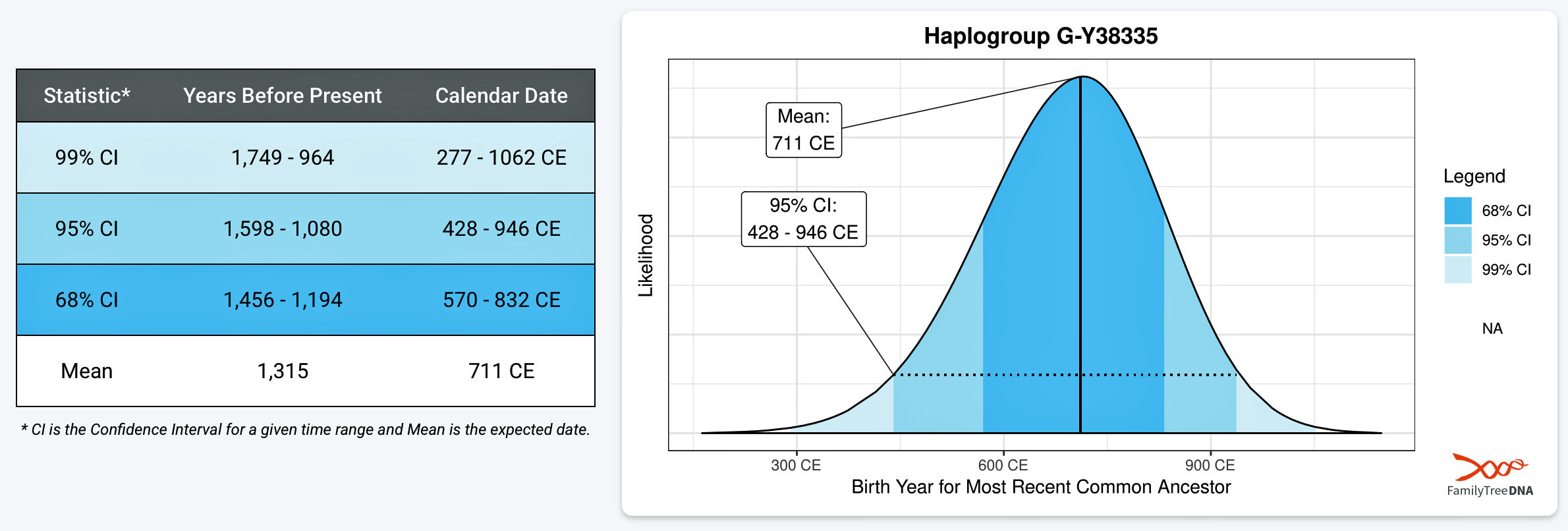
This most common recent ancestor associated with haplogroup G-Y38335 migrated from the continental coast or was born in East Anglia. His estimated birth date is at the turn of the 8th century (see table two). [28] His descendants represent virtually all of the presently known, discovered downstream haplogroups of G-Z6748 that are identified in Great Britain.
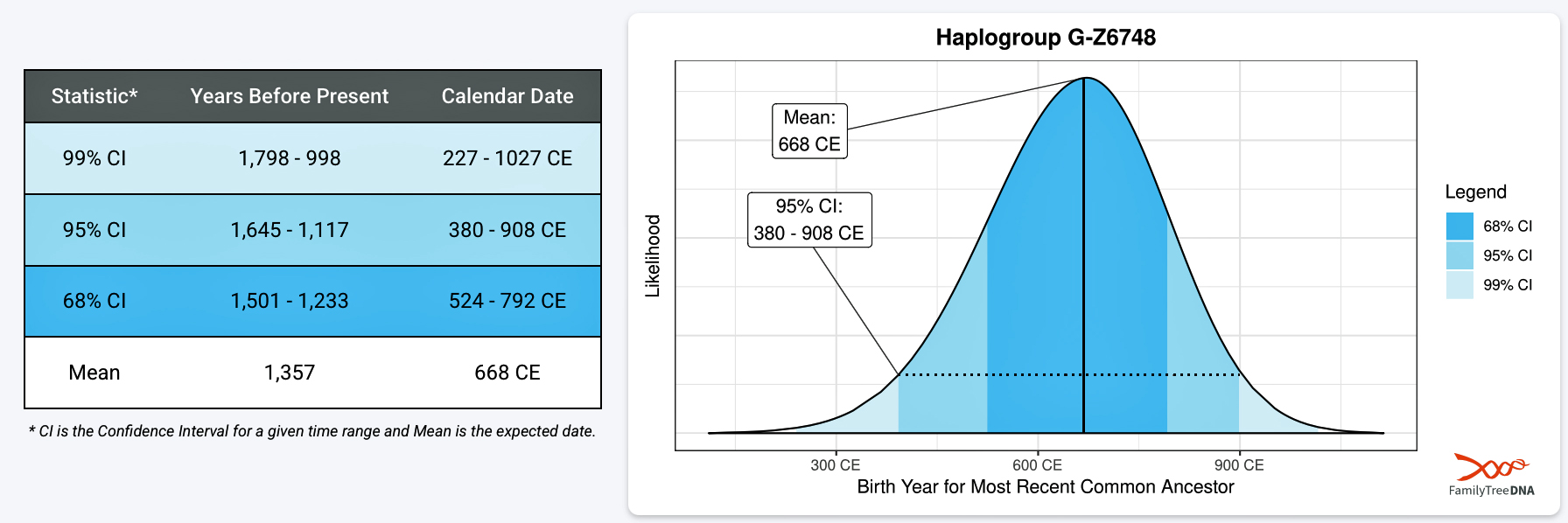
Table Two: Estimated Birth Dates of the MRCAs for G-Z6748, G-Y38335 and G-Z40857 [29]
| Estimated Birth Date | G-Z6748 Frisian Area | G-Y38335 East Anglia Area | G-Z40857 Sourthern Wessex Area |
|---|---|---|---|
| Mean | 668 CE | 711 CE | 971 CE |
| 68% Confidence Interval | 542 – 792 CE | 570 – 832 CE | 855 – 1070 CE |
| 95 % Confidence Interval | 380 – 908 CE | 428 – 946 CE | 739 – 1163 CE |
This is a classic example of a founder effect based on migration. Various studies underscore that this single migratory path for the G-Z6748 lineage was part of a larger continuing migratory population movement of people from across the North Sea to Britain that spanned centuries.
A growing body of bioarchaeological and archaeological work now emphasizes that migration into England from across the North Sea and wider north‑west Europe was a persistent feature of the period from the later Roman empire through the eleventh century. Recent large‑scale enamel‑isotope analysis of more than 700 individuals buried in England between the fourth and eleventh centuries has demonstrated continuous in‑migration from continental and extra‑local regions, with a notable increase in mobility in the seventh–eighth centuries, and has explicitly argued that “migration was a consistent feature of England between the 4th and the 11th centuries.” [30]
This isotopic work dovetails with wider projects on the medieval migrants of the North Sea world, which frame the North Sea basin as a long‑term zone of demographic and cultural connectivity from the post‑Roman period into the later Middle Ages, and builds on more traditional accounts of the Migration Period that already recognize substantial fifth‑ and sixth‑century crossings of the North Sea by Germanic‑speaking groups into Britain. [31]
A study by Leggett, Hakenbeck, and O’Connell push Anglo-Saxon “settlement” history away from what had traditionally been viewed as a short, fifth‑century ethnic migratory event and towards a long, regionally varied, gendered process of mobility and community formation. By extending well beyond the usual “Migration Period” associated with the Anglo-Saxon influx [32] , they show that migration remains substantial into the seventh–eighth centuries and through the Viking and Norman eras, reframing early medieval England as a persistently mobile society. [33]
Migration into East Anglia in this period overwhelmingly involved sea or coastal riverine movement rather than long overland treks. Modelling of early medieval migration routes and the broader archaeological pattern point to repeated crossings in relatively small vessels, not single armadas: groups of warriors, traders, craftsmen, dependants and some families moving along familiar seaways. [34]
In addition to the limiting founder effects of migration on the genetic diversity for subsequent generations, several interacting social processes during this time period could have created strong successive genetic bottlenecks on particular Y‑DNA lineages that migrated into Britain, especially in eastern and southern England. These processes could have sharply magnified a few male lines while eliminating many others, even when total population size is not tiny. [35]
The following are possible social processes that may have contributed to continued bottlenecks associated with the G-Y38335 lineage:
1. Founder effects in small kin‑based groups
Migration was often organized around extended families or warbands, not random samples of whole source populations. If a settlement is founded by a handful of related males (for example, several brothers and their close agnates), their Y lineages can rapidly dominate the local male pool purely by descent over a few generations. Repeated “patchy” colonization along river valleys and coasts (Thames, Humber, East Anglia, etc.) means many local founder events in different micro‑regions, each amplifying a narrow subset of continental Y lineages. [36]
2. Inter-group conflict, elite success, and differential male survival
The period was marked by endemic local conflicts, struggles between indigenous and incoming groups, and later inter‑kingdom competition. If certain male lineages were over‑represented in militarily successful groups (early royal/elite kindreds, successful warbands), those lines would experience higher survival of male offspring, more captured land, and greater reproductive opportunity, while defeated lineages could be reduced or wiped out. Over time, repeated “winners keep reproducing” episodes generate classic male‑line bottlenecks: a few successful patrilines expand, many others contract or vanish, even if autosomal diversity remains quite high.
Several interacting processes in the fifth–ninth centuries could create strong genetic bottlenecks in particular Y‑DNA lineages that migrated into Britain, especially in eastern and southern England. These processes can sharply magnify a few male lines while eliminating many others, even when total population size is not tiny. [37]
3. Social structure and patrilineal reproduction bias
Early medieval Germanic societies were strongly patrilineal and patrilocal: inheritance, identity, and land passed mainly through male lines, and wives often moved to the husband’s community. High‑status males could support more surviving children, so their Y lineages disproportionately increase in frequency. Low‑status or land‑poor males might delay marriage, remain celibate, or lose children at higher rates, leading to gradual loss of their lines. [38]
4. Serial admixture but constrained male lines
Early medieval England shows repeated waves of gene flow: North Sea migrants, plus later streams of ancestry related to Iron Age France and continued continental contacts. Admixture, the process by which individuals or populations acquire genetic material from different ancestral sources, can increase autosomal diversity but actually tighten Y bottlenecks if the incoming men are few but highly successful, or if later waves intermarry into already dominant male lineages rather than introducing many new patrilines. Over centuries, this creates a pattern where autosomal DNA records complex mixing, but Y‑DNA is dominated by a limited set of “survivor” lineages (for example, I1 and R1a lines rising in early medieval England amid decline of older R1b‑L21 lines in the east). [39]
5. Genetic drift in small small open populations
Early medieval settlement was highly local: villages and estates functioned as semi‑isolated groups where most marriages occurred within a short radius. In such small male breeding populations, random genetic drift is strong; a Y lineage can fix or disappear in a few dozen generations purely by chance, especially after prior founder events. Limited long‑range male mobility (outside warfare and elite networks) allows each micro‑region to drift in its own direction, producing sharp local peaks of specific subclades that look like bottlenecks when sampled later. [40]
Continued Bottleneck and Migration: East Anglia to South Wessex
As depicted in illustration four below, between approximately 700 CE and 950 CE, descendants of G-Y38335 migrated from the East Anglia area to the south-central area of Wessex.
Illustration Four: General Migratory Path of MRCA of G-38335 and G-Z40857 (Contemporary Boundaries)

This migratory path is only documented by the two endpoint haplogroups. The approximate 250-year gap, or roughly eight generations, spans the period when East Anglia went from an independent Anglo-Saxon kingdom to a Mercian vassal and then to a Danish Danelaw, while Wessex emerged as the safe, dominant kingdom.
Between 700 CE and 970 CE, the map of England transformed from a fragmented collection of rival Anglo-Saxon kingdoms (the Heptarchy) into a largely unified kingdom under the House of Wessex. This transformation was driven by the rise of Mercian, then West Saxon dominance, combined with the catastrophic impact of Viking invasions, which redrew the map of the isle by creating a distinct “Danelaw” region before it was eventually reconquered and consolidated (see illustrations five through ten below). [41]
One useful way to think about this gap is nothing “genetic” has gone missing, but the combination of demography, sampling, and social history has produced a long, straight branch with no surviving, sampled offshoots. Several kinds of processes during the East Anglia to Wessex / Danelaw transition could have produced this result. A 250‑year, eight generation stretch with no known sub-branches usually means that parallel male lines either died out or have not yet been sampled, not that they never existed. In a volatile period, several potential causes increase that extinction risk per generation. Because this involves one narrow migratory channel, the genetic signature between origin and destination will look like a long, unbranched trunk: all other “local” cousins either stayed put, died out, or remain unsampled.
The endpoints of this gap hint at a story of migration from an East Anglian origin context on one side and later survival in a Wessex-connected setting on the other. The historical record fits a landscape where East Anglia was an early magnet for continental settlers and remained heavily “north continental” in genetic profile, but then came under Mercian influence, then Scandinavian conquest, and finally West Saxon hegemony. Wessex, relatively safer from direct Scandinavian settlement, became the consolidating power and a refuge/attractor for various displaced or mobile families.
Historical Reasons for Migration from East Anglia
Multiple generations could have migrated gradually, or a single family or family member could have fled the Viking conquest of 869–870 and settled in Wessex within a few decades. This migration may have reflected and was influenced by the political shift of the center of power westward to Wessex, which eventually unified the English kingdoms.
Illustrations Five Through Ten: The Changing Political Boundaries of the Britsh Isle
Illustrations Five and Six: British Isles 719 CE and 800 CE (see Note [42] for numbered areas in maps)


Illustration Seven and Eight: British Isles 899 CE and 950 CE


Illustration Nine and Ten: British Isles: 975 CE and 1066 CE


By the mid-seventh century, the eastern region of Anglia was often under pressure from the growing power of the kingdom of Mercia. While the initial settlement of the G-Z6748 lineage was focused on the east, pressure from Mercian hegemony and later the Danish Great Heathen Army in the late ninth century caused shifts in population movement and loyalty and may have influenced the migration to the south central area of the island. This pattern is reflected in the changing political boundaries in the maps in illustration five through ten. [43]
In 825 CE, East Anglia, seeking independence from Mercia, acknowledged the overlordship of Ecgberht of Wessex. By the late ninth century, Alfred the Great of Wessex secured the region against the Danes, and Edward the Elder later fully integrated East Anglia into the growing Kingdom of England in 918 CE. [44]
Several major historical events between 700–950 CE provide plausible explanations why a G-Y38335 ancestor or series of generations would migrate from East Anglia to south-central Wessex, the area where the G-Z40857 MRCA is estimated to have lived.
Table Three: Key Historical Drivers for Migrating from East Anglia to Wessex
The south-central Wessex (Hampshire, Wiltshire) area was the core royal territory of the House of Wessex—the heartland where Alfred, Edward the Elder, and later Æthelstan built their power. This area offered:
- Safety from Viking control (unlike East Anglia after 869);
- Economic opportunity in Alfred’s fortified burhs and revived trade; and
- Political centrality as Wessex became the nucleus of unified England.
The Social Context Associated with the MRCA of G-Z40857 and Immediate Generations
After a 250 year phylogenetic gap, the most recent common ancestor of G-Z40857 appears in south central Wessex. As indicated in table two above, it is estimated that this ancestor was born around 971 CE. There is a sixty-eight percent chance that the MRCA of haplogrop G-Z40857 was born between 855 – 1070 CE [see note 29] .
The most likely scenario is a descendant of G-Y38335 fled East Anglia after 869–878, seeking safety in Wessex’s south-central core (Hampshire/Wiltshire), where King Alfred’s reforms created stability. Within two to three generations, the lineage, represented by the MRCA of G-Z04857, became established there by approximately the mid to late 900s CE.
Around the time of this ancestor’s birth, southern Wessex was in a phase of relative internal consolidation and monastic reform under King Edgar’s regime, with no major recorded battles within a kingdom that dominated most of England. By the mid–tenth century the royal house of Wessex had effectively become the royal dynasty of a unified English kingdom, with Wessex forming its southern core. After Æthelstan’s reign and subsequent consolidation, Wessex rulers controlled almost all territory south of the Danelaw. By Edgar’s time (959–975 CE) this was taken as a settled political fact rather than a frontier in crisis. Southern Wessex in the 960s–970s functioned more as the heartland of the realm than a contested border zone. [52]
Edgar’s reign is often interpreted as a high point of tenth‑century royal authority, with later tradition remembering him as “Edgar the Peaceful” because large‑scale warfare in England is not recorded for these years. Royal administration built on Alfredian and Edwardian foundations such as the fortified network of the burh system and fiscal structures of the hidage‑based taxation system still shaped local life in southern Wessex around 970. Lawgiving and royal assemblies in this period tend to be associated with the royal heartlands, which included key southern Wessex centers. The tenth century saw ongoing monetization and urban development in southern England, with burh‑towns evolving into more permanent commercial centers integrated into a kingdom‑wide economy. [53]
In southern Wessex, ports and market towns created or reinforced under Alfred and his successors continued to facilitate trade, tax collection, and royal presence by the 970s. For rural communities, the picture is of continuity under consolidated royal and ecclesiastical landlords, framed by older defensive and fiscal structures but with relatively few recorded disruptive events.
Illustration Elevin: Map of Hildage-Based Taxation

Hidage-based taxation was a historical land tax system in Anglo-Saxon and Norman England. It was assessed on the “hide,” a traditional unit of land theoretically capable of supporting a single household. This primitive but highly effective framework laid the groundwork for England’s early centralized tax state. [54]
Illustration Twelve: Medieval Tenth Century Bur-towns


Burh-towns (or burhs) were a network of fortified settlements established across early medieval England by King Alfred the Great and his successors (like Edward the Elder). Designed primarily to defend against Viking invasions, they also served as commercial and administrative centers that laid the foundation for English urban centers. [55]
Continuation of the Story: Part Two
Part two of the story discusses the Star-Like expansion of the phylogenetic tree. After roughly an eight generational gap in the phylogenetic tree, the ‘first wave’ of a star-like expansion of haplogroup branches start to emerge. It appears that descendants migrated westward from south central Wessex into the contested border line areas that were controlled by Anglo-Saxon and Celtic-Briton (nascent Welsh) areas.
The rapid diversification of haplogroup branches is evident between 1000–1500 CE. The clustering of haplogroups can be described as a single founding individual or small kin-group that achieved reproductive success just before the time of the Norman invasion and the continued proliferation of subclade branches through what is known as the Welsh Marches era.
Sources
Feature Image: “Every picture tells a story”. This banner visualy captures the essence of this story. The feature image consistes of two images. The image on the left is a modifed version of a Phylogenetic Tree created by Rolf Langland and Maurício Catelli (see reference below). The tree shows the relative sequential position of each of the haplogroups discussed in the story. The image on the left is a map I have created that illustrates the estimated migratory path and location of the MRCAs of G-Z6748 and G-Y38335 and G-Z40857.
Feature Image source for map: The source for creating the map is based on a variety of historical and archaeological studies as well as the estimates derived from the FTDNA Globetrekker tool, see Jim Griffis, Migrating to East Anglia, March 31, 2026, Griffis Family: Selected Stories from the Past, https://griffis.org/migrating-to-east-anglia/
Feature Image source for phylogenetic tree: Rolf Langland and Maurício Catelli, G-FGC477 / Chart D – v6 – 2 pages (Jan 26), G-L497 Y-DNA Work Project, https://drive.google.com/file/d/1U_-FfascgkP2kS4nVPEPQVr0l6w8Qc7U/view
See a Larger version of the Feature Banner

[1] “A most recent common ancestor (MRCA), also known as a last common ancestor (LCA) . . . , is the most recent individual from which all organisms of a set are inferred to have descended.”
Most Recent Common Ancestor, Wikipedia, This page was last edited on 29 September 2025, https://en.wikipedia.org/wiki/Most_recent_common_ancestor
[2] A Y-DNA phylogenetic tree structure is a branching diagram representing the patrilineal descent of human males based on Y-chromosome mutations. It is often called the YDNA Haplotree, it maps relationships from a common ancestor to modern lineages. Branches or subclades represent shared YDNA mutations, forming nested haplogroups.
Y-chromosome haplogroup G2a (M201) originated in the Middle East/Caucasus, characterized by its role as the primary lineage of early Neolithic farmers who expanded into Europe 9,000–6,000 years ago. Phylogenetically, it splits into multiple subclades (e.g. G2a1, G2a2, G2a3), with high diversity in the Caucasus and Anatolia, while European populations show high ancestral G2a concentrations. The definition of G2a has been refined by subsequent multiple YDNA defining mutations, including G-P15, G-L30, and others that helped differentiate Caucasian, Anatolian, and European branches.
See for example:
Sims LM, Garvey D, Ballantyne J. Improved resolution haplogroup G phylogeny in the Y chromosome, revealed by a set of newly characterized SNPs. PLoS One. 2009 Jun 4; 4(6):e5792. doi: 10.1371/journal.pone.0005792. PMID: 19495413; PMCID: PMC2686153. https://pmc.ncbi.nlm.nih.gov/articles/PMC2686153/
Rootsi S, Myres NM, Lin AA, Järve M, King RJ, Kutuev I, Cabrera VM, Khusnutdinova EK, Varendi K, Sahakyan H, Behar DM, Khusainova R, Balanovsky O, Balanovska E, Rudan P, Yepiskoposyan L, Bahmanimehr A, Farjadian S, Kushniarevich A, Herrera RJ, Grugni V, Battaglia V, Nici C, Crobu F, Karachanak S, Hooshiar Kashani B, Houshmand M, Sanati MH, Toncheva D, Lisa A, Semino O, Chiaroni J, Di Cristofaro J, Villems R, Kivisild T, Underhill PA. Distinguishing the co-ancestries of haplogroup G Y-chromosomes in the populations of Europe and the Caucasus. Eur J Hum Genet. 2012 Dec;20(12):1275-82. doi: 10.1038/ejhg.2012.86. Epub 2012 May 16. PMID: 22588667; PMCID: PMC3499744. https://pmc.ncbi.nlm.nih.gov/articles/PMC3499744/
Primorac D, Šarac J, Havaš Auguštin D, Novokmet N, Bego T, Pinhasi R, Šlaus M, Novak M, Marjanović D. Y Chromosome Story-Ancient Genetic Data as a Supplementary Tool for the Analysis of Modern Croatian Genetic Pool. Genes (Basel). 2024 Jun 6;15(6):748. doi: 10.3390/genes15060748. PMID: 38927684; PMCID: PMC11202852. https://pmc.ncbi.nlm.nih.gov/articles/PMC11202852/
Burkhard Berger, Harald Niederstätter, Daniel Erhart, Christoph Gassner, Harald Schennach, Walther Parson, High resolution mapping of Y haplogroup G in Tyrol (Austria), Forensic Science International: Genetics, Volume 7, Issue 5, 2013, Pages 529-536, ISSN 1872-4973,
https://doi.org/10.1016/j.fsigen.2013.05.013 .
(https://www.sciencedirect.com/science/article/pii/S1872497313001361 )
Hay, Maciamo, Haplogrup G2a (Y-DNA), May 2023, Eupedia, https://www.eupedia.com/europe/Haplogroup_G2a_Y-DNA.shtml#google_vignette
[3] Your Haplogroup Story: G-Z6748, FamilyTreeDNA, https://discover.familytreedna.com/y-dna/G-Z6748/story
G-Z6748 Haprogroup Project, About US, FamilyTreeDNA, https://www.familytreedna.com/groups/g-z6748/about
Hay, Maciamo, Haplogroup G2a (Y-DNA), Jul 2023, Eudepia, https://www.eupedia.com/europe/Haplogroup_G2a_Y-DNA.shtml
G-M201, The Genetic Genealogy of the Marres family, https://www.marres.nl/EN/G-M201.htm
See the following stories as a prelude to this story:
- The Ancestors of Haplogroup G-Z6748: A Frisian or Frank – Part Nine, February 11, 2026, https://griffis.org/the-ancestors-of-haplogroup-g-z6748-a-frisian-or-frank-part-nine/
- The Ancestor of Haplogroup G-Z6748, the Terps, Transport Corridors and Landscape Archaeology – Part Eight, January 14, 2026, https://griffis.org/the-ancestor-of-haplogroup-g-z6748-the-terps-transport-corridors-and-landscape-archaeology-part-eight/
- The Turbulent Roman Era – The Griff(is)(es)(ith) Y-DNA Phylogenetic Gap Associated with the Meuse and Rhine River Watershed – Part Seven, November 30, 2025, https://griffis.org/the-turbulent-roman-era-the-griffisesith-y-dna-phylogenetic-gap-associated-with-the-meuse-and-rhine-river-watershed-part-seven/
- Looking at the Tail End of the Griff(is)(es)(ith) Y-DNA Phylogenetic Gap Associated with the Meuse and Rhine River Watershed – Part Six, October 30, 2025, https://griffis.org/looking-at-the-tail-end-of-the-griffisesith-y-dna-phylogenetic-gap-associated-with-the-meuse-and-rhine-river-watershed-part-six/
- Looking at the Griff(is)(es)(ith) Y-DNA Phylogenetic Gap Associated with the Meuse and Rhine River Watershed from the Bronze Age Onward – Part Five, October 8, 2025, https://griffis.org/looking-at-the-griffisesith-y-dna-phylogenetic-gap-associated-with-the-meuse-and-rhine-river-watershed-from-the-bronze-age-onward-part-five/
- Looking at the Griff(is)(es)(ith) Y-DNA Phylogenetic Gap Associated with the Meuse and Rhine River Watershed from the Bronze Age Onward – Part Four, September 21, 2025, https://griffis.org/looking-at-the-griffisesith-y-dna-phylogenetic-gap-associated-with-the-meuse-and-rhine-river-watershed-from-the-bronze-age-onward-part-four/
- Looking at the Griff(is)(es)(ith) Y-DNA Phylogenetic Gap Associated with the Meuse and Rhine River Watershed – Part Three , August 29, 2025, https://griffis.org/looking-at-the-griffisesith-y-dna-phylogenetic-gap-associated-with-the-meuse-and-rhine-river-watershed-part-three/
- Looking at the Griff(is)(es)(ith) Y-DNA Phylogenetic Gap Associated with the Meuse and Rhine River Watershed – Part Two, July 29, 2025, https://griffis.org/looking-at-the-griffisesith-y-dna-phylogenetic-gap-associated-with-the-meuse-and-rhine-river-watershed-part-two/
- Looking at the Griff(is)(es)(ith) Y-DNA Phylogenetic Gap Associated with the Meuse and Rhine River Watershed – Part One, June 30, 2025, https://griffis.org/looking-at-the-griffisesith-y-dna-phylogenetic-gap-associated-with-the-meuse-and-rhine-river-watershed-part-one/
[4] The G-Z6748 Haplogroup Project is a dedicated Y-DNA research group on FamilyTreeDNA that explores the patrilineal descendants of an ancient Iron Age ancestor. This genetic lineage branched off from the rest of humankind roughly 2,200 years ago and sits downstream from the broader G-M201 >> L89 >> P15 >> L497 haplogroup tree.
The project is open to all participants who test positive for the Z6748 SNP. Because participants in the project often undergo advanced Y-DNA testing (such as Big Y), the group helps map a sprawling network of even more specific sub-clades (e.g., G-FT206737, G-Y132509, G-FTA94519). Descendants are primarily found throughout Europe. Members of this haplogroup often research surname lines connected to ancient or noble British and Scandinavian lineages (like Welsh patrons, Scottish/English gentry, and Norman ancestry).
Background, G-Z6748 Haplogroup Project. FamilyTreeDNA, Accessed 27 June, 2026, https://www.familytreedna.com/groups/g-z6748/about/background
[5] As of the writing of this story, there were 153 FamilyTreeDNA (FTDNA) DNA testers that could trace their YDNA back to G-Z6748. The following table provides a distribution of those 153 YDNA testers based on the testers’ self reported earliest known direct paternal countries of origin.

Your Haplogroup Story: G-Z6748, FamilyTreeDNA, Accessed 1 Apr 2026, https://discover.familytreedna.com/y-dna/G-Z6748/story
[6] Pattison , John E. “Integration Versus Apartheid in Post-Roman Britain: A Response to Thomas et al. (2008),” Human Biology 83(6), 715-733, (1 December 2011). https://doi.org/10.3378/027.083.0604
[7] Griffis, Jim, Migrating to East Anglia, March 31, 2026, Griffis Family: Selected Stories from the Past, https://griffis.org/migrating-to-east-anglia/
Griffis, Jim The Ancestors of Haplogroup G-Z6748: A Frisian or Frank – Part Nine, February 11, 2026, Griffis Family: Selected Stories from the Past, https://griffis.org/the-ancestors-of-haplogroup-g-z6748-a-frisian-or-frank-part-nine/
[8] G-Z6748 Haplogroup Project, About Us, FamilyTreeDNA, accessed 4 May 2026, https://www.familytreedna.com/groups/g-z6748/about
Haplogroup G –L497 Chart D: FGC477 Branch, L-497 Haplogroup Project, 24 Jan 2026, https://drive.google.com/file/d/1U_-FfascgkP2kS4nVPEPQVr0l6w8Qc7U/view
[9] In genetics, an allele is simply an alternative version of a DNA sequence of base pairs at a specific location on a chromosome. The definitions of alleles in the context of SNPs and STRs differ primarily in what type of genetic variation is being measured.
A SNP represents a change at a single “letter” (nucleotide) in the DNA sequence. An STR is a region of DNA where short sequences of 2 to 6 base pairs are repeated over and over.
| Allele | Description |
|---|---|
| SNP Allele | A change in a single nucleotide base (e.g., A vs. T) |
| STR Allele | A difference in the number of times a short DNA motif repeats (e.g., a “GATA” sequence repeating 8 times vs. 11 times) |
Phillips C, García-Magariños M, Salas A, Carracedo A, Lareu MV. SNPs as Supplements in Simple Kinship Analysis or as Core Markers in Distant Pairwise Relationship Tests: When Do SNPs Add Value or Replace Well-Established and Powerful STR Tests? Transfus Med Hemother. 2012 Jun;39(3):202-210. doi: 10.1159/000338857. Epub 2012 May 12. PMID: 22851936; PMCID: PMC3375139. https://pmc.ncbi.nlm.nih.gov/articles/PMC3375139/
[10] 20.9.2: Genetic Drift, Libre Texts, h10tps://bio.libretexts.org/Bookshelves/Introductory_and_General_Biology/Map:_Raven_Biology_12th_Edition/20:_Genes_Within_Populations/20.09:_Interactions_Among_Evolutionary_Forces/20.9.2:_Genetic_Drift
Kirk, Maggie, Genetic Drift and Founder Effects: Implications for Population Genetics, Conservation, and Human Health, April 16, 2024, Genet.Mol.Res. 23(2), https://www.geneticsmr.org/articles/genetic-drift-and-founder-effects-implications-for-population-genetics-conservation-and-human-health-7748.html
[11] An allele is one of two or more alternative versions of a gene at a specific location on a chromosome. Allele frequency measures how common a gene variant (allele) is within a population, calculated by dividing the count of a specific allele by the total of all alleles for that gene in the population. It is used to study genetic diversity, evolution, and population structure, with frequencies ranging from 0 to 1.0 (or 0–100%).
See:
Allele, National Human Genome Research Insitute, https://www.genome.gov/genetics-glossary/Allele
Allele Frequency, Wikipedia, This page was last edited on 31 March 2026, https://en.wikipedia.org/wiki/Allele_frequency
Minor Allele Frequency, Wikipedia, This page was last edited on 14 December 2025, https://en.wikipedia.org/wiki/Minor_allele_frequency
Allele frequency & the gene pool, Khan Academy, https://www.khanacademy.org/science/ap-biology/natural-selection/hardy-weinberg-equilibrium/a/allele-frequency-the-gene-pool
Gonzalez-Galarza FF, Christmas S, Middleton D, Jones AR. Allele frequency net: a database and online repository for immune gene frequencies in worldwide populations. Nucleic Acids Res. 2011 Jan;39(Database issue):D913-9. doi: 10.1093/nar/gkq1128. Epub 2010 Nov 9. PMID: 21062830; PMCID: PMC3013710. https://pubmed.ncbi.nlm.nih.gov/21062830/
allele frequency, Scitable, https://www.nature.com/scitable/definition/allele-frequency-298/
[12] Y-DNA genetic drift is the random change in frequencies of Y-chromosome lineages (haplogroups or subclades) over time, purely by chance rather than because they are biologically better or worse. Genetic drift is the random, unpredictable variations of allele or lineage frequencies from one generation to the next, caused by random sampling of which men leave surviving sons and which do not. On the Y chromosome, this means some Y lineages expand, others shrink, and some disappear entirely, even if they are selectively neutral.
See:
Genetic Drift, Wikipedia, This page was last edited on 28 March 2026, https://en.wikipedia.org/wiki/Genetic_drift
Chiaroni J, Underhill PA, Cavalli-Sforza LL. Y chromosome diversity, human expansion, drift, and cultural evolution. Proc Natl Acad Sci U S A. 2009 Dec 1;106(48):20174-9. doi: 10.1073/pnas.0910803106. Epub 2009 Nov 17. Erratum in: Proc Natl Acad Sci U S A. 2010 Jul 27;107(30):13556. PMID: 19920170; PMCID: PMC2787129. https://pmc.ncbi.nlm.nih.gov/articles/PMC2787129/
Slyman, Raleigh, How does Y chromosome variation happen?, 27 Feb 2024, The Tech Interactive, https://www.thetech.org/ask-a-geneticist/articles/2024/y-chromosome-variation/
[13] A population bottleneck is a sharp, drastic reduction in the size of a population due to environmental events (e.g. earthquakes, fires, famine) or human activities (e.g. impact of patrilineal systems on genetic diversity, the repressive practices of social groups on othersocial groups, etc ). Demographic bottlenecks cause massive losses of genetic diversity, leaving the surviving population with a limited gene pool and increased genetic drift.
Typical features of a demographic bottleneck are:
- A large population is drastically reduced for at least one generation (e.g., by disease, famine, climate event, habitat loss, hunting).
- The survivors are effectively a random sample of the original population, so rare alleles are likely to be lost and a few previously uncommon alleles can drift to higher frequency.
- When the population later expands, all descendants trace back to that small set of survivors, so the whole population shows reduced heterozygosity and fewer alleles per locus. Heterozygosity is the presence of two different versions (alleles) of a specific gene in an individual, with one inherited from each parent.
See:
Population bottleneck, Wikipeda, This page was last edited on 31 March 2026, https://en.wikipedia.org/wiki/Population_bottleneck
Bottlenecks and founder effects, Understanding Evolution, https://evolution.berkeley.edu/bottlenecks-and-founder-effects/
Klymkowski, Michael and Melanie M. Cooper, Population size, founder effects and population bottlenecks, LibreTexts, https://bio.libretexts.org/Bookshelves/Cell_and_Molecular_Biology/Biofundamentals_1e_(Klymkowsky_and_Cooper)/03:_Evolutionary_mechanisms_and_the_diversity_of_life/3.14:_Population_size_founder_effects_and_population_bottlenecks
Widdows, Megan, Genetic bottlenecks and the Founder effect: lessons learnt from the Woolly Mammoth, Evolution Letters, https://evolutionletters.wordpress.com/evolution-learning-zone/evolution-explained/genetic-bottlenecks-and-the-founder-effect-lessons-learnt-from-the-woolly-mammoth/
Kirk, Maggie, Genetic Drift and Founder Effects: Implications for Population Genetics, Conservation, and Human Health, April 16, 2024 Genet.Mol.Res. 23(2): , https://www.geneticsmr.org/articles/genetic-drift-and-founder-effects-implications-for-population-genetics-conservation-and-human-health.pdf
[14] A founder effect is a loss of genetic variation occurring when a new population is established by a very small number of individuals from a larger population. It causes reduced genetic diversity, with the new group’s gene frequencies differing significantly from the original population.
A founder effect occurs when a new population (a “colony”) is established by a small number of individuals drawn from a larger source population. Because the founders are few, they carry a non-representative sample of the source gene pool, and this sampling distortion is then amplified as the new population grows.
Typical features of a founder effect are:
- A small group separates from a larger population (e.g., colonizing an island, migrating to a new region, or becoming geographically/culturally isolated).
- The founding group has reduced genetic variation relative to the source and may, by chance, carry some alleles at unusually high or low frequency.
See:
Bottlenecks and founder effects, Understanding Evolution, https://evolution.berkeley.edu/bottlenecks-and-founder-effects/
Klymkowski, Michael and Melanie M. Cooper, Population size, founder effects and population bottlenecks, LibreTexts, https://bio.libretexts.org/Bookshelves/Cell_and_Molecular_Biology/Biofundamentals_1e_(Klymkowsky_and_Cooper)/03:_Evolutionary_mechanisms_and_the_diversity_of_life/3.14:_Population_size_founder_effects_and_population_bottlenecks
Widdows, Megan, Genetic bottlenecks and the Founder effect: lessons learnt from the Woolly Mammoth, Evolution Letters, https://evolutionletters.wordpress.com/evolution-learning-zone/evolution-explained/genetic-bottlenecks-and-the-founder-effect-lessons-learnt-from-the-woolly-mammoth/
Kirk, Maggie, Genetic Drift and Founder Effects: Implications for Population Genetics, Conservation, and Human Health, April 16, 2024 Genet.Mol.Res. 23(2): , https://www.geneticsmr.org/articles/genetic-drift-and-founder-effects-implications-for-population-genetics-conservation-and-human-health.pdf
[15] Mustapha J A, How does the genetic bottleneck or population expansion affect the pattern of DNA polymorphisms?, 8 Jan 2016, ResearchGate, https://www.researchgate.net/post/How-does-the-genetic-bottleneck-or-population-expansion-affect-the-pattern-of-DNA-polymorphisms
population bottleneck, scitable, https://www.nature.com/scitable/definition/population-bottleneck-300/
Bottlenecks and founder effects, Understanding Evolution, UC Museum of Paleontology, https://evolution.berkeley.edu/bottlenecks-and-founder-effects/
Lucena-Perez M, Kleinman-Ruiz D, Marmesat E, Saveljev AP, Schmidt K, Godoy JA. Bottleneck-associated changes in the genomic landscape of genetic diversity in wild lynx populations. Evol Appl. 2021 Oct 8;14(11):2664-2679. doi: 10.1111/eva.13302. PMID: 34815746; PMCID: PMC8591332. https://pmc.ncbi.nlm.nih.gov/articles/PMC8591332/
Population Bottleneck, Wikipedia, This page was last edited on 31 March 2026, https://en.wikipedia.org/wiki/Population_bottleneck
Haplotype, International Society of Genetic GenealologyWiki, This page was last edited on 1 July 2021, https://isogg.org/wiki/Haplotype
Haplotype, Wikipedia, This page was last edited on 27 February 2026, https://en.wikipedia.org/wiki/Haplotype
What is the difference between a Y-DNA haplotype and Y-DNA haplogroup?, genebase, https://www.genebase.com/what-is-the-difference-between-a-y-dna-haplotype-and-y-dna-haplogroup/
[16] See for a discussion of the relationship between bottlenecks, founder effects and star phylogenies:
Karmin M, Saag L, Vicente M, Wilson Sayres MA, Järve M, Talas UG, Rootsi S, Ilumäe AM, Mägi R, Mitt M, Pagani L, Puurand T, Faltyskova Z, Clemente F, Cardona A, Metspalu E, Sahakyan H, Yunusbayev B, Hudjashov G, DeGiorgio M, Loogväli EL, Eichstaedt C, Eelmets M, Chaubey G, Tambets K, Litvinov S, Mormina M, Xue Y, Ayub Q, Zoraqi G, Korneliussen TS, Akhatova F, Lachance J, Tishkoff S, Momynaliev K, Ricaut FX, Kusuma P, Razafindrazaka H, Pierron D, Cox MP, Sultana GN, Willerslev R, Muller C, Westaway M, Lambert D, Skaro V, Kovačevic L, Turdikulova S, Dalimova D, Khusainova R, Trofimova N, Akhmetova V, Khidiyatova I, Lichman DV, Isakova J, Pocheshkhova E, Sabitov Z, Barashkov NA, Nymadawa P, Mihailov E, Seng JW, Evseeva I, Migliano AB, Abdullah S, Andriadze G, Primorac D, Atramentova L, Utevska O, Yepiskoposyan L, Marjanovic D, Kushniarevich A, Behar DM, Gilissen C, Vissers L, Veltman JA, Balanovska E, Derenko M, Malyarchuk B, Metspalu A, Fedorova S, Eriksson A, Manica A, Mendez FL, Karafet TM, Veeramah KR, Bradman N, Hammer MF, Osipova LP, Balanovsky O, Khusnutdinova EK, Johnsen K, Remm M, Thomas MG, Tyler-Smith C, Underhill PA, Willerslev E, Nielsen R, Metspalu M, Villems R, Kivisild T. A recent bottleneck of Y chromosome diversity coincides with a global change in culture. Genome Res. 2015 Apr;25(4):459-66. doi: 10.1101/gr.186684.114. Epub 2015 Mar 13. PMID: 25770088; PMCID: PMC4381518. https://pmc.ncbi.nlm.nih.gov/articles/PMC4381518/
Zeng, T.C., Aw, A.J. & Feldman, M.W. Cultural hitchhiking and competition between patrilineal kin groups explain the post-Neolithic Y-chromosome bottleneck. Nat Commun9, 2077 (2018). https://doi.org/10.1038/s41467-018-04375-6 ,
Khan, Razib, Genghis Khan: they don’t make stars like they used to: Manspreading like the ancients: star phylogenies and the rise and fall of hyper-patriarchy, 26 Nov 2023, Razib Kan’s Unsupervised Learning, https://www.razibkhan.com/p/genghis-khan-manspreading-like-the
[17] Examples of studies that utilize the concept of cultural hitchiking:
Foody, M. George B. , Genetic Impact of the Bronze Age at the Fringes of Europe. Doctoral thesis, University of Huddersfield. 2021, https://eprints.hud.ac.uk/id/eprint/35516/, https://eprints.hud.ac.uk/id/eprint/35516/1/FINAL%20THESIS%20-%20Foody.pdf
Batini C, Hallast P, Vågene ÅJ, Zadik D, Eriksen HA, Pamjav H, Sajantila A, Wetton JH, Jobling MA. Population resequencing of European mitochondrial genomes highlights sex-bias in Bronze Age demographic expansions. Sci Rep. 2017 Sep 21;7(1):12086. doi: 10.1038/s41598-017-11307-9. PMID: 28935946; PMCID: PMC5608872. https://pmc.ncbi.nlm.nih.gov/articles/PMC5608872/
Zeng, T.C., Aw, A.J. & Feldman, M.W. Cultural hitchhiking and competition between patrilineal kin groups explain the post-Neolithic Y-chromosome bottleneck. Nat Commun, 9, 2077 (2018). https://doi.org/10.1038/s41467-018-04375-6
Ackland GJ, Signitzer M, Stratford K, Cohen MH. Cultural hitchhiking on the wave of advance of beneficial technologies. Proc Natl Acad Sci U S A. 2007 May 22;104(21):8714-9. doi: 10.1073/pnas.0702469104. Epub 2007 May 16. PMID: 17517663; PMCID: PMC1885568. https://pmc.ncbi.nlm.nih.gov/articles/PMC1885568/
Guyon, L., Guez, J., Toupance, B. et al. Patrilineal segmentary systems provide a peaceful explanation for the post-Neolithic Y-chromosome bottleneck. Nat Commun 15, 3243 (2024). https://doi.org/10.1038/s41467-024-47618-5
S. Carrignon, E.R. Crema, A. Kandler, & S. Shennan, Postmarital residence rules and transmission pathways in cultural hitchhiking, Proc. Natl. Acad. Sci. U.S.A. 121 (48) e2322888121, https://doi.org/10.1073/pnas.2322888121 (2024).
[18] G-L497 Y-DNA Haplogroup Project, FamilyTreeDNA, About Us, https://www.familytreedna.com/groups/g-ydna/about?srsltid=AfmBOorfbKDPy0LJSW66_gQbGMyCX-0o7BUKA22BopSqeeXuGntPxzYU
Haplogroup G-P303, Wikipeda, This page was last edited on 26 January 2026, https://en.wikipedia.org/wiki/Haplogroup_G-P303
Burkhard Berger, Harald Niederstätter, Daniel Erhart, Christoph Gassner, Harald Schennach, Walther Parson, High resolution mapping of Y haplogroup G in Tyrol (Austria), Forensic Science International: Genetics, Volume 7, Issue 5, 2013, Pages 529-536, ISSN 1872-4973,
https://doi.org/10.1016/j.fsigen.2013.05.013 .
(https://www.sciencedirect.com/science/article/pii/S1872497313001361 )
[19] Quote: Haplogroup G-M201, Wikipedia, This page was last edited on 20 February 2026, https://en.wikipedia.org/wiki/Haplogroup_G-M201
The quote references the ISOGG haplogroup G2a3b1 which is G-P303 . Direct match to G2a3b1 not found, but it is 3 steps up the haplotree G2a = G-P15.
See also:
Haplogroup G-P303, Wikipedia, This page was last edited on 26 January 2026, https://en.wikipedia.org/wiki/Haplogroup_G-P303
“There are seeming pockets of unusual concentrations within Europe. In Wales, a distinctive G2a3b1 (G-P15) type (DYS388=13 and DYS594=11) dominates there and pushes the G percentage of the population higher than in England.“
DYS399 and DYS594 stand for DNA Y-chromosome Segments. They are specific short-tandem repeat (STR) markers located on the Y-chromosome used in genetic genealogy to trace paternal ancestry. DYS markers, designated by the HUGO Gene Nomenclature Committee, identify specific spots where DNA sequences repeat, helping men determine relatedness to others through their direct paternal line.
Key Details About DYS Markers (e.g., DYS399 and DYS594):
- Paternal Tracking: DYS markers only exist on the Y-chromosome, passing from father to son with few changes, making them ideal for surname projects and genealogical research.
- STR (Short Tandem Repeat): These markers measure the number of times a short DNA sequence repeats, such as GATA-GATA-GATA (3 repeats).
- Mutation Rates: While highly stable, these markers can mutate, allowing researchers to estimate the time to the most recent common ancestor (TMRCA) between two men.
- Component of Y-DNA Profiles: Results for DYS399, alongside others like DYS390 or DYS393, form a Y-STR haplotype profile.
See: Understanding the Admin – Y-DNA Results Overview Report, FamilyTreeDNA, https://help.familytreedna.com/hc/en-us/articles/11165708791311-Understanding-the-Admin-Y-DNA-Results-Overview-Report#h_01JBYS1DRY1CMCC0FVK83ER1GQ
A review of the DYS values for DYS399 and DYS594 for members of the G-Z6748 FamilyTree Project confirms this observation. The following is the G-Z6748 – Y-DNA Results Overview for the FamilyTreeDNA project. As refleced in the chart, the value for DYS399 =13 for all members of this group project as of the writing of the story. . The value for all but one member of this group for DYS594=11.
G-Z6748 – Y-DNA Results Overview (as of April 2026)

[20] Haplogroup P-303, Wikipedia, This page was last edited on 26 January 2026, https://en.wikipedia.org/wiki/Haplogroup_G-P303
[21] Your Haplogroup Story: G-Z6748, FamilyTreeDNA, Accessed 03 May 2026, https://discover.familytreedna.com/y-dna/G-Z6748/story
[22] Griffis, Jim The Griff(is)(es)(ith) Patrilineal Line of Descent: The Shape and Movement of the G Phylogenetic Tree through Time, March 23, 2025, Griffis Family: Selected Stories from the Past, https://griffis.org/the-griffisesith-patrilineal-line-of-descent-the-shape-and-movement-of-the-g-phylogenetic-tree-through-time/
[23] Bell Beaker Culture, Wikipeida, This page was last edited on 8 May 2026, https://en.wikipedia.org/wiki/Bell_Beaker_culture
Vander Linden, Marc, The Bell Beaker Phenomenon in Europe, Cambridge University Press, 2024, https://doi.org/10.1017/9781009496872
Únětice culture, Wikipedia, This page was last edited on 16 April 2026, https://en.wikipedia.org/wiki/Únětice_culture
Quentin P. J. Bourgeois et al. ,Spatiotemporal reconstruction of Corded Ware and Bell Beaker burial rituals reveals complex dynamics divergent from steppe ancestry. Sci. Adv. 11, eadx2262 (2025). DOI: 10.1126/sciadv.adx2262
Olalde, I., Brace, S., Allentoft, M. et al. The Beaker phenomenon and the genomic transformation of northwest Europe. Nature 555, 190–196 (2018). https://doi.org/10.1038/nature25738
Olalde, Iñigoet al. , The genomic history of the Iberian Peninsula over the past 8000 years.Science 363, 1230-1234 (2019).DOI:10.1126/science.aav4040
[24] In Central and Northern Europe (like the Rhine Valley), the Bell Beaker population was almost entirely composed of individuals with heavy Steppe-related ancestry and R1b lineages. In contrast, Iberian Beaker individuals often retained the DNA of local farmers, only showing the arrival of R1b and Steppe ancestry later in the Bronze Age.
Paternal Lineages YDNA associated with the influx of the Bell Beaker cultural groups:
G2a, I2a, and R-V88: Found primarily in early Iberian Bell Beaker burials. In these regions, the culture often spread through trade and cultural adoption rather than mass migration, meaning local Neolithic lineages persisted longer than in Northern Europe.
R1b-M269 / R1b-L11: The primary male lineage for Bell Beaker groups outside of Iberia. It is linked to “Steppe” ancestry and is a definitive indicator of the population shift that occurred around 2500–2200 BCE.
R1b-P312: A major subclade that became the dominant lineage of the “Rhenish” Beakers (those in the Rhine area, Netherlands, and Britain).
Olalde, Iñigo al., The genomic history of the Iberian Peninsula over the past 8000 years.Science 363, 1230-1234 (2019). DOI: 10.1126/science.aav4040
Hay, Maciamo, Bell Beaker phenomenon (c. 2900-1800 BCE), Eupedia, https://www.eupedia.com/genetics/bell_beaker_phenomenon.shtml
[25] Griffis, Jim, The Turbulent Roman Era – The Griff(is)(es)(ith) Y-DNA Phylogenetic Gap Associated with the Meuse and Rhine River Watershed – Part Seven, November 30, 2025, https://griffis.org/the-turbulent-roman-era-the-griffisesith-y-dna-phylogenetic-gap-associated-with-the-meuse-and-rhine-river-watershed-part-seven/
[26] McDonald I. Improved Models of Coalescence Ages of Y-DNA Haplogroups. Genes (Basel). 2021 Jun 4;12(6):862. doi: 10.3390/genes12060862. PMID: 34200049; PMCID: PMC8228294. https://pmc.ncbi.nlm.nih.gov/articles/PMC8228294/
Jobling, M., Tyler-Smith, C. Human Y-chromosome variation in the genome-sequencing era. Nat Rev Genet 18, 485–497 (2017). https://doi.org/10.1038/nrg.2017.36
[27] The Kingdom of the East Angles (sixth century–918 CE) was an independent Anglo-Saxon kingdom comprising modern-day Norfolk and Suffolk. Founded by Angles settlers, it was part of the Heptarchy, later falling under Mercian dominance, Viking control (as part of the Danelaw), and finally becoming part of England in 918 CE.
Kingdom of East Anglia, Wikipedia, This page was last edited on 25 March 2026, https://en.wikipedia.org/wiki/Kingdom_of_East_Anglia
See also:
Griffis, Jim, Migrating to East Anglia, March 31, 2026, Griffis Family: Selected Stories from the Past, https://griffis.org/migrating-to-east-anglia/
Griffis, Jim, The Ancestors of Haplogroup G-Z6748: A Frisian or Frank – Part Nine, February 11, 2026, Griffis Family: Selected Stories from the Past, https://griffis.org/the-ancestors-of-haplogroup-g-z6748-a-frisian-or-frank-part-nine/
Griffis, Jim, The Ancestor of Haplogroup G-Z6748, the Terps, Transport Corridors and Landscape Archaeology – Part Eight , January 14, 2026, Griffis Family: Selected Stories from the Past, https://griffis.org/the-ancestor-of-haplogroup-g-z6748-the-terps-transport-corridors-and-landscape-archaeology-part-eight/
[28] Griffis, Jim, Migrating to East Anglia, 31 Mar 2026, Griffis Family, Selected Sotires from the Past, https://griffis.org/migrating-to-east-anglia/
[29] Scientific Details for G-Z6748
Scientific Details for G-Y38335
Scientific Details for G-Z40857:

[30] Leggett, S., Hakenbeck, S., & C O’Connell, T. (2025). Large-Scale Isotopic Data Reveal Gendered Migration into Early Medieval England 400–1100. Medieval Archaeology, 69(2), 280–308. https://doi.org/10.1080/00766097.2025.2583016
Gretzinger, J., Sayer, D., Justeau, P. et al. The Anglo-Saxon migration and the formation of the early English gene pool. Nature 610, 112–119 (2022). https://doi.org/10.1038/s41586-022-05247-2
Roots of medieval migration into England uncovered in new study, Press Release, 5 Jan 2026, Univesrity of Edinburgh, https://www.eurekalert.org/news-releases/1111454
Roots of medieval migration into England uncovered in new study, 8 Jan 2026, Archaeology Department, University of Cambridge, https://www.arch.cam.ac.uk/news/roots-of-medieval-migration-into-england-uncovered-in-new-study
Migration Period, Wikipedia, This page was last edited on 27 April 2026, https://en.wikipedia.org/wiki/Migration_Period
McIntosh, Matthew, The Migration Period in Ancient Europe, 300-568 CE, 15 May 2020, Brewminate, https://brewminate.com/the-migration-period-in-ancient-europe-300-568-ce/
[31] See Jim Griffis, Migrating to East Anglia, 31 Mar 2026, Griffis Family,: Stories from the Past, https://griffis.org/migrating-to-east-anglia/
[32] The fifth-century Migration Period (or Völkerwanderung) was a transformative era of mass population movements and tribal incursions that permanently reshaped Europe. Driven by Hunnish expansion, climate shifts, and tribal conflicts, this wave of migration precipitated the collapse of the Western Roman Empire and laid the foundation for medieval European states.
Key Migrations of the fifth Century
The Franks (Fifth century): Moving into Roman Gaul more gradually, these western Germanic tribes integrated with the local Roman-Gaulish populace. They fended off rival tribes like the Visigoths and the Alemanni, forming the nucleus of the future French and German states
Visigoths (410 CE ): Having migrated from the Balkans, they sacked Rome in 410 CE. They subsequently settled in southern Gaul (France) and established a powerful kingdom spanning nearly all of Hispania (Spain).
Vandals, Alans, and Suebi (406–409 CE): In a massive flight from the Huns, these groups crossed the frozen Rhine on December 31, 406. They swept through Gaul and into Spain before the Vandals crossed into North Africa in 429 to establish an independent state at Carthage.
Angles, Saxons, and Jutes (Mid-fifth century): With the Roman military withdrawing from Britain, these Germanic tribes from the Jutland Peninsula migrated across the North Sea, pushing native Britons west and establishing their own kingdoms.
See:
Migration Perod, Wikipedia, This page was last edited on 27 April 2026, https://en.wikipedia.org/wiki/Migration_Period
van der Crabben, Jan, Migration Age, 10 Jun 2010, World History Encyclopedia, https://www.worldhistory.org/Migration_Age/
Britannica Editors. “Migration period”. Encyclopedia Britannica, 23 Mar. 2018, https://www.britannica.com/event/Dark-Ages
[33] Leggett, S., Hakenbeck, S., & C O’Connell, T. (2025). Large-Scale Isotopic Data Reveal Gendered Migration into Early Medieval England 400–1100. Medieval Archaeology, 69(2), 280–308. https://doi.org/10.1080/00766097.2025.2583016
Anastasi, Luciano, Migration into Medieval England: New Evidence Shakes Old Narratives, 12 Jan 2026, History Medieval, https://historymedieval.com/migration-into-medieval-england-new-evidence-shakes-old-narratives/
[34] Leggett, S., Hakenbeck, S., & C O’Connell, T. (2025). Large-Scale Isotopic Data Reveal Gendered Migration into Early Medieval England 400–1100. Medieval Archaeology, 69(2), 280–308. https://doi.org/10.1080/00766097.2025.2583016
[35] Ashworth, James, Early English Anglo-Saxons descended from mass European migration, 21 Sep 2022, Science News, Natural History Museum London, https://www.nhm.ac.uk/discover/news/2022/september/early-english-anglo-saxons-descended-from-mass-european-migration.html
Genetic history of the British Isles, Wikipedia, This page was last edited on 11 April 2026, https://en.wikipedia.org/wiki/Genetic_history_of_the_British_Isles
Leggett, S., Hakenbeck, S., & C O’Connell, T. (2025). Large-Scale Isotopic Data Reveal Gendered Migration into Early Medieval England c 400–1100. Medieval Archaeology, 69(2), 280–308. https://doi.org/10.1080/00766097.2025.2583016
Roots of medieval migration into England uncovered in new study, 8 Jan 2026, Archaeology Department, University of Cambridge, https://www.arch.cam.ac.uk/news/roots-of-medieval-migration-into-england-uncovered-in-new-study
Anastasi, L., Migration into Medieval England: New Evidence Shakes Old Narratives – Medieval History. Medieval History – Yesterday in a Nutshell. 12 Jan 2026 https://historymedieval.com/migration-into-medieval-england-new-evidence-shakes-old-narratives/
McIntosh, Matthew, The Migration Period in Ancient Europe, 300-568 CE, 15 May 2020, Brewminate, https://brewminate.com/the-migration-period-in-ancient-europe-300-568-ce/
Gretzinger, J., Sayer, D., Justeau, P. et al. The Anglo-Saxon migration and the formation of the early English gene pool. Nature 610, 112–119 (2022). https://doi.org/10.1038/s41586-022-05247-2
J.F. Wilson, D.A. Weiss, M. Richards, M.G. Thomas, N. Bradman, & D.B. Goldstein, Genetic evidence for different male and female roles during cultural transitions in the British Isles, Proc. Natl. Acad. Sci. U.S.A. 98 (9) 5078-5083, 2001, https://doi.org/10.1073/pnas.071036898
Flavio De Angelis, Elizabeth A. Nelson, Sam Leggett, Kalina Kassadjikova, Tanya R.Pelayo, Rob Poulton, Todd C. Rae, Lars Fehren-Schmitz, Lia Betti, Carlos Eduardo G.Amorim, The Genomic Legacy of the Norman Conquest in Rural England, bioRxiv 2026.04.10.716983; doi: https://doi.org/10.64898/2026.04.10.716983
[36] Modern genetic studies of early medieval Britain support a model of fifth-seventh century Anglo-Saxon migration that was not a uniform, monolithic invasion. It was a patchy, sustained movement of Germanic peoples from the continental North Sea zone (modern-day Netherlands, Germany, and Denmark). This migration involved localized settlements or “founder events,” particularly along accessible coasts and river valleys like the Thames, Humber, and across East Anglia.
The genetic impact and “patchy” colonization resulted in:
- Localized Founder Events: The arrival was characterized by smaller groups settling in specific areas, where they often remained separate from local British populations in the immediate post-Roman period.
- Narrow Subset of Lineages: These localized communities allowed specific male lineages to thrive and dominate through local, generational growth.
- Regional Differences: This created distinct regional genetic landscapes—for example, higher concentrations of continental DNA in the east/southeast (30–40 percent or more) and significantly less in the west and north, where the local, pre-existing population remained more dominant.
Specific Y-Lineage Evidence:
- Male Dominance: The colonization was heavily driven by men, with Y-chromosomal DNA in early Anglo-Saxon England showing up to 50–100 percentontinental ancestry in some central areas.
- Continental Markers: The specific lineages linked to this, which amplified through these local, patchy events, include R1b-U106, R1a-M420, and I1-M253, which are common in northern and central Europe.
- Survival Rates: While subsequent Viking, Norman, and other influences occurred, the foundational 5th–7th century settlements provided the “patchy” genetic base that still shows high continental input in regions like East Anglia.
This process resulted in an early English population where the first settlers’ origins were tightly linked to specific areas of the continent, later modified by local admixture with the local Romano-British population.
See:
Roberston, Lauren, Combined genetics and archaeology data reveal origins of the early English gene pool, 27 Sep 2022, Front Line Genomics, https://frontlinegenomics.com/combined-genetics-and-archaeology-data-reveal-origins-of-the-early-english-gene-pool/
Gretzinger, J., Sayer, D., Justeau, P. et al. The Anglo-Saxon migration and the formation of the early English gene pool. Nature 610, 112–119 (2022). https://doi.org/10.1038/s41586-022-05247-2
Michael E. Weale, Deborah A. Weiss, Rolf F. Jager, Neil Bradman, Mark G. Thomas, Y Chromosome Evidence for Anglo-Saxon Mass Migration, Molecular Biology and Evolution, Volume 19, Issue 7, July 2002, Pages 1008–1021, https://doi.org/10.1093/oxfordjournals.molbev.a004160, https://www.csueastbay.edu/museum/files/docs/exhibit/dna/dna-chrom-migration.pdf
Ashworth, James, Early English Anglo-Saxons descended from mass European migration, 21 Sept 2022, Natural History Museum London, https://www.nhm.ac.uk/discover/news/2022/september/early-english-anglo-saxons-descended-from-mass-european-migration.html
[37] Based on the historical context of the British Isles between 700 and 950 CE, the era, characterized by Anglo-Saxon migration and Viking raids/settlement, saw significant, often violent, population turnover, particularly in eastern and central England.
- Male-Line Bottlenecks (Y-DNA): Modern genetic studies show that a few male lines dominate the Y-chromosome landscape of Europe and the British Isles, with these bottlenecks often reinforced by the success of specific patrilines associated with the Bronze Age Bell Beaker culture, and later, the Iron Age Celts and Germanic peoples.
- The “Winner” Effect: The success of Viking and Anglo-Saxon invaders (associated with Y-haplogroups I1, R1a, and R1b-U106) likely accelerated this process, where successful warbands and elites in early medieval England replaced or absorbed existing populations, leading to high survival of their own patrilines.
- Autosomal vs. Y-DNA Data: While Y-DNA shows strong, recent, and localized expansion (many men with the same ancestor), the autosomal DNA (total ancestry) remains much more diverse, revealing that these successful male lineages were mixing with the existing indigenous, mainly Celtic-like, population.
Consequently, while the appearance of the population (autosomal DNA) changed more gradually, the Y-chromosome data shows that the early medieval period exacerbated the “winners keep reproducing” dynamic, where a few elite male lineages expanded, and others (including native Romano-British or existing Northumbrian lineages) contracted or were destroyed.
See:
Hay, Maciamo, Genetic history of the British and the Irish, Oct 2016, Eupedia, https://www.eupedia.com/genetics/britain_ireland_dna.shtml
Pickrell, John, DNA Untangles Britain’s Past : Genetic survey reveals Viking blood in modern day Britain, 27 May 2003, Science.Org
Gretzinger J, Sayer D, Justeau P, Altena E, Pala M, Dulias K, Edwards CJ, Jodoin S, Lacher L, Sabin S, Vågene ÅJ, Haak W, Ebenesersdóttir SS, Moore KHS, Radzeviciute R, Schmidt K, Brace S, Bager MA, Patterson N, Papac L, Broomandkhoshbacht N, Callan K, Harney É, Iliev L, Lawson AM, Michel M, Stewardson K, Zalzala F, Rohland N, Kappelhoff-Beckmann S, Both F, Winger D, Neumann D, Saalow L, Krabath S, Beckett S, Van Twest M, Faulkner N, Read C, Barton T, Caruth J, Hines J, Krause-Kyora B, Warnke U, Schuenemann VJ, Barnes I, Dahlström H, Clausen JJ, Richardson A, Popescu E, Dodwell N, Ladd S, Phillips T, Mortimer R, Sayer F, Swales D, Stewart A, Powlesland D, Kenyon R, Ladle L, Peek C, Grefen-Peters S, Ponce P, Daniels R, Spall C, Woolcock J, Jones AM, Roberts AV, Symmons R, Rawden AC, Cooper A, Bos KI, Booth T, Schroeder H, Thomas MG, Helgason A, Richards MB, Reich D, Krause J, Schiffels S. The Anglo-Saxon migration and the formation of the early English gene pool. Nature. 2022 Oct;610(7930):112-119. doi: 10.1038/s41586-022-05247-2. Epub 2022 Sep 21. Erratum in: Nature. 2022 Nov;611(7934):E3. doi: 10.1038/s41586-022-05429-y. PMID: 36131019; PMCID: PMC9534755. https://pmc.ncbi.nlm.nih.gov/articles/PMC9534755/
[38] The migration of Germanic societies to England in the early medieval period, including Angles, Saxons, Jutes, and Friesians, was characterized by social structures that influenced the genetic landscape. Evidence from studies suggest these societies operated with strong patrilineal customs, where inheritance and identity were passed through male lines.
Impact on Population Genetics and Y Lineages:
- High-Status Male Reproductive Advantage: Early Anglo-Saxon elites, particularly those with higher social and economic standing, were able to support more surviving children, which allowed their Y-chromosome lineages to increase disproportionately.
- Gradual Loss of Low-Status Lines: The reverse was true for low-status or land-poor males, who may have faced higher infant mortality, delayed marriage, or enforced celibacy, resulting in the gradual disappearance of their paternal lines.
- Patrilocal Residence: The practice of patrilocality, where wives moved to the husband’s community, meant that Y-chromosome (paternal) signals often reflected the origin of the male, while mitochondrial DNA (maternal) might reflect a more local origin.
- Cultural Hitchhiking: The social structure likely caused “cultural hitchhiking,” where Y-chromosomes became closely tied to social groups, enhancing the spread of specific “star-shaped” male lineages associated with elites.
- Genetic Shift: Studies have indicated a substantial increase in continental Northern European ancestry in eastern England during this period—up to 76% in some areas—often linked to these Germanic populations.
- Long-Term Impact: This structural, patrilineal-driven reproduction resulted in a lasting legacy on the English gene pool, with high-status male lineages having a greater influence on the modern population.
These societal patterns of inheritance, marriage, and social stratification, rather than just raw numbers of migrants, played a key role in the rapid expansion of Germanic ancestry in England.
See:
Gretzinger, J., Sayer, D., Justeau, P. et al. The Anglo-Saxon migration and the formation of the early English gene pool. Nature 610, 112–119 (2022). https://doi.org/10.1038/s41586-022-05247-2
Thomas MG, Stumpf MP, Härke H. Evidence for an apartheid-like social structure in early Anglo-Saxon England. Proc Biol Sci. 2006 Oct 22;273(1601):2651-7. doi: 10.1098/rspb.2006.3627. PMID: 17002951; PMCID: PMC1635457. https://pmc.ncbi.nlm.nih.gov/articles/PMC1635457/
Blöcher, Jens & Vallini, Leonardo & Velte, Maren & Eckel, Raphael & Guyon, Léa & Winkelbach, Laura & Thomas, Mark & Gharehbaghi, Nadia & Mitchell, Cassandra & Schümann, Jonas & Köhler, Sophie & Seyr, Elsa & Krichel, Katharina & Rau, Sophie & Hirsch, Jana & Duras, Jana & Klement, Kristin & Wilkenhöner, Miriam & Vetterdietz, Lisa & Burger, Joachim. (2025). Historic Genomes Uncover Demographic Shifts and Kinship Structures in Post-Roman Central Europe. 10.1101/2025.03.01.640862. https://www.researchgate.net/publication/389635889_Historic_Genomes_Uncover_Demographic_Shifts_and_Kinship_Structures_in_Post-Roman_Central_Europe/citation/download
Guyon L, Guez J, Toupance B, Heyer E, Chaix R. Patrilineal segmentary systems provide a peaceful explanation for the post-Neolithic Y-chromosome bottleneck. Nat Commun. 2024 Apr 24;15(1):3243. doi: 10.1038/s41467-024-47618-5. PMID: 38658560; PMCID: PMC11043392. https://pmc.ncbi.nlm.nih.gov/articles/PMC11043392/
[39] Early medieval England (c. 450–850 CE) witnessed significant demographic shifts, with genetic evidence indicating that up to 76 percent of the ancestry of individuals in eastern and southern England originated from continental North Sea regions, such as modern-day Germany and Denmark. This influx was not a single event but a complex, multi-century process of migration and interaction.
Regional Differences: This process was not uniform; Eastern and Southern England show higher levels of North Sea/Germanic ancestry, while Western and Northern regions retained higher levels of indigenous Brythonic-related ancestry.
Autosomal Diversity & Admixture: The period was characterized by widespread mixing between incoming continental North Sea groups and local Romano-British populations. This resulted in an overall increase in genetic diversity in the autosomal (whole-genome) DNA, reflecting a patchwork of local and foreign ancestry, with higher levels of North Sea ancestry observed in eastern England.
Y-DNA Bottlenecks & “Survivor” Lineages: Despite the increased autosomal diversity, Y-chromosome DNA (paternal lines) tells a different story. The influx resulted in a severe, narrowed representation of certain paternal lineages. The early medieval period saw a decline in pre-existing insular R1b-L21 lines in the east.
Rise of New Male Lineages: In their place, Y-DNA haplogroups often associated with North Sea Germanic populations, such as I1 and R1a, increased significantly. These lineages, along with specific R1b sub-clades like U106, were often carried by highly successful, high-status males who successfully intermarried or replaced the older male population, reducing the overall diversity of male lines.
Continued Continental Contact: Later waves of migration, including those bringing ancestry related to Iron Age France and other continental zones, contributed further to the genetic landscape but often intermarried with these already established, dominant, Germanic-linked male lineages, reinforcing the Y-DNA bottleneck effect.
See:
Robertson, Lauren, Combined genetics and archaeology data reveal origins of the early English gene pool, 27 Sep 2022, Front Line Genomics, https://frontlinegenomics.com/combined-genetics-and-archaeology-data-reveal-origins-of-the-early-english-gene-pool/
Joscha Gretzinger and Stephan Schiffels, Transformations in early medieval England: the perspective from population genetics, 5 October 2022, Current Archaeology, Issue 392, https://the-past.com/feature/transformations-in-early-medieval-england/
Richards, Martin, The Anglo-Saxon migration and the formation of the early English gene pool, 17 Aug 2022, Nature, https://doi.org/10.1038/s41586-022-05247-2 , https://www.academia.edu/111305156/The_Anglo_Saxon_migration_and_the_formation_of_the_early_English_gene_pool
Max Planck Institute, The Anglo-Saxon migration: new insights from genetics, 21 Sep 2021, Popular Archaeology, Spring 2026, https://popular-archaeology.com/article/the-anglo-saxon-migration-new-insights-from-genetics/
[40] The scenario described is a well-recognized pattern in population genetics and molecular anthropology, particularly when studying Y-chromosome haplogroups in mountainous, isolated, or formerly tribal regions. This phenomenon highlights the contrast between long-term continuity (resulting from regional drift) and short-term, explosive expansion (resulting from warfare or patrilineal elite dominance).
Dynamics of Micro-Regional Genetic Drift:
- Isolation and Drift: When male mobility is limited—due to geography, social structure, or low population density—communities drift genetically, creating high concentrations of specific subclades that differ from neighboring valleys.
- The “Bottleneck” Illusion: These high concentrations, or “local peaks,” are often misread in modern sampling as a sharp population bottleneck (a massive die-off). In reality, they are usually the result of a small founder population expanding over time, amplified by the fact that only a few men with specific lineages successfully reproduced (a “founder effect”).
See:
Lell JT, Wallace DC. The peopling of Europe from the maternal and paternal perspectives. Am J Hum Genet. 2000 Dec;67(6):1376-81. doi: 10.1086/316917. Epub 2000 Nov 9. PMID: 11078473; PMCID: PMC1287914. https://pmc.ncbi.nlm.nih.gov/articles/PMC1287914/
Cox MP, Hammer MF. A question of scale: Human migrations writ large and small. BMC Biol. 2010 Jul 21;8:98. doi: 10.1186/1741-7007-8-98. PMID: 20659353; PMCID: PMC2908064. https://pmc.ncbi.nlm.nih.gov/articles/PMC2908064/
Furlan E, Stoklosa J, Griffiths J, Gust N, Ellis R, Huggins RM, Weeks AR. Small population size and extremely low levels of genetic diversity in island populations of the platypus, Ornithorhynchus anatinus. Ecol Evol. 2012 Apr;2(4):844-57. doi: 10.1002/ece3.195. PMID: 22837830; PMCID: PMC3399204. https://pmc.ncbi.nlm.nih.gov/articles/PMC3399204/
[41] History of Anglo-Saxon England, Wikipedia, This page was last edited on 28 April 2026, https://en.wikipedia.org/wiki/History_of_Anglo-Saxon_England
[42] Numbered Areas in Maps:
| Number Areas | Numbered Areas |
|---|---|
1. Ystrad Tywi 2. Ceredigion 3. Brycheiniog 4. Glywysing 5. Gwent 7. Buellt 9. Dogfeiling 10. Ergyng 11. Caer Gloui 12. Deywr 13. Suth Rig (Surrey) 14. Middle-Seaxe (Middlesex) 15. Spaldingas / Sweod Ora 16. Herstingas 17. North Engles 18. South Engles 20. Morgannwg 23. Buchan 24. Strathearn 33. Brecknock 34. Monmouth 35. Glamorgan | 37. Pembroke 38. Montgomery 39. Uí Cahan (O’Cahan) 40. Fir Manach (Fermanagh) 41. Clandeboye 42. Iveagh 44. West Bréifne 45. East Bréifne 46. Uí Farrells (O’Farrell) 47. Uí Conchobhair (O’Connor) 48. Uí Ceallaigh (O’Kelly) 49. Uí Flaithbheartaigh (O’Flaherty) 50. Muineachán (Monaghan) 51. Iveragh 52. Dúiche Ealla (Duhallow) 53. Múscraí (Muskerry) 54. Bhéara (Beare) 55. Cairbrigh (Carbery) |
[43] By the mid-seventh century, the Kingdom of East Anglia frequently fell under the dominance of the expanding Kingdom of Mercia. While initially a powerful kingdom, East Anglia was under heavy pressure, with kings such as Sigeberht and Ecgric killed by the Mercian king Penda in the early 640s, and later under total control by Mercian rulers such as Offa.
This regional pressure and the subsequent devastation by the Danish Great Heathen Army in the late ninth century created significant shifts in population and loyalty:
Final Absorption: Eventually, these shifted loyalties saw many inhabitants in the region begin to identify as “English” and support the Wessex kings against the Danes, leading to its final incorporation into the kingdom of England under Edward the Elder in the early 10th century.
Mercian Hegemony (Seventh-Eighth Century): East Anglia was often reduced to a puppet state or client kingdom, with Mercian kings dominating the East Anglian political structure, culminating in direct control under Offa of Mercia in 794.
Danish Invasion (Ninth Century): ‘The Great Heathen Army’ landed in East Anglia in 865, and in 869, they defeated and killed the last native king, St. Edmund the Martyr.
Shifts in Loyalty and Population: The Viking conquest turned East Anglia into a central part of the Danelaw. This led to a significant Scandinavian, or Danish, settlement alongside the native Anglo-Saxon population.
See:
Kingdom of East Anglia, Wikipedia, This page was last edited on 25 March 2026, https://en.wikipedia.org/wiki/Kingdom_of_East_Anglia
List of monarchs of East Anglia, Wikipedia, This page was last edited on 1 February 2026, https://en.wikipedia.org/wiki/List_of_monarchs_of_East_Anglia
Iles, Alex, The Great heathen Army ‘The Vaiking Invasion, YouTube, https://www.youtube.com/watch?v=AsN3cGsnkDU
[44] Kingdom of East Anglia, Wikipedia, This page was last edited on 25 March 2026, https://en.wikipedia.org/wiki/Kingdom_of_East_Anglia
List of monarchs of East Anglia, Wikipedia, This page was last edited on 1 February 2026, https://en.wikipedia.org/wiki/List_of_monarchs_of_East_Anglia
[45] Kingdom of East Anglia, Wikipedia, This page was last edited on 25 March 2026, https://en.wikipedia.org/wiki/Kingdom_of_East_Anglia
Abernathey, Susan, Offa, Anglo-Saxon King of Mercia, 18 Apr 2021, The Freelance History Writer, https://thefreelancehistorywriter.com/2014/04/18/offa-anglo-saxon-king-of-mercia/
[46] A brief history of Offa’s Dyke, 25, Apr 2015, History Extra, https://www.historyextra.com/period/anglo-saxon/a-brief-history-of-offas-dyke/
[47] McIntosh, Matthew A. , Vikings in East Anglia: Conquest and Impact , 24 APR 2017, Brewminate, https://brewminate.com/vikings-in-east-anglia-conquest-and-impact/
Johnson, Ben, Invaders! Angles, Saxons and Vikings, Historic UK, https://www.historic-uk.com/HistoryUK/HistoryofBritain/Invaders/
Kingdom of East Anglia, Wikipedia, This page was last edited on 25 March 2026, https://en.wikipedia.org/wiki/Kingdom_of_East_Anglia
Great Heathen Army, Wikipedia, This page was last edited on 12 February 2026, https://en.wikipedia.org/wiki/Great_Heathen_Army
Weiss, Daniel, The Viking Great Army, Mar/Apr 2018, Archaeology Magazine, https://archaeology.org/issues/march-april-2018/features/viking-great-army/
[48] McIntosh, Matthew A. , Vikings in East Anglia: Conquest and Impact , 24 APR 2017, Brewminate, https://brewminate.com/vikings-in-east-anglia-conquest-and-impact/
The Vikings in Britain, 13 Jan 2011, Historical Association, https://www.history.org.uk/primary/resource/3867/the-vikings-in-britain-a-brief-history
[49] Whitelock, Dorothy. “Alfred”. Encyclopedia Britannica, 24 Mar. 2026, https://www.britannica.com/biography/Alfred-king-of-Wessex .
McIntosh, Matthew A. , Vikings in East Anglia: Conquest and Impact , 24 APR 2017, Brewminate, https://brewminate.com/vikings-in-east-anglia-conquest-and-impact/
[50] By rebuilding society and creating a haven, King Alfred the Great laid the structural foundations for the eventual unification of England. Alfred’s rebuilding and defensive efforts created a magnetic pull for Anglo-Saxons looking to escape the Danelaw. His reforms transformed Wessex into a beacon of stability through several key initiatives:
- The Burghal System: Alfred established a network of 33 fortified towns (burhs) across his kingdom. These ensured that no West Saxon was ever more than a day’s ride from safety. This defensive security allowed refugee populations to settle and rebuild their lives without constant fear of raiding.
- Reforming the Military: He reorganized the Anglo-Saxon fyrd (military), splitting his forces so that one half was on duty guarding the kingdom while the other tended to their fields and homes. This allowed society and agriculture to thrive, which was essential to supporting the influx of migrants.
- Literacy and Education: Recognizing the cultural toll of the Viking invasions, Alfred fostered a massive educational revival. He encouraged the translation of important Latin texts into Old English, creating a centralized administrative class and fostering a shared cultural and religious identity that unified native West Saxons and newcomers.
Refugees were not treated as outsiders; they were actively incorporated into the military and political structure. This influx of displaced peoples from Mercia and Northumbria helped pool vital resources, warriors, and scholars in Wessex. By unifying these disparate Anglo-Saxon groups under one banner, Alfred set the stage for his successors—like his grandson, Athelstan—to reconquer the Danelaw and forge a single, unified English state.
See:
Wessex, Wikipedia, This page was last edited on 16 May 2026, https://en.wikipedia.org/wiki/Wessex
Lockett, Charles J., The Danelaw: Partition and Reconstruction in Early Medieval England, 6 Nov 2023, Medieval Ware, https://www.medievalware.com/blog/danelaw-england-partitioned/
Whitelock, Dorothy. “Alfred”. Encyclopedia Britannica, 24 Mar. 2026, https://www.britannica.com/biography/Alfred-king-of-Wessex
[51] The reconquest of the Danelaw (899–924) was a massive strategic expansion led by King Edward the Elder and his sister, Æthelflæd (Lady of the Mercians). By establishing heavily fortified frontier towns (burhs) and winning decisive battles, they systematically dismantled Viking rule in central and eastern England.
Key Campaigns and Timeline:
- The Turning Point (910): Following the decisive defeat of a northern Viking army at the Battle of Tettenhall, Edward and Æthelflæd were able to go on the offensive.
- Conquering the Midlands (917): Æthelflæd’s Mercian forces launched a massive assault, capturing major Danish strongholds including Derby and Leicester. Edward simultaneously advanced from the south, fortifying strategic sites and pushing into Essex and East Anglia.
- Fall of East Anglia (917–918): Following a coordinated offensive in 917, the Danish army of East Anglia was overwhelmed. By 918, East Anglia formally submitted and came under the direct control of Wessex.
- Absorption of Mercia (918): Upon Æthelflæd’s sudden death in June 918, Edward marched into Mercia, overthrew her daughter Ælfwynn, and consolidated the territory under direct West Saxon rule.
Long-Term Significance:
This aggressive campaign not only secured the eastern Midlands but effectively ended the independence of the Danelaw, giving the kings of Wessex dominion over all lands south of the Humber. This laid the essential political and military groundwork for Edward’s son, Æthelstan, to become the first King of all England
See:
History of Anglo-Saxon England, Wikipedia, This page was last edited on 28 April 2026, https://en.wikipedia.org/wiki/History_of_Anglo-Saxon_England
Edward the Elder, Wikipedia, This page was last edited on 23 March 2026, https://en.wikipedia.org/wiki/Edward_the_Elder
Crowther, David, 10 English Reconquest, 2011, The History of England, https://thehistoryofengland.co.uk/blog/2011/01/21/10-english-reconquest/
Wessex, Wikipedia, This page was last edited on 16 May 2026, https://en.wikipedia.org/wiki/Wessex
[52] History of Anglo-Saxon England, Wikipedia, This page was last edited on 28 April 2026, https://en.wikipedia.org/wiki/History_of_Anglo-Saxon_England
Wessex, Wikipedia, This page was last edited on 16 May 2026, https://en.wikipedia.org/wiki/Wessex
Kingdon of Wessex, World History Encyclopedia, Accessed 1 May 2026, https://www.worldhistory.org/timeline/Kingdom_of_Wessex/
Britannica Editors. “Wessex”. Encyclopedia Britannica, 20 Jun. 2025, https://www.britannica.com/place/Wessex-historical-kingdom
[53] Edgar, King of England, Wikipedia, This page was last edited on 8 March 2026, https://en.wikipedia.org/wiki/Edgar,_King_of_England
[54] Taxation in medieval England, Wikipedia, This page was last edited on 30 January 2026, https://en.wikipedia.org/wiki/Taxation_in_medieval_England
Hide (unit), Wikipedia, This page was last edited on 23 April 2026, https://en.wikipedia.org/wiki/Hide_(unit)
Burghal Hidage, Wikipedia, This page was last edited on 28 March 2026, https://en.wikipedia.org/wiki/Burghal_Hidage
Britannica Editors. “hide”. Encyclopedia Britannica, 20 Jul. 1998, https://www.britannica.com/topic/hide-English-land-unit
Wareham, A., Fiscal policies and the institution of a tax state in Anglo-Saxon England within a comparative context1. The Economic History Review, 2012, 65: 910-931. https://doi.org/10.1111/j.1468-0289.2011.00624.x
Hides and the Tribal Hidage, 13 Sep 2013, Medieval Histories, https://www.medieval.eu/hides-and-the-tribal-hidage/
[55] Burh, Wikipedia, This page was last edited on 4 August 2025, https://en.wikipedia.org/wiki/Burh
Hill, David; Rumble, Alexander R., eds. The Defence of Wessex: The Burghal Hidage and Anglo-Saxon Fortifications. Manchester: Manchester University Press 1996
Haslam, Jeremy, The Burghal Hidage and the West Saxon burhs: a reappraisal, Anglo-Saxon England, 45, 2017, 139-80, https://www.academia.edu/36005682/The_Burghal_Hidage_and_the_West_Saxon_burhs_a_reappraisal
Rumble, A. R. The Defence of Wessex: the Burghal Hidage and Anglo-Saxon Fortifications. Manchester University Press 1996