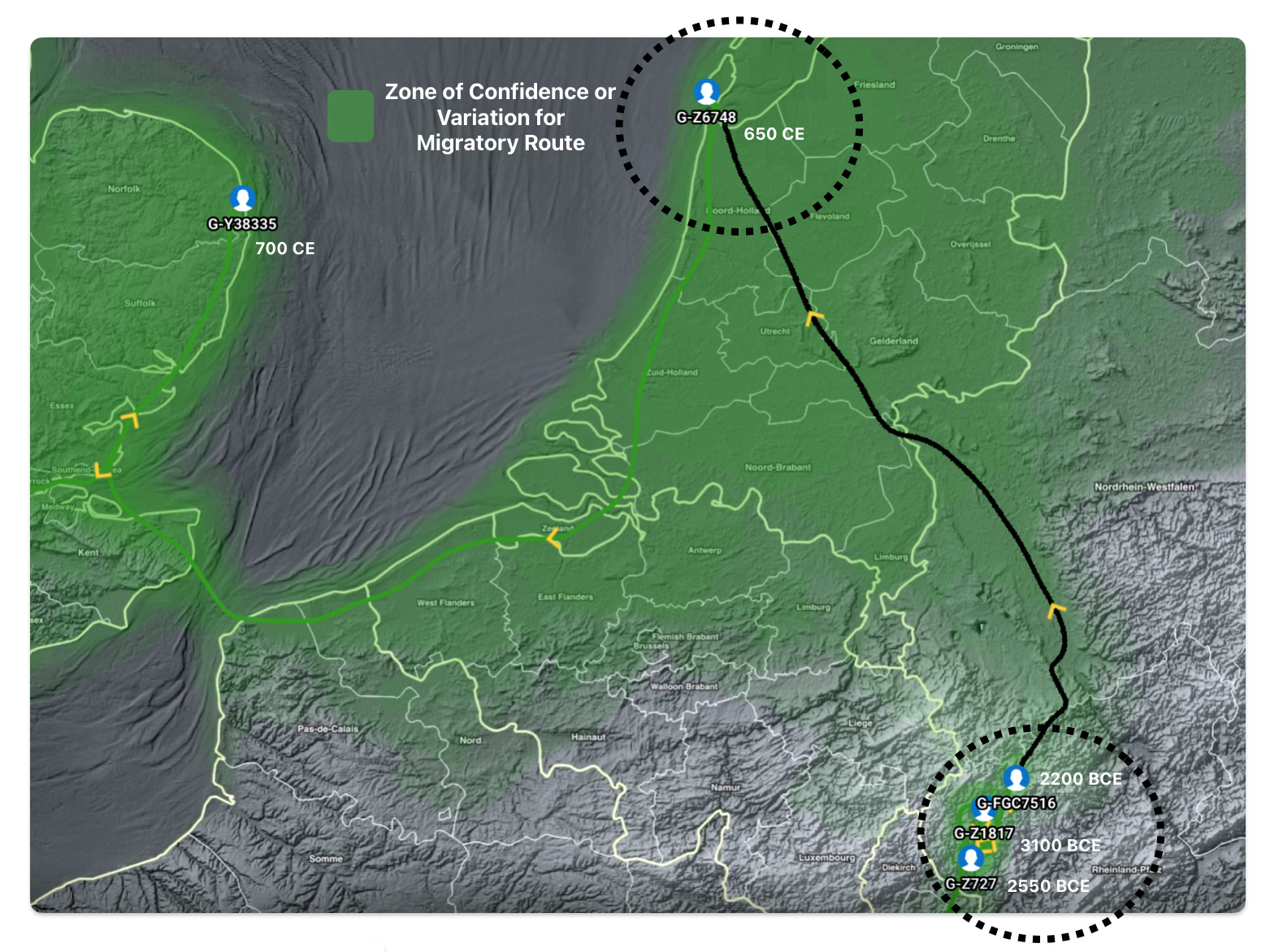


This story focuses on examining the possible social and cultural groups that generations of ancestors of the Griff(is)(es)(ith) paternal line may have been associated with between 500 BCE and 650 CE (see illustration one). The absence of identified subclades associated with the Griff(is)(es)(ith) YDNA line between 500 BCE and 650 CE may have been influenced by:
- The effects of persistant intergenerational interaction between different social and cultural groups in the watershed area as well as larger, regional influences on material cultural practices ;
- The effects of Roman occupation and being close or on the Roman frontier border;
- The late-Roman social and demographic collapse;
- Continued Germanic and Celtic tribal conflict and interaction; and
- The impact of the early medieval era.
The Meuse–Rhine watershed between roughly 500 BCE and 650 CE stands out historically for its continuity amid cultural, demographic, and environmental transformations. It served as a geographic frontier zone between the Celtic, Roman, and early Germanic worlds — absorbing influences from all three while maintaining a distinctive stability and unique characteristics in settlement patterns and local identity. [1]
The area’s role as a ‘contact or frontier zone’ fostered YDNA admixture, but local social structure and kinship patterns (small, isolated communities) reinforced lineage continuity and limited the founder effects of incomers, including Celtic elites and Roman-era groups. Classic Steppe and Bell Beaker Y-DNA variants (R1b-M269, R1a) became dominant, but local G2a and I2a lineages remained detectable yet were minority haplogroups, reflecting both demographic replacement and niche preservation of indigenous male lines.
The Meuse–Rhine watershed’s geographic and social distinctiveness, combined with successive waves of cultural contact, strongly shaped the phylogenetic architecture of local Y-DNA lineages during the first millennium BCE–CE. This impact is visible in unique haplogroup gaps, persistent subclades, and long and narrow branching structures in population genetic studies and ancient DNA results. [2]
A Geographical Frontier Zone Amidst A Mosaic of Local and Regional Tribes
The overarching archaeological culture that directly succeeded the Hallstatt culture in the Meuse–Rhine area after 450 BC was the La Tène culture, which marked the Late Iron Age in this region. While this cultural phase brought distinctive artistic styles, elite burials, and new forms of material culture, the Meuse Rhine watershed area was on the northern fringes of the supra-regional La Tène culture. Documented research shows significant differences in social structure, settlement patterns, material culture, and the extent of ‘latènisation‘—the adoption of La Tène elements in the Meuse Rhine watershed area. These contrasts are evident in archaeological, burial, and material evidence, shaped by both local traditions and selective appropriation of core La Tène forms (seeillustration one). [3]
Illustration One: The La Tène Culture Circa 400 BCE – 1 CE | See Full Map [4]

The La Tène culture began to decline in the mid-first century BCE, primarily due to the Roman conquest of Gaul, which led to the collapse of many Celtic societies. This process was gradual, with some regions experiencing a decline as early as the 80/70 to 50/40 BC period, while 50/30 to 15 BCE marked the final end in areas like the Roman conquest of Gaul. [5]
Illustration Two: Celtic and Germanic Tribes and the Approximate Migratory Path of the Griff(is)(es)(ith) Paternal YDNA Line – See Full Map [6]

After the La Tène period, the region saw the emergence of local Late Iron Age tribal groups (see illustration two), eventually followed by the integration into the Roman world of the Roman Empire. By the end of the La Tène period, a mosaic of regional and local tribes or peoples became visible in the archaeological record, including groups like the Eburones, Tungri, and others (see illustration three). These groups maintained local traditions but in many cases adopted aspects of La Tène art and burial practices, while also developing their own distinctive settlement and funerary patterns. [7]
Illustration Three: The Germanic Tribal World in the Meuse Rhine Watershed Area Between 50 BCE – 300 CE – See Full Map [8]

From the Late Iron Age onward, the Meuse–Rhine region was part of the northwestern edges of the La Tène cultural sphere yet it already exhibited hybridization between Celtic and northern Germanic traditions by 200 BCE – 50 BCE. After Roman incorporation around the first century BCE, the area became the empire’s frontier and a network of forts, river ports, and villa landscapes was established along the Lower Rhine and Meuse rivers (see illustration four). Despite frequent flooding, deltaic instability, and shifting river courses, Roman engineers adapted to the environment, stabilizing levees and settling dynamic meander zones successfully until Late Antiquity. [9]
Illustration Four: THe Migratory Path and the Northern Roman Territory Border: Location of Roman Legionary Fortresses (large squares) and of Attested and Presumed Smaller Forts (small squares) on the Left Bank of the River Rhine

After a strong demographic peak during the Middle Roman Period (c. 264–133 BCE), the region experienced a population decline between the third and fifth centuries CE, attributed to Roman military withdrawal, climatic deterioration, and the sixth‑century crisis affecting northwestern Europe. [10] Yet reoccupation began by the seventh century with the emergence of Merovingian settlements and metalworking centers (illustration five). [11]
Illustration Five: Map of the Rise of Frankish Empire, from 481 to 814 CE

The Meuse–Rhine region formed the core of the Frankish and Merovingian frontier zone, uniting former Romanized communities with incoming Frankish settlers. Following Clovis’s conversion to Catholic Christianity (493 CE), this area became pivotal in uniting Gallo‑Roman and Germanic populations within one polity and fostering early medieval Christianization. Culturally, this integration preserved late Roman administrative infrastructure while nurturing early medieval innovation in crafts, metallurgy, and trade. [12]
The Impact of the River Watershed From 450 BCE Onward
River landscapes such as the Meuse and the Rhine rivers continued to serve as ritual burial sites and where archaeolgoical areas and articfacts have documented the boundaries for communities where generations of the Griff(is)(es)(ith) paternal line of descendents may have lived. Prior to and during the Roman era in the Meuse–Rhine watershed area the region was inhabited primarily by local Celtic and Germanic groups whose material culture was strongly affected by the Roman presence, alongside the development of Romanized settlements and military infrastructure. After the Roman era, the area transitioned to dominate Germanic cultures, most notably the Franks and Frisians, who established new forms of settlement and social organization throughout the Early Middle Ages (see illustration six).
As mentioned in prior parts of this story (see the side bar list of related stories), the environmental conditions may have had a major impact on the dearth of discovered ancient DNA (aDNA) associated with the family paternal line.
Large-scale deforestation for agriculture in the Rhine basin began during the Bronze Age, increasing the amount of sediment delivered to the Meuse Rhine delta. By the Roman era (2000 years ago), sediment loads had nearly doubled. [13]
Between 500 BCE and 650 CE, the Rhine-Meuse watershed experienced significant, albeit gradual, changes to its river courses, primarily driven by avulsion (river switching channels), sea-level fluctuations, and early human interventions. The delta region saw the most dramatic shifts, with the Rhine’s mouth and main branches moving southwards before human activity, particularly around the Roman and early medieval periods, began to influence its path, eventually leading to the modern deltaic configuration. [14]
The extensive and complex Rhine-Meuse delta was highly dynamic, with rivers frequently avulsing and changing their courses. The foundations for later, more drastic human interventions were laid by the Romans and subsequent early medieval powers.
Julius Caesar crossed the Rhine, and under the emperor Augustus, the river formed the boundary of Roman Gaul and later the Roman Empire’s frontier (the limes). After the disintegration of the Western Roman Empire, Germanic tribes crossed the Rhine, and the river became the axis of the Frankish kingdom and the Carolingian Empire. [15]
The 2,850 year Gap between G-FGC7516 and G-Z6748: The most common recent ancestor associated with G-FGC7516 was born around 2200 BCE. The next genetic ancestor on the Griff(is)(es)(ith) YDNA line was associated with the genetic SNP mutation defining the G-Z6748 haplogroup, 2,850 years later. This gap of undocumented YDNA ancestors represents about 95 generations.

- Looking at the Griff(is)(es)(ith) Y-DNA Phylogenetic Gap Associated with the Meuse and Rhine River Watershed from the Bronze Age Onward – Part Five October 8, 2025
- Looking at the Griff(is)(es)(ith) Y-DNA Phylogenetic Gap Associated with the Meuse and Rhine River Watershed from the Bronze Age Onward – Part Four September 21, 2025
- Looking at the Griff(is)(es)(ith) Y-DNA Phylogenetic Gap Associated with the Meuse and Rhine River Watershed – Part Three August 29, 2025
- Looking at the Griff(is)(es)(ith) Y-DNA Phylogenetic Gap Associated with the Meuse and Rhine River Watershed – Part Two July 29, 2025
- Looking at the Griff(is)(es)(ith) Y-DNA Phylogenetic Gap Associated with the Meuse and Rhine River Watershed – Part One June 30, 2025
Illustration Six: The Rhine River Catchment Area

The Challenge of Estimating the Migratory Path of Ancestors and Corrrelating Associated Socio-Cultural Transformations
As indicated in the first part of this multipart story, the estimated migratory path between haplogroup G-FGC716 and haplogroup G-Z6748, the two endpoints associated with this phylogenetic gap, was visually structured through the use of the FamilyTreeDNA Globe Trekker program. The FamilyTreeDNA GlobeTrekker program is a visualization tool that is part of the company’s Discover platform, designed to reconstruct and map the paternal lineage migration routes. The GlobeTrekker program integrates data from ancient and modern Y‑DNA lineages and known haplogroup distributions through time. Geological and climatic factors (e.g., Ice Age glaciation, coastlines, and elevation) are incorporated in the mapping process and ‘least-cost path algorithms’ are used to infer feasible migration corridors.
In FamilyTreeDNA’s GlobeTrekker system, corridor paths represent least-cost migration corridors (LCCs) — probabilistic zones indicating the most likely routes Y-DNA lineages followed between ancestral haplogroup locations. Corridor paths are derived from Least Cost Path (LCP) and Least Cost Corridor (LCC) modeling, adapted from landscape genetics methods published in Heredity. The algorithm uses environmental data and ancient geography to estimate ancestral movement across time. [16]
Corridors are probabilistic bands that show how certain the model is about each migration path’s location. Within GlobeTrekker’s map, these corridors visually illustrate where lineages most likely traveled through time rather than a single deterministic line. They include three levels:
- 95% likelihood zone (narrowest, highest confidence);
- 96.6% likelihood zone; and
- 98.3% likelihood zone (widest, lowest confidence).
Illustration Seven: Estimated Migratory Corridor Path between Haplogroup G-FGC716 and Haplogroup G-Z6748

As reflected in illustration seven, the estimated likelihood zone of the migratory path of the approximately 95 generations or so associated with the Griff(is)(es)(ith) paternal line significantly widens as the migratory path approaches the area that is presently known as the Netherlands. The variance of the estimated migratory path is significant in context of the historical changes that occurred in this geographical area between the estimated birth of the most recent common ancestors associated with the two haplogroup endpoints of this migratory gap. Moreover, we do not know the rate of migration of the generations of ancestors between the two known haplogroups.
Illustration Eight: Birth Estimate of Most Common Recent Ancester Associated with Haplogroup G-Z6748

As depicted in illustration eight, it is estimated that the ancestor that marks the endpoint of this phylogenetic gap, a male descendant who represents the G-Z6748 haplogroup, was born around 668 CE.
There is a 95 percent chance of certainty that he was born between 380 – 908 CE.
While a probability range of roughly six hundred years is relatively small when analyzing long term genetic genealogical time, a lot happended socially and culturally between this particuar time period in this area. Between 380 and 900 CE, the Meuse–Rhine watershed underwent profound sociocultural transformation—from the collapse of Roman frontier society to becoming a core region of the Carolingian Empire. Archaeological, textual, and environmental evidence reveal successive phases of abandonment, resettlement, and social reorganization that reshaped landscape use, political structures, and identities.
In the late fourth to fifth centuries, Roman authority in the Lower Rhine basin disintegrated. Forts (castella) such as those at Rijswijk (Levefanum), Utrecht (Traiectum), and Nijmegen decayed or were sporadically reused, reflecting the retreat of Roman imperial administration and the shifting Rhine frontier. [17] Many villa estates were abandoned, while remaining settlements like De Geer near Wijk bij Duurstede survived through adaptation, sometimes retaining local elites aligned with late Roman or foederati systems. The Lower Rhine increasingly became a liminal zone between Latin and Germanic worlds, and frontier militarization gave way to hybrid Romano‑Frankish communities. [18]
As the Roman infrastructure waned, new Frankish rural systems emerged between 500 and 700 CE. Surviving agrarian communities reorganized around riverine transport routes and residual Roman field systems, shifting from a large-scale, tax-driven economy to a localized and more self-sufficient one. Material culture reflected a distinctive but regionally interlinked society stretching from the Lower Rhine to northern Gaul. [19]
By the mid‑seventh century the Meuse–Rhine delta re‑emerged as a central trade hub, epitomized by Dorestad at the Rhine‑Lek bifurcation. Dorestad’s rise was closely tied to its maritime accessibility and Carolingian political control. It became one of the chief areas connecting the North Sea, the Rhineland, and Francia. Settlements were organized into farm complexes and elite demesnes, replacing Roman villas. [20]
By the eighth century, the Meuse–Rhine heartland shifted from a former Roman periphery to the political and economic nucleus of the Carolingian world. Aristocratic estates and monasteries structured rural production and governance, while trading towns like Dorestad, Maastricht, and Cologne stimulated regional prosperity. [21]
If the most recent common ancestor was indeed born around 600 CE, the Meuse–Rhine watershed area was undergoing the consolidation of Merovingian power and a gradual recovery from the disruptions of the fifth and early sixth centuries. Archaeological and textual sources indicate renewed settlement density, economic reactivation, and hybridization between remaining Roman‑provincial populations and incoming Frankish elites.
By 600 CE, Merovingian rulers—descended from Clovis—had stabilized much of northern Gaul, including the Lower Rhine zone, under Frankish administration. The Rhine delta, which had been partially depopulated after the Roman withdrawal, began to see repopulation by agrarian communities. The Merovingian elite, particularly from Ripuarian Cologne, actively reclaimed the Lower Rhine frontier to restore control and reopen trade routes to the North Sea. [22]
The Meuse–Rhine delta was a contact zone between Franks and Frisians. Around 600 CE, Merovingian–Frisian competition intensified along northern Rhine branches, setting the stage for political and military encounters throughout the seventh century. Trade and cultural flows—especially imports of Rhineland and Anglo‑Saxon products—point to integration into broader North‑Sea exchange networks. [23]
So, in a nutshell, it is a challenge to pinpoint the general birth date of a most common recent ancestor associated with an haplogroup. It is equally challenging to isolate and correlate social and cultural associations with the genetic migratory path of ancient YDNA ancestors. However, it is plausible to assume that these profound ecological, demographic and sociocultural transformations during this time period had a negative impact on the phylogenetic tree of the Griff(is)(es)(ith) paternal line.
Emergence of and Interaction Between Celtic and Germanic Groups
“The term ‘Celts’ is commonly used to refer to peoples who lived in Iron Age Europe north of the Mediterranean region prior to the Roman conquest after ancient writers gave them that name. However, it is a problematic label. This is because these peoples were not part of a unified state but, rather, belonged to a multitude of tribes, many of which had no direct contact with each other. The term remains useful for its convenience but it does disguise the complex relations between different western and central European tribes, the overlapping of some cultural features in time and space, and the isolation and uniqueness of other such features.” [24]
Scholars have questioned the extent to which the label “Celtic” was used by the populations it describes, highlighting that ancient Greeks and Romans tended to group a wide variety of distinct tribes and cultures under broad umbrella categories for administrative, literary, or political convenience. Similarly, “Germanic” has been shown to be a Roman construct that grouped together various northern and central European peoples regardless of their real linguistic or cultural affiliations. [25]
Archaeological cultures in Europe have often been defined on the basis of material remains—such as pottery styles, burial practices, and settlement patterns—rather than clear ethnic or linguistic boundaries. Linguistic labels, on the other hand, are reconstructed from historical sources, place-names, and comparative studies of ancient and modern languages. This means that the two kinds of groupings often do not map neatly onto one another, and historical populations may not have corresponded at all to the categories modern scholars use.
Many studies highlight the dangers of simplistic equations between archaeological cultures and linguistic or genetic groups. Archaeologists and linguists frequently warn that shared material culture does not necessarily indicate a common language or ethnic identity. Examples include debates over the spread of Indo-European languages vs the archaeological distribution of the Corded Ware and Bell Beaker cultures, or the uncertainty in aligning Celtic language spread with “Celtic” archaeological finds. [26]
Recent scholarship increasingly advocates for interdisciplinary methods that combine archaeological, linguistic, and genetic data—while stressing that none of these should be treated as a proxy for ethnicity or identity in isolation. More critical approaches highlight local and network-based correlations, and recommend cautious interpretations that avoid the pitfalls of equating ‘culture’ with ‘people’ with ‘language’ models. [27]
In the context of and understanding of how these terms are used, the emergence of Germanic and Celtic tribal groups in Europe was closely intertwined, both chronologically and geographically. The two general ‘regional traditions’ arose from related Indo-European populations and diverged culturally and linguistically during the Early Iron Age, roughly between 1200 and 500 BCE, with continuous interaction along their frontier zones – one of frontier zones was the Meuse Rhine watershed area. [28]
This broad historical and geographical trajectory of cultural traditions and tribal groups may have had an impact on the absence of documented haplogroups associated with the migratory route of the Griff(is)(es)(ith) YDNA genetic line. The migatory path was in a contested corridor between these two broadly defined group of Celtic and Germanic tribal groups.
The Celtic Hallstatt culture (c. 800–450 BCE) developed in southern Germany, Austria, and Bohemia, while the Germanic Jastorf culture (c. 600–100 BCE) arose just to the north, in northern Germany and southern Scandinavia. The two regions formed a ‘cultural gradient‘ rather than a sharp border, sharing technological traits like iron smelting, cremation burial customs, and long-distance trade networks in amber, salt, and metals. [29]
Archaeological evidence shows that Celtic influence reached into the Jastorf area, visible in imported ornaments, pottery styles, and burial rites influenced by Hallstatt and later La Tène cultures. In contrast, northern exchange routes supplied amber and hides to Celtic regions. This reciprocal contact facilitated mutual innovation in material culture, especially during the sixth to fourth centuries BCE. [30]
Along this borderland, a “Celto-Germanic” hybrid population developed through both trade and occasional conflict. The material culture of tribes in these areas was influenced by both groups, blurring the lines between what is considered distinctly Celtic or Germanic in the archaeological record. [31]
Both groups ultimately stemmed from late Bronze Age Indo-European societies descending from the Corded Ware and Bell Beaker horizons, but linguistic divergence preceded ethnic differentiation. Proto-Celtic tribal groups likely developed by 1200–1000 BCE within the Urnfield–Hallstatt cultural sphere. The Proto-Germanic tribal groups took shape later, around 750–500 BCE, in the Nordic region. Genetically, both populations retained a similar mix of steppe-derived and Neolithic farmer ancestries, but Germanic communities show stronger continuity from northern Bronze Age groups. [32]
Illustration Eight: Celtic and Germanic Tribes Before Roman Expansion – See Full Map [33]

As the Roman Empire expanded, some Celtic tribes were linguistically or culturally assimilated by the more dominant Germanic peoples in central Europe. This was a long-term process, but it began with the close interactions of the pre-Roman Iron Age. [34]
Rather than representing two distinct, static populations, the labels of ‘Celtic’ and ‘Germanic’ refer to linguistic and cultural groups that coexisted, interacted, and intermingled over time, particularly along their shared borders.
Genetic evidence from Iron Age graves in southern Germany shows broad ancestral ties extending from Iberia through Central Europe, reflecting complex migration patterns and contact, especially among elite strata, rather than a single, isolated “Celtic” population. [35]
By the late Iron Age (third to first centuries BCE), demographic and cultural shifts began to favor Germanic expansion into formerly Celtic territories along the Main, Weser, and Rhine rivers. Regions like Thuringia and Franconia reveal mixed La Tène and Jastorf assemblages, representing hybrid communities of Celtic origin assimilating into emerging Germanic societies. This frontier dynamic persisted into Roman times, when Roman ethnographers distinguished “Germani” from “Celts,” though much of the population retained overlapping ancestry and traditions. [36]
During the Iron Age, Celtic–Germanic frontier zones formed a long and dynamic belt of interaction stretching across northern and central Europe, roughly from the Lower Rhine basin eastward through Thuringia and up toward the Elbe–Saale–Weser–Main river systems. These areas were culturally mixed, economically interconnected, and archaeologically distinct from either pure La Tène or Jastorf core regions. [37]
Research comparing Celtic and Germanic tribal social structures from 400 BCE to 5 BC reveals several notable similarities and contrasts, particularly in systems of hierarchy, leadership, social stratification, and identity. Both groups were complex, multifaceted, and regionally variable, but they displayed distinct tendencies in elite organization, kinship, and integration of outsiders. [38]
Archaeological evidence for social stratification in Celtic and Germanic societies is primarily revealed through burial practices, settlement patterns, and material culture, highlighting both significant differences and regional similarities in how elites and commoners were distinguished. [39]
Both societies featured patron-client or lord-vassal relationships, where powerful individuals commanded loyalty and provided protection in return for service and tribute, resembling later feudal systems. [40] Celtic tribes were stratified with a clear hierarchy: rulers or kings (sometimes queens), an elite warrior class, religious and intellectual specialists (notably druids), artisans, traders, farmers, and slaves. [41] Germanic tribes developed pronounced social stratification somewhat later, moving from originally more egalitarian structures toward clearer divisions between elites and commoners under Roman influence. Eventually, a nobility emerged as certain individuals rose in status. [42]
Celtic leadership usually involved monarchs or aristocratic families; some tribes had dual kingship or were governed by councils of elders, particularly in regions with Roman contact. [43] Germanic leadership was often patriarchal and clan-based, with chieftains or kings elected from among leading lineages. Over time, leading chieftains in larger confederations acquired more centralized power, often as a response to external pressures (notably Rome). [44] Celtic leaders maintained legitimacy through the redistribution of war booty, hosting feasts, and lavish gift-giving to followers. Germanic chieftains similarly relied on charismatic leadership and personal loyalty, especially among warrior retinues. [45]
Both cultures placed high importance on kinship, though in the Germanic context, clan and lineage ties were especially strong, underlying most social bonds and obligations. In both cases, social mobility was possible primarily through valor or acquisition of wealth, but position was strongly linked to birth, kin, and personal achievements. [46]
Archaeological and linguistic evidence reveals considerable sharing and adaptation between La Tène (Celtic) and Jastorf (Germanic) groups, such as similar warrior aristocracies, settlement forms, and ritual practices. Despite interaction, religious and intellectual specialization (like druids) remained distinctly Celtic, while Germanic societies had evolving priestly roles but less formalized intellectual classes in this period. [47]
Celtic communities varied from fortified hilltop settlements (oppida) to dispersed rural villages, with considerable urbanization in core Hallstatt and La Tène regions. Germanic peoples were mostly rural and village-based, gradually forming larger confederations and showing increasing social complexity by the end of the Iron Age. [48]
Table One: Summary of Celtic and Germanic Characteristics
La Téne Culture: An Overarching Regional Influence
Around 400 BCE, Celtic tribes were dominant in Western and Central Europe, spanning from the British Isles through Gaul and into parts of Central Europe and the Balkans. Germanic tribes, though less defined and widespread at this exact time, were emerging from the Nordic region and northern Germany, and were gradually moving southwards.
The Germanic tribes became more prominent in the following centuries, but at 400 BCE, they were still a distinct but developing cultural and linguistic group in the north. Major tribes under the La Tène cultural umbrella included, among others, the Parisii, Belgae, Aedui, Helvetii, Boii, Volcae, and Celtiberi. They were known for the Hallstatt and La Tène cultures and had a sophisticated societal structure with numerous independent communities. [49]
The La Tène culture existed from approximately 450 BCE to 50 BCE in Central and Western Europe, although its influence and material culture extended beyond this period. The La Tène culture gradually replaced the Hallstatt culture as the dominant regional material archaeological culture in central Europe. It is often described as the final phase of the European Iron Age. It was eventually succeeded by the Roman conquest in many regions of Europe which led to a decline in the culture (see ilustration nine). [50]
The La Tène culture is considered an archaeological culture. It is defined by a distinct overarching and recurring assemblage of material culture—artifacts and settlement patterns—from a specific time and geographic area during the European Iron Age. In varying degrees depending on geographical location, its material culture overlayed or mixed with local cultures.
Illustration Nine: La Tène Culture (Iron Age c 400 BCE – 50 BCE)

During the 4th century BCE, La Tène groups, often identified with the Celts, began to migrate and expand in all directions. This led to Celtic settlements and influence stretching across a vast area, from Ireland in the west to Hungary in the east.
“Though there is no agreement on the precise region in which La Tène culture first developed, there is a broad consensus that the centre of the culture lay on the northwest edges of Hallstatt culture, north of the Alps, within the region between in the West the valleys of the Marne and Moselle, and the part of the Rhineland nearby.” [51]
The periodization of the La Tène culture evolved from an early division into three stages (Early, Middle, and Late) based on metalwork typology by Tischler [52] , to more detailed schemes to reflect regional differences and the impact of Roman expansion see table one). The four major archaeological periods of the La Tène culture—La Tène A, B, C, and D—are defined using artifact typology, funerary customs, and evolving contact with neighboring cultures. [53]
Table Two: The Periodization of the La Tène “Core” Culture [54]
| Tischler (1885) | Reinecke (102) | Approximate Dates | Achaeological Characteristics |
|---|---|---|---|
| Early La Tène I | La Tène A | 450–380 BCE | The earliest phase is marked by elite burials (“chieftain graves”) with imported Mediterranean and Etruscan items, bronze vessels, and distinctive sword types. Funerary customs often include inhumation tumuli. Early La Tène art features S-shaped and curvilinear motifs. |
| Early La Tène I | La Tène B | 380–250 BCE | This period brought widespread adaptation across a broader area, with more developed cemeteries and high-status grave goods, including horse trappings and advanced metalwork. There is some shift toward regional pottery and local material culture. The art style, such as the Waldalgesheim style, evolved with floral and flowing patterns. |
| Middle La Tène II | La Tène C | 250–150 BCE | The Middle La Tène phase is characterized by changes in settlement organization, intensification of trade, and broader adoption of La Tène styles in peripheral regions. Graves emphasize weaponry and personal adornments, including ornate brooches. It is a period marked by significant ‘proto-Celtic’ migrations and expansion into new territories, including Italy and the Balkans. Regional variation increased, and evidence of large-scale feasting and elite consumption became more widespread, with an increase in imported Roman goods. |
| Late La Tène III | La Tène D | 150–1 BCE | The Late La Tène period shows signs of increasing Roman influence before direct conquest, with mixed finds in settlements and cemeteries. There is heightened regional variability, and in some places, cremation returns as a dominant funerary practice. Settlement evidence becomes more abundant, and defensive structures or proto-urban centers arise in key locations. This is a period of the oppida, or large fortified settlements, and increased pressure from the expanding Roman Empire. The Roman conquest of Gaul ultimately ended the traditional La Tène culture. |
Recent isotope studies that are part of the field of bioarchaeology have expanded the understanding of the Hallstatt to La Tène social transition by documenting patterns of individual mobility, dietary distinctions connected to social status, and providing nuanced insights into the social structural kinship patterns during the Early Iron Age. [55] (See sidebar discussion on bioarchaeological analysis).
Isotope analyses reveal considerable regional mobility among high-status individuals in the Hallstatt and La Tène periods. Several studies in southern Germany and northwestern Bohemia show that some elite burials include individuals whose isotope signatures differ from local geograhical baselines, indicating non-local origins and long-range connections. Notably, male warriors often display non-local isotope values, suggesting patterns of male migration or fosterage, while female burials tend to reflect local isotope signatures. This pattern supports the interpretation of elite families maintaining far-reaching alliances and exchange networks, consistent with evidence of regional social organization and dynastic succession among early proto-Celtic elites [57]
Isotope studies help identify males of nonlocal origin, consistent with warriors or relocated leaders, while local isotope signatures in females point to patrilocal kinship practices. This matches written accounts and archaeological data on military strata, the rise of new priestly groups, and increasing social complexity, often documented by funerary evidence and dietary markers. [58]
Recent studies indicate that isotope analyses of Hallstatt and La Tène burial sites generally find more nonlocal males (sometimes interpreted as evidence of mobility for warriors or elite relocated leaders) and local signatures in females, supporting classical models of patrilocality and patrilineal descent. The new ancient DNA and pedigree studies from the core area of these cultures reveal patterns consistent with avuncular (uncle-nephew) relationships and matrilineal transmission among elite lineages, reconciling apparent contradictions between isotope and genetic data (see side bar discussion on matrilineal kinship systems). [59]
While these studies provide compelling findings. There are acknowledged limitations to their studies. These gaps highlight the need for further multidisciplinary studies (aDNA, isotope, archaeological context) from other regions, population segments, and periods to test how widely the southern German Hallstatt mode of succession applied to other geographical areas. [60]
The core La Tène zones—centered in what is now France, Switzerland, southern Germany, Austria, and the Marne-Moselle—exhibited hierarchical social structures with clear differentiation between elites, religious classes (such as Druids), artisans, and commoners. Elite power was visible through lavish burials, rich metalwork, and the emergence of fortified towns (oppida). Urbanization and coinage use accelerated, and ritual sanctuaries became collective centers.
Social organization was tribally based with ruling chieftains, sometimes sacral kingship, and evidence of intertribal relations or confederacies in periods of crisis. Symbolic and ritual artifacts—especially decorated weapons and pottery—marked status, cross-regional ties, and belief systems.

Bioarchaeological Analysis

Isotope genetic studies of ancient DNA combine isotopes (chemical signatures in bones and teeth) and ancient DNA analysis to reconstruct the history of ancient populations by tracking migration, diet, and social structures. Isotopes reveal a person’s diet and geographical origin by showing the water and bedrock they were exposed to, while DNA analysis provides information on their genetic ancestry and relationships. Together, they offer a more comprehensive picture than either method can alone.
Scientists analyze the stable isotopes of elements like strontium and oxygen found in bones and teeth. As a tooth or bone forms, it locks in an isotopic snapshot of the water and local geology wherne the individual lived. Strontium isotopes are particularly useful for tracking movement, as different regions have different strontium signatures. By analyzing multiple teeth or bones from one person or comparing samples from a large sample size of individuals, researchers can map migration patterns over a lifetime or across a population. By combining genetic data on family relationships with isotope data on mobility, researchers can understand patterns of social organization and kinship. [56]
Impact of Matrilineal Kinship Systems on YDNA Phylogenetic Trees

Matrilineal kinship systems tend to increase local Y-chromosome diversity and diminish clustering of YDNA lineages within social groups, which directly affects the structure of YDNA phylogenetic trees by preventing pronounced bottlenecks and line-specific founder effects that are typical of patrilineal societies.
When interpreting ancient or modern YDNA trees, groups with matrilineal or matrilocal histories will show less clustering and higher branch diversity that cannot be explained by simple population size changes or geographic isolation alone. Instead, demographic events like migration, exogamy, and social organization must be considered, since these kinship systems maintain phylogenetic spread, and can even mask evidence of social structure if only YDNA trees are used without integrating mtDNA or archaeological context.
Read more on The Impact of Matrilineal Kinship Systems on YDNA Phylogenetic Tree Patterns
Archaeologist Nico Roymans, in his article, “On the latènisation of Late Iron Age material culture in the Lower Rhine/Meuse area”, examined how La Tène-style artifacts and cultural patterns were adopted and adapted in the Meuse Rhine Watershed area during the later La Tène ‘D’ period. The process of “latènisation” is not characterized by a simple, uniform adoption from the La Tène core, but by the local reinterpretation and hybridization influenced by indigenous traditions. The study documents significant diversification in material culture in the Lower Rhine/Meuse area during the late La Tène period, illustrating regional differences shaped by both external La Tène influence and enduring local practices. [61]
By contrast, archaeological evidence for the Meuse-Rhine watershed throughout the four La Tène eras (Early, Middle, Late, Final) reveals much less hierarchical complexity and limited elite display. Oppida and major fortified settlements are almost absent, with undifferentiated settlement patterns dominating the archaeological record. Burial rites remained simple, displaying low degrees of social stratification and fewer high-status grave goods. Collective sanctuaries—central to the core regions—were rare, with cult centers often sited in forests rather than urbanized loci. Studies show ongoing debate whether the weak presence of La Tène material forms resulted more from limited ‘latènisation’ (slow adoption of core styles) or entrenched local traditions.
Recent targeted studies in the Lower Rhine and Meuse regions describe the process of ‘latènisation‘ during the later La Tène periods: a selective and uneven integration of La Tène artifacts, with local societies putting distinctive interpretations on Mediterranean-derived motifs and artifacts. Metal detection and grave finds highlight how regional practices shaped and constrained cultural adoption. Social change in the Meuse-Rhine watershed lagged behind core areas, with most notable transformation only after the Roman conquest. [62]
Table Three: Differences between Core La Tène Areas and the Meuse Rhine Watershed Area
The Next Part of this Story
The next part of this story will discuss the impact of the Roman Era on Celtic and Germanic groups that occupied the Meuse Rhine watershed area.
Source:
Feature Banner: The banner at the top of the story features a map of the Meuse and Rhine River watersheds. Overlayed on the map is estimated migratory path of the Griff(is)(es)(ith) paternal YDNA line that is associated with this phylogenetic gap. In addition, various cultures that might be associated with the undocumented generations and their approximate time periods are provided.
[1] Gerlach R, Meurers-Balke J, and Kalis AJ. The Lower Rhine (Germany) in Late Antiquity: a time of dissolving structures, Netherlands Journal of Geosciences, Volume 101, e14. https://doi.org/10.1017/njg.2022.11
Rowin J. van Lanen, Maurice T.M. de Kleijn , Marjolein T.I.J. Gouw-Bouman & Harm Jan Pierik, Exploring Roman and early-medieval habitation of the Rhine–Meuse delta: modelling large-scale demographic changes and corresponding land-use impact, Netherlands Journal of Geosciences — Geologie en Mijnbouw, 97 – 1–2 , 45–68, 2018, doi:10.1017/njg.2018.3, https://dspace.library.uu.nl/bitstream/handle/1874/368285/exploring_roman_and_earlymedieval_habitation_of_the_rhinemeuse_delta_modelling_largescale_demographic_changes_and_corresponding_landuse_impact.pdf?sequence=1&isAllowed=y
[2] See for example:
S. Sasso, L. Saag, R. Spros, et al., Capturing the fusion of two ancestries and kinship structures in Merovingian Flanders, Proc. Natl. Acad. Sci. U.S.A. 121 (27) 2024, e2406734121 https://doi.org/10.1073/pnas.2406734121
Olalde I, Altena E, Bourgeois Q, Fokkens H, et al. . Long-term hunter-gatherer continuity in the Rhine-Meuse region was disrupted by local formation of expansive Bell Beaker groups. bioRxiv [Preprint]. 2025 Mar 25:2025.03.24.644985. doi: 10.1101/2025.03.24.644985. PMID: 40196638; PMCID: PMC11974744. (PubMed) https://pubmed.ncbi.nlm.nih.gov/40196638/
Altena, Eveline, Smeding, Risha, van der Gaag, Kristaan J., de Leeuw, Rick,H., Vaske, Eileen, Reusink, Paul, Diekmann, Yoan, Thomas, Mark G., de Kniff, Peter, The dutch Y-chromosome from the early middle ages to present day. Archaeol Anthropol Sci 17, 116 (2025). https://doi.org/10.1007/s12520-025-02224-4
What Ancient DNA Reveals About the Medieval Population of the Low Countries, Mediievalist.net, https://www.medievalists.net/2025/05/ancient-dna-low-countries/
[3] Roymans, Nico, On the latènisation of Late Iron Age material culture in the Lower Rhine/Meuse area, 99-114 in Jacqueline Cession-Loppe, ed, Les Celtes Aux Racines De L’Europe, Musée royal de Mariemont, Jun 2009, https://www.academia.edu/12290971/2009_On_the_latènisation_of_Late_Iron_Age_material_culture_in_the_Lower_Rhine_Meuse_area
Roymans N. Social change in the Late Iron Age Lower Rhine region. In: Ethnic Identity and Imperial Power: The Batavians in the Early Roman Empire. Amsterdam University Press; 2004:9-22. https://resolve.cambridge.org/core/books/abs/ethnic-identity-and-imperial-power/social-change-in-the-late-iron-age-lower-rhine-region/292A13C08E7EC83D03E48BD4673CD4FC
Le Tène Culture, This page was last edited on 13 October 2025, https://en.wikipedia.org/wiki/La_Tène_culture
[4] The original Map of the Tène Culture:

[5] La Tène Culture, Wikipedia, This page was last edited on 13 October 2025, https://en.wikipedia.org/wiki/La_Tène_culture
[6] The original map:

[7] List of ancient Celtic peoples and tribes, Wikipedia, This page was last edited on 20 October 2025, https://en.wikipedia.org/wiki/List_of_ancient_Celtic_peoples_and_tribes
Germanic peoples, Wikipedia, This page was last edited on 17 October 2025, https://en.wikipedia.org/wiki/Germanic_peoples
Eburones, Wikipedia, This page was last edited on 14 October 2025, https://en.wikipedia.org/wiki/Eburones
Tungri, Wikipedia, This page was last edited on 7 August 2025, https://en.wikipedia.org/wiki/Tungri
[8] The original map of the major Germanic tribes during the Roman era:

[9] H.J. Pierika, E. Stouthamera, K.M. Cohen, Natural levee evolution in the Rhine-Meuse delta, the Netherlands, during the first millennium CE, Geomorphology, 295 (2017), 215-234, https://dspace.library.uu.nl/bitstream/handle/1874/352044/Natural.pdf?sequence=1
Pierik, Harm Jan , van Lanen, Rowin, Roman and early-medieval occupation of a delta: settlement dynamics in the Rhine-Meuse delta (The Netherlands), EGU General Assembly 2016, held 17-22 April, 2016 in Vienna Austria, id. EPSC2016-15042, 2016, https://ui.adsabs.harvard.edu/abs/2016EGUGA..1815042P/abstract
Marinus Polak, Laura I. , Kooistra, A Sustainable Frontier? The Establishment of the Roman Frontier in the Rhine Delta Part 1: zfrom the End of the Iron Age to the Death of Tiberius (C.50 BC – AD 37) , Jahrbuch des Römisch-Germanischen Zentralmuseums 60 · 2013 , 355, https://www.academia.edu/12489579/A_sustainable_frontier_The_establishment_of_the_Roman_frontier_in_the_Rhine_delta_Part_1_From_the_end_of_the_Iron_Age_to_the_death_of_Tiberius_c_50_BC_AD_37_2_separate_files_
Gerlach Renate, Meurers-Balke Jutta, and Kalis Arie J. The Lower Rhine (Germany) in Late Antiquity: a time of dissolving structures. Netherlands Journal of Geosciences, Volume 101, e14. https://doi.org/10.1017/njg.2022.11
[10] The sixth-century crisis in northwestern Europe was a period of severe climatic cooling and famine, caused by volcanic eruptions in AD 536 and 540, which triggered widespread crop failure and was followed by the Plague of Justinian. This resulted in significant population decline, reduced agricultural activity, and social and political upheaval across Europe. [a]
Two periods of significant population growth are identified: the middle Roman period (AD 70‑270) and the early medieval period C (AD 725‑950). A striking population decline of 78%-85% occurred in the late Roman period (AD 270‑450), after which population numbers never recovered to previous Roman highs during the remainder of the first millennium AD. Comparative analysis shows similar demographic decline trends in regions including Belgium, Denmark, France, Germany, Italy, and Norway through analogous archaeological data. [b]
Historic population fluctuations in the Rhine-Meuse delta profoundly affected land-use patterns and landscape carrying capacity, with settlement abandonment and later redistribution linked to environmental changes such as flooding and shifting river courses. The precise timing and scale of the post-Roman decline differed across northwest Europe but generally followed a comparable pattern. [c]
The article stresses that future reconstructions must integrate high-resolution archaeological and paleoenvironmental data to produce more robust, nuanced demographic estimates rather than generalizing from limited or indirect proxies.
Population increases in the late 7th century and onwards suggest the gradual recovery of rural settlement, possibly tied to environmental adaptation and socio-political changes, but full recovery to Roman-era levels was never achieved within the first millennium
[10a] Helama, S., Arppe, L., Uusitalo, J. et al. Volcanic dust veils from sixth century tree-ring isotopes linked to reduced irradiance, primary production and human health. Sci Rep 8, 1339 (2018). https://doi.org/10.1038/s41598-018-19760-w
Loftsgarden, K., & Iversen, F. (2024). The Impact Of The 6th Century Crisis – Exploring Burials as a Proxy For Population Dynamics in Iron Age Scandinavia. Norwegian Archaeological Review, 57(2), 105–125. https://doi.org/10.1080/00293652.2024.2412018
Westling, S., Fredh, E. D., Lagerås, P., & Oma, K. A. (2022). Agricultural Resilience during the 6th Century Crisis: Exploring Strategies and Adaptations Using Plant-Macrofossil Data from Hove-Sørbø and Forsandmoen in Southwestern Norway. Norwegian Archaeological Review, 55(1), 38–63. https://doi.org/10.1080/00293652.2022.2071331
Plague of Justinian, Wikipedia, This page was last edited on 20 October 2025 https://en.wikipedia.org/wiki/Plague_of_Justinian
Helama, S., Arppe, L., Uusitalo, J. et al. Volcanic dust veils from sixth century tree-ring isotopes linked to reduced irradiance, primary production and human health. Sci Rep 8, 1339 (2018). https://doi.org/10.1038/s41598-018-19760-w
Brown, Paul, Weatherwatch: the real darkness that blighted the dark ages, 20 Apr 2018, The Guardian, https://www.theguardian.com/news/2018/apr/20/weatherwatch-real-darkness-blighted-dark-ages
Zielinski, Sarah, Sixth-Century Misery Tied to Not One, But Two, Volcanic Eruptions, 8 Jul 2015, Smithsonian Magazine, https://www.smithsonianmag.com/science-nature/sixth-century-misery-tied-not-one-two-volcanic-eruptions-180955858/
Hirschfeld, Yizhar, The crisis of the sixth century: climatic change, natural disasters and the plague, Jan 2006, Mediterranean Archaeology and Archaeometry, 19-32, https://www.researchgate.net/publication/260276141_The_crisis_of_the_sixth_century_climatic_change_natural_disasters_and_the_plague
Harper, K. “How Climate Change and Plague Helped Bring Down the Roman Empire.” Smithsonian. 2017. https://www.smithsonianmag.com/science-nature/how-climate-change-and-disease-helped-fall-rome-180967591/.
Harper, K. The Fate of Rome: Climate, Disease, and the End of an Empire. Princeton University Press, 2017.
Light, J. A. “Was the Roman Empire a Victim of Climate Change?” PBS. 2011. http://www.pbs.org/wnet/need-to-know/environment/was-the-roman-empire-a-victim-of-climate-change/6724/.
McCormick, M., et al. “Climate Change during and after the Roman Empire: Reconstructing the Past from Scientific and Historical Evidence.” The Journal of Interdisciplinary History, vol. 43, no. 2, 2012, pp. 169–220. DOI: https://10.1162/JINH_a_00379 .
Wazer, C. “The Plagues That Might Have Brought Down the Roman Empire.” The Atlantic. 2016. https://www.theatlantic.com/science/archive/2016/03/plagues-roman-empire/473862/.
[10b] Rowin J van Lanen and Bert Groenewoudt, Counting heads: Post-Roman population decline in the Rhine-Meuse delta (the Netherlands) and the need for more evidence-based reconstructions, 113-134, in Niall Brady & Claudia TheuneruraliaI, eds, Leiden: Sidestone Press, 2019, https://www.academia.edu/40523376/Counting_heads_Post_Roman_population_decline_in_the_Rhine_Meuse_delta_the_Netherlands_and_the_need_for_more_evidence_based_reconstructions
[10c] Rowin J. van Lanen, Maurice T.M. de Kleijn , Marjolein T.I.J. Gouw-Bouman & Harm Jan Pierik, Exploring Roman and early-medieval habitation of the Rhine–Meuse delta: modelling large-scale demographic changes and corresponding land-use impact, Netherlands Journal of Geosciences — Geologie en Mijnbouw, 97 – 1–2 , 45–68, 2018, doi:10.1017/njg.2018.3, https://dspace.library.uu.nl/bitstream/handle/1874/368285/exploring_roman_and_earlymedieval_habitation_of_the_rhinemeuse_delta_modelling_largescale_demographic_changes_and_corresponding_landuse_impact.pdf?sequence=1&isAllowed=y
Tobias Heal, Alexandre Disser, Florence Mercier, Guillaume Sarah, Frans Theuws, Hidden riches in the Early Medieval Rhine Delta: Iron working at Merovingian Oegstgeest,
Journal of Archaeological Science: Reports, Volume 53, 2024, 104236, ISSN 2352-409X, https://doi.org/10.1016/j.jasrep.2023.104236 .
(https://www.sciencedirect.com/science/article/pii/S2352409X2300411X )
W.A. van Es, W.J.H. Verwers, Early Medieval settlements along the Rhine: precursors and contemporaries of Dorestad, Journal of Archaeology in the Low Countries 2-1 (May 2010), https://jalc.nl/cgi/t/text/text-idx5416.html, https://www.academia.edu/289177/Early_Medieval_settlements_along_the_Rhine_precursors_and_contemporaries_of_Dorestad_W_A_van_Es_and_W_J_H_Verwers
[11] Franks, Wikipedia, This page was last edited on 17 October 2025, https://en.wikipedia.org/wiki/Franks
Francia, Wilkipedia, This page was last edited on 16 October 2025, https://en.wikipedia.org/wiki/Francia
Salian Franks, Wikipedia, This page was last edited on 10 September 2025, https://en.wikipedia.org/wiki/Salian_Franks
Merovingian dynasty, Wikipedia, This page was last edited on 10 September 2025, https://en.wikipedia.org/wiki/Merovingian_dynasty
[12] The Meuse–Rhine region was a frontier zone, and after the Frankish takeover of Gaul, many Roman administrative and political structures remained intact. The Merovingian Franks adapted the late Roman model of governance. The civitates, or Roman-era territorial districts centered on towns, continued to function as administrative units.
In these districts, the king appointed comites (counts), who had administrative, military, and judicial authority. This system integrated Frankish power into the existing Gallo-Roman structure. The Catholic Church also took over many administrative and legal functions from the Romans, playing a key role in maintaining institutional continuity during the early Middle Ages.
Merovingian dynasty, Wikipedia, This page was last edited on 10 September 2025, https://en.wikipedia.org/wiki/Merovingian_dynasty
Tobias Heal, Alexandre Disser, Florence Mercier, Guillaume Sarah, Frans Theuws,
Hidden riches in the Early Medieval Rhine Delta: Iron working at Merovingian Oegstgeest, Journal of Archaeological Science: Reports, Volume 53, 2024, 104236, ISSN 2352-409X, https://doi.org/10.1016/j.jasrep.2023.104236 .
(https://www.sciencedirect.com/science/article/pii/S2352409X2300411X )
Christianization of the Franks, Wikipedia, This page was last edited on 18 February 2025, https://en.wikipedia.org/wiki/Christianization_of_the_Franks
Rowin J. van Lanen, Maurice T.M. de Kleijn , Marjolein T.I.J. Gouw-Bouman & Harm Jan Pierik, Exploring Roman and early-medieval habitation of the Rhine–Meuse delta: modelling large-scale demographic changes and corresponding land-use impact, Netherlands Journal of Geosciences — Geologie en Mijnbouw, 97 – 1–2 , 45–68, 2018, doi:10.1017/njg.2018.3, https://dspace.library.uu.nl/bitstream/handle/1874/368285/exploring_roman_and_earlymedieval_habitation_of_the_rhinemeuse_delta_modelling_largescale_demographic_changes_and_corresponding_landuse_impact.pdf?sequence=1&isAllowed=y
Tobias Heal, Alexandre Disser, Florence Mercier, Guillaume Sarah, Frans Theuws, Hidden riches in the Early Medieval Rhine Delta: Iron working at Merovingian Oegstgeest,
Journal of Archaeological Science: Reports, Volume 53, 2024, 104236, ISSN 2352-409X, https://doi.org/10.1016/j.jasrep.2023.104236 .
(https://www.sciencedirect.com/science/article/pii/S2352409X2300411X )
W.A. van Es, W.J.H. Verwers, Early Medieval settlements along the Rhine: precursors and contemporaries of Dorestad, Journal of Archaeology in the Low Countries 2-1 (May 2010), https://jalc.nl/cgi/t/text/text-idx5416.html, https://www.academia.edu/289177/Early_Medieval_settlements_along_the_Rhine_precursors_and_contemporaries_of_Dorestad_W_A_van_Es_and_W_J_H_Verwers
[13] Middelkoop, H., Erkens, G. & van der Perk, M. The Rhine delta—a record of sediment trapping over time scales from millennia to decades. J Soils Sediments 10, 628–639 (2010). https://doi.org/10.1007/s11368-010-0237-z
Harm Jan Pierik, Esther Stouthamer, Tim Schuring, Kim M. Cohen; Human-caused avulsion in the Rhine-Meuse delta before historic embankment (The Netherlands). Geology 2018;; 46 (11): 935–938. doi: https://doi.org/10.1130/G45188.1
See also:
Erik Mosselman,, The Dutch Rhine branches in the Anthropocene – Importance of events and seizing of opportunities, Geomorphology, Volume 410, 2022, 108289, ISSN 0169-555X, https://doi.org/10.1016/j.geomorph.2022.10828.
(https://www.sciencedirect.com/science/article/pii/S0169555X22001829)
Esther Stouthamer, Henk J.A. Berendsen; Factors Controlling the Holocene Avulsion History of the Rhine-Meuse Delta (The Netherlands). Journal of Sedimentary Research 2000;; 70 (5): 1051–1064. doi: https://doi.org/10.1306/033000701051
M.J.P. Gouw, & G. Erkens. (2007). Architecture of the Holocene Rhine-Meuse delta (the Netherlands) – A result of changing external controls. Netherlands Journal of Geosciences, 86, 23 – 54. https://doi.org/10.1017/S0016774600021302
Middelkoop, H., Erkens, G. & van der Perk, M. The Rhine delta—a record of sediment trapping over time scales from millennia to decades. J Soils Sediments 10, 628–639 (2010). https://doi.org/10.1007/s11368-010-0237-z
Esther Stouthamer, Kim M. Cohen, Marc J.P. Gouw, 2011. “Avulsion and its Implications for Fluvial-Deltaic Architecture: Insights from the Holocene Rhine–Meuse Delta”, From River to Rock Record: The preservation of fluvial sediments and their subsequent interpretation, Stephanie K. Davidson, Sophie Leleu, Colin P. North, https://pubs.geoscienceworld.org/sepm/books/edited-volume/1194/chapter-abstract/10588902/Avulsion-and-its-Implications-for-Fluvial-Deltaic?redirectedFrom=fulltext
Harm Jan Pierik, Esther Stouthamer, Tim Schuring, Kim M. Cohen; Human-caused avulsion in the Rhine-Meuse delta before historic embankment (The Netherlands). Geology 2018;; 46 (11): 935–938. doi: https://doi.org/10.1130/G45188.1
H.J. Pierik, E. Stouthamer, K.M. Cohen, Natural levee evolution in the Rhine-Meuse delta, the Netherlands, during the first millennium CE, Geomorphology, Volume 295, 2017, Pages 215-234, ISSN 0169-555X,
https://doi.org/10.1016/j.geomorph.2017.07.003 .
(https://www.sciencedirect.com/science/article/pii/S0169555X17302817 )
Hoffmann, T., Erkens, G., Cohen, K. M., Houben, P., Seidel, J., & Dikau, R. (2007). Holocene floodplain sediment storage and hillslope erosion within the Rhine catchment. The Holocene, 17(1), 105-118. https://doi.org/10.1177/0959683607073287 (Original work published 2007)
G. Erkens, T. Hoffmann, R. Gerlach, J. Klostermann,
Complex fluvial response to Lateglacial and Holocene allogenic forcing in the Lower Rhine Valley (Germany), Quaternary Science Reviews, Volume 30, Issues 5–6, 2011, Pages 611 627, ISSN 0277-3791, https://doi.org/10.1016/j.quascirev.2010.11.019 .
[14] Stouthamer, E., Berendsen, H., Factors Controlling the Holocene Avulsion History of the Rhine-Meuse Delta (The Netherlands), 1 Sep 2000, 105, 1064, 70, Journal of Sedimentary Research, doi.org https://10.1306/033000701051
Pierik, Harm Jan, Stouthamer, Esther, Schuring, Tim, Cohen, Kim, Human-caused avulsion in the Rhine-Meuse delta before historic embankment (The Netherlands) 2018/09/25 Human-caused avulsion in the Rhine-Meuse delta before historic embankment (The Netherlands), 25 September 2018, Geology, 46 DOI https://10.1130/G45188.1 ,
https://www.researchgate.net/publication/327877066_Human-caused_avulsion_in_the_Rhine-Meuse_delta_before_historic_embankment_The_Netherlands
[15] Crossing the Rubicon, Wikipedia, This page was last edited on 1 October 2025, https://en.wikipedia.org/wiki/Crossing_the_Rubicon
Wells, Peter, The Limes and Hadrian’s Wall Rome’s Northern European Boundaries, 2005, Expedition Magazine, Vol 47, No 1, https://www.penn.museum/sites/expedition/the-limes-and-hadrians-wall/
Keleher, Edward P. and Watkins, Thomas H., Rhine-Danube Frontier, 2022, EBSCO Knowledge Advantage, https://www.ebsco.com/research-starters/history/rhine-danube-frontier
Gerlach R, Meurers-Balke J, and Kalis AJ. The Lower Rhine (Germany) in Late Antiquity: a time of dissolving structures. Netherlands Journal of Geosciences, Volume 101, e14. https://doi.org/10.1017/njg.2022.11
Mutton, Alice, History of the Rhine River, Britannica, https://www.britannica.com/place/Rhine-River/History
Lendering, Jonas, Rhenus (Rhine), 13 Oct 2020, Livius, https://www.livius.org/articles/place/rhenus-rhine/
[16] Estes, Roberta, Globetrekker – A New Feature for Big Y Customers from FamilyTreeDNA, 4 Aug 2023, DNAeXplained – Genetic Genealogy, https://dna-explained.com/2023/08/04/globetrekker-a-new-feature-for-big-y-customers-from-familytreedna/
Runfeldt, Goran , Globertrekker, Part 1: A NewFamilyTreeDNA Discover™ Report that Puts Big Y on the Map, 31 Jul 2023, FamilyTreeDNA Blog, https://blog.familytreedna.com/globetrekker-discover-report/
Maier, Paul, Globetrekker, Part 2: Advancing the Science of Phylogeography, 15 Aug 2023, FamilyTreeDNA Blog, https://blog.familytreedna.com/globetrekker-analysis/
Vilar, Miguel, Globetrekker, Part 3: We Are Making History, 26 Sep 2023, FamilyTreeDNA Blog, https://blog.familytreedna.com/globetrekker-history/
[17] The Roman forts (castella) at Rijswijk (Levefanum), Utrecht (Traiectum), and Nijmegen were key military outposts on the northern border of the Roman Empire, known as the Lower German Limes. As part of this UNESCO World Heritage Site, these forts defended the empire against Germanic tribes and facilitated Roman control along the Rhine River during the 1st to 3rd centuries CE.
Roman settlements in the Netherlands, Wikipedia, This page was last edited on 22 September 2025, https://en.wikipedia.org/wiki/Netherlands_in_the_Roman_era
Nijmegen, Wikipedia, This page was last edited on 18 October 2025, https://en.wikipedia.org/wiki/Nijmegen
Traiectum (Utrecht), Wikipedia, This page was last edited on 7 May 2025, https://en.wikipedia.org/wiki/Traiectum_(Utrecht)
[18] Nico Roymans and Stijn Heeren, Romano-Frankish interaction in the Lower Rhine frontier zone from the late 3rd to the 5th century – Some key archaeological trends explored , Germania 99, 2021, 133-156, https://www.academia.edu/95372330/Romano_Frankish_interaction_in_the_Lower_Rhine_frontier_zone_from_the_late_3rd_to_the_5th_century_Some_key_archaeological_trends_explored
Nico Roymans, Ethnic Identity and Imperial Power: The Batavians in the Early Roman Empire, Amsterdam University Press, 2004, https://www.academia.edu/56940817/Ethnic_Identity_and_Imperial_Power_The_Batavians_in_the_Early_Roman_Empire
W.A. van Es, W.J.H. Verwers, Early Medieval settlements along the Rhine: precursors and contemporaries of Dorestad, Journal of Archaeology in the Low Countries 2-1 (May 2010), https://jalc.nl/cgi/t/text/text-idx5416.html, https://www.academia.edu/289177/Early_Medieval_settlements_along_the_Rhine_precursors_and_contemporaries_of_Dorestad_W_A_van_Es_and_W_J_H_Verwers
Roymans, Nico, Stijn Heeren & Wim De Clercq, eds,, Social Dynamics in the Northwest Frontiers of the Late Roman Empire, Amsterdam University Press, 2017
Tamara Lewit, ‘Vanishing Villas: What happened to elite rural habitation in the West in the 5th and 6th centuries A.D.?’, Journal of Roman Archaeology 16, 2003, 260-275, https://doi.org/10.1017/S104775940001309X , https://www.academia.edu/392242/_Vanishing_Villas_What_happened_to_elite_rural_habitation_in_the_West_in_the_5th_and_6th_centuries_A_D_
Gerlach R, Meurers-Balke J, Kalis AJ. The Lower Rhine (Germany) in Late Antiquity: a time of dissolving structures. Netherlands Journal of Geosciences. 2022;101:e14. doi: https://10.1017/njg.2022.11 ; https://www.cambridge.org/core/journals/netherlands-journal-of-geosciences/article/lower-rhine-germany-in-late-antiquity-a-time-of-dissolving-structures/4D37B48DA4EC00C60A83AF11AFDB7CFE
[19] Halfond, Gregory I. , Transportation, Communication, and the Movement of Peoples in the Frankish Kingdom, ca. 500–900 C.E. History Compass, 7: 1554-1569. 2009, https://doi.org/10.1111/j.1478-0542.2009.00644.x , https://compass.onlinelibrary.wiley.com/doi/10.1111/j.1478-0542.2009.00644.x
Henning, Joachim, “Early European towns – The development of the economy in the Frankish realm between dynamism and deceleration AD 500-1100”, in: Joachim Henning (ed.), Post-Roman Towns, Trade and Settlement in Europe and Byzantium, vol. 1: The Heirs of the Roman West, Berlin/New York: De Gruyter 2007, pp. 3-40. https://www.academia.edu/846386/_Early_European_towns_The_development_of_the_economy_in_the_Frankish_realm_between_dynamism_and_deceleration_AD_500_1100_in_Joachim_Henning_ed_Post_Roman_Towns_Trade_and_Settlement_in_Europe_and_Byzantium_vol_1_The_Heirs_of_the_Roman_West_Berlin_New_York_De_Gruyter_2007_pp_3_40
Halsall, Guy, From Roman fundus to Early Medieval grand domaine: Crucial Ruptures between Antiquity and the Middle Ages, 1 Jan 2012/01/01, Revue belge de philologie et d’histoire. Belgisch tijdschrift voor philologie en geschiedenis, Vol 90, 273-298, DOI – 10.3406/rbph.2012.8325, https://www.researchgate.net/publication/290568148_From_Roman_fundus_to_Early_Medieval_grand_domaine_Crucial_Ruptures_between_Antiquity_and_the_Middle_Ages
Pazdernik CF. Late antiquity in Europe c. 300–900 ce. In: Benjamin C, ed. The Cambridge World History. The Cambridge World History. Cambridge University Press; 2015:375-406, https://resolve.cambridge.org/core/books/abs/cambridge-world-history/late-antiquity-in-europe-c-300900-ce/C4A4CB1DDF4F522C1EB7F9F63437F690
Merovingen Dynasty, Wikipedia, This page was last edited on 10 September 2025, https://en.wikipedia.org/wiki/Merovingian_dynasty
Barreveld, Jip, Topographies of power: towns and elites in Merovingian northern Gaul, 450-650 . 8 May 2025, PhD Thesis, Leiden University , Retrieved from https://hdl.handle.net/1887/4248070
Rowin J. van Lanen, Menne C. Kosian, Bert J. Groenewoudt, Theo Spek, Esther Jansma, Best travel options: Modelling Roman and early-medieval routes in the Netherlands using a multi-proxy approach, Journal of Archaeological Science: Reports, Volume 3, 2015, Pages 144-159, ISSN 2352-409X, https://doi.org/10.1016/j.jasrep.2015.05.024 .(https://www.sciencedirect.com/science/article/pii/S2352409X15300195 )
Rowin J. van Lanen, Esther Jansma, Jan van Doesburg, Bert J. Groenewoudt, Roman and early-medieval long-distance transport routes in north-western Europe: Modelling frequent-travel zones using a dendroarchaeological approach, Journal of Archaeological Science, Volume 73, 2016, Pages 120-137, ISSN 0305-4403, https://doi.org/10.1016/j.jas.2016.07.010 .(https://www.sciencedirect.com/science/article/pii/S0305440316300978 )
Philip Verhagen, Ivo Vossen, Mark R. Groenhuijzen, Jamie Joyce, Now you see them, now you don’t: Defining and using a flexible chronology of sites for spatial analysis of Roman settlement in the Dutch river area, Journal of Archaeological Science: Reports, Volume 10, 2016, Pages 309-321, ISSN 2352-409X, https://doi.org/10.1016/j.jasrep.2016.10.006 .
(https://www.sciencedirect.com/science/article/pii/S2352409X16303832 )
[20] W.A. van Es, W.J.H. Verwers, Early Medieval settlements along the Rhine: precursors and contemporaries of Dorestad, Journal of Archaeology in the Low Countries 2-1 (May 2010), https://jalc.nl/cgi/t/text/text-idx5416.html, https://www.academia.edu/289177/Early_Medieval_settlements_along_the_Rhine_precursors_and_contemporaries_of_Dorestad_W_A_van_Es_and_W_J_H_Verwers
Willemsen Annemarie & Hanneke Kik, Dorestad and Its Networks, Communities, Contact and Conflict in Early Medieval Europe, Leiden: Sidestone Press, 2021, https://www.sidestone.com/books/dorestad-and-its-networks
van de Keift, C., Adam Augustn, history of the Low Countries, Britannica, 29 Jul 2022, https://www.britannica.com/topic/history-of-the-Low-Countries-prehistoric-times-to-1579-2157575
Barzum, Jacques, The Frankish ascendancy, Sep. 10, 2025, Britannica, https://www.britannica.com/topic/history-of-Europe/The-Frankish-ascendancy
Loveluck, Christopher, The Age of the Carolingians, c. AD 600–900. In: Northwest Europe in the Early Middle Ages, c.AD 600–1150: A Comparative Archaeology. Cambridge University Press; 2013:31-212.
[21] W.A. van Es, W.J.H. Verwers, Early Medieval settlements along the Rhine: precursors and contemporaries of Dorestad, Journal of Archaeology in the Low Countries 2-1 (May 2010), https://jalc.nl/cgi/t/text/text-idx5416.html, https://www.academia.edu/289177/Early_Medieval_settlements_along_the_Rhine_precursors_and_contemporaries_of_Dorestad_W_A_van_Es_and_W_J_H_Verwers
[22] Clovis I, Wikipedia, This page was last edited on 27 October 2025, https://en.wikipedia.org/wiki/Clovis_I
Wasson, Donald, Clovis I, 10 Nov 2014, World History Encyclopedia, https://www.worldhistory.org/Clovis_I/
Merovingian dynasty, Wikipedia, This page was last edited on 10 September 2025, https://en.wikipedia.org/wiki/Merovingian_dynasty
Mark, Harrison W., Merovingian Dynasty, 13 Mar 2023, World History Encyclopedia, https://www.worldhistory.org/Merovingian_Dynasty/
Wright, Gorden, history of france, Britannica, https://www.britannica.com/topic/history-of-France
W.A. van Es, W.J.H. Verwers, Early Medieval settlements along the Rhine: precursors and contemporaries of Dorestad, Journal of Archaeology in the Low Countries 2-1 (May 2010), https://jalc.nl/cgi/t/text/text-idx5416.html, https://www.academia.edu/289177/Early_Medieval_settlements_along_the_Rhine_precursors_and_contemporaries_of_Dorestad_W_A_van_Es_and_W_J_H_Verwers
Harm Jan Pierik, Rowin J. van Lanen, Roman and early-medieval habitation patterns in a delta landscape: The link between settlement elevation and landscape dynamics, Quaternary International, Volume 501, Part B, 2019, Pages 379-392, ISSN 1040-6182, https://doi.org/10.1016/j.quaint.2017.03.010 .
(https://www.sciencedirect.com/science/article/pii/S1040618216313453 )
Tobias Heal, Alexandre Disser, Florence Mercier, Guillaume Sarah, Frans Theuws, Hidden riches in the Early Medieval Rhine Delta: Iron working at Merovingian Oegstgeest, Journal of Archaeological Science: Reports, Volume 53, 2024, 104236, ISSN 2352-409X, https://doi.org/10.1016/j.jasrep.2023.104236 .
(https://www.sciencedirect.com/science/article/pii/S2352409X2300411X )
The public administration of the Merovingian kingdoms in the sixth century, 31 May 2014, Master’s Thesis, University of Leaads, https://studenttheses.uu.nl/bitstream/handle/20.500.12932/17183/Merovingian%20government.pdf
Verhagen, P. (2019). Modelling the Dynamics of Demography in the Dutch Roman LimesZone: A Revised Model. In: Verhagen, P., Joyce, J., Groenhuijzen, M.R. (eds) Finding the Limits of the Limes. Computational Social Sciences(). Springer, Cham. https://doi.org/10.1007/978-3-030-04576-0_3
van Dinter, Marieke, Living along the Limes Landscape and settlement in the Lower Rhine Delta during Roman and Early Medieval times, 23 Aug 1970, Netherlands: Ipskamp Printing, 8 Jul 2017 , https://www.academia.edu/35123998/Living_along_the_Limes_Landscape_and_settlement_in_the_Lower_Rhine_Delta_during_Roman_and_Early_Medieval_times
[23] Rowin J. van Lanen, Esther Jansma, Jan van Doesburg, Bert J. Groenewoudt, Roman and early-medieval long-distance transport routes in northwestern, Europe: Modelling frequent-travel zones using a dendroarchaeological approach, Journal of Archaeological Science 73 (2016) 120e137
W.A. van Es, W.J.H. Verwers, Early Medieval settlements along the Rhine: precursors and contemporaries of Dorestad, Journal of Archaeology in the Low Countries 2-1 (May 2010), https://jalc.nl/cgi/t/text/text-idx5416.html, https://www.academia.edu/289177/Early_Medieval_settlements_along_the_Rhine_precursors_and_contemporaries_of_Dorestad_W_A_van_Es_and_W_J_H_Verwers
[24] Cartwright, Mark , Ancient Celts , 1 Apr 2021,World History Encyclopedia, https://www.worldhistory.org/celt/
[25] Harding, D. W., ‘The Celtic Debate: History, Linguistics, and Archaeology’, Rewriting History: Changing Perceptions of the Past (Oxford
, 2019; online edn, Oxford Academic, 23 Jan. 2020), https://doi.org/10.1093/oso/9780198817734.003.0010 .
P. Graves-Brown, Sian Jones, C.S. Gamble, eds, , Cultural Identity and Archaeology The Construction of European Communities, London: Routledge, 1996
John Peterson, Nicole Taylor, Ilja A. Seržant, Henny Piezonka, Ariba Hidayet Khan, Norbert Nübler, Connecting linguistics and archaeology in the study of identity: A first exploration, in Johannes Müller, ed, Connectivity Matters! Social, Environmental and Cultural Connectivity in Past Societies, ROOTS Studies, Vol. 2, Leiden: Sidestone Press Academics, 2022, 139- 164, https://www.uni-potsdam.de/fileadmin/projects/slavistik-slavische-sprachwissenschaft/migrated_contents/Peterson_et_al2022.pdf
[26] Chrisomalis, Stephen, Paleolinguistics and archaeolinguistics, 7 Jan 2009, Glossographia Language, number, script, https://glossographia.com/2009/01/07/paleolinguistics-and-archaeolinguistics/
Harding, D. W., ‘The Celtic Debate: History, Linguistics, and Archaeology’, Rewriting History: Changing Perceptions of the Past (Oxford
, 2019; online edn, Oxford Academic, 23 Jan. 2020), https://doi.org/10.1093/oso/9780198817734.003.0010 .
[27] Hofmann D, Burmeister S, Furholt M, Johannsen NN. Ethnicity in European archaeology: revitalizing a concept with the study of migration. Archaeological Dialogues. Published online 2025:1-19. doi: https://10.1017/S1380203825100081 , https://www.cambridge.org/core/journals/archaeological-dialogues/article/ethnicity-in-european-archaeology-revitalizing-a-concept-with-the-study-of-migration/64E6D3CFAE32024C0B343B282C46800C
Balari S, Benítez-Burraco A, Camps M, Longa VM, Lorenzo G, Uriagereka J. The archaeological record speaks: bridging anthropology and linguistics. Int J Evol Biol. 2011;2011:382679. doi: 10.4061/2011/382679. Epub 2011 Apr 14. PMID: 21716806; PMCID: PMC3123707 (PubMed) https://pmc.ncbi.nlm.nih.gov/articles/PMC3123707/
Dunn, Michael & Annemarie Verkirk, , Combining linguistics, archaeology and ancient DNA genetics to understand deep human history, 29 Mar 2018, The Conversation, https://doi.org/10.64628/AB.4skarr7p5, https://theconversation.com/combining-linguistics-archaeology-and-ancient-dna-genetics-to-understand-deep-human-history-93812
[28] Several major interdisciplinary studies link Celtic and Germanic groups as descended from Proto-Indo-European (PIE) speaking populations, using combined linguistic, genetic, and archaeological evidence. These studies demonstrate substantial population movement and shared vocabulary patterns in the European Bronze and Iron Ages, mapping both genetic ancestry and language evolution from the Pontic–Caspian steppe into Western and Northern Europe.
See for example:
Sluis, P. S. van, Jørgensen, A., & Kroonen, G. J. (2023). European prehistory between Celtic and Germanic: the Celto-Germanic isoglosses revisited. In K. Kristiansen & E. Willerslev (Eds.), The Indo-European puzzle revisited (pp. 193-244). Cambridge: Cambridge University Press. doi:10.1017/9781009261753.018
Hugh McColl, Guus Kroonen, J. Víctor Moreno-Mayar, et al., Steppe Ancestry in Western Eurasia and the Spread of the Germanic Languages, bioRxiv 13 Mar 2024.584607; doi: https://doi.org/10.1101/2024.03.13.584607
Sankaran, Vishwam, DNA study cracks centuries-old mystery over origin of languages spoken by half the world, 06 Feb 2025 , Independent, https://www.the-independent.com/news/science/archaeology/language-origin-indo-european-dna-b2693147.html
Koch, John T., Celto-Germanic Later Prehistory and Post-Proto-Indo European vocabulary in the North and West, John Koch, 2020, https://www.researchgate.net/profile/John-Koch-2/publication/348049711_CELTO-GERMANIC_Later_Prehistory_and_Post-Proto-Indo-European_vocabulary_in_the_North_and_West/links/5feddab592851c13fedb2e23/CELTO-GERMANIC-Later-Prehistory-and-Post-Proto-Indo-European-vocabulary-in-the-North-and-West.pdf
[29] Perdicoyianni-Paleologou, Helene, A Linguistical Analysis of Ancient Celtic Languages, 22 Jun 2022, World History Encyclopedia, https://www.worldhistory.org/article/2019/a-linguistical-analysis-of-ancient-celtic-language/
Celts, Wilipedia, This page was last edited on 28 September 2025, https://en.wikipedia.org/wiki/List_of_ancient_Celtic_peoples_and_tribes
Hugh McColl, et al., Steppe Ancestry in Western Eurasia and the Spread of the Germanic Languages, bioRxiv 13 Mar 2024.584607; doi: https://doi.org/10.1101/2024.03.13.584607
Jastorf culture, Wikipedia, This page was last edited on 25 September 2025, https://en.wikipedia.org/wiki/Jastorf_culture
Martens, Jes , Jastorf and Jutland (On the northern extent of the so-called Jastorf Culture), 245-267 in Jochen Brandt, Björn Rauchfuß und Verena Schwartz, Das Jastorf-Konzept und die vorrömische Eisenzeit im nördlichen Miteleuropa, Alle Rechte, auch die des auszugsweisen Nachdrucks, der fotomechanischen Wiedergabe und der Übersetzung, vorbehalten Archäologisches Museum Hamburg, 2014, https://www.academia.edu/10276827/Jastorf_and_Jutland_On_the_northern_extent_of_the_so_called_Jastorf_Culture_
Grill, Johnpeter Horst, Germany in the Ancient World, EBSCO Knowledge Advantage , 2022, https://www.ebsco.com/research-starters/history/germany-ancient-world
Musset, Lucien. The Germanic Invasions: The Making of Europe a.d. 400-600. University Park: Pennsylvania State University, 1975.
Todd, Malcolm. The Early Germans. Oxford, England: Blackwell, 1992.
[30] The Iron Age: The Pre-Roman Iron Age: 700 – 30 years BC, Museum Für Ur-Und Frühgeschichte Thüringens, https://alt-thueringen.com/museum/dauerausstellung/eisenzeit/
NewComb, Tim, They Were Supposed to Be Building a Highway. Instead, They Found a Town Full of Treasure, 22 JUL 22 2025, Popular Mechanics, https://www.popularmechanics.com/science/archaeology/a65449194/celtic-amber-road-town/
Guštin, Mitja, ‘The Amber route” during the Late Iron Age and Roman Imperial Periods, from the 5th century BC to the 3rd century AD, 1-32, in Markey, T. L., L. Repanšek (eds.), Revisiting Dispersions: Celtic and Germanic ca. 400 BC – ca. 400 AD. JIES 67, Washington DC, 2020, 184-219. https://www.academia.edu/71229151/GUŠTIN_M_The_Amber_Route_during_the_late_Iron_Age_and_Roman_imperial_periods_from_the_5th_century_BC_to_the_3rd_century_AD_In_Markey_T_L_L_Repanšek_eds_Revisiting_Dispersions_Celtic_and_Germanic_ca_400_BC_ca_400_AD_JIES_67_Washington_DC_2020_184_219
Karys, Jonas, Appendix B: Amber and Furs — Means of Exchange in Ancient Lithuania, condensed from “The Oldest Lithuanian Currencies,” which appeared in “Tautos Praeitis” (The Past of Nation), Vol. 1, No. I, Chicago, 1959 https://pressbooks.ulib.csuohio.edu/lithuanian-americans-and-their-communities-of-cleveland/back-matter/appendix-b-amber-and-furs-means-of-exchange-in-ancient-lithuania/
Przemysław Urbańczyk, ed, The Past Societies Polish Lands from the First Evidence of Human Presence to the Early Middle Ages 4 500 BC to 500 Ad, Institute of Archaeology and Ethnology, Polish Academy of Sciences, Warszawa 2016, https://prussia.online/Data/Book/th/the-balt-societies-in-poland-1-500-ad/Bitner-Wróblewska%20A.,%20Rzeszotarska-Nowakiewicz%20A.%20The%20Balt%20societies%20in%20Poland,%201-500%20AD%20(2016),%20OCR.pdf
Kayra, Oguz, , 8 July 2025, Czech Discovery Reveals One of the Largest Celtic Settlements in Central Europe, ArkeoNews, https://arkeonews.net/czech-discovery-reveals-one-of-the-largest-celtic-settlements-in-central-europe/
[31] There are several studies that support the idea that a “Celto-Germanic” hybrid population formed along the Celtic-Germanic borderland, with material culture in these regions reflecting influence from both groups. Archaeological and genetic research highlights how trade, conflict, migration, and interaction between Celtic and Germanic tribes resulted in blended populations and hybrid material traditions, making clear distinctions between “Celtic” and “Germanic” archaeology difficult in these border areas.
Summary Table: Evidence for Celto-Germanic Hybridity
[31a] Gretzinger J, Schmitt F, Mötsch A, Carlhoff S, Lamnidis TC, Huang Y, Ringbauer H, Knipper C, Francken M, Mandt F, Hansen L, Freund C, Posth C, Rathmann H, Harvati K, Wieland G, Granehäll L, Maixner F, Zink A, Schier W, Krausse D, Krause J, Schiffels S. Evidence for dynastic succession among early Celtic elites in Central Europe. Nat Hum Behav. 2024 Aug;8(8):1467-1480. doi: 10.1038/s41562-024-01888-7. Epub 2024 Jun 3. PMID: 38831077; PMCID: PMC11343710. (PubMed) https://pmc.ncbi.nlm.nih.gov/articles/PMC11343710/
[31b] Todd, Macwell, The Early Germans, Blackwell, 1992, https://www.blackwellpublishing.com/content/bpl_images/content_store/sample_chapter/1405117141/Todd_sample%20chapter_The%20early%20germans.pdf
[31c] Juergen and Angelika Gawend, The Celts in Germany, Dalriada, Volume 17, Lughnassadh 2002, Issue No. 3 https://www.aislingmagazine.com/aislingmagazine/articles/TAM33/monotheism/CeltsinGermany.html
[31d] Todd, Macwell, The Early Germans, Blackwell, 1992, https://www.blackwellpublishing.com/content/bpl_images/content_store/sample_chapter/1405117141/Todd_sample%20chapter_The%20early%20germans.pdf
[31e] O’Hara, Charles Joseph, Celts and Germans of the First Century BC – Second century AD: An Old Question, A modern Synthesis, PhD Thesis, University of Edinburgh. 2005, https://era.ed.ac.uk/handle/1842/29925
See also :
Wells PS. Identities, material culture, and change: ‘Celts’ and ‘Germans’ in late-Iron-Age Europe. Journal of European Archaeology Archive. 1995;3(2):169-185. doi: https://10.1179/096576695800703711 , https://www.cambridge.org/core/journals/journal-of-european-archaeology/article/abs/identities-material-culture-and-change-celts-and-germans-in-lateironage-europe/A7A22FC9739B1877F75BD81605EBC05C
[32] Reference Findings:
- Lexical and phonological evidence reinforces that linguistic innovation preceded formation of the archeological “Celts” and “Germanics”.
- Divergence of Celtic and Germanic languages occurred prior to the ethnogenesis of their respective archaeological cultures.
- Genetic splits in Bell Beaker and Corded Ware populations correlate with, but do not strictly define, the linguistic boundaries, supporting a lag between language divergence and ethnogenesis.
Recent research combining genetics and linguistics reinforces the idea that linguistic divergence preceded the formation of distinct ethnic groups.
Genomic analyses have shown that steppe ancestry—especially the Corded Ware and Bell Beaker components—tracks with populations later associated with Germanic and Celtic languages, but the genetic splits aligned with these cultures happened after their linguistic divergence. Linguistic phylogenetics now widely estimates the Germanic and Celtic branches diverged around 4,900 years ago (between roughly 3,700 and 6,200 years ago), predating distinct cultural or archaeological groupings by centuries to a millennium. This suggests that the differentiation had developed into separate linguistic identities for proto-Germanic and proto-Celtic well before state formation, tribal names, or clear archaeological ethnic markers. [a]
Ancient DNA studies have shown that the Bell Beaker culture brought steppe ancestry into Western Europe and set the demographic foundations for later Celtic populations, while Corded Ware ancestry is more strongly associated with Germanic-speaking regions. However, the formation of these genetic profiles lagged behind the likely linguistic separation, meaning genetics and language did not always move in perfect synchrony in the early stages. Genetic modeling supports a Bronze Age genetic divide that aligns with the linguistic boundary, but cultural differentiation (as seen in Celtic and Germanic tribes) came later. [b]
Comparative linguistics supports that Celtic and Italic languages share more structural innovations than either does with Germanic, negating the older “Italo-Germanic” hypothesis. The existence of Celtic-Germanic shared features is now thought to result from either ancient archaisms or secondary contact in Iron Age border regions, not from a joint post-PIE proto-language. [c]
[32a] Jackson, Justin, Ancient genomes provide final word in Indo-European linguistic origins, 25 Dec 2024, Phys.Org, https://phys.org/news/2024-12-ancient-genomes-word-indo-european.html
Fulya Eylem Yediay, Guus Kroonen, Serena Sabatini, Karin Margarita Frei, Anja B. Frank, Thomaz Pinotti, Andrew Wigman, Rasmus Thorsø, Tharsika Vimala, Hugh McColl, Ioanna Moutafi, Isin Altinkaya, Abigail Ramsøe, Charleen Gaunitz, Gabriel Renaud, Alfredo Mederos Martin, Fabrice Demeter, Gabriele Scorrano, Alessandro Canci, PeterFischer, Izzet Duyar, Claude Serhal, Alexander Varzari, Murat Türkteki, John O’Shea, Lorenz Rahmstorf, Gürcan Polat, Derya Atamtürk, Lasse Vinner, Sachihiro Omura, Kimiyoshi Matsumura, Jialu Cao, Frederik Valeur Seersholm, Jose Miguel Morillo Leon, Sofia Voutsaki, Raphaël Orgeolet, Brendan Burke, Nicholas P Herrmann, Giulia Recchia, Susi Corazza, Elisabetta Borgna, Mirella Cipolloni Sampò, Flavia Trucco, Ana Pajuelo Pando, Marie Louise Schjellerup Jørkov, Patrice Courtaud, Rebecca Peake, Juan Francisco Gibaja Bao, Györgyi Parditka, Jesper Stenderup, Karl-Göran Sjögren, Jacqueline Staring, Line Olsen, Igor V. Deyneko, György Pálfi, Pedro Manuel López Aldana, Bryan Burns, László Paja, Christian Mühlenbock, Claudio Cavazzuti, AlbertoCazzella, Anna Lagia, Vassilis Lambrinoudakis, Lazaros Kolonas, Jörg Rambach, EugenSava, Sergey Agulnikov, Vicente Castañeda Fernández, Mia Broné, Victoria Peña Romo, Fernando Molina González, Juan Antonio Cámara Serrano, Sylvia Jiménez Brobeil, Trinidad Nájera Molino, María Oliva Rodríguez Ariza, Catalina Galán Saulnier, ArmandoGonzález Martín, Nicolas Cauwe, Claude Mordant, Mafalda Roscio, Luc Staniaszek, Mary Anne Tafuri, Tayfun Yıldırım, Luciano Salzani, Thorfinn Sand Korneliussen, J. VíctorMoreno-Mayar, Morten Erik Allentoft, Martin Sikora, Rasmus Nielsen, KristianKristiansen, Eske Willerslev, Ancient genomics support deep divergence between Eastern and Western Mediterranean Indo-European languages, bioRxiv 2024.12.02.626332; doi: https://doi.org/10.1101/2024.12.02.626332
Paul Heggarty et al. ,Language trees with sampled ancestors support a hybrid model for the origin of Indo-European languages. Science 381,e abg0818(2023). DOI:10.1126/science.abg0818
Sluis, P. S. van, Jørgensen, A., & Kroonen, G. J. (2023). European prehistory between Celtic and Germanic: the Celto-Germanic isoglosses revisited. In K. Kristiansen & E. Willerslev (Eds.), The Indo-European puzzle revisited (pp. 193-244). Cambridge: Cambridge University Press. doi: https://10.1017/9781009261753.018
Paul Heggarty et al. ,Language trees with sampled ancestors support a hybrid model for the origin of Indo-European languages. Science 381, 08 18 2023. DOI:10.1126/science.abg0818
[32b] Fulya Eylem Yediay, et al, Ancient genomics support deep divergence between Eastern and Western Mediterranean Indo-European languages, bioRxiv 2024.12.02.626332; doi: https://doi.org/10.1101/2024.12.02.626332
DeSmith, Christy, Ancient-DNA Study Identifies Originators of Indo-European Language Family, 5 February 2025, Harvard Medical School, https://hms.harvard.edu/news/ancient-dna-study-identifies-originators-indo-european-language-family
van Sluis P, Jørgensen AR, Kroonen G. European Prehistory between Celtic and Germanic: The Celto-Germanic Isoglosses Revisited. In: Kristiansen K, Kroonen G, Willerslev E, eds. The Indo-European Puzzle Revisited: Integrating Archaeology, Genetics, and Linguistics. Cambridge University Press; 2023:193-244. https://10.1017/9781009261753.018 https://www.cambridge.org/core/books/abs/indoeuropean-puzzle-revisited/european-prehistory-between-celtic-and-germanic-the-celtogermanic-isoglosses-revisited/FA701D397D11CB8F456B3BF4DDF0DD9E
Hugh McColl, et al., Steppe Ancestry in Western Eurasia and the Spread of the Germanic Languages, bioRxiv 13 Mar 2024.584607; doi: https://doi.org/10.1101/2024.03.13.584607
Yediay, F. E., Kroonen, G., Sabatini, S., Frei, K. M., Frank, A. B., Pinotti, T., … Willerslev, E.. Ancient genomics support deep divergence between Eastern and Western Mediterranean Indo-European languages. bioRxiv. 2024 https://doi.org/10.1101/2024.12.02.626332
[32c] Sluis, P. S. van, Jørgensen, A., & Kroonen, G. J. (2023). European prehistory between Celtic and Germanic: the Celto-Germanic isoglosses revisited. In K. Kristiansen & E. Willerslev (Eds.), The Indo-European puzzle revisited (pp. 193-244). Cambridge: Cambridge University Press. doi: https://10.1017/9781009261753.018 https://www.cambridge.org/core/books/abs/indoeuropean-puzzle-revisited/european-prehistory-between-celtic-and-germanic-the-celtogermanic-isoglosses-revisited/FA701D397D11CB8F456B3BF4DDF0DD9E
[33] Celtic and Germanic Groups before Roman Expansion:

[34] Several academic studies support the view that as the Roman Empire expanded, many Celtic tribes in central Europe were gradually assimilated both linguistically and culturally by dominant Germanic peoples, with this process beginning well before Roman rule due to close contact in the pre-Roman Iron Age. However, scholarship also highlights significant local variation and prerequisites for such assimilation, and a persistent debate continues over the degree, timing, and mechanisms of this cultural transition.
Archaeological evidence indicates intensive contact between Celtic and Germanic groups from at least the early Iron Age, particularly in regions characterized by overlapping material cultures such as Jastorf, Hallstatt, and La Tène. The Jastorf Culture of northern Germany is widely interpreted as a mixed Germanic–Celtic cultural zone, marked by the adoption of iron technology from the Celts and the survival of earlier Bronze Age traditions. [a]
Roman accounts document the migration of Germanic tribes into territory previously dominated by Celtic peoples—particularly along the Rhine and Danube—forcing many Celts to retreat westward and southward, while others were absorbed by expanding Germanic populations. [b]
Summary Table: Major Academic Works
These studies collectively demonstrate that the interaction and assimilation of Celts into Germanic groups during the Roman era was a multidimensional process, corroborated by evidence from archaeology, linguistics, and genetics.
[34a] La Tène culture, WIkipedia, This page was last edited on 13 October 2025, https://en.wikipedia.org/wiki/La_Tène_culture
Jastorf culture, Wikipedia, This page was last edited on 25 September 2025, https://en.wikipedia.org/wiki/Jastorf_culture
Early Germanic culture, Wikipedia, https://en.wikipedia.org/wiki/Early_Germanic_culture
Grill, Johnpeter Horst, Germany in the Ancient World, 2022, EBSCO Knowledge Advantage , https://www.ebsco.com/research-starters/history/germany-ancient-world
[34b] Sheposh, Richard, Germanic peoples, 2024, EBSCO Knowledge Advantage, https://www.ebsco.com/research-starters/military-history-and-science/germanic-peoples
[34c] O’Hara, Charles Joseph, Celts and Germans of the first century BC-second century AD: an old question, a modern synthesis, Edinburgh Research Archive, 2006, https://era.ed.ac.uk/handle/1842/29925
[34d] R.J.A. Wilson and J.D. Creighton — Confrontation and interaction: Celts, Germans and Romans in the central German highlands in Creighton, John et al. “Roman Germany : Studies in Cultural Interaction.” Ed. by John Creighton and Roger John Anthony Wilson. Portsmouth, R.I: Journal of Roman Archaeology, 1999.
[34e] Scheungraber, Corinna C . , Old Germanic and Old Celtic Theonyms The onomastic evidence for language and culture contact in Roman provincial epigraphy, no date, https://www.academia.edu/40635964/Old_Germanic_and_Old_Celtic_Theonyms_The_onomastic_evidence_for_language_and_culture_contact_in_Roman_provincial_epigraphy
[34f] Lee, Shawn, “Celtic Romanization: Cultural Assimilation or Cultural Exchange?” 8 Apr 2015. Young Historians Conference. 6. https://pdxscholar.library.pdx.edu/younghistorians/2015/oralpres/6
[34g] van Sluis P, Jørgensen AR, Kroonen G. European Prehistory between Celtic and Germanic: The Celto-Germanic Isoglosses Revisited. In: Kristiansen K, Kroonen G, Willerslev E, eds. The Indo-European Puzzle Revisited: Integrating Archaeology, Genetics, and Linguistics. Cambridge University Press; 2023:193-244. https://www.cambridge.org/core/books/abs/indoeuropean-puzzle-revisited/european-prehistory-between-celtic-and-germanic-the-celtogermanic-isoglosses-revisited/FA701D397D11CB8F456B3BF4DDF0DD9E
[34h] Pattison JE. Is it necessary to assume an apartheid-like social structure in Early Anglo-Saxon England? Proc Biol Sci. 2008 Nov 7;275(1650):2423-9; discussion 2419-21. doi: 10.1098/rspb.2008.0352. PMID: 18430641; PMCID: PMC2603190. (PubMed) https://pmc.ncbi.nlm.nih.gov/articles/PMC2603190/
[34i] Hugh McColl, Guus Kroonen, Thomaz Pinotti, William Barrie, John Koch, Johan Ling, JeanPaul Demoule, Kristian Kristiansen, Martin Sikora, Eske Willerslev, Tracing the spread of Celtic languages using ancient genomics, bioRxiv, 2025.02.28., 640770; doi: https://doi.org/10.1101/2025.02.28.640770
Grill, Johnpeter Horst, Germany in the Ancient World, EBSCO Knowledge Advantage, https://www.ebsco.com/research-starters/history/germany-ancient-world
[35] Joscha Gretzinger, Felicitas Schmitt, Angela Mötsch, Selina Carlhoff, Thiseas Christos Lamnidis, Yilei Huang, Harald Ringbauer, Corina Knipper, Michael Francken, Franziska Mandt, Leif Hansen, Cäcilia Freund, Cosimo Posth, Hannes Rathmann, Katerina Harvati, Günther Wieland, Lena Granehäll, Frank Maixner, Albert Zink, Wolfram Schier, Dirk Krausse, Johannes Krause & Stephan Schiffels , Evidence for dynastic succession among early Celtic elites in Central Europe, Nature Human Behaviour volume 8, pages 1467–1480 (2024), https://www.nature.com/articles/s41562-024-01888-7
See also Article Supplementary information to the article: https://static-content.springer.com/esm/art%3A10.1038%2Fs41562-024-01888-7/MediaObjects/41562_2024_1888_MOESM1_ESM.pdf
Zdeněk Vytlačil, Alžběta Danielisová, Petr Velemínský, Jan Blažek, Sylva Drtikolová Kaupov, Dietary changes seen through the isotope analysis of the La Tène burial site of Prosmyky (Bohemia, 4 th -3 rd century BCE), 7 May 2024, Archaeological and Anthropological Sciences (2024) 16:86 https://doi.org/10.1007/s12520-024-01994-7
Cassidy LM, Russell M, Smith M, Delbarre G, Cheetham P, Manley H, Mattiangeli V, Breslin EM, Jackson I, McCann M, Little H, O’Connor CG, Heaslip B, Lawson D, Endicott P, Bradley DG. Continental influx and pervasive matrilocality in Iron Age Britain. Nature. 2025 Jan;637(8048):1136-1142. doi: 10.1038/s41586-024-08409-6. Epub 2025 Jan 15. Erratum in: Nature. 2025 Feb;638(8050):E5. doi: 10.1038/s41586-025-08679-8. PMID: 39814899; PMCID: PMC11779635.(PubMed) https://pubmed.ncbi.nlm.nih.gov/39814899/, https://doi.org/10.1038/s41586-024-08409-6
Joscha Gretzinger, Felicitas Schmitt, Angela Mötsch, Selina Carlhoff, Thiseas Christos Lamnidis, Yilei Huang, Harald Ringbauer, Corina Knipper, Michael Francken, Franziska Mandt, Leif Hansen, Cäcilia Freund, Cosimo Posth, Hannes Rathmann, Katerina Harvati, Günther Wieland, Lena Granehäll, Frank Maixner, Albert Zink, Wolfram Schier, Dirk Krausse, Johannes Krause & Stephan Schiffels , Evidence for dynastic succession among early Celtic elites in Central Europe, Nature Human Behaviour volume 8, pages 1467–1480 (2024), https://www.nature.com/articles/s41562-024-01888-7
Gretzinger J, Schmitt F, Mötsch A, Carlhoff S, Lamnidis TC, Huang Y, Ringbauer H, Knipper C, Francken M, Mandt F, Hansen L, Freund C, Posth C, Rathmann H, Harvati K, Wieland G, Granehäll L, Maixner F, Zink A, Schier W, Krausse D, Krause J, Schiffels S. Evidence for dynastic succession among early Celtic elites in Central Europe. Nat Hum Behav. 2024 Aug;8(8):1467-1480. doi: 10.1038/s41562-024-01888-7. Epub 2024 Jun 3. PMID: 38831077; PMCID: PMC11343710. (PubMed) https://pmc.ncbi.nlm.nih.gov/articles/PMC11343710/
Zdeněk Vytlačil, Alžběta Danielisová, Petr Velemínský, Jan Blažek, Sylva Drtikolová Kaupov, Dietary changes seen through the isotope analysis of the La Tène burial site of Prosmyky (Bohemia, 4 th -3 rd century BCE), 7 May 2024, Archaeological and Anthropological Sciences (2024) 16:86 https://doi.org/10.1007/s12520-024-01994-7
Smrcka V. Social evolution in the Hallstatt–La Tène period. Acta Univ Carol Med Monogr. 2009;156:27-56. PMID: 20063663. https://pubmed.ncbi.nlm.nih.gov/20063663/
[36] Thuringia, Wikipedia, This page was last edited on 18 October 2025, https://en.wikipedia.org/wiki/Thuringia
Franconia, Wikipedia, This page was last edited on 17 October 2025, https://en.wikipedia.org/wiki/Franconia
Barzun, Jaqcues, Barbarian migrations and invasions, 27 Oct 2025, Britannica, https://www.britannica.com/topic/history-of-Europe/Barbarian-migrations-and-invasions
Jastorf Culture, Wikipedia, This page was last edited on 25 September 2025, https://en.wikipedia.org/wiki/Jastorf_culture
Hendropurnobo, David, Who were the Celts, Germans, Greeks and Romans to each other? Did they have any contact or knowledge of one another’s existence prior to Julius Caesar’s conquests of Gaul/Germania/Italy respectively? Quora, 2018, https://www.quora.com/Who-were-the-Celts-Germans-Greeks-and-Romans-to-each-other-Did-they-have-any-contact-or-knowledge-of-one-another-s-existence-prior-to-Julius-Caesar-s-conquests-of-Gaul-Germania-Italy-respectively
Thurston, T L, Unity and Diversity in the European Iron Age: Out of the Mists, Some Clarity, 2009/ 1 Dec 2009, Journal of Archaeological Research, Vol 17, 347 – 423, DO – https://10.1007/s10814-009-9032-z , https://www.researchgate.net/publication/226814008_Unity_and_Diversity_in_the_European_Iron_Age_Out_of_the_Mists_Some_Clarity
[37] Hays, Jeff, Celts, Ancient romans and Germanic Tribes, in Northern Europe, Oct 2024, Facts and Details, https://europe.factsanddetails.com/article/entry-1089.html
Germanic Peoples, Wikipedia, This page was last edited on 17 October 2025, https://en.wikipedia.org/wiki/Germanic_peoples
Ancient celtic Warfare, Wikipedia, This page was last edited on 20 October 2025, https://en.wikipedia.org/wiki/Ancient_Celtic_warfare
Nico Roymans and Stijn Heeren, Romano-Frankish interaction in the Lower Rhine frontier zone from the late 3rd to the 5th century – Some key archaeological trends explored , Germania 99, 2021, 133-156, https://www.academia.edu/95372330/Romano_Frankish_interaction_in_the_Lower_Rhine_frontier_zone_from_the_late_3rd_to_the_5th_century_Some_key_archaeological_trends_explored
Nico Roymans, Ethnic Identity and Imperial Power: The Batavians in the Early Roman Empire, Amsterdam University Press, 2004, https://www.academia.edu/56940817/Ethnic_Identity_and_Imperial_Power_The_Batavians_in_the_Early_Roman_Empire
W.A. van Es, W.J.H. Verwers, Early Medieval settlements along the Rhine: precursors and contemporaries of Dorestad, Journal of Archaeology in the Low Countries 2-1 (May 2010), https://jalc.nl/cgi/t/text/text-idx5416.html, https://www.academia.edu/289177/Early_Medieval_settlements_along_the_Rhine_precursors_and_contemporaries_of_Dorestad_W_A_van_Es_and_W_J_H_Verwers
Roymans, Nico, Stijn Heeren & Wim De Clercq, eds,, Social Dynamics in the Northwest Frontiers of the Late Roman Empire, Amsterdam University Press, 2017
[38] Celtic societies display earlier and more visually ostentatious forms of social stratification via monumental burials, imported luxury goods, and clear settlement hierarchies, signaling a robust, formalized elite.[ a]
Germanic societies, while showing hierarchical differentiation, tended to manifest social ranking later and more subtly in the archaeological record, with elite burials and settlement differentiation becoming more pronounced only towards the Roman contact or Migration Period. [b]
Indicators such as monumental burial mounds, imported prestige goods, and dynastic tombs are considerably more prominent and widespread among Celtic tribes than among Germanic groups in the same period. [c]
House size is a reliable archaeological marker for social stratification in Iron Age societies. Larger, central houses—whether roundhouses, longhouses, or crannogs—are linked to elite status, leadership roles, and access to wealth, while more modest homes are associated with the broader population. [d]
[38a] See for example: Gretzinger J, Schmitt F, Mötsch A, Carlhoff S, Lamnidis TC, Huang Y, Ringbauer H, Knipper C, Francken M, Mandt F, Hansen L, Freund C, Posth C, Rathmann H, Harvati K, Wieland G, Granehäll L, Maixner F, Zink A, Schier W, Krausse D, Krause J, Schiffels S. Evidence for dynastic succession among early Celtic elites in Central Europe. Nat Hum Behav. 2024 Aug;8(8):1467-1480. doi: 10.1038/s41562-024-01888-7. Epub 2024 Jun 3. PMID: 38831077; PMCID: PMC11343710. (pubMed) https://pmc.ncbi.nlm.nih.gov/articles/PMC11343710/
Max Planck Society, Genetic analyses of remains from 500 BCE reveal kinship and ancestry of Celts in Germany, 3 Jun 2024, Phys.Org, https://phys.org/news/2024-06-genetic-analyses-bce-reveal-kinship.html
Pelegero, Borja , These treasures changed everything we thought we knew about the Celts, 27 Jun 2025, National Geographic, https://www.nationalgeographic.com/history/article/ancient-celtic-treasures
[38b] Elite Mobility and Funerary Practices in Iron Age Europe, International conference organized by Laurent Olivier, Robert Schumann & Sasja van der Vaart-Verschoof in the framework of the 2nd Joseph Déchelette European Archaeology Prize, hosted by the Musée d’Archéologie Nationale, Saint-Germain-en-Laye (19-21 October 2022)
Early Germanic Culture, Wikipedia, This page was last edited on 2 August 2025, https://en.wikipedia.org/wiki/Early_Germanic_culture
[38c] Elite Mobility and Funerary Practices in Iron Age Europe, nternational conference organized by Laurent Olivier, Robert Schumann & Sasja van der Vaart-Verschoof in the framework of the 2nd Joseph Déchelette European Archaeology Prize, hosted by the Musée d’Archéologie Nationale, Saint-Germain-en-Laye (19-21 October 2022)
Pelegero, Borja , These treasures changed everything we thought we knew about the Celts, 27 Jun 2025, National Geographic, https://www.nationalgeographic.com/history/article/ancient-celtic-treasures
Gretzinger J, Schmitt F, Mötsch A, Carlhoff S, Lamnidis TC, Huang Y, Ringbauer H, Knipper C, Francken M, Mandt F, Hansen L, Freund C, Posth C, Rathmann H, Harvati K, Wieland G, Granehäll L, Maixner F, Zink A, Schier W, Krausse D, Krause J, Schiffels S. Evidence for dynastic succession among early Celtic elites in Central Europe. Nat Hum Behav. 2024 Aug;8(8):1467-1480. doi: 10.1038/s41562-024-01888-7. Epub 2024 Jun 3. PMID: 38831077; PMCID: PMC11343710. (pubMed) https://pmc.ncbi.nlm.nih.gov/articles/PMC11343710/
[38d] See for example: Webley, Leo, Households and communities, Forthcoming in: C. Haselgrove, P. Wells and K. Rebay-Salisbury (eds) The Oxford Handbook to the European Iron Age. Oxford University Press. https://www.academia.edu/8703788/Households_and_communities
[39] Cartwright, Mark, Ancient Celtic Society, 6 Mar 2021, World History Encyclopedia, https://www.worldhistory.org/article/1720/ancient-celtic-society/
Early Germanic culture, Wikipedia, This page was last edited on 2 August 2025, https://en.wikipedia.org/wiki/Early_Germanic_culture
[40] Celts, Wikipedia, This page was last edited on 28 September 2025, https://en.wikipedia.org/wiki/Celts
Cartwright, Mark, Ancient Celtic Society, 6 Mar 2021, World History Encyclopedia, https://www.worldhistory.org/article/1720/ancient-celtic-society/
[41] Pope, Bailey, The Ancient Germanic People of the Pre-Roman Iron Age, 13 May 2019, https://www.academia.edu/39121175/The_Ancient_Germanic_People_of_the_Pre_Roman_Iron_Age
Early Germanic culture, Wikipedia, This page was last edited on 2 August 2025, https://en.wikipedia.org/wiki/Early_Germanic_culture
[42] Pope, Bailey, The Ancient Germanic People of the Pre-Roman Iron Age, 13 May 2019, https://www.academia.edu/39121175/The_Ancient_Germanic_People_of_the_Pre_Roman_Iron_Age
Early Germanic culture, Wikipedia, This page was last edited on 2 August 2025, https://en.wikipedia.org/wiki/Early_Germanic_culture
[43] Byrne, Jospeh P., Celts, EBSCO Knowledge Advantage, https://www.ebsco.com/research-starters/diplomacy-and-international-relations/celts
Celts, Wikipedia, This page was last edited on 28 September 2025, https://en.wikipedia.org/wiki/Celts
Cartwright, Mark, Ancient Celtic Society, 26 Mar 2021, World History Encyclopedia, 26 Mar 2021, https://www.worldhistory.org/article/1720/ancient-celtic-society/
[44] Early Germanic culture, Wikipedia, This page was last edited on 2 August 2025, https://en.wikipedia.org/wiki/Early_Germanic_culture
Germanic Peoples, Wikipedia, This page was last edited on 28 October 2025, https://en.wikipedia.org/wiki/Germanic_peoples
[45] Early Germanic culture, Wikipedia, This page was last edited on 2 August 2025, https://en.wikipedia.org/wiki/Early_Germanic_culture
Cartwright, Mark, Ancient Celtic Society, 26 Mar 2021, World History Encyclopedia, 26 Mar 2021, https://www.worldhistory.org/article/1720/ancient-celtic-society/
[46] Early Germanic culture, Wikipedia, This page was last edited on 2 August 2025, https://en.wikipedia.org/wiki/Early_Germanic_culture
Germanic Peoples, Wikipedia, This page was last edited on 28 October 2025, https://en.wikipedia.org/wiki/Germanic_peoples
Cartwright, Mark, Ancient Celtic Society, 26 Mar 2021, World History Encyclopedia, 26 Mar 2021, https://www.worldhistory.org/article/1720/ancient-celtic-society/
[47] Germanic peoples, Wikipedia, This page was last edited on 28 October 2025, https://en.wikipedia.org/wiki/Germanic_peoples
Cartwright, Mark, Ancient Celtic Society, 26 Mar 2021, World History Encyclopedia, 26 Mar 2021, https://www.worldhistory.org/article/1720/ancient-celtic-society/
Cartwright, Mark, Ancient Celtic Society, 26 Mar 2021, World History Encyclopedia, 26 Mar 2021, https://www.worldhistory.org/article/1720/ancient-celtic-society/
[48] Early Germanic culture, Wikipedia, This page was last edited on 2 August 2025, https://en.wikipedia.org/wiki/Early_Germanic_culture
Germanic Peoples, Wikipedia, This page was last edited on 28 October 2025, https://en.wikipedia.org/wiki/Germanic_peoples
Cartwright, Mark, Ancient Celtic Society, 26 Mar 2021, World History Encyclopedia, 26 Mar 2021, https://www.worldhistory.org/article/1720/ancient-celtic-society/
[49] List of ancient Celtic peoples and tribes, Wikipedia, This page was last edited on 25 September 2025, https://en.wikipedia.org/wiki/List_of_ancient_Celtic_peoples_and_tribes
[50] Cartwright, Mark, La Tène Culture, 31 Mar 2021, World History Encyclopedia, https://www.worldhistory.org/La_Tene_Culture/
La Tène Culture, Wikipedia, This page was last edited on 13 October 2025, https://en.wikipedia.org/wiki/La_Tène_culture
[51] Le Tène Culture, Wikipedia, This page was last edited on 12 October 2025, https://en.wikipedia.org/wiki/La_Tène_culture
[52] The academic source of the original division of La Tène history into “early,” “middle,” and “late” stages based on the typology of metal finds is archaeologist Otto Tischler, who proposed the system in 1885. Tischler’s chronological framework was based on typological studies of metal objects, particularly brooches (fibulae), which he had analyzed from grave finds in southern Germany. The changing styles and construction of these metal artifacts were used to establish a relative timeline. The publication of his work occurred shortly after intensive excavations took place at the La Tène type site in Switzerland in the 1880s.
Le Tène Culture, Wikipedia, This page was last edited on 12 October 2025, https://en.wikipedia.org/wiki/La_Tène_culture
“Über die Formen der Gewandnadeln (Fibeln) und deren zeitliche Geltung in der Eisenzeit” (On the forms of brooches and their chronological significance in the Iron Age). Correspondenz-Blatt der deutschen Gesellschaft für Anthropologie, Ethnologie und Urgeschichte. 1885. The journal is available through several digital archives and research libraries.
[53] Paul Reinecke expanded upon the three-part periodization of the La Tène culture in his 1902 work, “Zur chronologie der jüngeren eisenzeit”. The title translates to “On the chronology of the younger Iron Age,” referring to the La Tène period. In this paper, Reinecke refined and expanded Otto Tischler’s initial early, middle, and late system into the four-part scheme that is widely used today for Central European archaeology. Reinecke’s system created a more granular relative chronology based on a more extensive typological study of artifacts, particularly brooches (fibulae), which he denoted with the phases La Tène A, B, C, and D. This system is still a foundational reference for the Iron Age in much of Central Europe, although it has been revised and supplemented over time with absolute dating methods like dendrochronology.
Festschrift zur Feier des fünfzigjährigen Bestehens des Römisch-Germanischen Zentralmuseums zu Mainz (Celebratory publication for the 50th anniversary of the Römisch-Germanisches Zentralmuseum in Mainz).
Le Tène Culture, Wikipedia, This page was last edited on 12 October 2025, https://en.wikipedia.org/wiki/La_Tène_culture
[54] Le Tène Culture, Wikipedia, This page was last edited on 12 October 2025, https://en.wikipedia.org/wiki/La_Tène_culture
Cartwright, Mark, La Tène Culture, 31 Mar 2021, World History Encyclopedia, https://www.worldhistory.org/La_Tene_Culture/
Cartwright, Mark, Ancient Celtic Society, 26 Mar 2021, World History Encyclopedia, 26 Mar 2021, https://www.worldhistory.org/article/1720/ancient-celtic-society/
Łuczkiewicz, Piotr, On the chronology of the Late Pre-Roman Iron Age in eastern Germania in the light of selected types of brooches, 15 Oct 2020, 238-259, Vol 72, Archeologické rozhledy, DOI – https://10.35686/AR.2020.8
Kainzinger, A. The Mathematics of the Viereckschanzen of the La Tène Culture. Nexus Netw J23, 337–393 (2021). https://doi.org/10.1007/s00004-020-00511-2
[55] Joscha Gretzinger, Felicitas Schmitt, Angela Mötsch, Selina Carlhoff, Thiseas Christos Lamnidis, Yilei Huang, Harald Ringbauer, Corina Knipper, Michael Francken, Franziska Mandt, Leif Hansen, Cäcilia Freund, Cosimo Posth, Hannes Rathmann, Katerina Harvati, Günther Wieland, Lena Granehäll, Frank Maixner, Albert Zink, Wolfram Schier, Dirk Krausse, Johannes Krause & Stephan Schiffels , Evidence for dynastic succession among early Celtic elites in Central Europe, Nature Human Behaviour volume 8, pages 1467–1480 (2024), https://www.nature.com/articles/s41562-024-01888-7
See also Article Supplementary information to the article: https://static-content.springer.com/esm/art%3A10.1038%2Fs41562-024-01888-7/MediaObjects/41562_2024_1888_MOESM1_ESM.pdf
Zdeněk Vytlačil, Alžběta Danielisová, Petr Velemínský, Jan Blažek, Sylva Drtikolová Kaupov, Dietary changes seen through the isotope analysis of the La Tène burial site of Prosmyky (Bohemia, 4 th -3 rd century BCE), 7 May 2024, Archaeological and Anthropological Sciences (2024) 16:86 https://doi.org/10.1007/s12520-024-01994-7
Cassidy LM, Russell M, Smith M, Delbarre G, Cheetham P, Manley H, Mattiangeli V, Breslin EM, Jackson I, McCann M, Little H, O’Connor CG, Heaslip B, Lawson D, Endicott P, Bradley DG. Continental influx and pervasive matrilocality in Iron Age Britain. Nature. 2025 Jan;637(8048):1136-1142. doi: 10.1038/s41586-024-08409-6. Epub 2025 Jan 15. Erratum in: Nature. 2025 Feb;638(8050):E5. doi: 10.1038/s41586-025-08679-8. PMID: 39814899; PMCID: PMC11779635.(PubMed) https://pubmed.ncbi.nlm.nih.gov/39814899/
Cassidy, L.M., Russell, M., Smith, M. et al. Continental influx and pervasive matrilocality in Iron Age Britain. Nature 637, 1136–1142 (2025). https://doi.org/10.1038/s41586-024-08409-6
[56] See for example:
Haak W, Brandt G, de Jong HN, Meyer C, Ganslmeier R, Heyd V, Hawkesworth C, Pike AW, Meller H, Alt KW. Ancient DNA, Strontium isotopes, and osteological analyses shed light on social and kinship organization of the Later Stone Age. Proc Natl Acad Sci U S A. 2008 Nov 25;105(47):18226-31. doi: 10.1073/pnas.0807592105. Epub 2008 Nov 17. PMID: 19015520; PMCID: PMC2587582.CopyDownload .nb (PubMed) https://pubmed.ncbi.nlm.nih.gov/19015520/
Elise Naumann, Maja Krzewińska, Anders Götherström, Gunilla Eriksson, Slaves as burial gifts in Viking Age Norway? Evidence from stable isotope and ancient DNA analyses, Journal of Archaeological Science, Volume 41, 2014, Pages 533-540, ISSN 0305-4403, https://doi.org/10.1016/j.jas.2013.08.022 .
(https://www.sciencedirect.com/science/article/pii/S0305440313003117 )
Jonathan D. Le Huray, Holger Schutkowski, Diet and social status during the La Tène period in Bohemia: Carbon and nitrogen stable isotope analysis of bone collagen from Kutná Hora-Karlov and Radovesice, Journal of Anthropological Archaeology, Volume 24, Issue 2, 2005, Pages 135-147, ISSN 0278-4165,
https://doi.org/10.1016/j.jaa.2004.09.002 .
(https://www.sciencedirect.com/science/article/pii/S0278416505000176 )
Corina Knipper, Christian Meyer, Frauke Jacobi, Christina Roth, Marc Fecher, Elisabeth Stephan, Kristine Schatz, Leif Hansen, Axel Posluschny, Bernd Höppner, Michael Maus, Christopher F.E. Pare, Kurt W. Alt, Social differentiation and land use at an Early Iron Age “princely seat”: bioarchaeological investigations at the Glauberg (Germany), Journal of Archaeological Science, Volume 41, 2014, Pages 818-835, ISSN 0305-4403, https://doi.org/10.1016/j.jas.2013.09.019 .
(https://www.sciencedirect.com/science/article/pii/S0305440313003324 )
Joscha Gretzinger, et al , Evidence for dynastic succession among early Celtic elites in Central Europe, Nature Human Behaviour volume 8, pages 1467–1480 (2024), https://www.nature.com/articles/s41562-024-01888-7
Zdeněk Vytlačil, Alžběta Danielisová, Petr Velemínský, Jan Blažek, Sylva Drtikolová Kaupov, Dietary changes seen through the isotope analysis of the La Tène burial site of Prosmyky (Bohemia, 4 th -3 rd century BCE), 7 May 2024, Archaeological and Anthropological Sciences (2024) 16:86 https://doi.org/10.1007/s12520-024-01994-7
Cassidy LM, Russell M, Smith M, e al., Continental influx and pervasive matrilocality in Iron Age Britain. Nature. 2025 Jan;637(8048):1136-1142. doi: 10.1038/s41586-024-08409-6. Epub 2025 Jan 15. Erratum in: Nature. 2025 Feb;638(8050):E5. doi: 10.1038/s41586-025-08679-8. PMID: 39814899; PMCID: PMC11779635.(PubMed) https://pubmed.ncbi.nlm.nih.gov/39814899/
X. Wang, E. Skourtanioti, M. Benz, J. Gresky, J. Ilgner, M. Lucas, M. Morsch, J. Peters, N. Pöllath, H. Ringbauer, P. le Roux, M. Schultz, J. Krause, P. Roberts, & P.W. Stockhammer, Isotopic and DNA analyses reveal multiscale PPNB mobility and migration across Southeastern Anatolia and the Southern Levant, Proc. Natl. Acad. Sci. U.S.A. 120 (4) e2210611120, https://doi.org/10.1073/pnas.2210611120 (2023).
Vicky M. Oelze, Julia K. Koch, Katharina Kupke, Olaf Nehlich, Steve Zäuner, Joachim Wahl, Stephan M. Weise, Sabine Rieckhoff, Michael P. Richards, Multi-isotopic analysis reveals individual mobility and diet at the Early Iron Age monumental tumulus of Magdalenenberg, Germany, American Journal of Physical Anthropology, accepted manuscript (5th December 2011), https://scholarlypublications.universiteitleiden.nl/access/item:2964080/view
Smrcka V. Social evolution in the Hallstatt–La Tène period. Acta Univ Carol Med Monogr. 2009;156:27-56. PMID: 20063663. https://pubmed.ncbi.nlm.nih.gov/20063663/
[57] Joscha Gretzinger, et al., Evidence for dynastic succession among early Celtic elites in Central Europe, Nature Human Behaviour volume 8, pages 1467–1480 (2024), https://www.nature.com/articles/s41562-024-01888-7
[58] Joscha Gretzinger, et al., Evidence for dynastic succession among early Celtic elites in Central Europe, Nature Human Behaviour volume 8, pages 1467–1480 (2024), https://www.nature.com/articles/s41562-024-01888-7
Cassidy, L.M., Russell, M., Smith, M. et al. Continental influx and pervasive matrilocality in Iron Age Britain. Nature 637, 1136–1142 (2025). https://doi.org/10.1038/s41586-024-08409-6
[59] Joscha Gretzinger, et al. , Evidence for dynastic succession among early Celtic elites in Central Europe, Nature Human Behaviour volume 8, pages 1467–1480 (2024), https://www.nature.com/articles/s41562-024-01888-7
Cassidy LM, Russell M, Smith M, e al., Continental influx and pervasive matrilocality in Iron Age Britain. Nature. 2025 Jan;637(8048):1136-1142. doi: 10.1038/s41586-024-08409-6. Epub 2025 Jan 15. Erratum in: Nature. 2025 Feb;638(8050):E5. doi: 10.1038/s41586-025-08679-8. PMID: 39814899; PMCID: PMC11779635.(PubMed) https://pubmed.ncbi.nlm.nih.gov/39814899/
[60] The following acknowledged limitations were listed:
- The prevalence of dynastic hereditary leadership as a broader phenomenon—and whether it might apply to “non-elite” members of the Hallstatt communities—is unresolved.
- The findings may be limited to southern Germany and might not reflect kinship or inheritance patterns elsewhere in the wider Hallstatt cultural sphere.
- The sample size is relatively small (31 individuals) and heavily focused on elite burials, which means the exact social structure of the broader population is still unclear.
- The study provides direct evidence only for biological kinship, while other kinship types (adoption, fosterage, social ties) remain difficult to detect archaeologically and genetically.
- Inbreeding and cousin mating were observed but only in two individuals; it is uncertain how common these practices were across the Hallstatt elites or other social groups.
- There was no genetic or isotopic correlation with certain grave goods, meaning cultural markers do not always indicate biological origins or kin networks.
- The degree to which other parts of the Hallstatt and La Tène world followed the same dynastic, especially matrilineal, social organization remains unknown; recent studies in Slovenia, for example, suggest more complex or mixed systems.
- The role and frequency of fosterage and alliance-building practices in elite kin groups is still not fully documented and may have varied regionally and over time.
- The exact process and triggers for the observed genetic turnover and decline of the West-Hallstatt gene pool after the late Iron Age is still being studied.
[61] Roymans, Nico, On the latènisation of Late Iron Age material culture in the Lower Rhine/Meuse area, 99-114 in Jacqueline Cession-Loppe, ed, Les Celtes Aux Racines De L’Europe, Musée royal de Mariemont, Jun 2009, https://www.academia.edu/12290971/2009_On_the_latènisation_of_Late_Iron_Age_material_culture_in_the_Lower_Rhine_Meuse_area
[62] There are a number of interesting article found in the compendium edited by Nico Roymans, Liesbeth Theunissen, Louis Swinkels & Sasja Ven Der Vaart-Verschoof, eds, Chariots on Fire, Reins of Power Early Le Tène elite burials fromt he Lower Rhine-Meuse region and their Northwest European Context, :eiden: Sidestone Press, 2024, https://www.academia.edu/126058326/Nico_Roymans_Liesbeth_Theunissen_Louis_Swinkels_Sasja_van_der_Vaart_Verschoof_eds_Chariots_on_fire_reins_of_power_Early_La_Tène_elite_burials_from_the_Lower_Rhine_Meuse_region_and_their_Northwest_European_context
See:
Nico Royman, Liesbeth Theunissen & Sasja van der Vaart-Verschoof, Introduction: Early La Tène elite burials from the Lower Rhine-Meuse Region, 13- 20
Nico Royman, Tess Dooreward, Niels Stoffels, Liesbeth Theunissen & Sasja van der Vaart-Verschoof, The Heumen elite burial. A Newly discovered grave of a chariot driver and horse rider,, 23 – 80,
Guido Creeemer, Luc Van Impe, Guy De Mulder, Erwin Meylemans, Niels Stoffels, Nico Roymans & Sasja van der Vaart-Verschoof, The elite graves of Wijshagen-De Reiten, 123-178,
Nico Roymans, Louis Swinkels & Sasja van der Vaart-Verschoof, Other Conspicuous grave finds from the Lower rhine-Meuse region, 189 – 250
Birgit Berk & Martijn van Haasteren, Bioarchaeological analyses of the cremated remains from three Middle Iron Age cemeteries in the Nijmegen region
Nico Roymans, Characterising Early La Tène elite graves from the Lower Rhine-Meuse region and their interregional connections, 447 – 480
Nico Roymans, Lasse van den Dikkenberg & Lisette M. Kootker, Societal change and interregional connectivity in the 5th-century BC Lower Rhine-Meuse region, 481 – 524
Nico Roymans, Final remarks. New insights and the Lower Rhine-Meuse region from a European perspective , 527 – 534
See also : Nico Roymans and Joris Aarts, Coin use in a dynamic frontier region. Late Iron Age coinages in the Lower Rhine area, Journal of Archaeology in the Low Countries 1-1 (May 2009) https://jalc.nl/cgi/t/text/get-pdf86de.pdf?c=jalc%3Bidno%3D0101a02