
The Significance of Haplogroup G-Z6748 and its Descendants: Bottlenecks, Migration, Founder Effects and Star-Like Expansion (Part One)

The most recent common ancestor (MRCA) of the G-Z6748 haplogroup [1] and its descendants presents a compelling case study in the interplay between population bottlenecks, migration and the proliferation of generations. Specifically, the ancestor of G-Z6748 and his descendents provide examples of historic demographic bottlenecks, the migration across the North Sea to the English Island in the early medieval Northwestern Europe, and the subsequent founder-effect population expansion of this YDNA genetic lineage around the time of the Norman invasion.

This story focuses on this YDNA path through the view of the changes in the phylogenetic tree structure [2] of the paternal descendants, the subcludes or branches of this haplogroup and its connection with the Griff(is)(es)(ith) lineage. [3] This is a challenging but intellectually productive story โ€” one that requires integrating Y-DNA phylogenetics, population genetics theory, medieval social history, and landscape archaeology. Because this YDNA genetic line is a deep subclade without dedicated academic research, the scenario developed below is explicitly inferential and heuristic, built from convergent lines of evidence. It should be treated as a working hypothesis amenable to refinement as more BigY-tested descendants are added to the FamilyTreeDNA G-Z6748 haplogroup project. [4]

The MRCA associated with this YDNA haplogroup has a special significance for the Griff(is)(es)(ith) genetic paternal line as a direct paternal ancestor. In addtion, a small group of roughly 150 FamilyTreeDNA (FTDNA) YDNA testers can trace their paternal lines to this ancestor. [5]

A Comment on Phylogenetic Trees and Explaining Social Context

While I introduce and discuss socio -historical information to provide context to the changes in the phylogenetic tree structure of the descendants of G-Z6748, this merely provides a descriptive historical association between the two; and not necessarily inferences of causation.

“(G)eneticists are interested in ancestry, while archaeologists are interested in ethnicity: it is the bones, not the burial rites, which are important in the present context.” [6]

Geneticists are tracking ancestry, while archaeologists and historians often talk about ethnicity or other types of social groups. The two do not map oneโ€‘toโ€‘one, which makes the analysis of changing social groups and phylogenetic genetic trees over time particularly vulnerable to mis-interpretation when translated directly into population โ€‘ genetic models. While I attempt to provide historical social and cultural contexts and possible associations with the changing structure of phylogenetic trees, it is important not to assume causal relationships necessarily between the two.

Another significant fact associated with this most recent common ancestor of G-Z6748 is that one of his genetic descendants is the first to migrate from continental Europe to the eastern coast of East Angles on the British Isle (see illustration one). [7] This is a classic example of a founder effect for a lineage based on migration. Other descendants may have migrated to Denmark and possibly the coastal areas of what are now Belgium or France. [8]

Illustration One: Estimated Migratory Path for Most Recent Common Ancestors of G-Z6748, G-Y38335 and G-Z40857

Click for Larger View | Source: Modification of Globetrekker Map of Estimated Location of G-Z6748, G-Y38335, and G-Z40857, FamilyTreeDNA

Bottlenecks, Founder Effects, and Star Like Expansions

In Y-DNA phylogenetics, ‘bottlenecks‘, ‘founder effects‘, and ‘star-like expansions‘ are interconnected phenomena that describe how paternal lineages lose diversity and then rapidly multiply, often reflecting or coinciding with major social or demographic shifts. Table one below provides a comparison of defining aspects for each of these macroscopic demographic genetic patterns with examples associated with haplogroup G-Z6748.

Table One: Demographic Bottlenecks, Founder Effects and Star-Like Expansion

Defining AspectDemographic / Genetic BottleneckFounder EffectStar-Like Expansion
What happensPopulation groups or haplogroups sharply reduce in size.New population founded by a few individuals from a larger population source.It usually signals a “founder lineage,” where one man or a small group of related men had high reproductive success, with their descendants spreading through new subclades and geographical area.
Original populationOften reduced or partially destroyed; YDNA diversity is lost in the remaining population.Source population usually continues to exist with its original diversity; only the offshoot has drifted.A single ancestral male lineage branches out into numerous, closely related subclades (branches) within a very short period.
Genetic outcomeLower diversity & altered allele frequencies in the post-bottleneck population as a whole. [9] Lower diversity & altered allele frequencies primarily in the founded group & its descendants.Descendants differ by small number of SNPs / STRs from the common ancestor; Short genetic branch lengths = recent, explosive expansion.
ExamplesThe enduring impact of migrating groups associated with the Corded Ware & Bell Beaker cultures (associated with the R haplogroup) on limiting the proliferation of the indigenous social groups associated with G2a haplogroup. (e.g. the descendants of G-L497).
‘Pockets’ of European G haplogroup descendants of G-L497 survive; either become socially assimlated in dominant (R haplogroup) social groups or migrate to isolated areas. (e.g. the MRCA of G-Z6748).

The descendants of the MRCA of G-Z40857, a descendant of G-Z6748, genetically branched into five haplogroup subcaldes G-Y132505, G-FT21948, G-Z480859, G-Y132507, & G-FT349294 before & after the Norman Invasion into an area now known as Wales.
ExamplesThe Roman occupation of northwestern continental Europe on limiting the proliferation of G haplogroup subclades in susequent European generations. (e.g. the ancestors of G-Z6748).The MRCA of G-Y38335, a descendant of G-Z6748, migrating to British Isle, establishing a ‘founder effect’ from G-Z66748 YDNA lineage.

Genetic drift is the overarching evolutionary mechanism, while genetic bottlenecks and founder effects are specific scenarios that dramatically amplify its impact. The fundamental difference between these phenomena lies in their triggering mechanisms rather than their genetic consequences. Bottlenecks result from environmental, social or cultural causes that reduce an existing population while founder effects arise from migration, colonization or isolation events – separating a portion of a population from the main population..

Both create the small population conditions that make genetic drift a dominant evolutionary force, leading to reduced genetic diversity and the potential for greater vulnerability to extinction or genetic disorders. Demographic genetic bottlenecks and founder effect expansions are both situations where a population or genetic group passes through a phase of very small size, so chance (genetic drift) strongly reshapes its genetic variation, often leaving lasting, highly distinctive signatures in the descendant population. [10]

Genetic drift is a mechanism of evolution characterized by random, chance fluctuations in genetic composition (allele frequencies or base pairs in the YDNA chromosome) within a population over generations. [11] Unlike natural selection, it is not driven by environmental adaptation but by sampling error, often causing certain genes to become more common or disappear entirely. It affects all populations but has the strongest impact on small groups. [12]

A genetic bottleneck is a sharp reduction in the number of reproducing males in a population, drastically reducing YDNA diversity. [13] A founder effect occurs when a small subgroup or a male individual breaks off from a larger group to establish a new community, carrying only a fraction of the original genetic diversity. [14]

A genetic bottleneck reduces genetic haplotype diversity by drastically decreasing population size, leading to the random loss of rare haplotypes and fixing a small subset of the original genetic variation. This process increases genetic homogeneity and can result in a new population with unique haplotype frequencies compared to the original population. A Y-DNA haplotype is a set of numerical values (alleles or base pairs of chromosomes) representing specific markers on a male’s Y-chromosomeโ€”primarily Short Tandem Repeats (STRs)โ€”that form a “genetic signature” inherited from father to son (see illustration two). [15]

A star-like expansion is a phylogenetic tree pattern where many descendant haplotypes ‘radiate’ from a single ancestor with very few mutations between them, thus forming a “star” shape on the phylogenetic tree. In reality, it may not look literally like a star shape when depicted as a phylogenetic tree and when adding geographical locations of the newly formed branches of the tree. These expansions often appear during or after bottlenecks, as the few surviving lineages rapidly multiply to fill ecological / social niches. (see illustration two below). [16]

The typical pattern of this process involves:

  1. A bottleneck that reduces most or specific YDNA male lineages;
  2. The few surviving males act as founders for subsequent populations or population subgroups;
  3. If one founder or group of founders has a social/ reproductive advantage (e.g., elite status, territorial expansion, periods of prosperity), his lineage or specific lineages undergo a star-like expansion; and
  4. This may result in the proliferation of closely related subclades radiating from a recent common ancestor.

Illustration Two: Process Outcomes of Genetic Bottleneck, Founder Effects and Statr-Like Expansion

Click for Larger View | Source: James Griffis,The Significance of Haplogroup G-Z6748 and its Descendants: Bottlenecks, Migration, Founder Effects and Expansion, Griffis Family: Selected Stories from the Past

This pattern may provide telltale evidence of cultural hitchhikingโ€”where YDNA lineages spread not just through biology but through effects of social structures like patrilocality, polygyny, or warrior elites. Cultural hitchhiking in genetic research refers to the process by which culturally or genetically neutral traits โ€” ones that offer no inherent advantage on their own โ€” spread through a population simply because they are carried alongside advantageous traits or successful groups. An example of a ‘culltural neutral trait’ is a beneficial technology or a superior subsistence strategy (e.g. farming) or a powerful social organizational practice such as patrilineal marriage practices. [17]

G-Z6748: A Minority Lineage with an History of Successive Genetic Bottlenecks

Haplogroup G-Z6748 is a relatively rare, minority Y-DNA lineage characterized by a series of significant evolutionary bottlenecks. The haplogroup descends from the broader YDNA G-L497 branch. The Y-DNA haplogroup branch G-L497 (also known as G2a3b1c) is heavily concentrated in Central and Western Europe, with its deepest historical roots pointing to the Eastern Alps and the Danube Basin. Geneticists often associate G-L497 with the initial spread of agriculture from the Balkans into Central Europe, notably linked to the Linear Pottery culture (LBK). During the Bronze and Iron ages, the branch is strongly tied to Alpine and Central European populations. Ancient samples have been identified in the Hallstatt and La Tรจne Celtic cultures, as well as Etruscan and subsequent Germanic groups. [18]

“In Europe west of the Black Sea, Haplogroup G is found at about 5% of the population on average throughout most of the continent. The concentration of G falls below this average in Scandinavia, the westernmost former Soviet republics and Poland, as well as in Iceland and the British Isles. There are seeming pockets of unusual concentrations within Europe. In Wales, a distinctive G2a3b1 (Haplogroup G-P15) type (DYS388=13 and DYS594=11) dominates there and pushes the G percentage of the population higher than in England.” [19]

“Haplogroup G-P303 (G2a2b2a, formerly G2a3b1) is a Y-chromosome haplogroup. . . . This haplogroup represents the majority of haplogroup G men in most areas of Europe. . . .” [20]

The genetic descendants of Haplogroup Gโ€‘Z6748 are considered ‘rare’ or a minority genetic YDNA group because of their representation today and in the last 1,300 years. It represents a small, very geographically concentrated descendant cluster with a relatively few known sub-branches and YDNA testers. [21]

As discussed in prior stories, there is roughly a 2,850โ€‘year phylogenetic gap (about 95 generations) between the MRCA of G-Z6748 and its most recent documented ancestor associated with haplogroup G-FGC7516. (See illustration three below). There are no documented surviving intermediate branches. The gap implies strong bottlenecking or loss of parallel lineages, leaving only a very narrow path into the present (see table one, rows 3 and four). [22]

Table One: YDNA Ancestral Path between G-PF3345 and G-Z40857

HaplogroupEstimate of
when MRCA
was born
Time Passed
from Prior Haplogroup
Immediate Documented DescendantsNumber of
FTDNA Tested Modern Descendants
G-Z40857950 CE250 years460
G-Y38335700 CE<100 years262
G-Z6748650 CE2,850 years2153
G-FGC75162200 BCE<100 years6292
G-FGC4472250 BCE250 years2312
G-Z7272500 BCE550 years35,478
G-Z18173050 BCE900 Years25,551
G-Z69013950 BCE700 years15,620
G-Z19004650 BCE300 years25,806
G-CTS97374950 BCE600 years15,906
G-L4975550 BCE3,500 years26,063
G-PF33459050 BCE<100 years1110,943
Source: Ancestral Path for G-Z40857, FamilyTreeDNA, accessed 4 May 2026, https://discover.familytreedna.com/y-dna/G-Z40857/path

As reflected in table one, column four, the number of documented immediate genetic descendants for many of the haplogroups descending from the MRCA of G-L497 are few. With the exception of six documented haplogroup branches descending from G-FGC7526, the number of phylogenetic branches are limited to three or fewer descendants. Many of these haplogroups have gaps between them that are over 600 years or over 20 generations (see column four in table one).

The MRCA of haplogroup G-FGC7516 is estimated to have been born around 2200 BCE (row four in table one) with six documented genetic descendants. Around 2200 BCE, the Rhine River valley was dominated by communities of the Bell Beaker culture, which were rapidly transitioning into the early รšnฤ›tice culture. This period marked a major shift across Europe, bringing an emphasis on bronze metallurgy and wide-ranging trade networks. It is an area that descendants of G-FGC7516 may have lived (see illustration three).

The Bell Beaker Culture operated as highly mobile networks rather than a single unified civilization, focusing heavily on the trade of copper, tin, and gold across the river valleys. Emerging around 2200 BCE, the รšnฤ›tice culture represented the dawn of the Central European Early Bronze Age. The รšnฤ›tice people were the first highly stratified societies in the region. They controlled highly profitable trade routes, using the Rhine to transport raw metals and manufactured goods across the continent. [23]

Ancient DNA studies in the Lower Rhine region have shown that this era featured a major shift in the population’s genetic makeup, with newcomers from the east bringing significant steppe ancestry (predominantly YDNA R- haplogroup influence) into local communities.  [24]

Illustration Three: Estimated Migratory Path from G-FGC7516 to G-Z6748

Click for Larger View | Source: Modification of Map generated by Globetrekker Discovery Tool for Estmated Migratory Path to G-Z6748 from G-FGC7516, Globetrekker, FamilyTreeDNA, accessed 5 May 2026

The tail end of this 2,850โ€‘year phylogenetic gap reflected the repressive effects of the subjugation of indigienous social groups by the Roman Empire. This undoubtably further impacted the limited growth of the YDNA generations associated with this lineage. [25]

In Y-DNA phylogenetics, a tree characterized by three or fewer subclades branching off in successive generations over long periods suggests a prolonged, severe population bottleneck or a prolonged period of extremely low effective population size for the direct patrilineal lineage. When a lineage survives but its population numbers collapseโ€”or stay critically low for a millenniaโ€”the amount of surviving male-line diversity drops sharply. Instead of a bush-like tree (where one father has many sons who all leave surviving lineages), you get a “rake-like” or ladder-like structure. Only one or two surviving lines proceed into the next generation. This linear sequence rules out sudden, explosive population expansions, pointing instead to steady, isolated survival. [26]

Migration to East Anglia, Founder Effects and Continuation of Constrained YDNA Lineages

As indicated in a prior story, a plausible narrative is that a male individual and possibly his family, who was a most recent common ancestor associated with haplogroup G-Z6748, living in the Wadden Seaโ€“Texel zone around the late seventh century, utilized established Anglo-Saxon-Frisian dominated North Sea trading networks to migrate to East Anglia. The individual or small group moved by sea along established routes from the Dutch/North Frisian islands to the eastern shoreline of the island and ultimately settled in East Angles. [27]

This most common recent ancestor associated with haplogroup G-Y38335 migrated from the continental coast or was born in East Anglia. His estimated birth date is at the turn of the 8th century (see table two). [28] His descendants represent virtually all of the presently known, discovered downstream haplogroups of G-Z6748 that are identified in Great Britain.

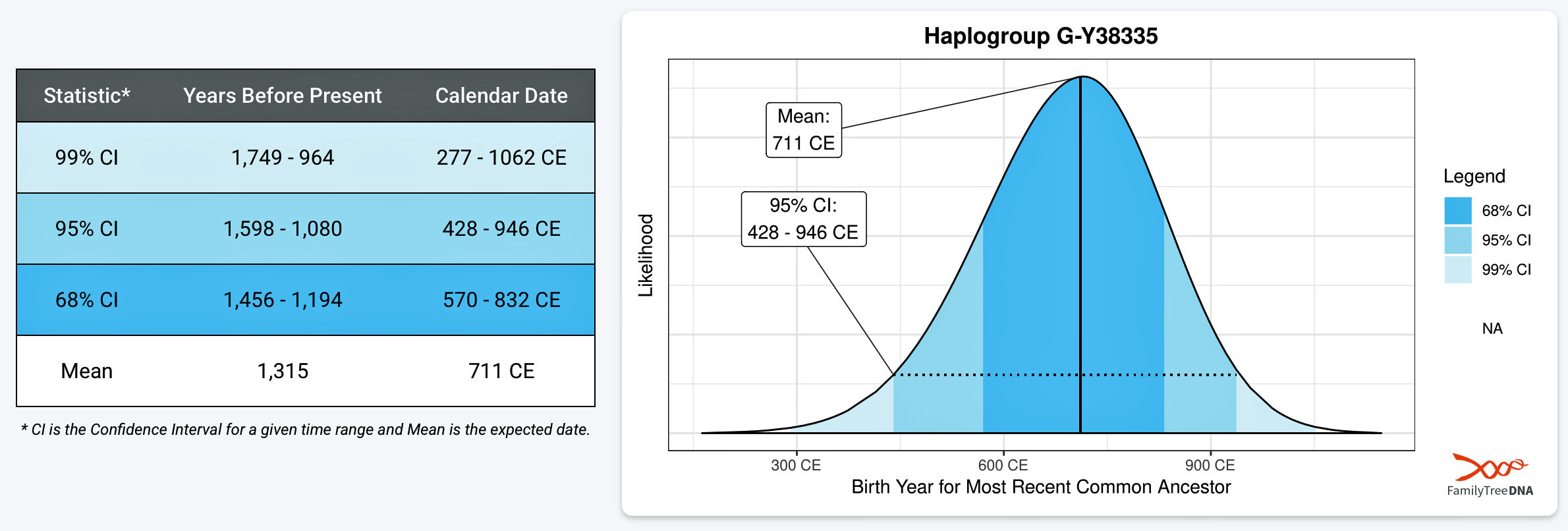
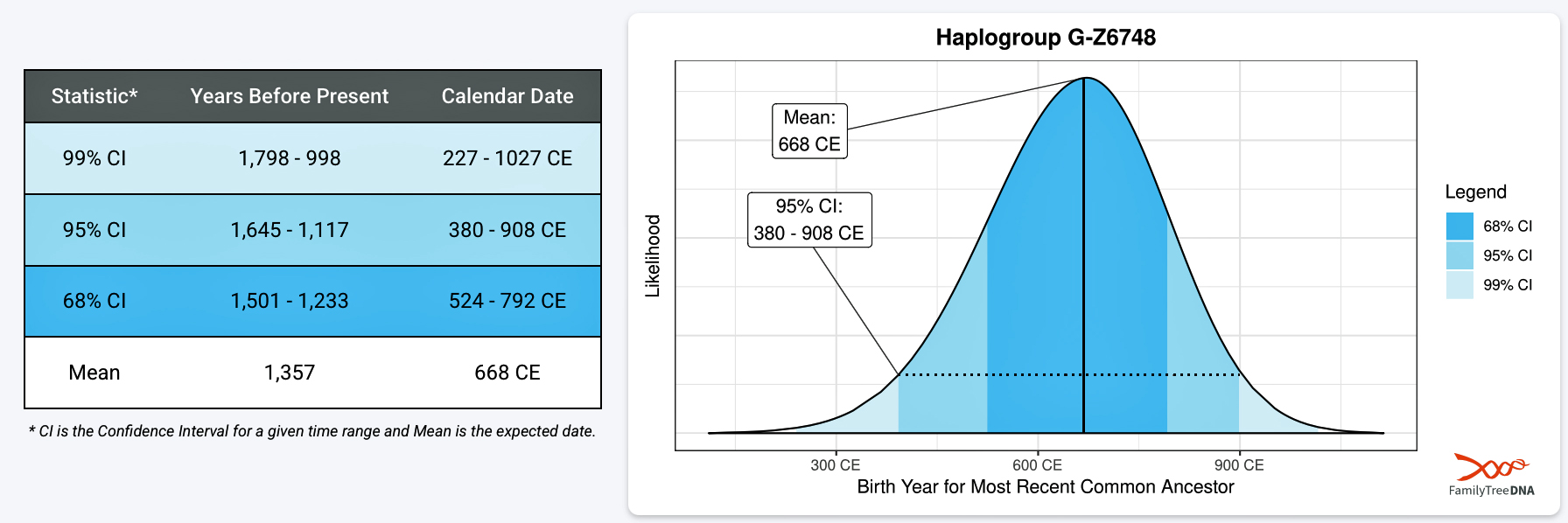
Table Two: Estimated Birth Dates of the MRCAs for G-Z6748, G-Y38335 and G-Z40857 [29]

Estimated Birth DateG-Z6748
Frisian Area
G-Y38335
East Anglia Area
G-Z40857
Sourthern Wessex Area
Mean668 CE711 CE971 CE
68% Confidence Interval 542 – 792 CE570 – 832 CE855 – 1070 CE
95 % Confidence Interval 380 – 908 CE428 – 946 CE739 – 1163 CE

This is a classic example of a founder effect based on migration. Various studies underscore that this single migratory path for the G-Z6748 lineage was part of a larger continuing migratory population movement of people from across the North Sea to Britain that spanned centuries.

A growing body of bioarchaeological and archaeological work now emphasizes that migration into England from across the North Sea and wider northโ€‘west Europe was a persistent feature of the period from the later Roman empire through the eleventh century. Recent largeโ€‘scale enamelโ€‘isotope analysis of more than 700 individuals buried in England between the fourth and eleventh centuries has demonstrated continuous inโ€‘migration from continental and extraโ€‘local regions, with a notable increase in mobility in the seventhโ€“eighth centuries, and has explicitly argued that โ€œmigration was a consistent feature of England between the 4th and the 11th centuries.โ€ [30]

This isotopic work dovetails with wider projects on the medieval migrants of the North Sea world, which frame the North Sea basin as a longโ€‘term zone of demographic and cultural connectivity from the postโ€‘Roman period into the later Middle Ages, and builds on more traditional accounts of the Migration Period that already recognize substantial fifthโ€‘ and sixthโ€‘century crossings of the North Sea by Germanicโ€‘speaking groups into Britain. [31]

A study by Leggett, Hakenbeck, and Oโ€™Connell push Anglo-Saxon โ€œsettlementโ€ history away from what had traditionally been viewed as a short, fifthโ€‘century ethnic migratory event and towards a long, regionally varied, gendered process of mobility and community formation. By extending well beyond the usual โ€œMigration Periodโ€ associated with the Anglo-Saxon influx [32] , they show that migration remains substantial into the seventhโ€“eighth centuries and through the Viking and Norman eras, reframing early medieval England as a persistently mobile society. [33]

Migration into East Anglia in this period overwhelmingly involved sea or coastal riverine movement rather than long overland treks. Modelling of early medieval migration routes and the broader archaeological pattern point to repeated crossings in relatively small vessels, not single armadas: groups of warriors, traders, craftsmen, dependants and some families moving along familiar seaways. [34]

In addition to the limiting founder effects of migration on the genetic diversity for subsequent generations, several interacting social processes during this time period could have created strong successive genetic bottlenecks on particular Yโ€‘DNA lineages that migrated into Britain, especially in eastern and southern England. These processes could have sharply magnified a few male lines while eliminating many others, even when total population size is not tiny. [35]

The following are possible social processes that may have contributed to continued bottlenecks associated with the G-Y38335 lineage:

1. Founder effects in small kinโ€‘based groups

Migration was often organized around extended families or warbands, not random samples of whole source populations. If a settlement is founded by a handful of related males (for example, several brothers and their close agnates), their Y lineages can rapidly dominate the local male pool purely by descent over a few generations. Repeated โ€œpatchyโ€ colonization along river valleys and coasts (Thames, Humber, East Anglia, etc.) means many local founder events in different microโ€‘regions, each amplifying a narrow subset of continental Y lineages. [36]

2. Inter-group conflict, elite success, and differential male survival

The period was marked by endemic local conflicts, struggles between indigenous and incoming groups, and later interโ€‘kingdom competition. If certain male lineages were overโ€‘represented in militarily successful groups (early royal/elite kindreds, successful warbands), those lines would experience higher survival of male offspring, more captured land, and greater reproductive opportunity, while defeated lineages could be reduced or wiped out. Over time, repeated โ€œwinners keep reproducingโ€ episodes generate classic maleโ€‘line bottlenecks: a few successful patrilines expand, many others contract or vanish, even if autosomal diversity remains quite high.

Several interacting processes in the fifthโ€“ninth centuries could create strong genetic bottlenecks in particular Yโ€‘DNA lineages that migrated into Britain, especially in eastern and southern England. These processes can sharply magnify a few male lines while eliminating many others, even when total population size is not tiny. [37]

3. Social structure and patrilineal reproduction bias

Early medieval Germanic societies were strongly patrilineal and patrilocal: inheritance, identity, and land passed mainly through male lines, and wives often moved to the husbandโ€™s community. Highโ€‘status males could support more surviving children, so their Y lineages disproportionately increase in frequency. Lowโ€‘status or landโ€‘poor males might delay marriage, remain celibate, or lose children at higher rates, leading to gradual loss of their lines. [38]

4. Serial admixture but constrained male lines

Early medieval England shows repeated waves of gene flow: North Sea migrants, plus later streams of ancestry related to Iron Age France and continued continental contacts. Admixture, the process by which individuals or populations acquire genetic material from different ancestral sources, can increase autosomal diversity but actually tighten Y bottlenecks if the incoming men are few but highly successful, or if later waves intermarry into already dominant male lineages rather than introducing many new patrilines. Over centuries, this creates a pattern where autosomal DNA records complex mixing, but Yโ€‘DNA is dominated by a limited set of โ€œsurvivorโ€ lineages (for example, I1 and R1a lines rising in early medieval England amid decline of older R1bโ€‘L21 lines in the east). [39]

5. Genetic drift in small small open populations

Early medieval settlement was highly local: villages and estates functioned as semiโ€‘isolated groups where most marriages occurred within a short radius. In such small male breeding populations, random genetic drift is strong; a Y lineage can fix or disappear in a few dozen generations purely by chance, especially after prior founder events. Limited longโ€‘range male mobility (outside warfare and elite networks) allows each microโ€‘region to drift in its own direction, producing sharp local peaks of specific subclades that look like bottlenecks when sampled later. [40]

Continued Bottleneck and Migration: East Anglia to South Wessex

As depicted in illustration four below, between approximately 700 CE and 950 CE, descendants of G-Y38335 migrated from the East Anglia area to the south-central area of Wessex.

Illustration Four: General Migratory Path of MRCA of G-38335 and G-Z40857 (Contemporary Boundaries)

Click for Larger View | Source: James Griffis,The Significance of Haplogroup G-Z6748 and its Descendants: Bottlenecks, Migration, Founder Effects and Star-Like Expansion, Griffis Family: Selected Stories from the Past

This migratory path is only documented by the two endpoint haplogroups. The approximate 250-year gap, or roughly eight generations, spans the period when East Anglia went from an independent Anglo-Saxon kingdom to a Mercian vassal and then to a Danish Danelaw, while Wessex emerged as the safe, dominant kingdom.

Between 700 CE and 970 CE, the map of England transformed from a fragmented collection of rival Anglo-Saxon kingdoms (the Heptarchy) into a largely unified kingdom under the House of Wessex. This transformation was driven by the rise of Mercian, then West Saxon dominance, combined with the catastrophic impact of Viking invasions, which redrew the map of the isle by creating a distinct “Danelaw” region before it was eventually reconquered and consolidated (see illustrations five through ten below).  [41]

One useful way to think about this gap is nothing โ€œgeneticโ€ has gone missing, but the combination of demography, sampling, and social history has produced a long, straight branch with no surviving, sampled offshoots. Several kinds of processes during the East Anglia to Wessex / Danelaw transition could have produced this result. A 250โ€‘year, eight generation stretch with no known sub-branches usually means that parallel male lines either died out or have not yet been sampled, not that they never existed. In a volatile period, several potential causes increase that extinction risk per generation. Because this involves one narrow migratory channel, the genetic signature between origin and destination will look like a long, unbranched trunk: all other โ€œlocalโ€ cousins either stayed put, died out, or remain unsampled.

The endpoints of this gap hint at a story of migration from an East Anglian origin context on one side and later survival in a Wessex-connected setting on the other. The historical record fits a landscape where East Anglia was an early magnet for continental settlers and remained heavily โ€œnorth continentalโ€ in genetic profile, but then came under Mercian influence, then Scandinavian conquest, and finally West Saxon hegemony. Wessex, relatively safer from direct Scandinavian settlement, became the consolidating power and a refuge/attractor for various displaced or mobile families.

Historical Reasons for Migration from East Anglia

Multiple generations could have migrated gradually, or a single family or family member could have fled the Viking conquest of 869โ€“870 and settled in Wessex within a few decades. This migration may have reflected and was influenced by the political shift of the center of power westward to Wessex, which eventually unified the English kingdoms.

Illustrations Five Through Ten: The Changing Political Boundaries of the Britsh Isle


Illustrations Five and Six: British Isles 719 CE and 800 CE (see Note [42] for numbered areas in maps)

Click for Larger View | Source: Ollie Bye,The History of the British Isles: Every Year, May 30, 2020, YouTube,https://www.youtube.com/watch?v=7k9utCpzF50

Illustration Seven and Eight: British Isles 899 CE and 950 CE

Click for Larger View | Source: Ollie Bye,The History of the British Isles: Every Year, May 30, 2020, YouTube,https://www.youtube.com/watch?v=7k9utCpzF50

Illustration Nine and Ten: British Isles: 975 CE and 1066 CE

Click for Larger View | Source: Ollie Bye,The History of the British Isles: Every Year, May 30, 2020, YouTube,https://www.youtube.com/watch?v=7k9utCpzF50

By the mid-seventh century, the eastern region of Anglia was often under pressure from the growing power of the kingdom of Mercia. While the initial settlement of the G-Z6748 lineage was focused on the east, pressure from Mercian hegemony and later the Danish Great Heathen Army in the late ninth century caused shifts in population movement and loyalty and may have influenced the migration to the south central area of the island. This pattern is reflected in the changing political boundaries in the maps in illustration five through ten. [43]

In 825 CE, East Anglia, seeking independence from Mercia, acknowledged the overlordship of Ecgberht of Wessex. By the late ninth century, Alfred the Great of Wessex secured the region against the Danes, and Edward the Elder later fully integrated East Anglia into the growing Kingdom of England in 918 CE. [44]

Several major historical events between 700โ€“950 CE provide plausible explanations why a G-Y38335 ancestor or series of generations would migrate from East Anglia to south-central Wessex, the area where the G-Z40857 MRCA is estimated to have lived.

Table Three: Key Historical Drivers for Migrating from East Anglia to Wessex

PeriodEventWhy it would drive migration south to Wessex
7thโ€“8th centuryMercian hegemony over East Anglia โ€“ Mercia (under ร†thelbald, then Offa 757โ€“796) dominated East Anglia, killing King ร†thelbert (794) and taking complete control by the 780s [45] Political subordination, land confiscation, or elite displacement could push East Anglians to seek refuge in the independent kingdom of Wessex [46]
865โ€“870‘Great Heathen Army’ arrives โ€“ Danish Vikings land in East Anglia (865), in the winter at Thetford, kill King Edmund (869), and make East Anglia Danish  [47] Catastrophic conquestโ€”East Anglia became part of the Danelaw. Many Anglo-Saxons fled south to unoccupied Wessex to escape Viking rule, slavery, or death [48]
871โ€“899Alfred the Great’s resistance โ€“ Alfred defeats Guthrum at Edington (878); treaty divides England (Wessex free, East Anglia Danish) [49] Wessex became the primary refuge for Anglo-Saxons fleeing the Danelaw. Alfred actively welcomed refugees and rebuilt society, attracting migrants from occupied territories [50]
910โ€“950Wessex’s reconquest of the Danelaw โ€“ Edward the Elder and ร†thelflรฆd conquer eastern Midlands; East Anglia comes under Wessex control by 918 [51]Continued population movement as Wessex consolidated power; some East Anglians may have moved to the political heartland (south-central Wessex: Hampshire/Wiltshire) for economic or administrative reasons

The south-central Wessex (Hampshire, Wiltshire) area was the core royal territory of the House of Wessexโ€”the heartland where Alfred, Edward the Elder, and later ร†thelstan built their power. This area offered:

  • Safety from Viking control (unlike East Anglia after 869);
  • Economic opportunity in Alfred’s fortified burhs and revived trade; and
  • Political centrality as Wessex became the nucleus of unified England.

The Social Context Associated with the MRCA of G-Z40857 and Immediate Generations

After a 250 year phylogenetic gap, the most recent common ancestor of G-Z40857 appears in south central Wessex. As indicated in table two above, it is estimated that this ancestor was born around 971 CE. There is a sixty-eight percent chance that the MRCA of haplogrop G-Z40857 was born between 855 – 1070 CE [see note 29] .

The most likely scenario is a descendant of G-Y38335 fled East Anglia after 869โ€“878, seeking safety in Wessex’s south-central core (Hampshire/Wiltshire), where King Alfred’s reforms created stability. Within two to three generations, the lineage, represented by the MRCA of G-Z04857, became established there by approximately the mid to late 900s CE.

Around the time of this ancestor’s birth, southern Wessex was in a phase of relative internal consolidation and monastic reform under King Edgarโ€™s regime, with no major recorded battles within a kingdom that dominated most of England. By the midโ€“tenth century the royal house of Wessex had effectively become the royal dynasty of a unified English kingdom, with Wessex forming its southern core. After ร†thelstanโ€™s reign and subsequent consolidation, Wessex rulers controlled almost all territory south of the Danelaw. By Edgarโ€™s time (959โ€“975 CE) this was taken as a settled political fact rather than a frontier in crisis. Southern Wessex in the 960sโ€“970s functioned more as the heartland of the realm than a contested border zone. [52]

Edgarโ€™s reign is often interpreted as a high point of tenthโ€‘century royal authority, with later tradition remembering him as โ€œEdgar the Peacefulโ€ because largeโ€‘scale warfare in England is not recorded for these years. Royal administration built on Alfredian and Edwardian foundations such as the fortified network of the burh system and fiscal structures of the hidageโ€‘based taxation system still shaped local life in southern Wessex around 970. Lawgiving and royal assemblies in this period tend to be associated with the royal heartlands, which included key southern Wessex centers. The tenth century saw ongoing monetization and urban development in southern England, with burhโ€‘towns evolving into more permanent commercial centers integrated into a kingdomโ€‘wide economy. [53]

In southern Wessex, ports and market towns created or reinforced under Alfred and his successors continued to facilitate trade, tax collection, and royal presence by the 970s. For rural communities, the picture is of continuity under consolidated royal and ecclesiastical landlords, framed by older defensive and fiscal structures but with relatively few recorded disruptive events.


Illustration Elevin: Map of Hildage-Based Taxation

Click for Larger View | Source: Hides and the Tribal Hidage,13 Oct 2016, Medieval Histories, https://www.medieval.eu/hides-and-the-tribal-hidage/

Hidage-based taxation was a historical land tax system in Anglo-Saxon and Norman England. It was assessed on the “hide,” a traditional unit of land theoretically capable of supporting a single household. This primitive but highly effective framework laid the groundwork for England’s early centralized tax state. [54]

Illustration Twelve: Medieval Tenth Century Bur-towns

Click for Larger View | Source: Hel-Hama, Map of burhs named in the 10th-century Burghal Hidage, 4 July 2012, Wikimedia Commons, https://commons.wikimedia.org/wiki/File:Anglo-Saxon_burhs.svg

Burh-towns (or burhs) were a network of fortified settlements established across early medieval England by King Alfred the Great and his successors (like Edward the Elder). Designed primarily to defend against Viking invasions, they also served as commercial and administrative centers that laid the foundation for English urban centers. [55]

Continuation of the Story: Part Two

Part two of the story discusses the Star-Like expansion of the phylogenetic tree. After roughly an eight generational gap in the phylogenetic tree, the โ€˜first waveโ€™ of a star-like expansion of haplogroup branches start to emerge. It appears that descendants migrated westward from south central Wessex into the contested border line areas that were controlled by Anglo-Saxon and Celtic-Briton (nascent Welsh) areas.

The rapid diversification of haplogroup branches is evident between 1000โ€“1500 CE. The clustering of haplogroups can be described as a single founding individual or small kin-group that achieved reproductive success just before the time of the Norman invasion and the continued proliferation of subclade branches through what is known as the Welsh Marches era. 

Sources

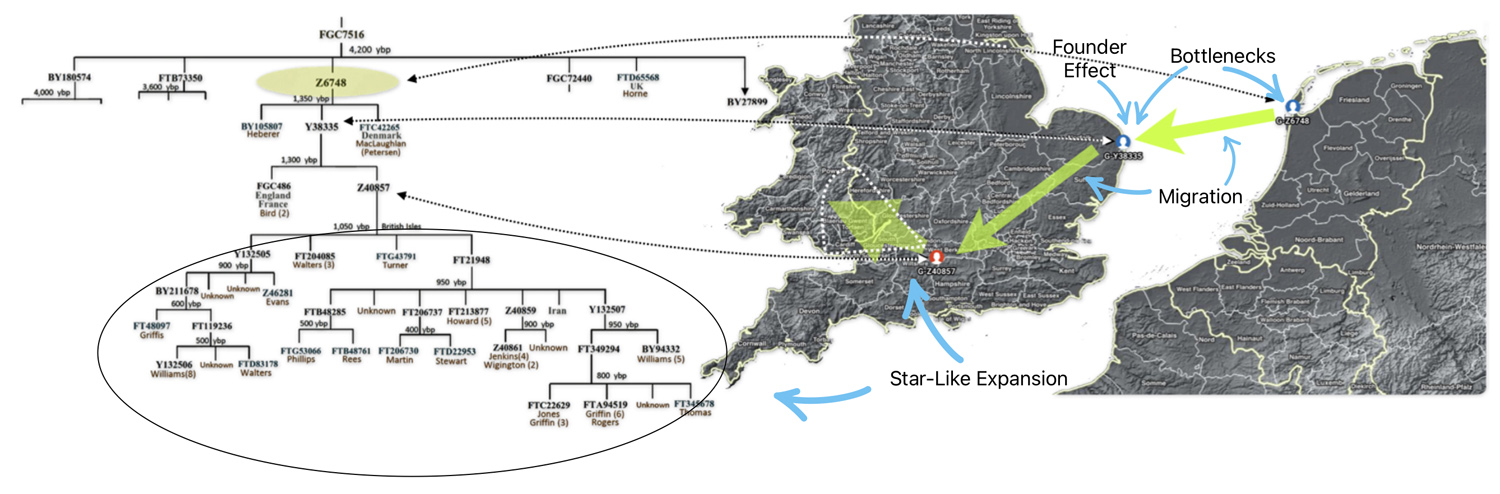
Feature Image: “Every picture tells a story”. This banner visualy captures the essence of this story. The feature image consistes of two images. The image on the left is a modifed version of a Phylogenetic Tree created by Rolf Langland and Maurรญcio Catelli (see reference below). The tree shows the relative sequential position of each of the haplogroups discussed in the story. The image on the left is a map I have created that illustrates the estimated migratory path and location of the MRCAs of G-Z6748 and G-Y38335 and G-Z40857.

Feature Image source for map: The source for creating the map is based on a variety of historical and archaeological studies as well as the estimates derived from the FTDNA Globetrekker tool, see Jim Griffis, Migrating to East Anglia, March 31, 2026, Griffis Family: Selected Stories from the Past, https://griffis.org/migrating-to-east-anglia/

Feature Image source for phylogenetic tree: Rolf Langland and Maurรญcio Catelli, G-FGC477 / Chart D – v6 – 2 pages (Jan 26), G-L497 Y-DNA Work Project, https://drive.google.com/file/d/1U_-FfascgkP2kS4nVPEPQVr0l6w8Qc7U/view

See a Larger version of the Feature Banner

[1] “A most recent common ancestor (MRCA), also known as a last common ancestor (LCA) . . . , is the most recent individual from which all organisms of a set are inferred to have descended.”

Most Recent Common Ancestor, Wikipedia, This page was last edited on 29 September 2025, https://en.wikipedia.org/wiki/Most_recent_common_ancestor

[2] A Y-DNA phylogenetic tree structure is a branching diagram representing the patrilineal descent of human males based on Y-chromosome mutations. It is often called the YDNA Haplotree, it maps relationships from a common ancestor to modern lineages. Branches or subclades represent shared YDNA mutations, forming nested haplogroups.

Y-chromosome haplogroup G2a (M201) originated in the Middle East/Caucasus, characterized by its role as the primary lineage of early Neolithic farmers who expanded into Europe 9,000โ€“6,000 years ago. Phylogenetically, it splits into multiple subclades (e.g. G2a1, G2a2, G2a3), with high diversity in the Caucasus and Anatolia, while European populations show high ancestral G2a concentrations. The definition of G2a has been refined by subsequent multiple YDNA defining mutations, including G-P15, G-L30, and others that helped differentiate Caucasian, Anatolian, and European branches.

See for example:

Sims LM, Garvey D, Ballantyne J. Improved resolution haplogroup G phylogeny in the Y chromosome, revealed by a set of newly characterized SNPs. PLoS One. 2009 Jun 4; 4(6):e5792. doi: 10.1371/journal.pone.0005792. PMID: 19495413; PMCID: PMC2686153. https://pmc.ncbi.nlm.nih.gov/articles/PMC2686153/

Rootsi S, Myres NM, Lin AA, Jรคrve M, King RJ, Kutuev I, Cabrera VM, Khusnutdinova EK, Varendi K, Sahakyan H, Behar DM, Khusainova R, Balanovsky O, Balanovska E, Rudan P, Yepiskoposyan L, Bahmanimehr A, Farjadian S, Kushniarevich A, Herrera RJ, Grugni V, Battaglia V, Nici C, Crobu F, Karachanak S, Hooshiar Kashani B, Houshmand M, Sanati MH, Toncheva D, Lisa A, Semino O, Chiaroni J, Di Cristofaro J, Villems R, Kivisild T, Underhill PA. Distinguishing the co-ancestries of haplogroup G Y-chromosomes in the populations of Europe and the Caucasus. Eur J Hum Genet. 2012 Dec;20(12):1275-82. doi: 10.1038/ejhg.2012.86. Epub 2012 May 16. PMID: 22588667; PMCID: PMC3499744. https://pmc.ncbi.nlm.nih.gov/articles/PMC3499744/

Primorac D, ล arac J, Havaลก Auguลกtin D, Novokmet N, Bego T, Pinhasi R, ล laus M, Novak M, Marjanoviฤ‡ D. Y Chromosome Story-Ancient Genetic Data as a Supplementary Tool for the Analysis of Modern Croatian Genetic Pool. Genes (Basel). 2024 Jun 6;15(6):748. doi: 10.3390/genes15060748. PMID: 38927684; PMCID: PMC11202852. https://pmc.ncbi.nlm.nih.gov/articles/PMC11202852/

Burkhard Berger, Harald Niederstรคtter, Daniel Erhart, Christoph Gassner, Harald Schennach, Walther Parson, High resolution mapping of Y haplogroup G in Tyrol (Austria), Forensic Science International: Genetics, Volume 7, Issue 5, 2013, Pages 529-536, ISSN 1872-4973,
https://doi.org/10.1016/j.fsigen.2013.05.013 .
(https://www.sciencedirect.com/science/article/pii/S1872497313001361 )

Hay, Maciamo, Haplogrup G2a (Y-DNA), May 2023, Eupedia, https://www.eupedia.com/europe/Haplogroup_G2a_Y-DNA.shtml#google_vignette

[3] Your Haplogroup Story: G-Z6748, FamilyTreeDNA, https://discover.familytreedna.com/y-dna/G-Z6748/story

G-Z6748 Haprogroup Project, About US, FamilyTreeDNA, https://www.familytreedna.com/groups/g-z6748/about

Hay, Maciamo, Haplogroup G2a (Y-DNA), Jul 2023, Eudepia, https://www.eupedia.com/europe/Haplogroup_G2a_Y-DNA.shtml

G-M201, The Genetic Genealogy of the Marres family, https://www.marres.nl/EN/G-M201.htm

See the following stories as a prelude to this story:

[4] The G-Z6748 Haplogroup Project is a dedicated Y-DNA research group on FamilyTreeDNA that explores the patrilineal descendants of an ancient Iron Age ancestor. This genetic lineage branched off from the rest of humankind roughly 2,200 years ago and sits downstream from the broader G-M201 >> L89 >> P15 >> L497 haplogroup tree.

The project is open to all participants who test positive for the Z6748 SNP. Because participants in the project often undergo advanced Y-DNA testing (such as Big Y), the group helps map a sprawling network of even more specific sub-clades (e.g., G-FT206737, G-Y132509, G-FTA94519). Descendants are primarily found throughout Europe. Members of this haplogroup often research surname lines connected to ancient or noble British and Scandinavian lineages (like Welsh patrons, Scottish/English gentry, and Norman ancestry).

Background, G-Z6748 Haplogroup Project. FamilyTreeDNA, Accessed 27 June, 2026, https://www.familytreedna.com/groups/g-z6748/about/background

[5] As of the writing of this story, there were 153 FamilyTreeDNA (FTDNA) DNA testers that could trace their YDNA back to G-Z6748. The following table provides a distribution of those 153 YDNA testers based on the testers’ self reported earliest known direct paternal countries of origin.

Click for Larger View | Source: Country Frequency of G-Z6758 descendants based on self-reported earliest known direct paternal countries of origin from participants, FamilyTreeDNA, Accessed Apr 2026,https://discover.familytreedna.com/y-dna/G-Z6748/frequency?view=table

Your Haplogroup Story: G-Z6748, FamilyTreeDNA, Accessed 1 Apr 2026, https://discover.familytreedna.com/y-dna/G-Z6748/story

[6] Pattison , John E. “Integration Versus Apartheid in Post-Roman Britain: A Response to Thomas et al. (2008),” Human Biology 83(6), 715-733, (1 December 2011). https://doi.org/10.3378/027.083.0604

[7] Griffis, Jim, Migrating to East Anglia, March 31, 2026, Griffis Family: Selected Stories from the Past, https://griffis.org/migrating-to-east-anglia/

Griffis, Jim The Ancestors of Haplogroup G-Z6748: A Frisian or Frank โ€“ Part Nine, February 11, 2026, Griffis Family: Selected Stories from the Past, https://griffis.org/the-ancestors-of-haplogroup-g-z6748-a-frisian-or-frank-part-nine/

[8] G-Z6748 Haplogroup Project, About Us, FamilyTreeDNA, accessed 4 May 2026, https://www.familytreedna.com/groups/g-z6748/about

Haplogroup G โ€“L497 Chart D: FGC477 Branch, L-497 Haplogroup Project, 24 Jan 2026, https://drive.google.com/file/d/1U_-FfascgkP2kS4nVPEPQVr0l6w8Qc7U/view

[9] In genetics, an allele is simply an alternative version of a DNA sequence of base pairs at a specific location on a chromosome. The definitions of alleles in the context of SNPs and STRs differ primarily in what type of genetic variation is being measured.

A SNP represents a change at a single “letter” (nucleotide) in the DNA sequence.  An STR is a region of DNA where short sequences of 2 to 6 base pairs are repeated over and over.

AlleleDescription
SNP AlleleA change in a single nucleotide base (e.g., A vs. T)
STR AlleleA difference in the number of times a short DNA motif repeats (e.g., a “GATA” sequence repeating 8 times vs. 11 times)

Phillips C, Garcรญa-Magariรฑos M, Salas A, Carracedo A, Lareu MV. SNPs as Supplements in Simple Kinship Analysis or as Core Markers in Distant Pairwise Relationship Tests: When Do SNPs Add Value or Replace Well-Established and Powerful STR Tests? Transfus Med Hemother. 2012 Jun;39(3):202-210. doi: 10.1159/000338857. Epub 2012 May 12. PMID: 22851936; PMCID: PMC3375139. https://pmc.ncbi.nlm.nih.gov/articles/PMC3375139/

[10] 20.9.2: Genetic Drift, Libre Texts, h10tps://bio.libretexts.org/Bookshelves/Introductory_and_General_Biology/Map:_Raven_Biology_12th_Edition/20:_Genes_Within_Populations/20.09:_Interactions_Among_Evolutionary_Forces/20.9.2:_Genetic_Drift

Kirk, Maggie, Genetic Drift and Founder Effects: Implications for Population Genetics, Conservation, and Human Health, April 16, 2024, Genet.Mol.Res. 23(2), https://www.geneticsmr.org/articles/genetic-drift-and-founder-effects-implications-for-population-genetics-conservation-and-human-health-7748.html

[11] An allele is one of two or more alternative versions of a gene at a specific location on a chromosome. Allele frequency measures how common a gene variant (allele) is within a population, calculated by dividing the count of a specific allele by the total of all alleles for that gene in the population. It is used to study genetic diversity, evolution, and population structure, with frequencies ranging from 0 to 1.0 (or 0โ€“100%). 

See:

Allele, National Human Genome Research Insitute, https://www.genome.gov/genetics-glossary/Allele

Allele Frequency, Wikipedia, This page was last edited on 31 March 2026, https://en.wikipedia.org/wiki/Allele_frequency

Minor Allele Frequency, Wikipedia, This page was last edited on 14 December 2025, https://en.wikipedia.org/wiki/Minor_allele_frequency

Allele frequency & the gene pool, Khan Academy, https://www.khanacademy.org/science/ap-biology/natural-selection/hardy-weinberg-equilibrium/a/allele-frequency-the-gene-pool

Gonzalez-Galarza FF, Christmas S, Middleton D, Jones AR. Allele frequency net: a database and online repository for immune gene frequencies in worldwide populations. Nucleic Acids Res. 2011 Jan;39(Database issue):D913-9. doi: 10.1093/nar/gkq1128. Epub 2010 Nov 9. PMID: 21062830; PMCID: PMC3013710. https://pubmed.ncbi.nlm.nih.gov/21062830/

allele frequency, Scitable, https://www.nature.com/scitable/definition/allele-frequency-298/

[12] Y-DNA genetic drift is the random change in frequencies of Y-chromosome lineages (haplogroups or subclades) over time, purely by chance rather than because they are biologically better or worse. Genetic drift is the random, unpredictable variations of allele or lineage frequencies from one generation to the next, caused by random sampling of which men leave surviving sons and which do not. On the Y chromosome, this means some Y lineages expand, others shrink, and some disappear entirely, even if they are selectively neutral.

See:

Genetic Drift, Wikipedia, This page was last edited on 28 March 2026,  https://en.wikipedia.org/wiki/Genetic_drift

Chiaroni J, Underhill PA, Cavalli-Sforza LL. Y chromosome diversity, human expansion, drift, and cultural evolution. Proc Natl Acad Sci U S A. 2009 Dec 1;106(48):20174-9. doi: 10.1073/pnas.0910803106. Epub 2009 Nov 17. Erratum in: Proc Natl Acad Sci U S A. 2010 Jul 27;107(30):13556. PMID: 19920170; PMCID: PMC2787129. https://pmc.ncbi.nlm.nih.gov/articles/PMC2787129/

Slyman, Raleigh, How does Y chromosome variation happen?, 27 Feb 2024, The Tech Interactive, https://www.thetech.org/ask-a-geneticist/articles/2024/y-chromosome-variation/

[13] A population bottleneck is a sharp, drastic reduction in the size of a population due to environmental events (e.g. earthquakes, fires, famine) or human activities (e.g. impact of patrilineal systems on genetic diversity, the repressive practices of social groups on othersocial groups, etc ). Demographic bottlenecks cause massive losses of genetic diversity, leaving the surviving population with a limited gene pool and increased genetic drift.

Typical features of a demographic bottleneck are:

  • A large population is drastically reduced for at least one generation (e.g., by disease, famine, climate event, habitat loss, hunting).
  • The survivors are effectively a random sample of the original population, so rare alleles are likely to be lost and a few previously uncommon alleles can drift to higher frequency.
  • When the population later expands, all descendants trace back to that small set of survivors, so the whole population shows reduced heterozygosity and fewer alleles per locus. Heterozygosity is the presence of two different versions (alleles) of a specific gene in an individual, with one inherited from each parent.

See:

Population bottleneck, Wikipeda, This page was last edited on 31 March 2026, https://en.wikipedia.org/wiki/Population_bottleneck

Bottlenecks and founder effects, Understanding Evolution, https://evolution.berkeley.edu/bottlenecks-and-founder-effects/

Klymkowski, Michael and Melanie M. Cooper, Population size, founder effects and population bottlenecks, LibreTexts, https://bio.libretexts.org/Bookshelves/Cell_and_Molecular_Biology/Biofundamentals_1e_(Klymkowsky_and_Cooper)/03:_Evolutionary_mechanisms_and_the_diversity_of_life/3.14:_Population_size_founder_effects_and_population_bottlenecks

Widdows, Megan, Genetic bottlenecks and the Founder effect: lessons learnt from the Woolly Mammoth, Evolution Letters, https://evolutionletters.wordpress.com/evolution-learning-zone/evolution-explained/genetic-bottlenecks-and-the-founder-effect-lessons-learnt-from-the-woolly-mammoth/

Kirk, Maggie, Genetic Drift and Founder Effects: Implications for Population Genetics, Conservation, and Human Health, April 16, 2024 Genet.Mol.Res. 23(2): , https://www.geneticsmr.org/articles/genetic-drift-and-founder-effects-implications-for-population-genetics-conservation-and-human-health.pdf

[14] A founder effect is a loss of genetic variation occurring when a new population is established by a very small number of individuals from a larger population. It causes reduced genetic diversity, with the new group’s gene frequencies differing significantly from the original population.

A founder effect occurs when a new population (a โ€œcolonyโ€) is established by a small number of individuals drawn from a larger source population. Because the founders are few, they carry a non-representative sample of the source gene pool, and this sampling distortion is then amplified as the new population grows.

Typical features of a founder effect are:

  • A small group separates from a larger population (e.g., colonizing an island, migrating to a new region, or becoming geographically/culturally isolated).
  • The founding group has reduced genetic variation relative to the source and may, by chance, carry some alleles at unusually high or low frequency.

See:

Bottlenecks and founder effects, Understanding Evolution, https://evolution.berkeley.edu/bottlenecks-and-founder-effects/

Klymkowski, Michael and Melanie M. Cooper, Population size, founder effects and population bottlenecks, LibreTexts, https://bio.libretexts.org/Bookshelves/Cell_and_Molecular_Biology/Biofundamentals_1e_(Klymkowsky_and_Cooper)/03:_Evolutionary_mechanisms_and_the_diversity_of_life/3.14:_Population_size_founder_effects_and_population_bottlenecks

Widdows, Megan, Genetic bottlenecks and the Founder effect: lessons learnt from the Woolly Mammoth, Evolution Letters, https://evolutionletters.wordpress.com/evolution-learning-zone/evolution-explained/genetic-bottlenecks-and-the-founder-effect-lessons-learnt-from-the-woolly-mammoth/

Kirk, Maggie, Genetic Drift and Founder Effects: Implications for Population Genetics, Conservation, and Human Health, April 16, 2024 Genet.Mol.Res. 23(2): , https://www.geneticsmr.org/articles/genetic-drift-and-founder-effects-implications-for-population-genetics-conservation-and-human-health.pdf

[15] Mustapha J A, How does the genetic bottleneck or population expansion affect the pattern of DNA polymorphisms?, 8 Jan 2016, ResearchGate, https://www.researchgate.net/post/How-does-the-genetic-bottleneck-or-population-expansion-affect-the-pattern-of-DNA-polymorphisms

population bottleneck, scitable, https://www.nature.com/scitable/definition/population-bottleneck-300/

Bottlenecks and founder effects, Understanding Evolution, UC Museum of Paleontology, https://evolution.berkeley.edu/bottlenecks-and-founder-effects/

Lucena-Perez M, Kleinman-Ruiz D, Marmesat E, Saveljev AP, Schmidt K, Godoy JA. Bottleneck-associated changes in the genomic landscape of genetic diversity in wild lynx populations. Evol Appl. 2021 Oct 8;14(11):2664-2679. doi: 10.1111/eva.13302. PMID: 34815746; PMCID: PMC8591332. https://pmc.ncbi.nlm.nih.gov/articles/PMC8591332/

Population Bottleneck, Wikipedia, This page was last edited on 31 March 2026, https://en.wikipedia.org/wiki/Population_bottleneck

Haplotype, International Society of Genetic GenealologyWiki, This page was last edited on 1 July 2021, https://isogg.org/wiki/Haplotype

Haplotype, Wikipedia, This page was last edited on 27 February 2026, https://en.wikipedia.org/wiki/Haplotype

What is the difference between a Y-DNA haplotype and Y-DNA haplogroup?, genebase, https://www.genebase.com/what-is-the-difference-between-a-y-dna-haplotype-and-y-dna-haplogroup/

[16] See for a discussion of the relationship between bottlenecks, founder effects and star phylogenies:

Karmin M, Saag L, Vicente M, Wilson Sayres MA, Jรคrve M, Talas UG, Rootsi S, Ilumรคe AM, Mรคgi R, Mitt M, Pagani L, Puurand T, Faltyskova Z, Clemente F, Cardona A, Metspalu E, Sahakyan H, Yunusbayev B, Hudjashov G, DeGiorgio M, Loogvรคli EL, Eichstaedt C, Eelmets M, Chaubey G, Tambets K, Litvinov S, Mormina M, Xue Y, Ayub Q, Zoraqi G, Korneliussen TS, Akhatova F, Lachance J, Tishkoff S, Momynaliev K, Ricaut FX, Kusuma P, Razafindrazaka H, Pierron D, Cox MP, Sultana GN, Willerslev R, Muller C, Westaway M, Lambert D, Skaro V, Kovaฤevic L, Turdikulova S, Dalimova D, Khusainova R, Trofimova N, Akhmetova V, Khidiyatova I, Lichman DV, Isakova J, Pocheshkhova E, Sabitov Z, Barashkov NA, Nymadawa P, Mihailov E, Seng JW, Evseeva I, Migliano AB, Abdullah S, Andriadze G, Primorac D, Atramentova L, Utevska O, Yepiskoposyan L, Marjanovic D, Kushniarevich A, Behar DM, Gilissen C, Vissers L, Veltman JA, Balanovska E, Derenko M, Malyarchuk B, Metspalu A, Fedorova S, Eriksson A, Manica A, Mendez FL, Karafet TM, Veeramah KR, Bradman N, Hammer MF, Osipova LP, Balanovsky O, Khusnutdinova EK, Johnsen K, Remm M, Thomas MG, Tyler-Smith C, Underhill PA, Willerslev E, Nielsen R, Metspalu M, Villems R, Kivisild T. A recent bottleneck of Y chromosome diversity coincides with a global change in culture. Genome Res. 2015 Apr;25(4):459-66. doi: 10.1101/gr.186684.114. Epub 2015 Mar 13. PMID: 25770088; PMCID: PMC4381518. https://pmc.ncbi.nlm.nih.gov/articles/PMC4381518/

Zeng, T.C., Aw, A.J. & Feldman, M.W. Cultural hitchhiking and competition between patrilineal kin groups explain the post-Neolithic Y-chromosome bottleneck. Nat Commun9, 2077 (2018). https://doi.org/10.1038/s41467-018-04375-6 ,

Khan, Razib, Genghis Khan: they donโ€™t make stars like they used to: Manspreading like the ancients: star phylogenies and the rise and fall of hyper-patriarchy, 26 Nov 2023, Razib Kan’s Unsupervised Learning, https://www.razibkhan.com/p/genghis-khan-manspreading-like-the

[17] Examples of studies that utilize the concept of cultural hitchiking:

Foody, M. George B. , Genetic Impact of the Bronze Age at the Fringes of Europe. Doctoral thesis, University of Huddersfield. 2021, https://eprints.hud.ac.uk/id/eprint/35516/, https://eprints.hud.ac.uk/id/eprint/35516/1/FINAL%20THESIS%20-%20Foody.pdf

Batini C, Hallast P, Vรฅgene ร…J, Zadik D, Eriksen HA, Pamjav H, Sajantila A, Wetton JH, Jobling MA. Population resequencing of European mitochondrial genomes highlights sex-bias in Bronze Age demographic expansions. Sci Rep. 2017 Sep 21;7(1):12086. doi: 10.1038/s41598-017-11307-9. PMID: 28935946; PMCID: PMC5608872. https://pmc.ncbi.nlm.nih.gov/articles/PMC5608872/

Zeng, T.C., Aw, A.J. & Feldman, M.W. Cultural hitchhiking and competition between patrilineal kin groups explain the post-Neolithic Y-chromosome bottleneck. Nat Commun, 9, 2077 (2018). https://doi.org/10.1038/s41467-018-04375-6

Ackland GJ, Signitzer M, Stratford K, Cohen MH. Cultural hitchhiking on the wave of advance of beneficial technologies. Proc Natl Acad Sci U S A. 2007 May 22;104(21):8714-9. doi: 10.1073/pnas.0702469104. Epub 2007 May 16. PMID: 17517663; PMCID: PMC1885568. https://pmc.ncbi.nlm.nih.gov/articles/PMC1885568/

Guyon, L., Guez, J., Toupance, B. et al. Patrilineal segmentary systems provide a peaceful explanation for the post-Neolithic Y-chromosome bottleneck. Nat Commun 15, 3243 (2024). https://doi.org/10.1038/s41467-024-47618-5

S. Carrignon, E.R. Crema, A. Kandler, & S. Shennan, Postmarital residence rules and transmission pathways in cultural hitchhiking, Proc. Natl. Acad. Sci. U.S.A. 121 (48) e2322888121, https://doi.org/10.1073/pnas.2322888121 (2024).

[18] G-L497 Y-DNA Haplogroup Project, FamilyTreeDNA, About Us, https://www.familytreedna.com/groups/g-ydna/about?srsltid=AfmBOorfbKDPy0LJSW66_gQbGMyCX-0o7BUKA22BopSqeeXuGntPxzYU

Haplogroup G-P303, Wikipeda, This page was last edited on 26 January 2026, https://en.wikipedia.org/wiki/Haplogroup_G-P303

Burkhard Berger, Harald Niederstรคtter, Daniel Erhart, Christoph Gassner, Harald Schennach, Walther Parson, High resolution mapping of Y haplogroup G in Tyrol (Austria), Forensic Science International: Genetics, Volume 7, Issue 5, 2013, Pages 529-536, ISSN 1872-4973,
https://doi.org/10.1016/j.fsigen.2013.05.013 .
(https://www.sciencedirect.com/science/article/pii/S1872497313001361 )

[19] Quote: Haplogroup G-M201, Wikipedia, This page was last edited on 20 February 2026, https://en.wikipedia.org/wiki/Haplogroup_G-M201

The quote references the ISOGG haplogroup G2a3b1 which is G-P303 . Direct match to G2a3b1 not found, but it is 3 steps up the haplotree G2a = G-P15.

See also:

Haplogroup G-P303, Wikipedia, This page was last edited on 26 January 2026, https://en.wikipedia.org/wiki/Haplogroup_G-P303

“There are seeming pockets of unusual concentrations within Europe. In Wales, a distinctive G2a3b1 (G-P15) type (DYS388=13 and DYS594=11) dominates there and pushes the G percentage of the population higher than in England.“

DYS399 and DYS594 stand for DNA Y-chromosome Segments. They are specific short-tandem repeat (STR) markers located on the Y-chromosome used in genetic genealogy to trace paternal ancestry. DYS markers, designated by the HUGO Gene Nomenclature Committee, identify specific spots where DNA sequences repeat, helping men determine relatedness to others through their direct paternal line.

Key Details About DYS Markers (e.g., DYS399 and DYS594):

  • Paternal Tracking: DYS markers only exist on the Y-chromosome, passing from father to son with few changes, making them ideal for surname projects and genealogical research.
  • STR (Short Tandem Repeat): These markers measure the number of times a short DNA sequence repeats, such as GATA-GATA-GATA (3 repeats).
  • Mutation Rates: While highly stable, these markers can mutate, allowing researchers to estimate the time to the most recent common ancestor (TMRCA) between two men.
  • Component of Y-DNA Profiles: Results for DYS399, alongside others like DYS390 or DYS393, form a Y-STR haplotype profile.

See: Understanding the Admin – Y-DNA Results Overview Report, FamilyTreeDNA, https://help.familytreedna.com/hc/en-us/articles/11165708791311-Understanding-the-Admin-Y-DNA-Results-Overview-Report#h_01JBYS1DRY1CMCC0FVK83ER1GQ

A review of the DYS values for DYS399 and DYS594 for members of the G-Z6748 FamilyTree Project confirms this observation. The following is the G-Z6748 – Y-DNA Results Overview for the FamilyTreeDNA project. As refleced in the chart, the value for DYS399 =13 for all members of this group project as of the writing of the story. . The value for all but one member of this group for DYS594=11.

G-Z6748 – Y-DNA Results Overview (as of April 2026)

Click for Larger View | Source: G-Z6748 – Y-DNA Results Overview, G-Z6748 FamilyTreeDNA Haoplogroup Project, FamilyTreeDNA, Accessed 21 April 2026,https://www.familytreedna.com/public/G-Z6748?iframe=ydna-results-overview

[20] Haplogroup P-303, Wikipedia, This page was last edited on 26 January 2026, https://en.wikipedia.org/wiki/Haplogroup_G-P303

[21] Your Haplogroup Story: G-Z6748, FamilyTreeDNA, Accessed 03 May 2026, https://discover.familytreedna.com/y-dna/G-Z6748/story

[22] Griffis, Jim The Griff(is)(es)(ith) Patrilineal Line of Descent: The Shape and Movement of the G Phylogenetic Tree through Time, March 23, 2025, Griffis Family: Selected Stories from the Past, https://griffis.org/the-griffisesith-patrilineal-line-of-descent-the-shape-and-movement-of-the-g-phylogenetic-tree-through-time/

[23] Bell Beaker Culture, Wikipeida, This page was last edited on 8 May 2026, https://en.wikipedia.org/wiki/Bell_Beaker_culture

Vander Linden, Marc, The Bell Beaker Phenomenon in Europe, Cambridge University Press, 2024, https://doi.org/10.1017/9781009496872

รšnฤ›tice culture, Wikipedia, This page was last edited on 16 April 2026, https://en.wikipedia.org/wiki/รšnฤ›tice_culture

Quentin P. J. Bourgeois et al. ,Spatiotemporal reconstruction of Corded Ware and Bell Beaker burial rituals reveals complex dynamics divergent from steppe ancestry. Sci. Adv. 11, eadx2262 (2025). DOI: 10.1126/sciadv.adx2262

Olalde, I., Brace, S., Allentoft, M. et al. The Beaker phenomenon and the genomic transformation of northwest Europe. Nature 555, 190โ€“196 (2018). https://doi.org/10.1038/nature25738

Olalde, Iรฑigoet al. , The genomic history of the Iberian Peninsula over the past 8000 years.Science 363, 1230-1234 (2019).DOI:10.1126/science.aav4040

[24] In Central and Northern Europe (like the Rhine Valley), the Bell Beaker population was almost entirely composed of individuals with heavy Steppe-related ancestry and R1b lineages. In contrast, Iberian Beaker individuals often retained the DNA of local farmers, only showing the arrival of R1b and Steppe ancestry later in the Bronze Age.

Paternal Lineages YDNA associated with the influx of the Bell Beaker cultural groups:

G2a, I2a, and R-V88: Found primarily in early Iberian Bell Beaker burials. In these regions, the culture often spread through trade and cultural adoption rather than mass migration, meaning local Neolithic lineages persisted longer than in Northern Europe.

R1b-M269 / R1b-L11: The primary male lineage for Bell Beaker groups outside of Iberia. It is linked to “Steppe” ancestry and is a definitive indicator of the population shift that occurred around 2500โ€“2200 BCE.

R1b-P312: A major subclade that became the dominant lineage of the “Rhenish” Beakers (those in the Rhine area, Netherlands, and Britain).

Olalde,  Iรฑigo al., The genomic history of the Iberian Peninsula over the past 8000 years.Science 363, 1230-1234 (2019). DOI: 10.1126/science.aav4040

Hay, Maciamo, Bell Beaker phenomenon (c. 2900-1800 BCE), Eupedia, https://www.eupedia.com/genetics/bell_beaker_phenomenon.shtml

[25] Griffis, Jim, The Turbulent Roman Era โ€“ The Griff(is)(es)(ith) Y-DNA Phylogenetic Gap Associated with the Meuse and Rhine River Watershed โ€“ Part Seven, November 30, 2025, https://griffis.org/the-turbulent-roman-era-the-griffisesith-y-dna-phylogenetic-gap-associated-with-the-meuse-and-rhine-river-watershed-part-seven/

[26] McDonald I. Improved Models of Coalescence Ages of Y-DNA Haplogroups. Genes (Basel). 2021 Jun 4;12(6):862. doi: 10.3390/genes12060862. PMID: 34200049; PMCID: PMC8228294. https://pmc.ncbi.nlm.nih.gov/articles/PMC8228294/

Jobling, M., Tyler-Smith, C. Human Y-chromosome variation in the genome-sequencing era. Nat Rev Genet 18, 485โ€“497 (2017). https://doi.org/10.1038/nrg.2017.36

[27] The Kingdom of the East Angles (sixth centuryโ€“918 CE) was an independent Anglo-Saxon kingdom comprising modern-day Norfolk and Suffolk. Founded by Angles settlers, it was part of the Heptarchy, later falling under Mercian dominance, Viking control (as part of the Danelaw), and finally becoming part of England in 918 CE. 

Kingdom of East Anglia, Wikipedia, This page was last edited on 25 March 2026, https://en.wikipedia.org/wiki/Kingdom_of_East_Anglia

See also:

Griffis, Jim, Migrating to East Anglia, March 31, 2026, Griffis Family: Selected Stories from the Past, https://griffis.org/migrating-to-east-anglia/

Griffis, Jim, The Ancestors of Haplogroup G-Z6748: A Frisian or Frank โ€“ Part Nine, February 11, 2026, Griffis Family: Selected Stories from the Past, https://griffis.org/the-ancestors-of-haplogroup-g-z6748-a-frisian-or-frank-part-nine/

Griffis, Jim, The Ancestor of Haplogroup G-Z6748, the Terps, Transport Corridors and Landscape Archaeology โ€“ Part Eight , January 14, 2026, Griffis Family: Selected Stories from the Past, https://griffis.org/the-ancestor-of-haplogroup-g-z6748-the-terps-transport-corridors-and-landscape-archaeology-part-eight/

[28] Griffis, Jim, Migrating to East Anglia, 31 Mar 2026, Griffis Family, Selected Sotires from the Past, https://griffis.org/migrating-to-east-anglia/

[29] Scientific Details for G-Z6748
Click for Larger View | Source: FamilyTreeDNA,Scientific Details on Haplogroup G-Z6748, https://discover.familytreedna.com/y-dna/G-Z6748/scientific

Scientific Details for G-Y38335

Click for Larger View | Source: Scientific Details for Haplogroup G-Y38335, FamilyTreeDNA, Accessed 12 Feb 2026, https://discover.familytreedna.com/y-dna/G-Y38335/scientific?section=tmrca

Scientific Details for G-Z40857:

Click for Larger View | Source: Scientific Details for Haplogroup G-Z40857, 5 May 2026, FamilyTreeDNA,https://discover.familytreedna.com/y-dna/G-Z40857/scientific?section=tmrca

[30] Leggett, S., Hakenbeck, S., & C Oโ€™Connell, T. (2025). Large-Scale Isotopic Data Reveal Gendered Migration into Early Medieval England 400โ€“1100. Medieval Archaeology, 69(2), 280โ€“308. https://doi.org/10.1080/00766097.2025.2583016

Gretzinger, J., Sayer, D., Justeau, P. et al. The Anglo-Saxon migration and the formation of the early English gene pool. Nature 610, 112โ€“119 (2022). https://doi.org/10.1038/s41586-022-05247-2

Roots of medieval migration into England uncovered in new study, Press Release, 5 Jan 2026, Univesrity of Edinburgh, https://www.eurekalert.org/news-releases/1111454

Roots of medieval migration into England uncovered in new study, 8 Jan 2026, Archaeology Department, University of Cambridge, https://www.arch.cam.ac.uk/news/roots-of-medieval-migration-into-england-uncovered-in-new-study

Migration Period, Wikipedia, This page was last edited on 27 April 2026, https://en.wikipedia.org/wiki/Migration_Period

McIntosh, Matthew, The Migration Period in Ancient Europe, 300-568 CE, 15 May 2020, Brewminate, https://brewminate.com/the-migration-period-in-ancient-europe-300-568-ce/

[31] See Jim Griffis, Migrating to East Anglia, 31 Mar 2026, Griffis Family,: Stories from the Past, https://griffis.org/migrating-to-east-anglia/

[32] The fifth-century Migration Period (or Vรถlkerwanderung) was a transformative era of mass population movements and tribal incursions that permanently reshaped Europe. Driven by Hunnish expansion, climate shifts, and tribal conflicts, this wave of migration precipitated the collapse of the Western Roman Empire and laid the foundation for medieval European states. 

Key Migrations of the fifth Century

The Franks (Fifth century): Moving into Roman Gaul more gradually, these western Germanic tribes integrated with the local Roman-Gaulish populace. They fended off rival tribes like the Visigoths and the Alemanni, forming the nucleus of the future French and German states

Visigoths (410 CE ): Having migrated from the Balkans, they sacked Rome in 410 CE. They subsequently settled in southern Gaul (France) and established a powerful kingdom spanning nearly all of Hispania (Spain).

Vandals, Alans, and Suebi (406โ€“409 CE): In a massive flight from the Huns, these groups crossed the frozen Rhine on December 31, 406. They swept through Gaul and into Spain before the Vandals crossed into North Africa in 429 to establish an independent state at Carthage.

Angles, Saxons, and Jutes (Mid-fifth century): With the Roman military withdrawing from Britain, these Germanic tribes from the Jutland Peninsula migrated across the North Sea, pushing native Britons west and establishing their own kingdoms.

See:

Migration Perod, Wikipedia, This page was last edited on 27 April 2026, https://en.wikipedia.org/wiki/Migration_Period

van der Crabben, Jan, Migration Age, 10 Jun 2010, World History Encyclopedia, https://www.worldhistory.org/Migration_Age/

Britannica Editors. “Migration period”. Encyclopedia Britannica, 23 Mar. 2018, https://www.britannica.com/event/Dark-Ages

[33] Leggett, S., Hakenbeck, S., & C Oโ€™Connell, T. (2025). Large-Scale Isotopic Data Reveal Gendered Migration into Early Medieval England 400โ€“1100. Medieval Archaeology, 69(2), 280โ€“308. https://doi.org/10.1080/00766097.2025.2583016

Anastasi, Luciano, Migration into Medieval England: New Evidence Shakes Old Narratives, 12 Jan 2026, History Medieval, https://historymedieval.com/migration-into-medieval-england-new-evidence-shakes-old-narratives/

[34] Leggett, S., Hakenbeck, S., & C Oโ€™Connell, T. (2025). Large-Scale Isotopic Data Reveal Gendered Migration into Early Medieval England 400โ€“1100. Medieval Archaeology, 69(2), 280โ€“308. https://doi.org/10.1080/00766097.2025.2583016

[35] Ashworth, James, Early English Anglo-Saxons descended from mass European migration, 21 Sep 2022, Science News, Natural History Museum London, https://www.nhm.ac.uk/discover/news/2022/september/early-english-anglo-saxons-descended-from-mass-european-migration.html

Genetic history of the British Isles, Wikipedia, This page was last edited on 11 April 2026, https://en.wikipedia.org/wiki/Genetic_history_of_the_British_Isles

Leggett, S., Hakenbeck, S., & C Oโ€™Connell, T. (2025). Large-Scale Isotopic Data Reveal Gendered Migration into Early Medieval England c 400โ€“1100. Medieval Archaeology, 69(2), 280โ€“308. https://doi.org/10.1080/00766097.2025.2583016

Roots of medieval migration into England uncovered in new study, 8 Jan 2026, Archaeology Department, University of Cambridge, https://www.arch.cam.ac.uk/news/roots-of-medieval-migration-into-england-uncovered-in-new-study

Anastasi, L., Migration into Medieval England: New Evidence Shakes Old Narratives โ€“ Medieval History. Medieval History โ€“ Yesterday in a Nutshell. 12 Jan 2026 https://historymedieval.com/migration-into-medieval-england-new-evidence-shakes-old-narratives/

McIntosh, Matthew, The Migration Period in Ancient Europe, 300-568 CE, 15 May 2020, Brewminate, https://brewminate.com/the-migration-period-in-ancient-europe-300-568-ce/

Gretzinger, J., Sayer, D., Justeau, P. et al. The Anglo-Saxon migration and the formation of the early English gene pool. Nature 610, 112โ€“119 (2022). https://doi.org/10.1038/s41586-022-05247-2

J.F. Wilson, D.A. Weiss, M. Richards, M.G. Thomas, N. Bradman, & D.B. Goldstein, Genetic evidence for different male and female roles during cultural transitions in the British Isles, Proc. Natl. Acad. Sci. U.S.A. 98 (9) 5078-5083, 2001, https://doi.org/10.1073/pnas.071036898 

Flavio De Angelis, Elizabeth A. Nelson, Sam Leggett, Kalina Kassadjikova, Tanya R.Pelayo, Rob Poulton, Todd C. Rae, Lars Fehren-Schmitz, Lia Betti, Carlos Eduardo G.Amorim, The Genomic Legacy of the Norman Conquest in Rural England, bioRxiv 2026.04.10.716983; doi: https://doi.org/10.64898/2026.04.10.716983

[36] Modern genetic studies of early medieval Britain support a model of fifth-seventh century Anglo-Saxon migration that was not a uniform, monolithic invasion. It was a patchy, sustained movement of Germanic peoples from the continental North Sea zone (modern-day Netherlands, Germany, and Denmark). This migration involved localized settlements or “founder events,” particularly along accessible coasts and river valleys like the Thames, Humber, and across East Anglia. 

The genetic impact and “patchy” colonization resulted in:

  • Localized Founder Events: The arrival was characterized by smaller groups settling in specific areas, where they often remained separate from local British populations in the immediate post-Roman period.
  • Narrow Subset of Lineages: These localized communities allowed specific male lineages to thrive and dominate through local, generational growth.
  • Regional Differences: This created distinct regional genetic landscapesโ€”for example, higher concentrations of continental DNA in the east/southeast (30โ€“40 percent or more) and significantly less in the west and north, where the local, pre-existing population remained more dominant.

Specific Y-Lineage Evidence:

  • Male Dominance: The colonization was heavily driven by men, with Y-chromosomal DNA in early Anglo-Saxon England showing up to 50โ€“100 percentontinental ancestry in some central areas.
  • Continental Markers: The specific lineages linked to this, which amplified through these local, patchy events, include R1b-U106, R1a-M420, and I1-M253, which are common in northern and central Europe.
  • Survival Rates: While subsequent Viking, Norman, and other influences occurred, the foundational 5thโ€“7th century settlements provided the “patchy” genetic base that still shows high continental input in regions like East Anglia. 

This process resulted in an early English population where the first settlers’ origins were tightly linked to specific areas of the continent, later modified by local admixture with the local Romano-British population.

See:

Roberston, Lauren, Combined genetics and archaeology data reveal origins of the early English gene pool, 27 Sep 2022, Front Line Genomics, https://frontlinegenomics.com/combined-genetics-and-archaeology-data-reveal-origins-of-the-early-english-gene-pool/

Gretzinger, J., Sayer, D., Justeau, P. et al. The Anglo-Saxon migration and the formation of the early English gene pool. Nature 610, 112โ€“119 (2022). https://doi.org/10.1038/s41586-022-05247-2

Michael E. Weale, Deborah A. Weiss, Rolf F. Jager, Neil Bradman, Mark G. Thomas, Y Chromosome Evidence for Anglo-Saxon Mass Migration, Molecular Biology and Evolution, Volume 19, Issue 7, July 2002, Pages 1008โ€“1021, https://doi.org/10.1093/oxfordjournals.molbev.a004160, https://www.csueastbay.edu/museum/files/docs/exhibit/dna/dna-chrom-migration.pdf

Ashworth, James, Early English Anglo-Saxons descended from mass European migration, 21 Sept 2022, Natural History Museum London, https://www.nhm.ac.uk/discover/news/2022/september/early-english-anglo-saxons-descended-from-mass-european-migration.html

[37] Based on the historical context of the British Isles between 700 and 950 CE, the era, characterized by Anglo-Saxon migration and Viking raids/settlement, saw significant, often violent, population turnover, particularly in eastern and central England. 

  • Male-Line Bottlenecks (Y-DNA): Modern genetic studies show that a few male lines dominate the Y-chromosome landscape of Europe and the British Isles, with these bottlenecks often reinforced by the success of specific patrilines associated with the Bronze Age Bell Beaker culture, and later, the Iron Age Celts and Germanic peoples.
  • The “Winner” Effect: The success of Viking and Anglo-Saxon invaders (associated with Y-haplogroups I1, R1a, and R1b-U106) likely accelerated this process, where successful warbands and elites in early medieval England replaced or absorbed existing populations, leading to high survival of their own patrilines.
  • Autosomal vs. Y-DNA Data: While Y-DNA shows strong, recent, and localized expansion (many men with the same ancestor), the autosomal DNA (total ancestry) remains much more diverse, revealing that these successful male lineages were mixing with the existing indigenous, mainly Celtic-like, population.

Consequently, while the appearance of the population (autosomal DNA) changed more gradually, the Y-chromosome data shows that the early medieval period exacerbated the “winners keep reproducing” dynamic, where a few elite male lineages expanded, and others (including native Romano-British or existing Northumbrian lineages) contracted or were destroyed.

See:

Hay, Maciamo, Genetic history of the British and the Irish, Oct 2016, Eupedia, https://www.eupedia.com/genetics/britain_ireland_dna.shtml

Pickrell, John, DNA Untangles Britain’s Past : Genetic survey reveals Viking blood in modern day Britain, 27 May 2003, Science.Org

Gretzinger J, Sayer D, Justeau P, Altena E, Pala M, Dulias K, Edwards CJ, Jodoin S, Lacher L, Sabin S, Vรฅgene ร…J, Haak W, Ebenesersdรณttir SS, Moore KHS, Radzeviciute R, Schmidt K, Brace S, Bager MA, Patterson N, Papac L, Broomandkhoshbacht N, Callan K, Harney ร‰, Iliev L, Lawson AM, Michel M, Stewardson K, Zalzala F, Rohland N, Kappelhoff-Beckmann S, Both F, Winger D, Neumann D, Saalow L, Krabath S, Beckett S, Van Twest M, Faulkner N, Read C, Barton T, Caruth J, Hines J, Krause-Kyora B, Warnke U, Schuenemann VJ, Barnes I, Dahlstrรถm H, Clausen JJ, Richardson A, Popescu E, Dodwell N, Ladd S, Phillips T, Mortimer R, Sayer F, Swales D, Stewart A, Powlesland D, Kenyon R, Ladle L, Peek C, Grefen-Peters S, Ponce P, Daniels R, Spall C, Woolcock J, Jones AM, Roberts AV, Symmons R, Rawden AC, Cooper A, Bos KI, Booth T, Schroeder H, Thomas MG, Helgason A, Richards MB, Reich D, Krause J, Schiffels S. The Anglo-Saxon migration and the formation of the early English gene pool. Nature. 2022 Oct;610(7930):112-119. doi: 10.1038/s41586-022-05247-2. Epub 2022 Sep 21. Erratum in: Nature. 2022 Nov;611(7934):E3. doi: 10.1038/s41586-022-05429-y. PMID: 36131019; PMCID: PMC9534755. https://pmc.ncbi.nlm.nih.gov/articles/PMC9534755/

[38] The migration of Germanic societies to England in the early medieval period, including Angles, Saxons, Jutes, and Friesians, was characterized by social structures that influenced the genetic landscape. Evidence from studies suggest these societies operated with strong patrilineal customs, where inheritance and identity were passed through male lines. 

Impact on Population Genetics and Y Lineages:

  • High-Status Male Reproductive Advantage: Early Anglo-Saxon elites, particularly those with higher social and economic standing, were able to support more surviving children, which allowed their Y-chromosome lineages to increase disproportionately.
  • Gradual Loss of Low-Status Lines: The reverse was true for low-status or land-poor males, who may have faced higher infant mortality, delayed marriage, or enforced celibacy, resulting in the gradual disappearance of their paternal lines.
  • Patrilocal Residence: The practice of patrilocality, where wives moved to the husband’s community, meant that Y-chromosome (paternal) signals often reflected the origin of the male, while mitochondrial DNA (maternal) might reflect a more local origin.
  • Cultural Hitchhiking: The social structure likely caused “cultural hitchhiking,” where Y-chromosomes became closely tied to social groups, enhancing the spread of specific “star-shaped” male lineages associated with elites.
  • Genetic Shift: Studies have indicated a substantial increase in continental Northern European ancestry in eastern England during this periodโ€”up to 76% in some areasโ€”often linked to these Germanic populations.
  • Long-Term Impact: This structural, patrilineal-driven reproduction resulted in a lasting legacy on the English gene pool, with high-status male lineages having a greater influence on the modern population.

These societal patterns of inheritance, marriage, and social stratification, rather than just raw numbers of migrants, played a key role in the rapid expansion of Germanic ancestry in England.

See:

Gretzinger, J., Sayer, D., Justeau, P. et al. The Anglo-Saxon migration and the formation of the early English gene pool. Nature 610, 112โ€“119 (2022). https://doi.org/10.1038/s41586-022-05247-2

Thomas MG, Stumpf MP, Hรคrke H. Evidence for an apartheid-like social structure in early Anglo-Saxon England. Proc Biol Sci. 2006 Oct 22;273(1601):2651-7. doi: 10.1098/rspb.2006.3627. PMID: 17002951; PMCID: PMC1635457. https://pmc.ncbi.nlm.nih.gov/articles/PMC1635457/

Blรถcher, Jens & Vallini, Leonardo & Velte, Maren & Eckel, Raphael & Guyon, Lรฉa & Winkelbach, Laura & Thomas, Mark & Gharehbaghi, Nadia & Mitchell, Cassandra & Schรผmann, Jonas & Kรถhler, Sophie & Seyr, Elsa & Krichel, Katharina & Rau, Sophie & Hirsch, Jana & Duras, Jana & Klement, Kristin & Wilkenhรถner, Miriam & Vetterdietz, Lisa & Burger, Joachim. (2025). Historic Genomes Uncover Demographic Shifts and Kinship Structures in Post-Roman Central Europe. 10.1101/2025.03.01.640862. https://www.researchgate.net/publication/389635889_Historic_Genomes_Uncover_Demographic_Shifts_and_Kinship_Structures_in_Post-Roman_Central_Europe/citation/download

Guyon L, Guez J, Toupance B, Heyer E, Chaix R. Patrilineal segmentary systems provide a peaceful explanation for the post-Neolithic Y-chromosome bottleneck. Nat Commun. 2024 Apr 24;15(1):3243. doi: 10.1038/s41467-024-47618-5. PMID: 38658560; PMCID: PMC11043392. https://pmc.ncbi.nlm.nih.gov/articles/PMC11043392/

[39] Early medieval England (c. 450โ€“850 CE) witnessed significant demographic shifts, with genetic evidence indicating that up to 76 percent of the ancestry of individuals in eastern and southern England originated from continental North Sea regions, such as modern-day Germany and Denmark. This influx was not a single event but a complex, multi-century process of migration and interaction. 

Regional Differences: This process was not uniform; Eastern and Southern England show higher levels of North Sea/Germanic ancestry, while Western and Northern regions retained higher levels of indigenous Brythonic-related ancestry. 

Autosomal Diversity & Admixture: The period was characterized by widespread mixing between incoming continental North Sea groups and local Romano-British populations. This resulted in an overall increase in genetic diversity in the autosomal (whole-genome) DNA, reflecting a patchwork of local and foreign ancestry, with higher levels of North Sea ancestry observed in eastern England.

Y-DNA Bottlenecks & “Survivor” Lineages: Despite the increased autosomal diversity, Y-chromosome DNA (paternal lines) tells a different story. The influx resulted in a severe, narrowed representation of certain paternal lineages. The early medieval period saw a decline in pre-existing insular R1b-L21 lines in the east.

Rise of New Male Lineages: In their place, Y-DNA haplogroups often associated with North Sea Germanic populations, such as I1 and R1a, increased significantly. These lineages, along with specific R1b sub-clades like U106, were often carried by highly successful, high-status males who successfully intermarried or replaced the older male population, reducing the overall diversity of male lines.

Continued Continental Contact: Later waves of migration, including those bringing ancestry related to Iron Age France and other continental zones, contributed further to the genetic landscape but often intermarried with these already established, dominant, Germanic-linked male lineages, reinforcing the Y-DNA bottleneck effect.

See:

Robertson, Lauren, Combined genetics and archaeology data reveal origins of the early English gene pool, 27 Sep 2022, Front Line Genomics, https://frontlinegenomics.com/combined-genetics-and-archaeology-data-reveal-origins-of-the-early-english-gene-pool/

Joscha Gretzinger and Stephan Schiffels, Transformations in early medieval England: the perspective from population genetics, 5 October 2022, Current Archaeology, Issue 392, https://the-past.com/feature/transformations-in-early-medieval-england/

Richards, Martin, The Anglo-Saxon migration and the formation of the early English gene pool, 17 Aug 2022, Nature, https://doi.org/10.1038/s41586-022-05247-2 , https://www.academia.edu/111305156/The_Anglo_Saxon_migration_and_the_formation_of_the_early_English_gene_pool

Max Planck Institute, The Anglo-Saxon migration: new insights from genetics, 21 Sep 2021, Popular Archaeology, Spring 2026, https://popular-archaeology.com/article/the-anglo-saxon-migration-new-insights-from-genetics/

[40] The scenario described is a well-recognized pattern in population genetics and molecular anthropology, particularly when studying Y-chromosome haplogroups in mountainous, isolated, or formerly tribal regions. This phenomenon highlights the contrast between long-term continuity (resulting from regional drift) and short-term, explosive expansion (resulting from warfare or patrilineal elite dominance). 

Dynamics of Micro-Regional Genetic Drift:

  • Isolation and Drift: When male mobility is limitedโ€”due to geography, social structure, or low population densityโ€”communities drift genetically, creating high concentrations of specific subclades that differ from neighboring valleys.
  • The “Bottleneck” Illusion: These high concentrations, or “local peaks,” are often misread in modern sampling as a sharp population bottleneck (a massive die-off). In reality, they are usually the result of a small founder population expanding over time, amplified by the fact that only a few men with specific lineages successfully reproduced (a “founder effect”).

See:

Lell JT, Wallace DC. The peopling of Europe from the maternal and paternal perspectives. Am J Hum Genet. 2000 Dec;67(6):1376-81. doi: 10.1086/316917. Epub 2000 Nov 9. PMID: 11078473; PMCID: PMC1287914. https://pmc.ncbi.nlm.nih.gov/articles/PMC1287914/

Cox MP, Hammer MF. A question of scale: Human migrations writ large and small. BMC Biol. 2010 Jul 21;8:98. doi: 10.1186/1741-7007-8-98. PMID: 20659353; PMCID: PMC2908064. https://pmc.ncbi.nlm.nih.gov/articles/PMC2908064/

Furlan E, Stoklosa J, Griffiths J, Gust N, Ellis R, Huggins RM, Weeks AR. Small population size and extremely low levels of genetic diversity in island populations of the platypus, Ornithorhynchus anatinus. Ecol Evol. 2012 Apr;2(4):844-57. doi: 10.1002/ece3.195. PMID: 22837830; PMCID: PMC3399204. https://pmc.ncbi.nlm.nih.gov/articles/PMC3399204/

[41] History of Anglo-Saxon England, Wikipedia, This page was last edited on 28 April 2026, https://en.wikipedia.org/wiki/History_of_Anglo-Saxon_England

[42] Numbered Areas in Maps:

Number AreasNumbered Areas

1. Ystrad Tywi
2. Ceredigion
3. Brycheiniog
4. Glywysing
5. Gwent
7. Buellt
9. Dogfeiling
10. Ergyng
11. Caer Gloui
12. Deywr
13. Suth Rig (Surrey)
14. Middle-Seaxe (Middlesex)
15. Spaldingas / Sweod Ora
16. Herstingas
17. North Engles
18. South Engles
20. Morgannwg
23. Buchan
24. Strathearn
33. Brecknock
34. Monmouth
35. Glamorgan
37. Pembroke
38. Montgomery
39. Uรญ Cahan (O’Cahan)
40. Fir Manach (Fermanagh)
41. Clandeboye
42. Iveagh
44. West Brรฉifne
45. East Brรฉifne
46. Uรญ Farrells (O’Farrell)
47. Uรญ Conchobhair (O’Connor)
48. Uรญ Ceallaigh (O’Kelly)
49. Uรญ Flaithbheartaigh (O’Flaherty)
50. Muineachรกn (Monaghan)
51. Iveragh
52. Dรบiche Ealla (Duhallow)
53. Mรบscraรญ (Muskerry)
54. Bhรฉara (Beare)
55. Cairbrigh (Carbery)

[43] By the mid-seventh century, the Kingdom of East Anglia frequently fell under the dominance of the expanding Kingdom of Mercia. While initially a powerful kingdom, East Anglia was under heavy pressure, with kings such as Sigeberht and Ecgric killed by the Mercian king Penda in the early 640s, and later under total control by Mercian rulers such as Offa. 

This regional pressure and the subsequent devastation by the Danish Great Heathen Army in the late ninth century created significant shifts in population and loyalty: 

Final Absorption: Eventually, these shifted loyalties saw many inhabitants in the region begin to identify as “English” and support the Wessex kings against the Danes, leading to its final incorporation into the kingdom of England under Edward the Elder in the early 10th century.

Mercian Hegemony (Seventh-Eighth Century): East Anglia was often reduced to a puppet state or client kingdom, with Mercian kings dominating the East Anglian political structure, culminating in direct control under Offa of Mercia in 794.

Danish Invasion (Ninth Century): ‘The Great Heathen Army’ landed in East Anglia in 865, and in 869, they defeated and killed the last native king, St. Edmund the Martyr.

Shifts in Loyalty and Population: The Viking conquest turned East Anglia into a central part of the Danelaw. This led to a significant Scandinavian, or Danish, settlement alongside the native Anglo-Saxon population.

See:

Kingdom of East Anglia, Wikipedia, This page was last edited on 25 March 2026, https://en.wikipedia.org/wiki/Kingdom_of_East_Anglia

List of monarchs of East Anglia, Wikipedia, This page was last edited on 1 February 2026, https://en.wikipedia.org/wiki/List_of_monarchs_of_East_Anglia

Iles, Alex, The Great heathen Army ‘The Vaiking Invasion, YouTube, https://www.youtube.com/watch?v=AsN3cGsnkDU

[44] Kingdom of East Anglia, Wikipedia, This page was last edited on 25 March 2026, https://en.wikipedia.org/wiki/Kingdom_of_East_Anglia

List of monarchs of East Anglia, Wikipedia, This page was last edited on 1 February 2026, https://en.wikipedia.org/wiki/List_of_monarchs_of_East_Anglia

[45] Kingdom of East Anglia, Wikipedia, This page was last edited on 25 March 2026, https://en.wikipedia.org/wiki/Kingdom_of_East_Anglia

Abernathey, Susan, Offa, Anglo-Saxon King of Mercia, 18 Apr 2021, The Freelance History Writer, https://thefreelancehistorywriter.com/2014/04/18/offa-anglo-saxon-king-of-mercia/

[46] A brief history of Offaโ€™s Dyke, 25, Apr 2015, History Extra, https://www.historyextra.com/period/anglo-saxon/a-brief-history-of-offas-dyke/

[47] McIntosh, Matthew A. , Vikings in East Anglia: Conquest and Impact , 24 APR 2017, Brewminate, https://brewminate.com/vikings-in-east-anglia-conquest-and-impact/

Johnson, Ben, Invaders! Angles, Saxons and Vikings, Historic UK, https://www.historic-uk.com/HistoryUK/HistoryofBritain/Invaders/

Kingdom of East Anglia, Wikipedia, This page was last edited on 25 March 2026, https://en.wikipedia.org/wiki/Kingdom_of_East_Anglia

Great Heathen Army, Wikipedia, This page was last edited on 12 February 2026, https://en.wikipedia.org/wiki/Great_Heathen_Army

Weiss, Daniel, The Viking Great Army, Mar/Apr 2018, Archaeology Magazine, https://archaeology.org/issues/march-april-2018/features/viking-great-army/

[48] McIntosh, Matthew A. , Vikings in East Anglia: Conquest and Impact , 24 APR 2017, Brewminate, https://brewminate.com/vikings-in-east-anglia-conquest-and-impact/

The Vikings in Britain, 13 Jan 2011, Historical Association, https://www.history.org.uk/primary/resource/3867/the-vikings-in-britain-a-brief-history

[49] Whitelock, Dorothy. “Alfred”. Encyclopedia Britannica, 24 Mar. 2026, https://www.britannica.com/biography/Alfred-king-of-Wessex . 

McIntosh, Matthew A. , Vikings in East Anglia: Conquest and Impact , 24 APR 2017, Brewminate, https://brewminate.com/vikings-in-east-anglia-conquest-and-impact/

[50] By rebuilding society and creating a haven, King Alfred the Great laid the structural foundations for the eventual unification of England. Alfredโ€™s rebuilding and defensive efforts created a magnetic pull for Anglo-Saxons looking to escape the Danelaw. His reforms transformed Wessex into a beacon of stability through several key initiatives: 

  • The Burghal System: Alfred established a network of 33 fortified towns (burhs) across his kingdom. These ensured that no West Saxon was ever more than a day’s ride from safety. This defensive security allowed refugee populations to settle and rebuild their lives without constant fear of raiding.
  • Reforming the Military: He reorganized the Anglo-Saxon fyrd (military), splitting his forces so that one half was on duty guarding the kingdom while the other tended to their fields and homes. This allowed society and agriculture to thrive, which was essential to supporting the influx of migrants.
  • Literacy and Education: Recognizing the cultural toll of the Viking invasions, Alfred fostered a massive educational revival. He encouraged the translation of important Latin texts into Old English, creating a centralized administrative class and fostering a shared cultural and religious identity that unified native West Saxons and newcomers.

Refugees were not treated as outsiders; they were actively incorporated into the military and political structure. This influx of displaced peoples from Mercia and Northumbria helped pool vital resources, warriors, and scholars in Wessex. By unifying these disparate Anglo-Saxon groups under one banner, Alfred set the stage for his successorsโ€”like his grandson, Athelstanโ€”to reconquer the Danelaw and forge a single, unified English state.

See:

Wessex, Wikipedia, This page was last edited on 16 May 2026, https://en.wikipedia.org/wiki/Wessex

Lockett, Charles J., The Danelaw: Partition and Reconstruction in Early Medieval England, 6 Nov 2023, Medieval Ware, https://www.medievalware.com/blog/danelaw-england-partitioned/

Whitelock, Dorothy. “Alfred”. Encyclopedia Britannica, 24 Mar. 2026, https://www.britannica.com/biography/Alfred-king-of-Wessex

[51] The reconquest of the Danelaw (899โ€“924) was a massive strategic expansion led by King Edward the Elder and his sister, ร†thelflรฆd (Lady of the Mercians). By establishing heavily fortified frontier towns (burhs) and winning decisive battles, they systematically dismantled Viking rule in central and eastern England.

Key Campaigns and Timeline:

  • The Turning Point (910): Following the decisive defeat of a northern Viking army at the Battle of Tettenhall, Edward and ร†thelflรฆd were able to go on the offensive.
  • Conquering the Midlands (917): ร†thelflรฆdโ€™s Mercian forces launched a massive assault, capturing major Danish strongholds including Derby and Leicester. Edward simultaneously advanced from the south, fortifying strategic sites and pushing into Essex and East Anglia.
  • Fall of East Anglia (917โ€“918): Following a coordinated offensive in 917, the Danish army of East Anglia was overwhelmed. By 918, East Anglia formally submitted and came under the direct control of Wessex.
  • Absorption of Mercia (918): Upon ร†thelflรฆdโ€™s sudden death in June 918, Edward marched into Mercia, overthrew her daughter ร†lfwynn, and consolidated the territory under direct West Saxon rule.

Long-Term Significance:

This aggressive campaign not only secured the eastern Midlands but effectively ended the independence of the Danelaw, giving the kings of Wessex dominion over all lands south of the Humber. This laid the essential political and military groundwork for Edward’s son, ร†thelstan, to become the first King of all England

See:

History of Anglo-Saxon England, Wikipedia, This page was last edited on 28 April 2026, https://en.wikipedia.org/wiki/History_of_Anglo-Saxon_England

Edward the Elder, Wikipedia, This page was last edited on 23 March 2026, https://en.wikipedia.org/wiki/Edward_the_Elder

Crowther, David, 10 English Reconquest, 2011, The History of England, https://thehistoryofengland.co.uk/blog/2011/01/21/10-english-reconquest/

Wessex, Wikipedia, This page was last edited on 16 May 2026, https://en.wikipedia.org/wiki/Wessex

[52] History of Anglo-Saxon England, Wikipedia, This page was last edited on 28 April 2026, https://en.wikipedia.org/wiki/History_of_Anglo-Saxon_England

Wessex, Wikipedia, This page was last edited on 16 May 2026, https://en.wikipedia.org/wiki/Wessex

Kingdon of Wessex, World History Encyclopedia, Accessed 1 May 2026, https://www.worldhistory.org/timeline/Kingdom_of_Wessex/

Britannica Editors. “Wessex”. Encyclopedia Britannica, 20 Jun. 2025, https://www.britannica.com/place/Wessex-historical-kingdom

[53] Edgar, King of England, Wikipedia, This page was last edited on 8 March 2026, https://en.wikipedia.org/wiki/Edgar,_King_of_England

[54] Taxation in medieval England, Wikipedia, This page was last edited on 30 January 2026, https://en.wikipedia.org/wiki/Taxation_in_medieval_England

Hide (unit), Wikipedia, This page was last edited on 23 April 2026, https://en.wikipedia.org/wiki/Hide_(unit)

Burghal Hidage, Wikipedia, This page was last edited on 28 March 2026, https://en.wikipedia.org/wiki/Burghal_Hidage

Britannica Editors. “hide”. Encyclopedia Britannica, 20 Jul. 1998, https://www.britannica.com/topic/hide-English-land-unit 

Wareham, A., Fiscal policies and the institution of a tax state in Anglo-Saxon England within a comparative context1. The Economic History Review, 2012, 65: 910-931. https://doi.org/10.1111/j.1468-0289.2011.00624.x

Hides and the Tribal Hidage, 13 Sep 2013, Medieval Histories, https://www.medieval.eu/hides-and-the-tribal-hidage/

[55] Burh, Wikipedia, This page was last edited on 4 August 2025, https://en.wikipedia.org/wiki/Burh

Hill, David; Rumble, Alexander R., eds. The Defence of Wessex: The Burghal Hidage and Anglo-Saxon Fortifications. Manchester: Manchester University Press 1996

Haslam, Jeremy, The Burghal Hidage and the West Saxon burhs: a reappraisal, Anglo-Saxon England, 45, 2017, 139-80, https://www.academia.edu/36005682/The_Burghal_Hidage_and_the_West_Saxon_burhs_a_reappraisal

Rumble, A. R. The Defence of Wessex: the Burghal Hidage and Anglo-Saxon Fortifications. Manchester University Press 1996

The Turbulent Roman Era – The Griff(is)(es)(ith) Y-DNA Phylogenetic Gap Associated with the Meuse and Rhine River Watershed – Part Seven

This part of the story focuses on the impact of the Roman era on the absence of documented haplogroups associated with the Griff(is)(es)(ith) paternal line between the first century BCE and 300 CE in an area we now call the Netherlands and Belgium. The absence of identified YDNA subclades associated with the Griff(is)(es)(ith) YDNA paternal line in this time period may have been influenced by the effects of:

  • The changing dynamics between local Celtic and Germanic groups in the Meuse Rhine area;
  • The effects of Roman conquest and occupation;
  • Being close to or on the Roman frontier border; and
  • The late-Roman social and demographic collapse.

The Roman era did not just overlay a single Roman identity. It acted as a catalyst for a dynamic and complex set of social processes where Celtic and Germanic social groups were relocated, subjugated, blended or destroyed. This lead to the formation of new group identities that would define the post-Roman, early-medieval landscape of the region, ultimately contributing to the development of the Frankish kingdom. 

Rural communities and social groups underwent major transformations in this period of time. The violently disruptive Caesarian Roman conquest of the area in the first century BCE led to substantial demographic losses and trauma for indigenous populations. The subsequent large-scale migration and managed resettlement of Germanic groups resulted in new tribal configurations and ethnogenesis (the process by which a new ethnic identity emerges from existing groups, often through migration, interaction, and cultural blending). The integration of rural populations into the Roman military system, with extensive recruitment for auxiliary forces, also led to the accelerated diffusion of Roman military culture and altered local social structures. [1]

The Changing Dynamics Between Indigenous Groups in the Meuse Rhine Watershed Area Pre-Roman Era

It is highly likely that the changes in Celtic and Germanic group composition and the impact of the Roman incursion in the Meuse Rhine watershed area during this time period had a major impact on the continued absence of documented haplogroups in the YDNA Griff(is)(es)(ith) YDNA phylogenetic line. It probably contributed to the resultant and reinforced pattern of a phylogenetic tree with long branches between identified haplogroups with minimal subclade formation. [2]

High levels of intergroup competition, associated with migration or conflict, led to the physical displacement or decline of male lineages. This resulted in observable changes in haplogroup prevalence over time in the Meuse Rhine watershed region. Social and culturally driven group processes (i.e.the Roman incusion and subjagation) resulted in specific Y-DNA lineages (clades) dying out more frequently than would be expected by random chance.

This altered the overall structure of the YDNA phylogenetic tree, potentially leading to the loss of entire branches that, in the absence of such social pressures, might have persisted. Interaction and conflict among social groups acted as a potent filter on Y-DNA transmission, making Y-DNA phylogenetic trees a reflection not only of biological mutation and migration but also of the cultural and social history of the populations they represented.

Prior to the Roman impact (pre-first century BCE), the area between the Meuse and Rhine rivers was inhabited by a mix of Celtic and Germanic groups, some displaying transitional identities and social pattterns due to centuries of interaction and migration. The identity and culture in the Rhine and Germania regions during this period were highly fluid, marked by ongoing processes of migration, assimilation, and hybridization among small groups rather than fixed ethnic divides and geographical boundaries.

A comparative review of maps depicting Germanic and Celtic groups during this time peiod show a wide range of variable depictions of indigenous groups. These maps often differ significantly in their representation of tribal boundaries, ethnic affiliations, and even the names assigned to specific groups. See illustrations one through six as examples.

Illustration One – Six: Examples of Variability of Identified Local Indigenous Groups in the Meuse Rhine Watershed Area and Outlying Areas

Illustration One: Tribal map of the Lower Rhine frontier zone in the Caesarian Era

Click for Larger View | Source: Roymans N, Derks T, Heeren S (2020) Roman Imperialism and the transformation of rural society in a frontier province: diversifying the narrative. Britannia 51:265โ€“294. https://www.cambridge.org/core/journals/britannia/article/roman-imperialism-and-the-transformation-of-rural-society-in-a-frontier-province-diversifying-the-narrative/BF7FA75997E14A1B7BA4241E5DC981C3

Illustration Two: Map of Germanic and Celtic Tribes circa 52 BCE

Click for Larger View | Source: Modification of map by P L Kessler, Map of Celtic and Germanic Tribes,05 March 2015, World History Encyclopedia,https://www.worldhistory.org/image/3687/map-of-celtic-and-germanic-tribes/

Illustration Three: The Germanic Tribal World of the Provincial Roman Period between 50 BCE to 300 CE

Click for Larger View | Source: A section of a map created by Arch.-Stud. A.P., The Germanic Tribal World of the Provincial Roman Period between 50 BC to 300 AD, 7 Apr 2023, Wikimedia Commons, https://commons.wikimedia.org/wiki/File:Germanic_Tribes_in_the_Roman_Imperial_Period.png

Illustration Four: Map of the Germanic tribes, circa 15 BCE

Click for Larger View | Source: Jason Abdale, Map of the Germanic tribes, circa 15 BC, 26 Jul 2013, Dinosaurs and Barbarians,https://dinosaursandbarbarians.com/2013/07/26/map-of-the-germanic-tribes-circa-15-bc/

Illustration Five: Roman provinces & tribes in vicinity of Gallia c 58 BC, prior to Gallic Wars

Click for Parger View | Source: Modified version of a map by Feitscherg, Map of Roman provinces & tribes in vicinity of Gallia c 58 BC, prior to Gallic Wars,2 Sep 2019, Wikimedia Commons,https://commons.wikimedia.org/wiki/File:Map_Gallia_Tribes_Towns-la.svg

Illustration Six: Map of Celtic, Germanic and Iberian tribes before Roman expansion

Click for Larger View | Source: Modified version of map documented in a 2017 reddit post by ironandrewoods, I drew a map of the pre-Roman peoples of Western Europe and North Africa! [3170 ร— 5042] [OC], https://www.reddit.com/r/MapPorn/comments/6u61sl/i_drew_a_map_of_the_preroman_peoples_of_western/

There are a number of reasons for this variability. Many maps are based on fragmentary and sometimes contradictory ancient sources, such as Roman and Greek accounts, which themselves were often incomplete or biased.โ€‹ The boundaries and identities of tribes were fluid, with frequent migrations, alliances, and assimilations, making it difficult to draw fixed lines on a map.โ€‹

Modern mapmakers often extrapolate from limited evidence, leading to different interpretations and sometimes speculative placements of tribes. Modern maps often rely on a combination of archaeological evidence, linguistic data, and historical texts, but these sources do not always align, resulting in differing interpretations of tribal territories and ethnic identities.

Scholars debate the extent to which ethnic or tribal identities were fixed or fluid, with some arguing for a more dynamic and overlapping picture rather than clear-cut divisions. The lack of consensus on the precise locations and affiliations of many tribes means that different maps may show significant discrepancies, especially in regions like the Rhine-Meuse watershed where Germanic and Celtic groups interacted closely.

Illustration seven (below) reflects the general location of the main Celtic and Germanic groups in the Meuse Rhine watershed area prior to Roman occupation. The map is the result of research conducted by Fanny Martin. Her research was aimed at establishing
a reliable geographic and chronological framework based on material culture and territorial dynamics of the late Iron Age tribes in the middle Meuse basin on the eve of the Roman Conquest. [3]

Illustration Seven: Tribal Groups in the Meuse Rhine Watershed Area Prior to Roman Occupation

Click for Larger View | Modification of original image found in: Martin, F. (2019). Recent research on material culture and territorial dynamics of late Iron Age tribes in the middle Meuse basin, on the eve of the Roman Conquest, Abb. 10 Proposed localization of the main Celtic tribes of the area in : Spรคtlatรจnezeitliche und frรผhkaiserzeitliche Archรคologie zwischen Maas und Rhein, Bonn, 323-334. https://www.academia.edu/43850047/Martin_F_2019_Recent_research_on_material_culture_and_territorial_dynamics_of_late_Iron_Age_tribes_in_the_middle_Meuse_basin_on_the_eve_of_the_Roman_Conquest_In_Spรคtlatรจnezeitliche_und_frรผhkaiserzeitliche_Archรคologie_zwischen_Maas_und_Rhein_Bonn_323_334

Martinโ€™s methodology for mapping late Iron Age tribes in the middle Meuse basin is noteworthy. It is centered on a detailed, comparative analysis of the distribution of material culture (primarily ceramics, glass bracelets, salt containers, fibulae, and coinages) and settlement patterns (the modalities and distribution of housing, farming evidence, defensive settlements, funeral practices or cave occupation) within a newly established chronological framework. The archaeological data was compared with historical sources to observe the integration of local populations into the Roman sphere of influence. I added the approximate location of Germanic groups east of the Rhine to the map.

Based on the approximate migratory path of the Griff(is)(es)(ith) paternal genetic line, it is possible a number of generations of the Griff(is)(es)(ith) line were associated the Treveri Celtic group. Depending on the rate of migratory movement over time, generations of the genetic line may also have been associated with the Eburones.

Between 300 BCE and 1 BCE, the area between the Meuse and Rhine Rivers underwent significant changes, with a changing mix of Celtic and Germanic groups inhabiting the area, including some with hybrid origins or shifting allegiances due to group migrations.

Migration and assimilation in the Meuse-Rhine region before the Roman era led to dynamic changes in local tribal groups, with tribal identities shifting, merging, and evolving in response to population movement and intergroup contact. Tribal group migration resulted in tribal splits, hybridization and changes in group characteristics. Migration and assimilation transformed local tribal communities and tribal identity in the Meuse-Rhine region from static designations to fluid, ‘negotiated identities’. [4]

Internal disputes, environmental pressures, or external threats spurred subgroup migrationsโ€”like the Batavians splitting off from the Chatti and settling in the Rhine delta. Another example is the Ubii, allied with the Romans, moving from the east bank of the Rhine to the west bank, filling a geographical vacuum where the annihilated Eburones lived. These relocated groups often adopted new names and distinct identities tailored to their new socio-political environment, sometimes preserving older tribal names only superficially while forming completely new communities.โ€‹ [5]

Migrants and resident populations engaged in broad facets of acculturation such as intermarriage, shared burial rites, and exchange of technologies which led to changes in tribal identification. Dress styles and funerary customs, for example, became markers of new group identities, not indicators of longstanding ethnic continuity.โ€‹ [6]

‘Ethnic’ characteristics, such as language, material culture, or place-names were changed with local groups and newcomers often combining or abandoning traditions for social advantage. This ‘adaptive negotiation’ generated new identities with names linked to older tribal entities but whose membership and meaning were entirely transformed. [7]

The process of tribal assimilation was not unidirectional. Groups negotiated and adapted cultural elements for prestige and belonging. Immigrant โ€œbarbariansโ€ and original inhabitants adopted or performed traditions to establish social distinction, producing a blended, hybridized population and new ethnic groupings. [8]

As new communities formed, they often retained ancient tribal namesโ€”such as Franks, Batavians, or Chattiโ€”but these now referred to socially and genetically mixed groups divergent from their predecessors. [9] Recent genetic and archaeological studies reveal that these processes led to mosaic populationsโ€”emphasizing local continuity alongside significant input from newcomers, further destabilizing clear-cut tribal labels. [10]

Archaeological and linguistic evidence shows considerable hybridization and cultural mixing. Many tribal names and material cultures east or west of the Rhine (e.g., Chatti, Batavi, Eburones, Nemetes) displayed La Tรจne (Celtic) signatures even after initial “Germanic” migrations, leading scholars to recognize transitional or hybrid populations with changing language, traditions, and identities. [11]

Repeated waves of migration, assimilation, and sociopolitical restructuring led to evolving ethnic boundaries. For example, tribes that began as Celtic-speaking could be subsumed by groups adopting Germanic languages and material cultures through intermarriage or power shifts. This is reflected in archaeological records and analyses of personal and place-names, all of which document the fuzzy boundaries between groups. [12]

The Identification of Indigienous Groups in the Pre-Roman and Roman Era

Recent research in the last fifty years on indigenous communities in the Meuse-Rhine watershed has critically reconsidered the use of the term “tribe.” The concept is increasingly viewed as problematic because it reflects nineth-century sociopolitical models more than the actual archaeological or ancient realities. [13]

The naming of Celtic and Germanic tribes in the Meuse-Rhine area before and during the Roman era has been fraught with difficulty due to both scholarly and historical ambiguities about ethnic identities, linguistic affiliations, and shifting cultural frontiers.

The term “tribe” was largely imposed by Roman and later classical authors, as well as modern ethnographers, onto diverse and dynamic local groups whose social, political, and cultural organization do not match the simplified, static model implied by “tribe.” Archaeologists, anthropologists, and historians now recognize that local identities were more fluid, overlapping, and constructed in response to both local and imperial pressures, rather than being fixed or primordial entities. [14]

“An attempt to describe the environmental (and social) aspects of the prehistory and early history of the lowland rivers Rhine and Meuse is a confrontation with a poignant lack of information. How little do we know from that period? The most reliable records come from geological, palaeogeographical and palynological research, and from scanty archaeological excavations. The first written sources date back to the Roman period, but these are subjective, often second-hand observations of educated military men and historians. After the Roman period, until roughly ad 800โ€“900, again, there is a great lack of written documentation.” [15]

Beginning around the late second to early first century BCE, the Meuseโ€“Rhine region became home to several Celtic or partly Celtic tribes belonging to the Belgic cultural sphere. These tribes occupied territories that bridged Celtic and early Germanic zones, [16] forming a cultural frontier that Julius Caesar later described in his Commentarii de Bello Gallico. [17]

Read more on Ethnicity, Tribes and Archaeology

Ethnicity, Tribes and Archaeology

“In many ways, ethnic identity has remained the elephant in the room in many aDNA-driven narratives. While there have been efforts to revise nomenclature to better reflect criticisms of the culture concept and its inherent assumptions about collective identity, in practice many models still work on the assumption that DNA signatures and experienced identities as reflected in material culture should largely coincide.” [18]

Scholars consistently caution against equating specific artifacts or burial customs with fixed ethnic identities, emphasizing the dynamic, negotiated nature of ethnicity in the archaeological record.โ€‹

Ethnicity is increasingly studied as an active, socially constructed phenomenon, not merely a biological or cultural inheritance, resonating with trends in both historical and prehistoric research.

Studies of ethnicity in complex societies highlight both the difficulties and insights that archaeological approaches contribute, advocating a critical stance on linking material culture directly to ethnic groups.

“The concept of โ€˜tribal societyโ€™ is one of the most prominent and popular โ€˜anthropologicalโ€™ notions of our time, yet within western social and cultural anthropology it has been largely abandoned as a sociological category. . . . In the nineteenth century, the term tribe was woven into the theories of primitive society governed by the principles of โ€˜kinshipโ€™ proposed by the emerging social sciences. . . . By the beginning of this century โ€˜the tribeโ€™ had been widely discredited as an analytical term outside some specialized fields such as theories of early state formation. It is now commonly considered an ethnographic, rather than an analytical, term.“ [19]

Illustration Eight: Germanic Forces Crossing the Rhine 406 CE

Germanic Forces Cross the Rhine, 406 CE
Click for Larger View | Source: modified version of an original image from Ancient Warfare Magazine/ Karwansaray Publishers. It was uploaded by Arienne King and published on 13 September 2020 at the World History Encyclopedia website. โ€œGermanic Forces Cross the Rhine, 406 CE, World History Encyclopedia, https://www.worldhistory.org/image/12731/germanic-forces-cross-the-rhine-406-ce/

The Rhine River served as a de facto cultural boundary between Celtic Gaul and Germania. Table one provides a list of the key local groups, or tribes as defined by the Romans, in the Meuse Rhine watershed area during the late second to early first century BCE . [20]

Table One: Celtic-Germanic Groups West of the Rhine River First Centruy BCE

Roman NameDescription
EburonesThis was a large tribe situated between the Rhine and Meuse rivers, in the area of modern-day Limburg (southern Netherlands), eastern Belgium, and the German Rhineland. Caesar claimed to have virtually exterminated them after their revolt in 53 BCE, though many likely lived on and were later known as the Tungri.
Aduatuci/
Atuatuci
This grouup lived in the area of modern-day Tongeren, Belgium, between the Scheldt and Meuse rivers.
NerviiKnown for their fierce resistance to Roman rule, the Nervii were a powerful Belgic ‘tribe’ located north of the Eburones.
SegriThe Segni are generally presumed to have dwelled in the Luxembourgish and Belgian Ardennes. Their territory was located between that of the Treveri and the Eburones, indicating that they settled not far from the Condrusi,
TreveriSituated in the left bank of the Middle Rhine region, around the Ardennes and Eifel areas (modern Luxembourg and the surrounding regions), they had a mixed Celtic-Germanic culture.
Condrusi/ CondrusThis was a small, left-bank Celtic-Germanic group in the Middle Rhine region. Like the Segni, their territory was located between that of the Treveri and Eburones. At the time of Caesar’s conquest of the region in the mid-first century BCE, they lived as clients of the Treveri.
Caeroesi/ CaerosiThe Caeroesi were a left-bank, Celto-Germanic tribe located in the Eifel-Ardennes area.
MenapiiThe Menapii were a Celtic tribe with Germanic influence, located primarily south of the Meuse river. 

What Celtic-Germanic tribe are We from?

As indicated in the first part of this multipart story, the estimated migratory path between haplogroup G-FGC716 and haplogroup G-Z6748, the two endpoints associated with this phylogenetic gap, was visually structured through the use of the FamilyTreeDNA Globe Trekker program. In FamilyTreeDNAโ€™s GlobeTrekkeprogram, corridor paths represent  probabilistic zones indicating the most likely routes Y-DNA lineages followed between ancestral haplogroup locations. 

Illustration nine depicts the migratory corridor where the Griff(is)(es)(th) lineage most likely traveled, based on 95 percent probability, through time rather than a single deterministic line. It also indicates the general area where various Celtic and Germanic groups resdes during the pre-Roman era.

Illustration Nine: Tribal Map of the Lower Rhine frontier Zone in the Caesarian Period circa 50 BCE

Click for Larger View | Source:Roymans N, Derks T, Heeren S (2020) Roman Imperialism and the transformation of rural society in a frontier province: diversifying the narrative. Britannia 51:265โ€“294. https://www.cambridge.org/core/journals/britannia/article/roman-imperialism-and-the-transformation-of-rural-society-in-a-frontier-province-diversifying-the-narrative/BF7FA75997E14A1B7BA4241E5DC981C3

Since the rate of northwest movement of the undocumented lineages associated with the Griff(is)(es)(ith) YDNA migratory path are not known, the ability to pinpoint the location of roughly ninety generations of ancestors living along this migratory zone is uncertain. Based on the date ranges associated with the two endpoints of the phylogenetic gap (see illustration ten below), as previously stated, it is likely that the generations that lived during the pre-Roman era may have lived in an area where either the Eburones or the Treveri lived.

It is perhaps more likely the generations that lived in this time period were in the territory that was occupied by the Eburones.

Illustration Ten: Estimated Birth Date Ranges of the Ancestors Associated with the Haplogroup Endpoints of the Phylogenetic Gap Based on a 95 Percent Probability Rate

Click for Larger View | Source: FamilyTreeDNA, Scientific Details on Haplogroups G-FGC7516 and G-Z6748

“The Eburones lived in an area broadly situated between the Ardennes and Eifel region in the south, and the Rhine-Meuse delta in the north. Their territory lay east of the Atuatuci (themselves east of the Nervii), south of the Menapii, and north of the Segni and Condrusi (themselves north of the Treveri). To the east, the Sugambri and Ubii were their neighbours on the opposite bank of the Rhine. When the Germanic Tencteri and Usipetes crossed the Rhine from Germania in 55 BC, they first fell on the Menapii and advanced into the territories of the Eburones and Condrusi, who were both “under the protection of ” the Treveri to the south. “[21]

The Eburones were a Belgic-Germanic tribe who lived in the northeastern part of Gaul during the Roman conquest, in what is now southern Netherlands, eastern Belgium, and the German Rhineland, situated between the Rhine and the Meuse rivers.

“Caesar explains that the heartland of the Eburones was between the Meuse and Rhine, which probably is more or less identical to the Belgian and Dutch provinces called Limburg, and the western part of Nordrhein-Westphalen. In any case, it was north of the Ardennes. South of these old mountains lived the Treverans, of whom the Eburones were a client-tribe, which was protected by the mightier tribe.” [22]

The Eburones are primarily known for their rebellion against Julius Caesar during the Gallic Wars (54โ€“53 BCE), which led to the near-extermination of their people by the Roman army. Their revolt, led by Ambiorix, resulted in the destruction of 15 Roman cohorts at Aduatuca before the Romans retaliated ( an artistic rendtion of this battle is portrayed in illustration twelve below). Following the revolt, Caesar led a punitive campaign against the Eburones, resulting in their near-complete annihilation. The tribe effectively disappeared from historical records afterward, with new tribes eventually settling their former territory. [23] Whether any significant part of the population lived on in the area as Tungri, the tribal name found here later, is uncertain but considered likely. [24]

A significant portion of the Eburones population appears to have been devastated by Julius Caesarโ€™s retaliatory campaigns after their rebellion, as archaeological evidence demonstrates a dramatic demographic decline and settlement abandonment in the Eburonean core area between the Meuse and Rhine rivers in the mid-first century BCE. However, archaeological and historical studies indicate that although many settlements were depopulated or destroyed, the territory was not completely emptied of inhabitants, and some degree of population continuity is supported by later reoccupation evidence. [25]

Illustration Eleven: Model of the Eburonian settlement at Hambach-Niederzier, which was abandoned after the mid-first century BCE

Click for Larger View | Source: Jona Lendering, Model of the Eburonian settlement at Hambach-Niederzier, Photo source – Marco Prins, Rheinisches Landesmuseum, Bonn , Livius.org, https://www.livius.org/pictures/germany/hambach-niederzier/hambach-niederzier-eburonian-village-model/

There is archaeological evidence for their survival and discontinuity as a group in the area. Archaeological surveys show a sharp break or reduction in habitation following the rebellion, but traces of subsequent reoccupation or survival, particularly in the western parts of Eburonean territory, are evident later in the Roman period.โ€‹ Some fortified sites, possibly used as refuges, lack evidence of use after the mid-first century BCE, indicating localized extinction. However, refuge was likely sought in inaccessible regions like the Ardennes, swamps, or coastal islands.โ€‹ The rapid return of settlement in parts of the region during the later first century BCE and early first century CE suggests outsiders (likely Germanic settlers invited by the Romans) filled some of the demographic vacuum left by the devastation. [26]

Illustration Twelve: Artistโ€™s impression of the battle between the Eburonean king Ambiorix and the Roman army in 54 BC

Click for Larger View | Source: Roymans, N. and Fernรกndez-Gรถtz, M., (2015): Fire and Sword. The archaeology of Caesarโ€™s Gallic War. Military History Monthly 56: 52-56. https://www.academia.edu/12866878/Fire_and_Sword_The_archaeology_of_Caesar_s_Gallic_War

Caesarโ€™s claim that the Eburones and their name were eradicated is likely exaggerated. Ancient historians (notably Tacitus) describe the emergence of the Tungri, who settled in the same region, as possible successors or absorbers of the remaining Eburonean elements.โ€‹ [27]

Modern scholarship, such as that of Nico Roymans, Ton Derks, Stijn Heeren and others suggest that the disappearance of the Eburones from historical records may reflect Roman policies of land confiscation and deliberate erasure of ethnic labels, rather than true population extermination.โ€‹ The formation of new tribal entities (like the Tungri) likely involved the assimilation of surviving Eburonean groups, people from neighboring tribes, and new migrants, supported by some archaeological continuity in the landscape. Landscape archaeology, rather than genetics, currently provides the most persuasive evidence for both a severe demographic crisis and eventual population mixing and cultural transformation in the area after the Gallic Wars. [28]

Impact on Local Groups After the Gallic Wars

Archaeological surveys in the Meuseโ€“Rhine region show abrupt discontinuity in settlement patterns during the first century BCE, specifically around the time of Caesar’s campaigns. Stratified archaeological deposits, weapon caches, and mass graves (see illustration thirteen) have been linked to documented events such as Caesarโ€™s slaughter of the Usipetes and Tencteri, with forensic examinations of human remains (perimortem trauma, carbon dating) supporting the association (see illustration thirteen). The landscape was partly depopulated due to massacre and displacement, and occupation patterns only resumed under Romanization and later Germanic migrations. [29]

Illustration Thirteen: Human remains from a battle-related find complex dredged from the River Meuse at Kessel-Lith (the Netherlands), probably linked to Caesar’s massacre of the Germanic Tencteri and Usipetes in 55 BC

Click for Larger View | Source: Manuel Fernรกndez-Gรถtz, Dominik Maschek and Nico Roymans, The Dark Side of the Empire: Roman Expansionism between Object Agency and Predatory Regime, https://www.researchgate.net/publication/346718218_The_dark_side_of_the_Empire_Roman_expansionism_between_object_agency_and_predatory_regime

An article by Roymans, Derks, and Heeren challenges conventional narratives of Roman โ€˜romanisationโ€™ of northwestern europe (see sidebar discussion on Romanization versus the Imperial Agent model of ethnogenesis) by focusing on the often overlooked exploitative and repressive aspects of Roman rule, especially in rural frontier societies. The work highlights the crucial role that Roman imperial power played in shapingโ€”and sometimes destabilizingโ€”indigenous groups and rural communities and their social dynamics. [30]

The writers argue that Roman imperial agency in the emerging Roman province of Germania Inferior was direct, dynamic, and often disruptive, fundamentally reshaping rural society through mechanisms that went far beyond โ€˜romanisationโ€™ as peaceful cultural diffusion. Imperial policies were implemented as top-down interventions, orchestrating violence, population movements, and administrative restructuring to serve the needs of the Roman Empire.

Roman authorities actively engineered mass violence, depopulation, and forced migration during the initial conquest phase, leaving the region traumatized and its population dramatically reduced. (See illustration thirteen above and fourteen below).

The post-conquest era saw imperial actors organize the large-scale settlement of new Germanic groups, using land allocation and tribal reorganization as a means of exercising control and maintaining stability in frontier zones.

The Romanization Model Versus the Imperial Agent Model of Ethnogenesis

Roymans et al.โ€™s article diverges sharply from the traditional archaelogical Romanization model, providing a critique rooted in imperial agency and highlighting exploitation, violence, and engineered social transformation, especially in Germania Inferior.

The traditional Romanization paradigm interprets provincial change as largely a process of cultural assimilation and acculturation, where local elites emulate Roman ways and gradually spread these practices to the broader population, with a strong focus on urbanism, elite culture, and the ‘civilizing’ effects of Rome.

Key Points of Contrast:

  • Traditional models highlight voluntary adoption and negotiation, viewing rural transformation as peaceful and evolutionary.โ€‹
  • Roymans et al. argue rural societies were fundamentally transformed by direct imperial actions, involving large-scale violence, population displacement, and elite reshuffling, with Romanization often occurring as a byproduct of imperial policies rather than as a result of indigenous choice or gradual acculturation.โ€‹
  • The paper positions Germania Inferior not as a passive recipient of civilization, but as a ‘laboratory for imperial social engineering’ and the exercise of Roman power.โ€‹

Roymans et al. insist that understanding frontier rural change requires revealing Roman expansionโ€™s โ€œdark sideโ€ and dismantling the simplistic, optimistic narrative of Romanization as peaceful assimilation.

Read More on Roman frontier archaeology and studies on imperial power and rural transformation

The violence of the Gallic Wars led to the near-genocide of certain local groups, dramatically altering social organization and local ethnic identities. Literary and archaeological evidence suggest an almost complete purge of prior inhabitants in some areas, but not total extinctionโ€”remnants persisted, with subsequent resettlement by new peoples during the Roman and Early Empire periods. (See illustration fourteen) [31]

Illustration Fourteen: Distribution of cases of genocide in Gaul described by Caesar in his Commentarii

Click for Larger View | Source: Modified veersion on map,Distribution of cases of genocide in Gaul described by Caesar in his Commentarii, in Roymans, N. 2019: โ€˜Conquest, mass violence and ethnic stereotyping: investigating Caesar’s actions in the Germanic frontier zoneโ€™, Journal of Roman Archaeology 32, 443, see note 26c

Roymans and his colleagues use a series of interrelated case studies focused on the Lower Rhine frontierโ€”specifically the region of Germania Inferiorโ€”to illustrate the transformative effects of Roman imperial expansion, population movement, and rural reordering.

(1) Mass Depopulation and Repopulation of Germania Inferior: The researchers analyze the near-total depopulation of the countryside in the southern Netherlands and northern Belgium (Germania Inferior) following Caesar’s conquest, using archaeological settlement discontinuities and written sources about forced deportations as evidence.

“ One argument for taking (Caesar’s written) account of his destructive activities seriously . . . is the radically-altered tribal map of the Lower Germanic frontier in the early post-conquest period, combined with reports of the substantial settlement of immigrant groups from the E(ast) bank of the Rhine (illustration fifteen below). This settlement of new groups โ€” the Batavi are even said to have moved to uninhabited land (Tac., Hist. 4.12: vacua cultoribus) in the Dutch river area โ€” implies a phase of demographic decline in the preceding period.” [32]

Illustration Fifteen: Tribal map of the Lower Rhine frontier zone in the early Imperial period (c. 27 BCE – 193 CE)

Click for Larger View | Source: Roymans N, Derks T, Heeren S (2020) Roman Imperialism and the transformation of rural society in a frontier province: diversifying the narrative. Britannia 51:265โ€“294. https://www.cambridge.org/core/journals/britannia/article/roman-imperialism-and-the-transformation-of-rural-society-in-a-frontier-province-diversifying-the-narrative/BF7FA75997E14A1B7BA4241E5DC981C3

“Most tribes in the Germanic frontier zone were confronted with another variant of mass violence: the scorched-earth policy. This policy was practised against groups who avoided an open battle and turned to guerrilla warfare, such as the Menapii, Morini, Sugambri, and above all the Eburones in the years after their revolt in 54 B.C. The Roman strategy was the large-scale (i.e., in actions involving several legions) burning to the ground of settlements, taking of prisoners, carrying off cattle, and destroying the harvest. Because of their sheer scale and systematic planning, the scorched-earth campaigns will have had a disastrous short-term impact on the subsistence and demography of the indigenous populations.” [33]

(2) Augustan Reordering and Migration: The authors present the influx of new Germanic groups during the Augustan era as a case of strategic repopulation. This includes the administrative creation of new tribes and the integration of war bands and their leaders into existing civitates, with many of these groups recruited as auxiliaries for the Roman military.

In the Roman era, a civitas was an autonomous local administrative unit, essentially the capital town of a pre-Roman tribe or a large ‘tribal’ area. They were crucial in frontier regions because they served as centers for Roman tax collection, economic activity, and cultural administration, extending Roman influence through local elites rather than direct rule. Each civitas had a town council (curia or ordo) and was responsible for governing the surrounding rural territory. [34]

“(T)he post-conquest period, and in particular the age of Augustus, can be described as a formative phase for the Lower Germanic frontier zone, characterised by the influx of new Germanic groups from the eastern bank of the Rhine, the formation of new tribes and the first administrative ordering of the military district of Germania inferior. This resulted over the course of the first century in a fundamental reorganisation of the tribal map.” [35]

“Based on the written sources, the post-conquest period, and in particular the age of Augustus, can be described as a formative phase for the Lower Germanic frontier zone, characterised by the influx of new Germanic groups from the eastern bank of the Rhine, the formation of new tribes and the first administrative ordering of the military district of Germania inferior. This resulted over the course of the first century in a fundamental reorganisation of the tribal map compared to that of the Caesarian period . . . . Germania inferior most likely had six civitates . . .  : the Ubii around Cologne, the Cugerni near Xanten, the Tungri with Tongres as their centre, the Batavians around Nijmegen, the Cananefates with their capital at Voorburg and the Frisiavones in the coastal area of Zeeland. In addition, we hear about a number of smaller tribes, such as the Texuandri, Baetasii and Sunuci, which were probably attributed (as pagi?) to one of the civitates mentioned.” [36]

Illustration Sixteen: Recruitment of Indigenous Population in Roman Military for Roman Auxiliary Units

Click for Larger View | Source: FIG. 6. Overview of pre-Flavian ethnic recruitment by Rome in Germania inferior and Gallia Belgica (data after Alfรถldy Reference Alfรถldy1968): (A) civitates used for the conscription of auxiliary units; (B) ala; (C) cohors, inRoymans N, Derks T, Heeren S. Roman Imperialism and the Transformation of Rural Society in a Frontier Province: Diversifying the Narrative. Britannia. 2020;51:265-294

(3) Ethnic Reconfiguration and Political Constructs: Roymans, Derks and Heeren draw attention to the use the phenomenon of ‘created tribes’, such as the Batavians, as case studies for political (rather than purely ethnic) identity formation driven by Roman needs for human resources and political control.

“The Ubii were moved from the right to the left bank of the Rhine (the Cologne region) by Agrippa in 39/38 or 20/19 B.C. The Batavi โ€“ a subgroup of the Chatti who lived in modern Hesse โ€“ were allowed to settle in an area said to be empty (vacua cultoribus) in the eastern half of the Dutch Rhine delta at some time between Caesar’s departure from Gaul and the arrival of Drusus in about 15 B.C. In 8 B.C. Tiberius transferred a group of 40,000 subject Sugambri and Suebi to the Gallic bank of the Rhine, where they were probably settled in sparsely populated regions; this is the only case for which we have information about the size of an immigrant population. The Cugerni and the Baetasii in the Xanten territory are often regarded as potential descendants of this immigrant group. The Cananefates in the Dutch coastal area had a close relationship with the Chauci, and probably originated in the North Sea coastal area, and the Frisiavones are often considered the descendants of a group of Frisians transferred by the Roman general Corbulo in 47. Although this is not always explicitly mentioned, it is clear that the land allocations to Germanic groups were often directed or at least sanctioned by the Roman authorities, thereby continuing a long tradition of rearranging both land and people in newly conquered areas. ” [37]

Roman conquest replaced Celtic political structures with Roman administrative systems, and Roman colonies were established to consolidate control. Land grants to Roman citizens in Celtic territory spread Roman culture and population, accelerating Romanization. The term โ€œromanizationโ€ or cultural Rominzation refers to a historical process, such as the adoption of Roman culture, law, and language by conquered peoples in the Roman Empire. This involved cultural assimilation and integration into the empireโ€™s systems, often for political or economic advantage.

“From the days of Augustus until the 5th century AD the basic units of the Roman imperial administration were the civitates, consisting of an urban center and its surrounding countryside. The landowning elite controlled the administration of the cities as well as the rural peasantry.“ [38]

Despite Roman conquest and dominance, Celtic culture did not entirely vanish in the Roman Empire. Celts selectively adopted Roman customs, laws, and governance while retaining aspects of their identity. During the Roman era and Post Roman era, Celtic culture became mainly restricted to peripheral areas like Ireland, western and northern Britain, and Brittany. [39]

Given the general migratory path of the descendants of the YDNA genetic line of the Griff(is)(es)(ith) family, it is likely that generations leading up to the endpoint of this phylogenetic gap were associated with Germanic indigenous communities.

Table Two: Summary of Roman Impact on Celtic and Germanic Indigenous Groups

AspectGermanic TribesCeltic Tribes
Roman InteractionMilitary threat, conflict; then relocation and utilized for human resources and political control Conquest, depopulation, territorial loss, absorbtion into Germanic groups, Romanization
Settlement TypeRoman military colonies and trading settlements near frontiersRoman colonies and military outposts in conquered territories
Territorial ImpactFixed borders replacing fluid tribal territories; westward migration into former Roman landsTraditional tribal lands fragmented or absorbed into Roman provinces
Political ChangesLarger confederations, Roman-style governanceReplacement of tribal structures by Roman government
Cultural InfluenceAdoption of Roman law, ChristianitySelective adoption of Roman customs
Migration & SettlementPushed westward by Huns, formed successor statesSpread of Roman colonies, confinement to fringes of Roman Empire
Long-Term OutcomeFusion of Roman and Germanic elites creating medieval European nobilityRetention in remote regions of Empire; cultural survival with Roman elements

The Enduring Impact of the Roman Limes on Indigenous Groups along the Rhine River in Muese-Rhine Watershed Area

The Roman Empire transformed the Meuseโ€“Rhine river economy from loosely connected agrarian communities into a frontier zone tied into imperial supply, trade, and monetary systems, but this integration was uneven over time and collapsed again from the late third century CE onward. Military provisioning, recruitment, and riverine transport were the core drivers of change, with Batavian and other local communities becoming heavily dependent on the army market while retaining a localized rural economy. [40]

Archaeological evidence from settlement patterns, route networks, and landscape use indicates that the arrival of Roman rule led to major enduring demographic and economic shifts in the region. New forts, river ports, villa landscapes, and Romanized settlements appeared along the Rhine and Meuse Rivers and the region, reflecting both administrative restructuring and increased integration of the land and people into Roman economic systems. [41]

The Roman era in northwestern Europe primarily lasted from the late first century BCE to the fifth century CE, with a sustained presence developing in areas like Gaul and Britannia. Roman conquest and control varied, with provinces established along the Rhine River by the late first century CE and Roman withdrawal from Britain around 410 CE. While Roman influence was present earlier, a sustained military and administrative presence developed after 27 BCE. Roman forces under Augustus waged campaigns into Germanic territories. After the Battle of the Teutoburg Forest in 9 CE, they retreated and consolidated control west of the Rhine River. [42]

Illustration Seventeen: The Lower Limes Roman Fronter

Click for Larger View | Source: Fig. 1. The Lower German Limes: World Heritage Sites (D/NL) in Gerlach R, Meurers-Balke J, and Kalis AJ. The Lower Rhine (Germany) in Late Antiquity: a time of dissolving structures. Netherlands Journal of Geosciences, Volume 101, e14. https://doi.org/10.1017/njg.2022.11

The Rhine served as a frontier, cultural and political boundary. Roman engineering along the Rhine river and the development of roadways during the first and third centuries CE influenced the environmental configuration of the region.

The Roman limes along the northern border of the Meuse-Rhine watershed acted as both ‘a barrier and a bridge’, reshaping indigenous society through ongoing cycles of integration, resistance, and transformation, as documented by archaeological and anthropological studies. [43]

The Limes refers to the fortified boundaries or frontiers of the Roman Empire that marked the limits of Roman territory and played a vital defensive, administrative, and cultural role throughout antiquity (see illustration seventeen). Originally a Latin term for a path or boundary line, it evolved to describe elaborate systems of border defenses consisting of walls, ditches, ramparts, palisades, watchtowers, forts, and military roads positioned along the Empireโ€™s edges. Forts and towns were built on undercut river meanders with stabilized banks (e.g., Packwerk structures at Xanten) to ensure year-round harborage. [44] 

As reflected in illustration seventeen above, the approximate migratory path of the Griff(is)(es)(ith) paternal YDNA genetic line generally mirrors the contour of the Roman frontier Limes boundary. The Limes transitioned from a defensive line to a trade corridor by the third century CE, guarded via mobile patrols as water based activity increased.

Along the Roman frontier, especially near the Rhine and Danube rivers, Roman military colonies and fortifications were established to secure borders. These settlements marked a shift from tribal, fluid territories to more controlled boundary influenced by Roman presence.

Living along the Roman limes was envisionedโ€”according to archaeological and anthropological studiesโ€”as an experience of liminality, shaped by borderland dynamics, military presence, economic integration, and a mix of cultural groups. [45]

Roman trade and cultural exchange led some Germanic tribes to settle closer to or within Roman-controlled areas, adopting Roman economic practices such as the use of Roman currency and luxury goods. This gradual integration influenced tribal social structures and increased their political complexity.

Everyday life near the limes involved a mix of military and civilian routines, with garrisons, watchtowers, and fortresses serving as foci for both Roman soldiers and local populations. Archaeological evidence points to the coexistence of military installations and agrarian settlements, where locals engaged in farming, livestock raising, and the provisioning of Roman outposts with cereals, cattle, and wood. [46]

Living along the Limes Landscape and settlement in the Lower Rhine Delta during Roman and Early Medieval times

Marieke van Dinterโ€™s dissertation provides a comprehensive analysis of how landscape dynamics and human settlement interacted in the Lower Rhine Delta from the Roman to the Early Medieval periods. The work is notable for its integration of geological, geomorphological, and archaeological data, yielding insights into settlement patterns, military logistics, and landscape use in a challenging deltaic environment. [47]

Van Dinter constructed highly detailed palaeogeographical maps of the Oude Rijn distributary, enabling the study of how landscape changes influenced settlement locations over time.โ€‹ These reconstructions clarify the relationship between river dynamics, crevasse splay formation, and human habitation, showing that even short-lived landscape features could provide settlement sites from the Neolithic onward.

Illustration Eighteen: Palaegeographic Map of Netherlands First Century CE

Click for Larger View | Source: Figure 2.2 Palaeogeographic map of the Netherlands in 1st century AD Box indicates the research area, in Marieke van Dinter, Living Along the Limes, PhD Thesis, 23 Aug 1970, Utrecht Studies in Earth Sciences 2017

The dissertation challenges the long-held assumption that Roman military sites along the Rhine were built next to abandoned meanders (oxbow lakes) for safety. Instead, Van Dinterโ€™s research demonstrates that most Roman forts and settlements were established on the raised edges of active meanders, specifically on the undercut banks of the main river channel.โ€‹

These locations were chosen for their strategic advantages: they allowed for the construction of quays that ensured year-round mooring and access to the river, essential for military logistics and trade.

Contrary to previous beliefs that the Roman army in the Rhine-Meuse delta was supplied mainly from distant sources, Van Dinterโ€™s analysis of archaeological data suggests that local agrarian settlements played a significant role in provisioning the army with wood, cereals, and beef. Modelling of the landscapeโ€™s carrying capacity and the armyโ€™s supply needs revealed that the local environment could support a much larger population and military presence than previously assumed

The dissertation documents how major environmental changes, such as the avulsion (course change) of the Rhine and increased flooding frequency between 250 and 850 CE, influenced settlement abandonment and relocation, particularly after the withdrawal of the Roman limes.โ€‹

From the Augustan period, the Lower Rhineโ€“Meuse zone became a permanent military corridor (limes), with chains of forts and roads whose garrisons required large, regular supplies of grain, fodder, timber and other basics.โ€‹ Studies of plant remains and rural sites in the Rhine delta show that farms in the immediate limes hinterland intensified cereal production and participated directly in provisioning the army, while more distant loess zones remained closer to mixed subsistence farming. [48]

The Meuse Rhine Watershed Area as a Economic Hub and Networked Periphery to the Roman Empire

The Rhineโ€“Meuse delta functioned as a transport hub linking the North Sea, Britain, and the German Rhineland to the interior via river and canal routes. Reconstructed canals and boat finds show organized inland navigation connecting the limes with the Scheldt and lower Meuse regions.โ€‹ Timber, building materials, and other resources were extracted on a large scale for fort construction and road building, while river ports and quays along active Rhine meanders facilitated continuous movement of bulk goods and military supplies. [49]

The demographic character of the limes zone was defined primarily by its role as an area of immigration, commerce and defence, with constant influxes and mixing of populations rather than static, isolated communities. Roman frontier populations underwent constant demographic redistribution and adaptationโ€”migration, workforce management, and regional realignmentโ€”not simply the decline or collapse of indigenous groups. [50]

Civilian settlement patterns, household composition, and local labor organization were strongly conditioned by military presence and recruitment cycles, โ€œcivil societyโ€ demography could not be modelled independently of the army. Recruitment and veteran settlement in the limes zone were structurally redistributive forces. They removed able-bodied men from local communities, reโ€‘concentrated them in military places, and then partially โ€œreturnedโ€ them as veterans, reshaping the ageโ€“sex structure of surrounding populations. [51]

The so-called โ€œRomanizationโ€ of local groups was not uniform. Archaeological and anthropological analyses reveal a spectrum of adoption, adaptation, and resistance to Roman material culture, language, burial customs, and settlement organization. In the Batavian and civitas Tungrorum areas, for example, local material culture diversified and hybrid forms emerged, displaying a blend of indigenous traditions and Roman imports. The persistence of native identities and practices is documented well into the Roman period, supporting a nuanced, bottom-up model of culture change. [52]

The Rhine river basin, as a frontier Roman territory, was not economically isolated and not just a part of the periphery of the Roman Empire. Instead it became an engine of regional development and adaptation, grounded in both military investment and local agency. Economic activity along the Rhine was dynamic, with evidence for agricultural intensification, specialization, and commercial production, demonstrating responsiveness to both Roman imperial demands and local environmental constraints. Roman infrastructural and administrative investments in the region catalyzed enduring patterns of connectivity with other areas, which continued to shape economic behavior and regional integration well beyond the end of Roman rule (see illustration nineteen). [53]

Illustration Nineteen: Late Roman Military and Roadway Infrastructure

Click for Larger View |Source: Fig. 1. Late Roman military forces on the frontiers: command centres and fortifications in Raymond Brulet, The Roman army and military defense in Northern Gaul and the Germanic provinces during the Late Empire, Nico Roymans, Stijn Heeren & Wim De Clercq, eds, Social Dynamics in the Northwest Frontiers of the Late Roman Empire, page 36, Amsterdam University Press, 2017 , https://www.researchgate.net/publication/365257551_The_Roman_army_and_military_defence_in_Northern_Gaul_and_the_Germanic_provinces_during_the_Late_Empire

Roman state and military investments led to a dramatic rise in connectivity, integrating coastal areas into a broader imperial context and transforming rural life of indigenous groups. This is aparent in the middle to upper Rhine river areas. The construction of Roman roads, waterways, and quaysโ€”most notably the Corbulo Canal and the limes roadโ€”greatly increased mobility and integration, particularly from the middle of the second century onward (see illustration nineteen). [54]

The rural communities became increasingly connected to wider networks. Towns like Voorburg were granted municipium status, catalyzing urban development and acting as administrative and economic centers. There was a marked rise in imported goods found at rural sites, indicating intensified regional trade and economic prosperity for parts of the population. Roman-style buildings and material culture proliferated as connectivity increased. Military installations and urban centers played a critical role in facilitating and sustaining connectivity, including interactions with the Roman fleet (Classis Germanica), as evidenced by finds of stamped artifacts and inscriptions (re: illustration nineteen). [55]

These transformations were ultimately subject to broader environmental and political challenges. Many rural settlements were abandoned in the early third century due to rising water tables. By the mid-to-late third century, habitation in both military and urban centers declined sharply, except for continued activity in major Roman cities and maintenance of main roads. The highest degree of connectivity and prosperity was reached in the late second and early third centuries, followed by abrupt decline and depopulation by the late third to early fourth century. While the Roman presence drastically altered local settlement and economic patterns, these changes were not permanent, illustrating the vulnerability of regional prosperity to environmental and imperial shifts. [56]

When reviewing illustration nineteen above, it is apparent that there were fewer roads connecting cities, towns and forts with the rural areas in the lower Rhine / delta area. A study by Philipe Verhagen corroborates this distinction. Verhagen finds that rural settlements in the Dutch Roman border region of the Lower Rhine region exhibited a relatively weak socioeconomic hierarchy compared to urban and military centers. The research highlights limited interaction between towns, forts, and their rural hinterlands (see illustration twenty). Verhagenโ€™s findings, in contrast to the middle and upper portion of the Limes areas in the Lowland, identify a distinctive lack of strong central places in the lower Rhine river area and emphasize minimal economic or social interdependence between towns, forts, and rural communities. [57]

This lack of road network structure in the lower Rhine River area suggests a more fragmented network, shaped more by location of military installations and river logistics than by market-driven or state-imposed centrality. Verhagenโ€™s case shows that while core models of hierarchy and centralization work in some provinces, frontier zones could manifest far weaker forms of settlement network organization. [58]

Illustration Twenty: Map of the Lower Rhine region with major towns and indigenous groups, with the Verhagen study region outlined in red

Click for larger View | Source: Fig 1. in Verhagen, P. Centrality on the periphery: an analysis of rural settlement hierarchy in the Dutch part of the Roman limes. Archaeol Anthropol Sci 15, 45 (2023). https://doi.org/10.1007/s12520-023-01745-0

The Changing Composition of Indigenous Groups

Charles Joseph O’Hara, in his PhD thesis, proposes a multidisciplinary re-evaluation of the concept of an ethnic divide between Celts and Germans during this period. By synthesizing historical, linguistic, and archaeological evidence, O’Hara challenges the traditional boundaries and narratives established by Roman sources. The overall conclusion is that identity and culture in the Rhine and Germania regions during this period were highly fluid, marked by ongoing processes of migration, assimilation, and hybridization rather than fixed ethnic divides. [59]

Greco-Roman writers, starting with Poseidonius and especially Julius Caesar, helped create an artificial divide between “Celts” (Galli) west of the Rhine and “Germans” east of it. Caesar manipulated these definitions for political reasons, solidifying the concept of an ethnic dichotomy that lacked real contemporary tribal self-identification. [60]

The thesis documents how tribal names, personal names, place names, and the archaeological record reveal the hybridization and ethnogenesis of new cultural groups, such as the Chatti, Batavi, Cugerni, Tungri, and Texuandri, reflecting both Celtic and Germanic influences. Material culture in โ€œGermanicโ€ areas is sometimes found to be entirely La Tรจne (Celtic), demonstrating the fluidity of ethnic and cultural boundaries. Major demographic and cultural shiftsโ€”prompted by migration waves from northern and eastern Germania (Teutonic zones) into the Rhine frontier and Central Europeโ€”led to the transformation of the ethnic, linguistic, and material landscape, producing hybrid societies with mixed identities.

Following the settlement of Germanic groups and after Caesarโ€™s Gallic campaigns, there was large-scale movement and expansion of Teutonic tribes from northern and eastern Germania into central Europe. This process led to the fall of traditional Celtic centers (oppida) and the assimilation of Celts into emerging Germanic confederacies, contributing to new “hybrid” ethnic identities such as the Chatti. [61]

By the end of the first century CE, many of the so-called “Germanic” tribes had substantial Celtic roots, having adopted new languages and material cultures due to migrations and political change. The multicultural, multilingual, and hybrid nature of the region’s population is attested both linguistically and archaeologically. Language cannot reliably distinguish Gallic (Celtic) from Germanic identity, nor can material culture alone.

Ethnogenesis in this period was the product of ongoing movement, cultural exchange, and amalgamation of diverse ‘tribal’ societies. O’Hara’s thesis strongly emphasizes integrating evidence from all three disciplinesโ€”history, linguistics, and archaeologyโ€”to arrive at a reconstruction of early European ethnogenesis, moving beyond the simplified narratives imposed by Roman authors (see table three). [62]

The Roman era catalyzed deep transformations in the composition, distribution, and social structures of both Germanic and Celtic groups, through conquest, migration pressures, and cultural integration that shaped early medieval Europe. [63]

Table Three: Changing Tribal Composition in Roman Era

TribePeriod ActiveApprox. RegionNotes
Germani cisrhenaniLate 2ndโ€“1stโ€ฏc.โ€ฏBCEBetween lower Meuse and RhineBelgic tribes with early Germanic influence
Ubii39โ€ฏBCE onwardCologne area (West bank Rhine)Voluntarily allied with Rome
Cugerni (Sugambri)8โ€ฏBCE onwardNear Xanten (Lower Rhine)Resettled east-Rhine tribe
Batavians (Chatti)Late 1stโ€ฏc.โ€ฏBCEโ€“3rdโ€ฏc.โ€ฏCERhineโ€“Meuse deltaNotable Roman auxiliaries
Tencteri & Usipetes1stโ€ฏc.โ€ฏBCEEast of Lower RhineEarly Germanic intruders
Frisians & Chauci1stโ€“3rdโ€ฏc.โ€ฏCERhineโ€“Meuse estuaryNorth Sea Germans expanding south
Franks3rdโ€“5thโ€ฏc.โ€ฏCELower Rhine & ToxandriaDominant postโ€‘Roman group

The Late-Roman Social and Demographic Collapse

The late-Roman social and demographic collapse may have also had an impact on the absence of identified haplogroups of the Griff(is)(es)(ith) paternal line. The social and demographic collapse in the late Roman era occurred between the late fourth and late fifth centuries CE. [64] The collapse spanned roughly a century, with its most acute effects felt between 400 and 476 CE. Internal socio-economic decline was evident as early as the Crisis of the Third Century (c. 235โ€“284 CE), marked by civil wars, epidemics, and economic trouble in the Roman Empire.โ€‹ [65] The demographic and social unraveling accelerated sharply following the crossing of the Rhine by Germanic groups in 406/407, the sack of Rome in 410, and ongoing barbarian invasions and fragmentation.โ€‹ [66]

The process culminated in 476 CE when Romulus Augustulus was deposed, ending central imperial control in the West.โ€‹ While some scholars point to continued infrastructure and regional Romanized practices into the early sixth century, the principal period of collapse is broadly agreed to be around 400โ€“476 CE. [67]

The late-Roman social and demographic collapse was due to a complex interplay of factors, including environmental disasters, epidemics, social instability, economic decline, migration pressures, and regional genetic turnover, as revealed by archaeological, genetic, and anthropological research. [68]

Archaeological and climate studies point to climate deterioration, notably the Late Antique Little Ice Age, which led to crop failures and food shortages that triggered famines.โ€‹Epidemics, including plagues such as the Antonine Plague and later the Justinian Plague, caused abrupt population declines and eroded social resilience.โ€‹ Malnutrition and declining living standards are directly evidenced archaeologically, as average nutrition and health markers decrease in the fourth and fifth centuries. [69]

Economic collapse was reflected in the marked decline of urban centers, reduction in per-capita output, and weakening of imperial taxation and bureaucratic structures, resulting in widespread ruralization and urban abandonment. Social fragmentation intensified as Roman political and social systems failed, leading to the breakdown of order and widened individual hardship and class inequality. [70]

Large-scale migrations occurred as the Roman frontier collapsed under pressure from groups such as Huns, Goths, and other ‘barbarian’ peoples โ€” many of these groups forced to migrate westward by climate changes in Eurasia. [71] Ancient DNA and isotope studies show marked genetic turnover, with new populations (many genetically similar to Slavic-speaking groups in the Balkans or northern Europeans elsewhere) arriving and replacing previous local populations, creating one of Europeโ€™s largest permanent demographic changes. [72] Large population movements within Europe introduced Slavic speakers into areas formerly populated by Germans, Romance speakers into areas formerly populated by Thracians and Dacians, and German speakers in areas formerly populated by Romance speakers. [73]

The major plagues of the Roman eraโ€”the Antonine Plague, Plague of Cyprian, and Justinianic Plagueโ€”had differing impacts on Belgica, Germania Inferior, and the Rhineโ€“Meuse Delta, with the frontier regions often experiencing less severe or more ambiguous effects than Mediterranean core provinces (see table four).

Table Four: Pandemic Outbreaks and Timing

EventDate RangeImpact/Correlation
Drought, cooling, instability [74] 3rdโ€“4th c.Agricultural crisis, migrationโ€‹
Antonine Plague [75]165โ€“180 CEFirst major pandemic, onset of declineโ€‹
Plague of Cyprian 250โ€“270 CESecond pandemic, continued losses
โ€œLate Antique Little Ice Ageโ€ [76]530sโ€“540s CESevere cooling, crop failure, famineโ€‹
Justinian Plague [77]541โ€“549 CE & afterMassive mortality, further collapseโ€‹

The Antonine Plague, thought to be smallpox, was a catastrophic pandemic for the Roman Mediterranean and core provinces. Archaeological and economic survey data from Germania Inferior and neighboring provinces show some demographic decline and contraction in rural settlement after the Antonine Plague but with less dramatic impact recorded than in the urbanized Mediterranean heartland. The effect in regions like Germania Inferior appears in the archaeological record as stagnation or slow declineโ€”rather than mass catastropheโ€”likely due to lower population density, limited urbanization, and more rural/flexible settlement structures. [79]

The Cyprian Plague’s most visible impact is documented in Roman North Africa, Egypt, and Italy.โ€‹ There is little direct archaeological or written evidence that it caused major demographic collapse in the Rhineโ€“Meuse region or Germania Inferior, though indirect effects (military disruption, economic weakening) may have contributed to long-term decline. [80]

The Justinianic Plague devastated the Eastern Roman Empire and parts of the Mediterranean, with catastrophic mortality and economic disruption.โ€‹ Recent research questions the extent to which the plague severely affected Frankish Europe and the former western frontier provinces, including Belgica and the Rhineโ€“Meuse delta. Contemporary sources and modern studies suggest the black rat vector (and therefore the disease) was less prevalent in northern and western Europe during the sixth century, so the mortality impact was likely less severe in these areas compared to the cities of the Mediterranean basin.โ€‹ Archaeological and genetic evidence from these northern regions indicate some demographic contraction, but not the unprecedented mortality apparent farther south and east; many modern reviews argue that the Justinianic Plagueโ€™s reach into the Rhineโ€“Meuse was limited or indirect. [81]

The timing and severity of demographic decline during the late-Roman collapse varied considerably across western provinces, with key regional differences shaped by invasions, environmental change, local resilience, and economic context. In frontier areas such as the Meuseโ€“Rhine watershed area, the collapse was felt chiefly through settlement abandonment, incursions of groups from Germania, population decline, and the end of effective Roman administration, especially after 410 and more drastically after 450โ€“476 CE. [82]

Repeated invasions and migrations by groups from the periphery (often termed “barbarians”) placed immense pressure on Roman borders and internal stability. The breakdown of centralized authority and the fragmentation of political power led to the erosion of administrative and economic systems, weakening the ability to respond to crises.

The late Roman Era Crisis of the third century, the formation of the Gallic Empire, and further settlement and integration of Germanic populations, including forced or negotiated settlement of Frankish groups, are used by authors Roymans, Derks and Heeren as a case study to illustrate the effects of Roman imperial expansion, population movement, and rural reordering during the late Roman era crisis. Their argument is corroborated by archaeological signs of settlement abandonment and later reoccupation. [83]

“The historical developments in the fourth and early fifth century in Germania secunda were determined by two key themes. The first is the continuous attempt of the Roman authorities to control the Rhine corridor in order to protect the Gallic hinterland against Germanic raiders and to keep open the strategic routes to Britannia via the Rhine and Meuse.” [84]

“The second theme . . . , concerns the substantial influx of Germanic groups, or more specifically the groups described as Franks in the written sources, from the period around 400 onwards. Franci is a collective name for a series of smaller tribes in the areas east and north of the Lower Rhine who had long maintained relations with the Roman Empire. Not until the middle of the third century does this name appear in the written accounts. In the third and fourth centuries Franks were generally described as people living outside the Roman Empire, but in the late fourth and fifth centuries they also inhabited land in Germania secunda. Frankish society underwent a major transformation during the late Roman period, which was closely tied to increasing interaction โ€“ both friendly and hostile โ€“ with the Roman Empire. Viewed from this perspective, the Franks can be regarded as a product of the late Roman frontier.“ [85]

Ancient DNA studies reveal significant population movements and genetic turnover, especially in frontier regions like the Balkans, where large-scale migrations from Eastern Europe introduced new genetic lineages.โ€‹ The collapse of Roman urban centers and the ruralization of populations are reflected in both archaeological and genetic data, with evidence of declining urban populations and increased genetic heterogeneity. [86]

The decline of long-distance trade networks and the collapse of complex economic systems led to a reduction in social stratification and the loss of specialized crafts and professions.โ€‹ Archaeological evidence points to a shift from urban to rural living, with the abandonment of cities and a reorganization of settlement patterns.

Anthropological models, such as “barbarigenesis” (see sidebar discussion), suggest that the formation of new societies on the periphery of the Roman Empire was both a cause and consequence of Roman decline, as peripheral groups adapted to and exploited the weaknesses of Roman power.โ€‹ The “barbarigenesis” model views the formation of new societies at the Roman Empire’s periphery as a reciprocal process with Roman decline, where peripheral groups developed more power relative to their wealth by adapting to and exploiting Roman weaknesses. [87]

This is seen as a dynamic of social simplification, as the core Roman society declined and peripheral societies adapted, resulting in a decrease in social complexity, especially as wealth and power became more aligned across regions over time. [88]

The Barbarigenesis Model Explaining the collapse of complex societies such as the Roman Empire [89]

The core-periphery dynamic and wealth-power mismatch 

  • Wealth and power imbalance: A key concept in the model is the mismatch between wealth and power. The Roman core focused more on wealth production, while peripheral societies focused more on fighting.
  • Opportunity cost: Peripheral groups could be more successful because the opportunity cost of fighting was lower for them than for the richer, more powerful Roman core.
  • Consequence of the mismatch: This imbalance created a long-lasting decline in social complexity, with the effects spreading from the more developed center to the less developed periphery, as social and political structures simplified over time. 

Social simplification

Another key concept of this model is social simplification.

  • Diminished complexity: The collapse was characterized by social simplification, marked by a reduction in markers of complex society.
  • Decline in infrastructure and literacy: This included a diminished investment in large-scale monumental architecture, such as the grand public buildings, and a decline in the use of literacy across the population.
  • Formation of new social structures: As the Roman Empire fractured, new social structures, like the manorial system and later feudalism, began to develop at the local level to provide protection and manage resources in the absence of a central authority

The late-Roman collapse had tangible impacts on the Meuseโ€“Rhine watershed, transforming its demographic, environmental, and cultural landscape through population decline, settlement abandonment, intensified flooding, and notable genetic shifts. The area is characterized by two major periods of population growth: the middle Roman period (70โ€“270 CE) and the early medieval period C (725โ€“950 CE).โ€‹ Between these periods, a significant population decline occurred during the late Roman period (270โ€“450 CE), with population numbers dropping by 78โ€“85 percent. [90]

In a paper “Counting heads: Post-Roman population decline in the Rhine-Meuse delta (the Netherlands) and the need for more evidence-based reconstructions”, authors Rowin J. van Lanen and Bert Groenewoudt present a quantitative method for modeling demographic fluctuations in the Rhine-Meuse delta during the first millennium CE, focusing on the transition from the Roman to the early medieval period. [91]

As identified by van Lanen and Groenewoudt, within the Rhineโ€“Meuse delta, several subโ€‘regions experienced the late/postโ€‘Roman decline with markedly different timing and severity, especially when comparing the coastal belt, the central river area, and the higher coversand zones inland. Ilustration twenty-one depicts the diverging declines conditioned by local geomorphology, hydrology, and landโ€‘use.

  • Coastal and tidalโ€‘influenced zone (western delta and estuarine margins): Here, the combination of marine influence, peat and tidal landscapes, and high geomorphological instability produced strong settlement contraction and, in some sectors, nearโ€‘abandonment in the late Roman and earliest postโ€‘Roman phases. Recovery of rural occupation was relatively late, only becoming substantial again in the later early medieval period.
  • Fluvial levee and central river zone (Rhine and Waal levees and adjacent floodplains): This zone shows the classic โ€œboomโ€“bustโ€“slow recoveryโ€ pattern: very high densities in the middle Roman period, a severe drop in the late Roman period (around 80% loss), followed by a prolonged low plateau and then renewed growth from ca. 8thโ€“9th centuries. Within this, some levee segments with more favourable elevation and hydrological conditions retained or regained settlement earlier than others.
  • Inland coversand and higher Pleistocene grounds (eastern and southโ€‘eastern margins of the delta): These higher, relatively floodโ€‘safe areas show less dramatic contraction and, in some models, a smoother, more gradual demographic curve with smaller amplitude of decline. In several of these inland sectors, rural populations remain comparatively stable or recover earlier than in the lowโ€‘lying fluvial and coastal tracts.

Illustration Twenty-One: Reconstructed regional population trends in Late Roman Era and Early Medieval Period

Click for Larger View | Source: Bert Groenewoudt and Rowin J van Lanen, Post-Roman population dynamics in the Rhine- Meuse delta (the Netherlands). RURALIA XII Conference, 11th-17th September, Kilkenny (Ireland), https://www.academia.edu/37462618/Diverging_decline_Reconstructing_and_validating_post_Roman_population_trends_AD_0_1000_in_the_Rhine_Meuse_delta_the_Netherlands_?nav_from=15cb6c13-c1d0-4f81-bb5c-0f8de12d669f

The thesis of this study is one of the key studies underpinning the now widely accepted picture of a severe Late Romanโ€“Early Medieval population trough in the Rhineโ€“Meuse delta area, on the order of a 70โ€“80 percent decline from midโ€‘Roman to late Roman levels in many sectors. The reduced settlement densities and contraction of arable land in the third to fifth centuries led to marked changes in land use intensity, with abandonment of marginal fields and a shift in the balance between cultivated, grazed, and regenerating woodland areas.

A central finding is that postโ€‘Roman woodland regeneration occurred on a large scale in parts of the southern Netherlands and selected sandy landscapes, but was spatially uneven and contingent on earlier landโ€‘use histories. In some eastern and central sandy regions (e.g. Veluwe), palynological records [92] show only modest woodland recovery, whereas in the south extensive reforestation followed the contraction of Roman-period agriculture, implying a mosaic of semi-open to closed woodland rather than a uniformly โ€œre-wildedโ€ landscape. In densely exploited Roman-era core zones, postโ€‘Roman decades saw both demographic contraction and partial ecological โ€œreleaseโ€ (woodland and wetland expansion); whereas other areas show continuity or even renewed intensification in the Early Middle Ages, foreshadowing later medieval reclamation cycles. [93]

Settlements concentrated along high, dry alluvial ridges were abandoned or depopulated; many lower-lying Roman sites became lost due to environmental transformations, as large swathes of land were overtaken by new floodplain processes or buried beneath fluvial sediments.โ€‹ A lack of archaeological finds from post-Roman times in key locations implies that occupation patterns shifted, and previously populous riverine and urban centers saw steep reductions in habitation and visibility. [94]

The Genetic Impact of Roman Colonization

Given current data and available research, the safest reading of the genetic impact of Roman colonization is it added a detectable but secondary โ€œcosmopolitanโ€ layer to Y-DNA diversity in the northwestern frontier, superimposed on and later overshadowed by both earlier Bronze Age and later post-Roman demographic events. [95]

The Roman period introduced some new YDNA lineages into the northwestern frontier, but current evidence suggests only modest and uneven impact on the longโ€‘term male-line pool in regions such as Germania Inferior compared with much larger earlier (Bronze Age) and later (Migration/Medieval) shifts. This is inspite of the turbulant and disruptive effects of Roman incursion in the region. Most of the dominant YDNA lineages in the modern Low Countries still appear rooted in pre-Roman (especially Corded Ware / Bell Beaker) and post-Roman (Frankish and later) YDNA lineages rather than in Roman-era soldier or migrant input.

Studies of ancient Y-DNA (aDNA) for the Roman-period Lower Rhine itself is still extremely sparse. This is perhaps due to the impact of Roman incursion and their destructive actions against the indigenous groups, the reordering and mass migration of local groups in the Meuse Rhine waterway region and the lack identification and of testing of human remains in the area.

Most inferences on ancient aDNA distribution rely on pre-Roman aDNA in the Rhineโ€“Meuse region, Roman frontier datasets from other provinces, and later (Merovingianโ€“medieval) and modern Y-chromosome structure in the Low Countries. A 2025 wholeโ€‘genome study on the Rhineโ€“Meuse shows early Corded Ware-associated males with R1b-U106 already present by the late third millennium BCE, implying that a key โ€œGermanicโ€ lineage was well established locally long before the Roman conquest. [96]

Roman-era activity on the northwestern frontier appears to have had only a modest, and mostly local, impact on Yโ€‘chromosome lineages: current data point to strong continuity of preโ€‘Roman โ€œlocalโ€ haplogroups (especially R1b-U106/R1b-P312 subclades and I1/I2) from the Late Iron Age into the early medieval period, with limited detectable input of distinctly Italian or eastern provincial paternal lines into communities like those of Germani Inferior. The main detectable shifts in YDNA structure in the region seem to cluster around earlier Bronzeโ€“Iron Age processes (steppe-derived lineages becoming dominant) and later Migration- and early medieval-period movements, rather than the Roman imperial phase itself. [97]

Holocene aDNA from the Rhineโ€“Meuse region shows that by the later third millennium BCE, male lines had already undergone a major turnover, with Mesolithic I2a/R1b-V88/C1a lineages replaced by steppe-associated Y haplogroups such as R1b-U106 appearing in early Corded Ware contexts. This creates a ‘preโ€‘Roman baseline’ in which Germanic-speaking Iron Age groups around the Lower Rhine are already dominated by โ€œnorthern/central Europeanโ€ R1b (U106 and P312-derivatives) and I1/I2 lineages, the same broad clades that continue into historical times. [98]

Genome-wide work on Roman frontiers elsewhere (Danube, Balkans) shows surprisingly little long-term Yโ€‘chromosome impact from Italian colonists and legionaries: typical Italian Iron Age lineages such as R1b-U152 remain rare even in areas with heavy Roman military presence, and local or Balkan lineages (e.g. E-V13, I2, R1b-M269) dominate male burials. This pattern supports a model where recruitment was increasingly local and where foreign soldiers often did not leave enduring male lines in frontier rural communities, a scenario that is consistent with the limited evidence from the northwestern limes. [99]

A study of 348 male individuals from the Netherlands, dated c. 500โ€“1850 CE, found that Yโ€‘chromosome diversity changes across time can be largely explained by drift under a patrilocal regime, with no strong evidence for major paternal discontinuities between early medieval and later populations. This implies that whatever Roman-era demographic perturbations occurred in the wider region, they did not produce a clear, lasting break in Yโ€‘haplogroup composition in the post-Roman Low Countries, which remained dominated by R1b and I lineages throughout. [100]

Synthesizing these lines of evidence, the Roman era in the northwest frontier appears to have:

  • Left the main preโ€‘existing male lineages (R1b-U106/P312, I1, I2, C1a) largely intact into the postโ€‘Roman period, suggesting continuity of local patrilines across the imperial frontier centuries.โ€‹
  • Introduced some non-local Y lineages through soldiers, merchants, and slaves (including Mediterranean and possibly African clades), but these are so far detected as rare or idiosyncratic rather than forming new dominant haplogroups.โ€‹
  • Maintained genetic continuity among local populations, with no large-scale replacement of male lineages, as most settlements absorbed rather than supplanted indigenous groups; despite the influx of new cultural and administrative practices and the exploitative and repressive aspects of Roman rule.
  • Fostered some degree of genetic mixing from Roman military presence and urban development, but the demographic impact was diluted by prevailing local kinship patterns, rural settlement structures, and social boundaries that limited the integration of outside male lineages into the general population.
  • Prepared the social and demographic setting (through urban nodes, mobility, and later military recruitment) for substantial early medieval mixing and migration, whose genetic effectsโ€”especially in autosomes and mtDNAโ€”are clearer than any distinct Roman Yโ€‘chromosomal horizon in the Germani Inferior zone.

The net result was a paradoxical pattern: despite the collective social and cultural practices of the Roman Empire, a strong substrate of indigenous male Y-DNA diversity in the Meuse-Rhine watershed was preserved throughout the period. The Lower Rhine Limes, in particular, shows a distinctive genetic landscape with ancient G2a and I2a haplogroups preserved in Roman enclaves and an expansion of R1b-U106 after the Roman collapse.

Recent ancient DNA studies from the medieval Low Countries found that Y-chromosome structure became regionally entrenched in the patrilocal societies of the Middle Ages. Limited male mobility and local authority boundaries reinforced haplogroup differences, helping to preserve and differentiate lineages on a local scale, as seen in the patterns for R1b-U106 (Germanic, north/east of the Rhine) and R1b-P312 (Celtic, south/west), with residual pre-Indo-European (G2a) lineages in Roman and isolated enclaves. [101]

Most of the โ€œabsenceโ€ of documented haplogroups reflects methodological and contextual limitations of aDNA work on the Roman-period Low Countries rather than a real impossibility of reconstructing phylogenetic trees. Current projects only rarely have the depth, coverage, and sample base needed to build robust, fine-grained Yโ€‘DNA phylogenies specifically for Roman-era lineages in this region.

The Y chromosome is a tiny fraction of total DNA and is especially hard to recover from degraded ancient bone, so shotgun sequencing often yields too few reliable Yโ€‘SNPs to place Roman-period males deeply in a phylogeny. Common capture panels (e.g. 1240k) were designed around modern variation, underrepresent many older or rare lineages, and thus often allow only broad haplogroup calls rather than branch-level trees for local Roman samples. [102]

Ancient Yโ€‘chromosome datasets frequently have low coverage with substantial postโ€‘mortem damage, which provides low statistical confidence ranges for phylogenetic inference. To avoid overinterpreting ‘statistical noise’, many studies restrict themselves to assigning individuals to known haplogroups instead of attempting full lineage trees that would require high-quality sequence across thousands of informative sites. [103]

For the Low Countries, Roman-period skeletons with good DNA preservation are relatively scarce and unevenly distributed compared to early medieval and later burials, so sample sizes by site and horizon are often too small for robust local Yโ€‘phylogenies. Several major Low Countries Yโ€‘chromosome projects explicitly target early medieval to modern periods to study patrilocality and recent substructure, leaving the Roman era poorly represented. [104]

Many Roman sites in the Rhineโ€“Meuseโ€“Scheldt region are military, urban, or cremation-heavy contexts, all of which tend to yield poorer skeletal preservation and fewer suitable male inhumations than later rural cemeteries. Where preservation is good (e.g. some frontier and rural cemeteries), research agendas often focus on overall ancestry and mobility rather than detailed male-line descent, so only coarse Yโ€‘haplogroup assignments are reported. [105]

Genetic drift and population bottlenecks can entirely remove Yโ€‘chromosome lineages over time, and both processes are now seen as major contributors to the loss and reshaping of male lines in Europe, including the Low Countries, especially across the Holocene and into the historical period. In finite populations, random variation in male reproductive success means that some Y lineages increase in frequency while others decline and disappear purely by chance, without any selective advantage.

This effect is amplified in small, fragmented, or patrilocal communities, such as the Lowlands of the Meuse Rhine watershed area, where local male effective population sizes are low and drift can rapidly erase rare or moderately frequent lineages. In highly structured, patrilocal landscapes like much of northwestern Europe after late antiquity, repeated local bottlenecks from war, epidemic, or economic disruption could remove entire villageโ€‘level patrilines, cumulatively contributing to the disappearance of many Romanโ€‘period Y lineages even if overall census size recovered later.

Sources:

Feature Banner: The banner at the top of the story features two tribal maps of the Lower Rhine frontier zone in the Caesarian and early Imperial periods. Overlayed on the maps is estimated migratory path of the Griff(is)(es)(ith) paternal YDNA line that is associated with the phylogenetic gap that is the major topic of the multipart story. The maps are from an article by Nico Roymans, Ton Derks, Stijn Heeren, Roman Imperialism and the Transformation of Rural Society in a Frontier Province: Diversifying the Narrative, Britannia, 51, 24 Jun 2020 (1 Nov 2020), 265 – 294, https://research.vu.nl/en/publications/roman-imperialism-and-the-transformation-of-rural-society-in-a-fr/

[1] Mata, Karim, Anthropological Perspectives on Colonialism, Globalisation and Rural Lifeways: Expanding the Limits of Archaeological Interpretation in the Lower Rhineland, Pages: 33โ€“47 in Duggan, M., McIntosh, F. and Rohl, D.J (eds.) (2012) TRAC 2011: Proceedings of the Twenty First Annual Theoretical Roman Archaeology Conference, Newcastle 2011. Oxford: Oxbow Books.

Manuel Fernรกndez-Gรถtz, Dominik Maschek and Nico Roymans, The Dark Side of the Empire: Roman Expansionism between Object Agency and Predatory Regime, https://ora.ox.ac.uk/objects/uuid:772a01a4-e5f4-4094-8cac-563e1e1f7d0f/files/s6t053g09b

Nico Roymans, Ton Derks, Stijn Heeren, Roman Imperialism and the Transformation of Rural Society in a Frontier Province: Diversifying the Narrative, Britannia, 51, 24 Jun 2020 (1 Nov 2020), 265 – 294, https://research.vu.nl/en/publications/roman-imperialism-and-the-transformation-of-rural-society-in-a-fr/

Fernandez-Gotz, M, Maschek, D & Roymans, N 2020, ‘The dark side of the Empire: Roman expansionism between object agency and predatory regime’, Antiquity, vol. 94, no. 378, pp. 1630 – 1639.

https://doi.org/10.15184/aqy.2020.125 , https://www.pure.ed.ac.uk/ws/files/184974216/Fernandez_GotzMA2020TheDarkSide.pdf

Gardner A. Re-balancing the Romans. Antiquity. 2020;94(378):1640-1642. doi: https://10.15184/aqy.2020.170 

Diederick Habermehl, Julie Van Kerckhove, Nico Roymans, Lisette Kootker, Gerard Boreel, Dennis Braekmans, and Stijn Heeren, Investigating migration and mobility in the Early Roman frontier. The case of the Batavi in the Dutch Rhine delta (c. 50/30 BCโ€“AD 40) , Germania 100, 2022, 65-108

[2] See James Griffis, The Griff(is)(es)(ith) Patrilineal Line of Descent: The Shape and Movement of the G Phylogenetic Tree through Time, 23 Mar 2025, Griffis Family Blog, https://griffis.org/the-griffisesith-patrilineal-line-of-descent-the-shape-and-movement-of-the-g-phylogenetic-tree-through-time/

[3] Martin’s research relied on:โ€‹

  • the interpretation of shifts, breaks, or continuities in material culture and occupation as evidence for changing sociopolitical dynamics, migration, and identity negotiation within and between tribal groups;
  • the typological study of pottery assemblages from numerous excavated sites, enabling chronological phase distinctions and regional cultural characterization;
  • spatial analysis of settlements and artifact distributions to identify recurrent patterns associated with specific cultural groups, using both published and unpublished excavation data as well as literature from regional surveys;
  • the synthesis of archaeological data with ancient written sources (such as Caesar and other Roman authors), using these texts cautiously to cross-check or contextualize archaeological models rather than to define a priori boundaries.

Martin focused on the civitas Tungrorum area, comparing settlement density, site hierarchies (notably oppida, rural settlements, and isolated farms), and the presence of culturally diagnostic artifacts to propose the most likely zones of influence for different tribal entities.โ€‹

Overall, the mapping derived from a cross-disciplinary framework integrating ceramic typology, settlement archaeology, and judicious historical comparison, with an emphasis on variability and negotiation of tribal identities rather than static boundaries is noteworthy.

See: Martin, F. , Recent research on material culture and territorial dynamics of late Iron Age tribes in the middle Meuse basin, on the eve of the Roman Conquest, Abb. 10 Proposed localization of the main Celtic tribes of the area, 2019, in : Spรคtlatรจnezeitliche und frรผhkaiserzeitliche Archรคologie zwischen Maas und Rhein, Bonn, 323-334. https://www.academia.edu/43850047/Martin_F_2019_Recent_research_on_material_culture_and_territorial_dynamics_of_late_Iron_Age_tribes_in_the_middle_Meuse_basin_on_the_eve_of_the_Roman_Conquest_In_Spรคtlatรจnezeitliche_und_frรผhkaiserzeitliche_Archรคologie_zwischen_Maas_und_Rhein_Bonn_323_334

[4] Habermehl, D., van Kerckhove, J., Roymans, N., Kootker, L., Boreel, G., Braekmans, D., & Heeren, S. , Investigating migration and mobility in the Early Roman frontier. The case of the Batavi in the Dutch Rhine delta c. 50/30 BCโ€“AD 40). Germania, 100(1-2), 65-108. 2022, https://research.vu.nl/ws/portalfiles/portal/265709035/Germania_Investigating_migration_and_mobility_in_the_Early_Roman_frontier_The_case_of_the_Batavi_in_the_Dutch_Rhine_delta.pdf

Berber Sanderijn van der Meulen-van der Veen, Cultural Transformations in Germania Secunda A Holistic Approach to โ€˜Barbarianโ€™ Migrations, Oxfordshire: Araeopress Publishing Ltd, 2025, https://www.archaeopress.com/Archaeopress/DMS/95CA439F52F34DFB96093E2D8E3A8740/9781803279916-sample.pdf

Hofmann D, Burmeister S, Furholt M, Johannsen NN. Ethnicity in European archaeology: revitalizing a concept with the study of migration. Archaeological Dialogues. Published online 2025:1-19. doi:10.1017/S1380203825100081, https://www.cambridge.org/core/journals/archaeological-dialogues/article/ethnicity-in-european-archaeology-revitalizing-a-concept-with-the-study-of-migration/64E6D3CFAE32024C0B343B282C46800C

Oโ€™Hara, Charles Joseph, Celts and Germans of the First Century BC โ€“ Second century AD: An Old Question, A modern Synthesis, PhD Thesis, University of Edinburgh. 2005, https://era.ed.ac.uk/handle/1842/29925

[5] Nico Roymans is an Emeritus Professor of West-European Archaeology at the Vrije Universiteit Amsterdam, specializing in the archaeology of the Late Iron Age and the integration of Celtic and Germanic societies into the Roman world. In his published work he emphasizes that processes of tribal ethnogenesisโ€”such as for the Bataviansโ€”did not occur in isolation but as responses to the pressures and opportunities of Roman imperial presence. The Romans actively contributed to the shaping of tribal identities at the imperial frontier, sometimes fostering the emergence of more clearly defined and militarized ethnic groups (like the Batavians) that served specific roles, such as supplying auxiliary troops to the Roman army. He highlights how these identities could shift, be re-invented, or gain new significance as local groups negotiated their place within the imperial structure.โ€‹

Key to Roymans’ perspective is the view that ethnic group unity is ideologically constructed, often involving myth, tradition, and invention, and is open to challenge or redefinition in response to changing political and social circumstances. Collective identities were far from primordial. Instead, the Roman era witnessed dynamic developments where such identities could be reinforced, transformed, or even invented, partly through imperial policies and interactions with the Roman state. Roymans interprets tribal group identity and transformation as fluid, historically contingent processes, with Roman imperialism playing a crucial, sometimes catalytic, role in shaping, promoting, or even creating the ethnic groups recognized in historical and archaeological sources.

Roymans contrasts essentialist and social-constructionist models by critiquing the former as overly rigid and static, while championing the latter as more sensitive to historical dynamics and context. Essentialist models treat ethnic and tribal identities as fixed, primordial, and rooted in inherent biological or cultural traits that persist unchanged over long periods; these perspectives ignore how group identities can change or be reinvented in response to social and political developments.โ€‹

In contrast, Roymans’s social-constructionist approach emphasizes that tribal and ethnic identities are ideologically constructed, situational, and often involve invented traditions or myths of origin. He stresses that these identities are fluid, contingent on external circumstances such as imperial intervention, and subject to active negotiation, challenge, and even abandonment. Adopting this model, Roymans argues for an understanding of identity as a product of lived experience, power structures, and shifting traditions, rather than as a timeless essence.

See: Nico Roymans, Ethnic Identity and Imperial Power. The Batavians in the Roman Empire. Amsterdam, Archaeological Studies, volume 10. Amsterdam University Press, 2004.

For similar perspectives see also:

Moore, T. , Detribalizing the later prehistoric past: concepts of tribes in Iron Age and Roman studies. Journal of Social Archaeology 11(3): 334-360) , 2011 

Cristina Crizbasan,  Moving Communities and Changing Ceramics: The Impact of Batavian Auxiliaries across the Roman Empire, PhD Thessis, 2025

Habermehl, D., van Kerckhove, J., Roymans, N., Kootker, L., Boreel, G., Braekmans, D., & Heeren, S. , Investigating migration and mobility in the Early Roman frontier. The case of the Batavi in the Dutch Rhine delta c. 50/30 BCโ€“AD 40). Germania, 100(1-2), 65-108. 2022, https://research.vu.nl/ws/portalfiles/portal/265709035/Germania_Investigating_migration_and_mobility_in_the_Early_Roman_frontier_The_case_of_the_Batavi_in_the_Dutch_Rhine_delta.pdf

Oโ€™Hara, Charles Joseph, Celts and Germans of the First Century BC โ€“ Second century AD: An Old Question, A modern Synthesis, PhD Thesis, University of Edinburgh. 2005, https://era.ed.ac.uk/handle/1842/29925

[6] Berber Sanderijn van der Meulen-van der Veenโ€™s “Cultural Transformations in Germania Secunda” delivers a nuanced, data-driven reassessment of the Lower German frontierโ€™s in the Late Roman era transformations. The research reinterprets frontier change in general by looking at local socio-economic processes and the continuity of critical material culture.

Van der Meulen-van der Veen argues that population change was gradual, shaped by long-term depopulation and resettlement fueled by regional interactions, not abrupt ethnic replacement. Van der Meulen-van der Veen stresses that construction techniques and much of the material culture can reflect adaptation and local living patterns. Van der Meulen-van der Veen uses settlement pattern archaeology, metallurgical studies, and landscape evidence to reconstruct multi-phase occupation and long-term transformation.

See:

Berber Sanderijn van der Meulen-van der Veen, Cultural Transformations in Germania SecundaA Holistic Approach to โ€˜Barbarianโ€™ Migrations, Oxfordshire: Araeopress Publishing Ltd, 2025, https://www.archaeopress.com/Archaeopress/DMS/95CA439F52F34DFB96093E2D8E3A8740/9781803279916-sample.pdf

In general, see:

Hofmann D, Burmeister S, Furholt M, Johannsen NN. Ethnicity in European archaeology: revitalizing a concept with the study of migration. Archaeological Dialogues. Published online 2025:1-19. doi:10.1017/S1380203825100081, https://www.cambridge.org/core/journals/archaeological-dialogues/article/ethnicity-in-european-archaeology-revitalizing-a-concept-with-the-study-of-migration/64E6D3CFAE32024C0B343B282C46800C

[7] Hofmann D, Burmeister S, Furholt M, Johannsen NN. Ethnicity in European archaeology: revitalizing a concept with the study of migration. Archaeological Dialogues. Published online 2025:1-19. doi:10.1017/S1380203825100081, https://www.cambridge.org/core/journals/archaeological-dialogues/article/ethnicity-in-european-archaeology-revitalizing-a-concept-with-the-study-of-migration/64E6D3CFAE32024C0B343B282C46800C

Berber Sanderijn van der Meulen-van der Veen, Cultural Transformations in Germania SecundaA Holistic Approach to โ€˜Barbarianโ€™ Migrations, Oxfordshire: Araeopress Publishing Ltd, 2025, https://www.archaeopress.com/Archaeopress/DMS/95CA439F52F34DFB96093E2D8E3A8740/9781803279916-sample.pdf

[8] Hofmann D, Burmeister S, Furholt M, Johannsen NN. Ethnicity in European archaeology: revitalizing a concept with the study of migration. Archaeological Dialogues. Published online 2025:1-19. doi:10.1017/S1380203825100081, https://www.cambridge.org/core/journals/archaeological-dialogues/article/ethnicity-in-european-archaeology-revitalizing-a-concept-with-the-study-of-migration/64E6D3CFAE32024C0B343B282C46800C

[9] Hofmann D, Burmeister S, Furholt M, Johannsen NN. Ethnicity in European archaeology: revitalizing a concept with the study of migration. Archaeological Dialogues. Published online 2025:1-19. doi:10.1017/S1380203825100081, https://www.cambridge.org/core/journals/archaeological-dialogues/article/ethnicity-in-european-archaeology-revitalizing-a-concept-with-the-study-of-migration/64E6D3CFAE32024C0B343B282C46800C

[10] Habermehl, D., van Kerckhove, J., Roymans, N., Kootker, L., Boreel, G., Braekmans, D., & Heeren, S. , Investigating migration and mobility in the Early Roman frontier. The case of the Batavi in the Dutch Rhine delta c. 50/30 BCโ€“AD 40). Germania, 100(1-2), 65-108, 2022, https://www.academia.edu/106603054/Investigating_migration_and_mobility_in_the_Early_Roman_frontier_The_case_of_the_Batavi_in_the_Dutch_Rhine_delta_c_50_30_BC_AD_40_

Hofmann D, Burmeister S, Furholt M, Johannsen NN. Ethnicity in European archaeology: revitalizing a concept with the study of migration. Archaeological Dialogues. Published online 2025:1-19. doi:10.1017/S1380203825100081, https://www.cambridge.org/core/journals/archaeological-dialogues/article/ethnicity-in-european-archaeology-revitalizing-a-concept-with-the-study-of-migration/64E6D3CFAE32024C0B343B282C46800C

[11] Oโ€™Hara, Charles Joseph, Celts and Germans of the First Century BC โ€“ Second century AD: An Old Question, A modern Synthesis, PhD Thesis, University of Edinburgh. 2005, https://era.ed.ac.uk/handle/1842/29925

Batavi (Germanic tribe), Wikipedia, This page was last edited on 27 October 2025, https://en.wikipedia.org/wiki/Batavi_(Germanic_tribe)

[12] Oโ€™Hara, Charles Joseph, Celts and Germans of the First Century BC โ€“ Second century AD: An Old Question, A modern Synthesis, PhD Thesis, University of Edinburgh. 2005, https://era.ed.ac.uk/handle/1842/29925

Roymans, Nico, Ethnic Identity and Imperial Power : The Batavians in the Early Roman Empire, Amsterdam: Amsterdam University Press, 2004, https://www.academia.edu/56940817/Ethnic_Identity_and_Imperial_Power_The_Batavians_in_the_Early_Roman_Empire

Wetzels, Eric , Terra Mosana Storyline Language changes in the Euregio Meuse Rhine between 100 BC and 1000 AD DEF, Workpackage 2 – Deliverable No. DT 2.2.1 (A) Language,

[13] See, for example:

Sneath, David. (2016) 2023. โ€œTribeโ€. In The Open Encyclopedia of Anthropology, edited by Felix Stein. Facsimile of the first edition in The Cambridge Encyclopedia of Anthropology. Online: http://doi.org/10.29164/16tribe

Moore, T. (2011). Detribalizing the later prehistoric past: concepts of tribes in Iron Age and Roman studies. Journal of Social Archaeology, 11(3), 334-360. https://doi.org/10.1177/1469605311403861; https://durham-repository.worktribe.com/output/1534900/detribalizing-the-later-prehistoric-past-concepts-of-tribes-in-iron-age-and-roman-studies

Fried, Morton H., The Notion of Tribe, Menlo Park: Morton Fried’s 1975 book, 1975, https://www.scribd.com/doc/51384839/Morton-Fried-The-Notion-of-Tribe

Derks, A. M. J. (2009). Ethnic identity in the Roman frontier. The epigraphy of Batavi and other Lower Rhine tribes. In A. M. J. Derks, & N. G. A. M. Roymans (Eds.), Ethnic constructs in antiquity. The role of power andtradition (pp. 239-276). (Amsterdam Archaeological Studies; No. 13). Amsterdam University Press. https://research.vu.nl/ws/portalfiles/portal/2406626/DerksEthnicity.pdf

[14] Sneath, David. (2016) 2023. โ€œTribeโ€. In The Open Encyclopedia of Anthropology, edited by Felix Stein. Facsimile of the first edition in The Cambridge Encyclopedia of Anthropology. Online: http://doi.org/10.29164/16tribe

Oโ€™Hara, Charles Joseph, Celts and Germans of the First Century BC โ€“ Second century AD: An Old Question, A modern Synthesis, PhD Thesis, University of Edinburgh. 2005, https://era.ed.ac.uk/handle/1842/29925

Fried, Morton H., The Notion of Tribe, Menlo Park: Morton Fried’s 1975 book, 1975, https://www.scribd.com/doc/51384839/Morton-Fried-The-Notion-of-Tribe

[15] Nienhuis, Piet H., Environmental History of the Rhineโ€“Meuse Delta, Springer Science + Business Media B.V., 2008, Page 17, https://www.researchgate.net/profile/Piet-Nienhuis/publication/242024465_Environmental_History_of_the_Rhine-Meuse_Delta_An_Ecological_Story_on_Evolving_Human-Environmental_Relations_Coping_with_Climate_Change_and_Sea-level_Rise/links/53e7d1090cf2fb74872386e6/Environmental-History-of-the-Rhine-Meuse-Delta-An-Ecological-Story-on-Evolving-Human-Environmental-Relations-Coping-with-Climate-Change-and-Sea-level-Rise.pdf

[16] Sneath, David. (2016) 2023. โ€œTribeโ€. In The Open Encyclopedia of Anthropology, edited by Felix Stein. Facsimile of the first edition in The Cambridge Encyclopedia of Anthropology. Online: http://doi.org/10.29164/16tribe

Oโ€™Hara, Charles Joseph, Celts and Germans of the First Century BC โ€“ Second century AD: An Old Question, A modern Synthesis, PhD Thesis, University of Edinburgh. 2005, https://era.ed.ac.uk/handle/1842/29925

Fried, Morton H., The Notion of Tribe, Menlo Park: Morton Fried’s 1975 book, 1975, https://www.scribd.com/doc/51384839/Morton-Fried-The-Notion-of-Tribe

[17] Commentarii de Bello Gallico, Wikipedia, This page was last edited on 30 October 2025, https://en.wikipedia.org/wiki/Commentarii_de_Bello_Gallico

Caesar, Julius, Commentarii de Bello Gallico, with notes by George Long,  London, Whittaker, 1871, https://archive.org/details/commentariid00caes/page/n3/mode/2up

Germania (book), Wikipedia, This page was last edited on 21 October 2025, https://en.wikipedia.org/wiki/Germania_(book)

Sheposh, Richard, Germanic Peoples, 2024, EBSCO Knowledge Advantage, https://www.ebsco.com/research-starters/military-history-and-science/germanic-peoples

Rhineland, Wikipedia, This page was last edited on 5 November 2025,  https://en.wikipedia.org/wiki/Rhineland

List of ancient Celtic peoples and tribes, Wikipedia, This page was last edited on 20 October 2025, https://en.wikipedia.org/wiki/List_of_ancient_Celtic_peoples_and_tribes

List of early Germanic peoples, Wikipedia, This page was last edited on 1 November 2025, https://en.wikipedia.org/wiki/List_of_early_Germanic_peoples

[18] Hofmann D, Burmeister S, Furholt M, Johannsen NN. Ethnicity in European archaeology: revitalizing a concept with the study of migration. Archaeological Dialogues. Published online 2025:1-19. doi:10.1017/S1380203825100081

[19] Sneath, David. (2016) 2023. โ€œTribeโ€. In The Open Encyclopedia of Anthropology, edited by Felix Stein. Facsimile of the first edition in The Cambridge Encyclopedia of Anthropology. Online: http://doi.org/10.29164/16tribe

[20] See the following sources:

Eburones, Wikipedia, This page was last edited on 14 October 2025, https://en.wikipedia.org/wiki/Eburones

Atuatuci, Wikipedia, This page was last edited on 20 April 2025, https://en.wikipedia.org/wiki/Atuatuci

Nervii, Wikipedia, This page was last edited on 30 October 2025, https://en.wikipedia.org/wiki/Nervii

Segri, Wikipedia, This page was last edited on 15 April 2024, https://en.wikipedia.org/wiki/Segni_(tribe)

Treveri, Wikipedia, This page was last edited on 1 August 2025, https://en.wikipedia.org/wiki/Treveri

Condrusi, Wikipedia, This page was last edited on 23 January 2025, https://en.wikipedia.org/wiki/Condrusi

Caerosi, Wikipedia, Wikipedia, This page was last edited on 23 August 2025, https://en.wikipedia.org/wiki/Caerosi

Caerosi, Jatland, This page was last edited on 3 October 2022, https://www.jatland.com/home/Caerosi

Menapii, Wikipedia, This page was last edited on 10 September 2025, https://en.wikipedia.org/wiki/Menapii

[21] Eburones, Jatland, This page was last edited on 12 October 2022, https://www.jatland.com/home/Eburones

[22] Lendering, Jona, Eburones, Last Modified on 5 August 2020, Livius, https://www.livius.org/articles/people/eburones/

See also Toorians, Laura, “Aduatuca, ‘place of the prophet’. The names of the Eburones as representatives of a Celtic language, with an excursus on Tungri”, in: Creemers, G. (ed.), Archaeological contributions to materials and immateriality, Atvatvca 4 (2013) 108-121, https://www.academia.edu/33460316/Toorians_Aduatuca_pdf

[23] Eburones, Wikipedia, This page was last edited on 14 October 2025, https://en.wikipedia.org/wiki/Eburones

[24] Eburones, Jatland, This page was last edited on 12 October 2022, https://www.jatland.com/home/Eburones

[25] Potter, David, ‘Rebellion and Reconstruction’, Master of Rome: A Life of Julius Caesar (New York , 2025; online edn, Oxford Academic, 24 July 2025), 170-194 https://doi.org/10.1093/oso/9780190867188.003.0013

Roymans, Nico & Fernandez-Gotz, Manuel, Caesar in Gaul: New perspectives on the archaeology of mass violence in T. Brindle, M. Allen, E. Durham & A . Smith (eds) TRAC 2014: Proceedings of the Twenty-Four Theoretical Roman Archaelogy Conference, Oxbow Books, 2015,pp 70-80, www.ooxbowbooks.com/oxbow/trac-2014.html , https://www.pure.ed.ac.uk/ws/portalfiles/portal/22191489/2015_Caesar_in_Gaul._New_perspectives_on.pdf

Eburones, Wikipedia, This page was last edited on 14 October 2025, https://en.wikipedia.org/wiki/Eburones

[26] Potter, David, ‘Rebellion and Reconstruction’, Master of Rome: A Life of Julius Caesar (New York , 2025; online edn, Oxford Academic, 24 July 2025), 170-194 https://doi.org/10.1093/oso/9780190867188.003.0013

Roymans, Nico & Fernandez-Gotz, Manuel, Caesar in Gaul: New perspectives on the archaeology of mass violence in T. Brindle, M. Allen, E. Durham & A . Smith (eds) TRAC 2014: Proceedings of the Twenty-Four Theoretical Roman Archaelogy Conference, Oxbow Books, 2015,pp 70-80, www.ooxbowbooks.com/oxbow/trac-2014.html , https://www.pure.ed.ac.uk/ws/portalfiles/portal/22191489/2015_Caesar_in_Gaul._New_perspectives_on.pdf

Eburones, Wikipedia, This page was last edited on 14 October 2025, https://en.wikipedia.org/wiki/Eburones

[27] Eburones, Wikipedia, This page was last edited on 14 October 2025, https://en.wikipedia.org/wiki/Eburones

Gallic Wars, Wikipedia, This page was last edited on 2 November 2025, https://en.wikipedia.org/wiki/Gallic_Wars

[28] Lendering, Jona, Eburones, Last Modified on 5 August 2020, Livius, https://www.livius.org/articles/people/eburones/

Eburones, Wikipedia, This page was last edited on 14 October 2025, https://en.wikipedia.org/wiki/Eburones

Roymans, Nico & Fernandez-Gotz, Manuel, Caesar in Gaul: New perspectives on the archaeology of mass violence in T. Brindle, M. Allen, E. Durham & A . Smith (eds) TRAC 2014: Proceedings of the Twenty-Four Theoretical Roman Archaelogy Conference, Oxbow Books, 2015,pp 70-80, www.ooxbowbooks.com/oxbow/trac-2014.html , https://www.pure.ed.ac.uk/ws/portalfiles/portal/22191489/2015_Caesar_in_Gaul._New_perspectives_on.pdf

Tungri, Wikipedia, This page was last edited on 7 August 2025, https://en.wikipedia.org/wiki/Tungri

[29] See for example:

Manuel Fernรกndez-Gรถtz, Dominik Maschek and Nico Roymans, The Dark Side of the Empire: Roman Expansionism between Object Agency and Predatory Regime, https://ora.ox.ac.uk/objects/uuid:772a01a4-e5f4-4094-8cac-563e1e1f7d0f/files/s6t053g09b

Urbanus, Jason, Caesarโ€™s Diplomatic Breakdown, Mar/Arp 2016, Archaeology Magazine, https://archaeology.org/issues/march-april-2016/digs-discoveries/trenches-netherlands-roman-battle/

Roymans, Nico & Fernandez-Gotz, Manuel, Caesar in Gaul: New perspective on the archaeology of mass violence in T Brindle, M. Allen, E. Durham & A. Smith  (eds) TRAC 2014: Proceedings of the Twenty-Fourth Theoretical Roman Conference, Oxbrow Books, Oxford, 2015, 70-80, https://www.pure.ed.ac.uk/ws/portalfiles/portal/22191489/2015_Caesar_in_Gaul._New_perspectives_on.pdf

Taylor, Michael, Book Review of Julius Caesarโ€™s Battle for Gaul: New Archaeological Perspectives, Jan 2021 (125.1), American Journal of Archaeology, https://ajaonline.org/book-review/4225/

Schadee, H. 2008: โ€˜Caesar’s construction of northern Europe: inquiry, contact and corruption in De Bello Gallicoโ€™, The Classical Quarterly 58, 158โ€“80, https://scholar.google.com/scholar_lookup?title=Caesar%27s+construction+of+northern+Europe%3A+inquiry%2C+contact+and+corruption+in+De+Bello+Gallico&author=Schadee+H.&publication+year=2008&journal=The+Classical+Quarterly&volume=58&doi=10.1017%2FS0009838808000128

Slofstra, J. 2002: โ€˜Batavians and Romans on the Lower Rhine: the romanisation of a frontier areaโ€™, Archaeological Dialogues 9, 16โ€“3, https://scholar.google.com/scholar_lookup?title=Batavians+and+Romans+on+the+Lower+Rhine%3A+the+romanisation+of+a+frontier+area&author=Slofstra+J.&publication+year=2002&journal=Archaeological+Dialogues&volume=9&doi=10.1017%2FS1380203800002014&pages=16-38

[30] Roymans N, Derks T, Heeren S. Roman Imperialism and the Transformation of Rural Society in a Frontier Province: Diversifying the Narrative. Britannia. 2020;51:265-294. doi:10.1017/S0068113X20000148, https://www.cambridge.org/core/journals/britannia/article/roman-imperialism-and-the-transformation-of-rural-society-in-a-frontier-province-diversifying-the-narrative/BF7FA75997E14A1B7BA4241E5DC981C3

For related articles, see:

Roymans, N. and Fernรกndez-Gรถtz, M., (2015): Fire and Sword. The archaeology of Caesarโ€™s Gallic War. Military History Monthly 56: 52-56. https://www.academia.edu/12866878/Fire_and_Sword_The_archaeology_of_Caesar_s_Gallic_War

Fernandez-Gotz, Manuel, Identity and Power: The transformation of Iron Age societies in northeast Gaul. Amsterdam Archaeological Studies 21. Amsterdam University Press, Amsterdam, 2014

Roymans, Nico, Conquest, mass violence and ethnic stereotyping: investigating Caesarโ€™s actions in the Germanic frontier zone, Journal of Roman Archaeology, Vol 32, 2019, Page 443, https://doi.org/10.1017/S1047759419000229, https://www.academia.edu/43467135/2019_Conquest_mass_violence_and_ethnic_stereotyping_investigating_Caesar_s_actions_in_the_Germanic_frontier_zone

Riggsby, Andrew, Caesar in Gaul and Rome War in Words, Astin, University of Texaas Press, 2006

[31] Roymans N, Derks T, Heeren S. Roman Imperialism and the Transformation of Rural Society in a Frontier Province: Diversifying the Narrative. Britannia. 2020;51:265-294. doi:10.1017/S0068113X20000148, https://www.cambridge.org/core/journals/britannia/article/roman-imperialism-and-the-transformation-of-rural-society-in-a-frontier-province-diversifying-the-narrative/BF7FA75997E14A1B7BA4241E5DC981C3

Roymans, Nico, Conquest, mass violence and ethnic stereotyping: investigating Caesarโ€™s actions in the Germanic frontier zone, Journal of Roman Archaeology, Vol 32, 2019, Page 443, https://doi.org/10.1017/S1047759419000229, https://www.academia.edu/43467135/2019_Conquest_mass_violence_and_ethnic_stereotyping_investigating_Caesar_s_actions_in_the_Germanic_frontier_zone

[32] Quote from Roymans N, Derks T, Heeren S. Roman Imperialism and the Transformation of Rural Society in a Frontier Province: Diversifying the Narrative. Britannia. 2020;51:265-294.

See also:

Roymans, N. 2019: โ€˜Conquest, mass violence and ethnic stereotyping: investigating Caesar’s actions in the Germanic frontier zoneโ€™, Journal of Roman Archaeology 32, 443

Roymans, N., Heeren, S., and De Clercq, W. (eds) 2017: Social Dynamics in the Northwest Frontiers of the Late Roman Empire: Beyond Decline or Transformation, Amsterdam Archaeological Studies 26, Amsterdam, https://scholar.google.com/scholar_lookup?title=Social+Dynamics+in+the+Northwest+Frontiers+of+the+Late+Roman+Empire%3A+Beyond+Decline+or+Transformation&author=Roymans+N.&author=Heeren+S.&author=De+Clercq+W.&publication+year=2017

[33] Quote from Roymans N, Derks T, Heeren S. Roman Imperialism and the Transformation of Rural Society in a Frontier Province: Diversifying the Narrative. Britannia. 2020;51:265-294.

[34] Civitas, Wikipedia, This page was last edited on 4 November 2025, https://en.wikipedia.org/wiki/Civitas

de Bruin , Jasper, Border communities at the Edge of the Roman Empire. Processes of Change in the Civitas Cananefatium, Amsterdam Archaeological Studies 28. Amsterdam: Amsterdam University Press. 2019, https://www.academia.edu/42688371/Border_communities_at_the_Edge_of_the_Roman_Empire_Processes_of_Change_in_the_Civitas_Cananefatium

[35] Quote from Roymans N, Derks T, Heeren S. Roman Imperialism and the Transformation of Rural Society in a Frontier Province: Diversifying the Narrative. Britannia. 2020;51:265-294

[36] Quote from Roymans N, Derks T, Heeren S. Roman Imperialism and the Transformation of Rural Society in a Frontier Province: Diversifying the Narrative. Britannia. 2020;51:265-294

[37] Quote from Roymans N, Derks T, Heeren S. Roman Imperialism and the Transformation of Rural Society in a Frontier Province: Diversifying the Narrative. Britannia. 2020;51:265-294

[38] Roymans, Nico and Stijn Heeren, Introduction. New perspectives on the Late Roman Northwest, page 5, in Nico Roymans, Stijn Heeren & Wim De Clercq, eds, Social Dynamics in the Northwest Frontiers of the Late Roman Empire, page 36, Amsterdam University Press, 2017

[39] How Rome Conquered the Ancient Celts, The Roma Empire, https://roman-empire.net/army/how-rome-conquered-the-ancient-celts

Lee, Shawn, Celtic Romanization: Cultural Assimilation or Celtic Romanization: Cultural Assimilation or Cultural Exchange?, 28 Apr 2015, Young Historians Conference, 6, Portland State University, https://pdxscholar.library.pdx.edu/cgi/viewcontent.cgi?article=1071&context=younghistorians

Ancient Celtic Warfare, Wikipedia, This page was last edited on 20 October 2025, https://en.wikipedia.org/wiki/Ancient_Celtic_warfare

Celts, Wikipedia, This page was last edited on 28 September 2025, https://en.wikipedia.org/wiki/Celts

[40] Kooistra, Laura I., The Provisioning of the Roman Army in the Rhine Delta between C. AD 40 and 140, International Congress of Roman Frontier Studies (20th : 2006 : Leรณn, Spain). Limes XX Vol. III. Madrid :Ediciones Polifemo : Consejo Superior de Investigaciones Cientรญficas, Instituto Histรณrico Hoffmeyer, Instituto de Arqueologรญa de Merida, 2009. https://www.ancientportsantiques.com/wp-content/uploads/Documents/PLACES/UK-EUNorth/NLlimes-Kooistra2009.pdf

Laura I. Kooistra; Marieke van Dinter; Monica K. Dรผtting; Pauline van Rijn; Chiara Cavallo: Could the local population of the Lower Rhine delta supply the Roman army? Part 1: The archaeological and historical framework, Journal of Archaeology in the Low Countries 4-2 (April 2013), https://jalc.nl/cgi/t/text/get-pdf6920.pdf?idno=m0402a01;c=jalc

Gerlach R, Meurers-Balke J, and Kalis AJ. The Lower Rhine (Germany) in Late Antiquity: a time of dissolving structures. Netherlands Journal of Geosciences, Volume 101, e14. https://doi.org/10.1017/njg.2022.11

van Lanen RJ, de Kleijn MTM, Gouw-Bouman MTIJ, Pierik HJ. Exploring Roman and early-medieval habitation of the Rhineโ€“Meuse delta: modelling large-scale demographic changes and corresponding land-use impact. Netherlands Journal of Geosciences. 2018;97(1-2):45-68. doi:10.1017/njg.2018.3

Cavallo, Chiara and , Laura I. Kooistra and Monica K. Dรผttingin, Food supply to the Roman army in the Rhine delta in the First Century A.D., in Sue Stallibrass and Richard Thomas, eds, Feeding the Roman Army the Archaeology of Production and Supply in NW Europe, Oxford: Oxbow Books, 2008, 69-82, https://www.academia.edu/6359653/Cavallo_et_al_2008_Food_supply_to_the_Roman_army_in_the_Rhine_delta_in_the_first_century_A_D

Thomas, Richard and Sue Stallibrass, For starters: producing and supplying food to the army in the Roman north-west provinces, in Sue Stallibrass and Richard Thomas, eds, Feeding the Roman Army the Archaeology of Production and Supply in NW Europe, Oxford: Oxbow Books, 2008, 1 – 18, https://www.academia.edu/6359653/Cavallo_et_al_2008_Food_supply_to_the_Roman_army_in_the_Rhine_delta_in_the_first_century_A_D

[41] van Lanen RJ, de Kleijn MTM, Gouw-Bouman MTIJ, Pierik HJ. Exploring Roman and early-medieval habitation of the Rhineโ€“Meuse delta: modelling large-scale demographic changes and corresponding land-use impact. Netherlands Journal of Geosciences. 2018;97(1-2):45-68. doi:10.1017/njg.2018.3 , https://www.cambridge.org/core/journals/netherlands-journal-of-geosciences/article/exploring-roman-and-earlymedieval-habitation-of-the-rhinemeuse-delta-modelling-largescale-demographic-changes-and-corresponding-landuse-impact/40F68343AEEC8FF41124C5F098069863

de Soto, P., Paลพout, A., Brughmans, T. et al. Itiner-e: A high-resolution dataset of roads of the Roman Empire. Sci Data 12, 1731 (2025). https://doi.org/10.1038/s41597-025-06140-z

Derks, Ton, Town-country dynamics in Roman Gual. The epigraphy of the ruling elite, in Nico Roymans& Ton Derks, Villa Landscapes in the Roman North, Amsterdam, Amsterdam University Press, 2011

Roymans, Ethnic recruitment, returning veterans and the diffusion of Roman culture among rural populations in the Rhineland frontier zone, in in Nico Roymans& Ton Derks, Villa Landscapes in the Roman North, Amsterdam, Amsterdam University Press, 2011

Nico Roymans and Marianne Zandstra, Indications for rural slavery in the northern provinces, in in Nico Roymans & Ton Derks, Villa Landscapes in the Roman North, Amsterdam, Amsterdam University Press, 2011

Dinter, Marieke, The Roman Limes in the Netherlands: How a delta landscape determined the location of the military structures, 1 Apr 2013, Geologie en Mijnbouw/Netherlands Journal of Geosciences, 92, 11-32, DO โ€“ 10.1017/S0016774600000251, https://www.researchgate.net/publication/287527529_The_Roman_Limes_in_the_Netherlands_How_a_delta_landscape_determined_the_location_of_the_military_structures/citation/download

Franconi, T.V. (2021). The Environmental Imperialism of the Roman Empire in Northwestern Europe. In: Erdkamp, P., Manning, J.G., Verboven, K. (eds) Climate Change and Ancient Societies in Europe and the Near East. Palgrave Studies in Ancient Economies. Palgrave Macmillan, Cham. https://doi.org/10.1007/978-3-030-81103-7_11

David J. Breeze, Andreas Thiel, Sarah Roth, Thomas Becker, Frontiers of the Roman Empire: The Upper Germanic Limes, Oxford: Archaepress Publishing, 2022 , https://www.archaeopress.com/Archaeopress/download/9781803271743

Krogstad , Peter, Limes Germanicus โ€“ Barrier or Highway? The Transfer of Technology between the Roman World and Northwestern Europe during the Iron Age โ€“ A Maritime Perspective, , https://www.academia.edu/2515458/Limes_Germanicus_Barrier_or_Highway_The_Transfer_of_Technology_between_the_Roman_World_and_Northwestern_Europe_during_the_Iron_Age_A_Maritime_Perspective

Berber van der Meulen-van der Veen, The Late Roman limes revisited. The changing function of the Roman army in the Dutch river/coastal area (AD 260-406/7), Masters Thesis, 18 Jun 2017, https://www.academia.edu/35391375/The_Late_Roman_limes_revisited_The_changing_function_of_the_Roman_army_in_the_Dutch_river_coastal_area_AD_260_406_7_?nav_from=9a71d3d7-3906-4b8e-a8a2-f7b086734a27

[42] Roymans, N. 2019: โ€˜Conquest, mass violence and ethnic stereotyping: investigating Caesar’s actions in the Germanic frontier zoneโ€™, Journal of Roman Archaeology 32, 443

Battle of the Teutoburg Forest, Wkipedia, This page was last edited on 25 October 2025, https://en.wikipedia.org/wiki/Battle_of_the_Teutoburg_Forest

[43] Huntink, Emmelie, Roman Limes in the Rhine Delta: A historical perspective on the early developments of the north-western frontier of the Roman Empire, MA Thesis Ancient History, Leiden: Universiteit Leiden, 2022, https://studenttheses.universiteitleiden.nl/access/item%3A3446973/view

Frontiers of the Roman Empire โ€“ The Lower German Limes, UNESCO, https://whc.unesco.org/en/list/1631/

Renger de Bruin, Astrid Hertog and Roeland Paardekooper, The Roman Limes on the Lower Rhine: A European Borderโ€™s Visibility in Landscape and Museums, Museum international, 2, 2018, 116-125 , https://www.icom-italia.org/wp-content/uploads/2018/02/ICOMItalia.MuseumInternational.Articolo.RengerdeBruin.AstridHertog.RoelandPaardekooper.pdf

Dinter, Marieke, The Roman Limes in the Netherlands: How a delta landscape determined the location of the military structures, 1 Apr 2013, Geologie en Mijnbouw/Netherlands Journal of Geosciences, 92, 11-32, DO – 10.1017/S0016774600000251, https://www.researchgate.net/publication/287527529_The_Roman_Limes_in_the_Netherlands_How_a_delta_landscape_determined_the_location_of_the_military_structures/citation/download

Franconi, T.V. (2021). The Environmental Imperialism of the Roman Empire in Northwestern Europe. In: Erdkamp, P., Manning, J.G., Verboven, K. (eds) Climate Change and Ancient Societies in Europe and the Near East. Palgrave Studies in Ancient Economies. Palgrave Macmillan, Cham. https://doi.org/10.1007/978-3-030-81103-7_11

David J. Breeze, Andreas Thiel, Sarah Roth, Thomas Becker, Frontiers of the Roman Empire: The Upper Germanic Limes, Oxford: Archaepress Publishing, 2022 , https://www.archaeopress.com/Archaeopress/download/9781803271743

Krogstad , Peter, Limes Germanicus – Barrier or Highway? The Transfer of Technology between the Roman World and Northwestern Europe during the Iron Age – A Maritime Perspective, , https://www.academia.edu/2515458/Limes_Germanicus_Barrier_or_Highway_The_Transfer_of_Technology_between_the_Roman_World_and_Northwestern_Europe_during_the_Iron_Age_A_Maritime_Perspective

Berber van der Meulen-van der Veen, The Late Roman limes revisited. The changing function of the Roman army in the Dutch river/coastal area (AD 260-406/7), Masters Thesis, 18 Jun 2017, https://www.academia.edu/35391375/The_Late_Roman_limes_revisited_The_changing_function_of_the_Roman_army_in_the_Dutch_river_coastal_area_AD_260_406_7_?nav_from=9a71d3d7-3906-4b8e-a8a2-f7b086734a27

[44] “Packwerk” structures at Xanten are ancient Roman bank protection constructions, identified through archaeological excavation at the site of the former Roman city, 
Colonia Ulpia Traiana. These structures were built to stabilize the riverbank, and a well-preserved example was found with square timber posts and piles made of soil. They provide evidence of sophisticated engineering used by the Romans to manage the river’s course. 

Gerlach R, Meurers-Balke J, and Kalis AJ. The Lower Rhine (Germany) in Late Antiquity: a time of dissolving structures. Netherlands Journal of Geosciences, Volume 101, e14. https://doi.org/10.1017/njg.2022.11

See related work on the LImes:

Lines (Roman Empire), Wikipedia, This page was last edited on 20 November 2025, https://en.wikipedia.org/wiki/Limes_(Roman_Empire)

Frontiers of the Roman Empire, UNESCO, not dated, https://whc.unesco.org/en/list/430/

Lendering, Jona, Limes, last modified on 10 October 2020, Livius.org, https://www.livius.org/articles/concept/limes/

Krogstad , Peter, Limes Germanicus โ€“ Barrier or Highway? The Transfer of Technology between the Roman World and Northwestern Europe during the Iron Age โ€“ A Maritime Perspective, , https://www.academia.edu/2515458/Limes_Germanicus_Barrier_or_Highway_The_Transfer_of_Technology_between_the_Roman_World_and_Northwestern_Europe_during_the_Iron_Age_A_Maritime_Perspective

[45] See for example:

Marieke van Dinter, Living Along the Limes, PhD Thesis, 23 Aug 1970, Utrecht Studies in Earth Sciences 2017, https://www.academia.edu/35123998/Living_along_the_Limes_Landscape_and_settlement_in_the_Lower_Rhine_Delta_during_Roman_and_Early_Medieval_times

Brunner, Katrin, The Emperorโ€™s new frontier, modified 10 Jul 2025,Blog Schweizerisches Naticnal Museum, https://blog.nationalmuseum.ch/en/2021/04/roman-frontier/

Harry van Enckevort, Mark Driessen, Erik Graafstal, Tom Hazenberg, Tatiana Ivleva and Carol van Driel-Murray, eds, Living and Dying on the Roman Frontier and Beyond (Limes XXV Volume 3), Leiden: Sidestone Press, 2024 , https://www.sidestone.com/books/living-and-dying-on-the-roman-frontier-and-beyond-limes-xxv-volume-3

Collins, Rob, and Frances McIntosh, editors. Life in the Limes: Studies of the People and Objects of the Roman Frontiers. Oxbow Books, 2014. JSTOR, https://doi.org/10.2307/j.ctvh1dk1v

Dinter, Marieke, The Roman Limes in the Netherlands: How a delta landscape determined the location of the military structures, 1 Apr 2013, Geologie en Mijnbouw/Netherlands Journal of Geosciences, 92, 11-32, DO โ€“ 10.1017/S0016774600000251, https://www.researchgate.net/publication/287527529_The_Roman_Limes_in_the_Netherlands_How_a_delta_landscape_determined_the_location_of_the_military_structures/citation/download

[46] Tomas, Angieszka, Living with the Army I. Civil Settlements near Roman Legionary Fortresses in Lower Moesia, Warsaw: University of Warsaw, 2017

Tomas. Angieszka, Life on the Frontier: Roman Military Families in Lower Moesia,  Studia Europaea Gnesnensia, 16 2016, 225-257, https://www.academia.edu/35662809/LIFE_ON_THE_FRONTIER_ROMAN_MILITARY_FAMILIES_IN_LOWER_MOESIA?nav_from=0aa553b7-73ac-4941-b487-cb5c9eb620ee

Lendering, Jona, Germania Inferior (7), last modified on 10 October 2020, Livius.org, https://www.livius.org/articles/place/germania-inferior/germania-inferior-7/

Marieke van Dinter, Living Along the Limes, PhD Thesis, 23 Aug 1970, Utrecht Studies in Earth Sciences 2017, https://www.academia.edu/35123998/Living_along_the_Limes_Landscape_and_settlement_in_the_Lower_Rhine_Delta_during_Roman_and_Early_Medieval_times

[47] Marieke van Dinter, Living Along the Limes, PhD Thesis, 23 Aug 1970, Utrecht Studies in Earth Sciences 2017, https://www.academia.edu/35123998/Living_along_the_Limes_Landscape_and_settlement_in_the_Lower_Rhine_Delta_during_Roman_and_Early_Medieval_time

[48] Ployer, Renรฉ and Marinus Polak & Ricarda Schmidt, The Frontiers of the Roman Empire, Munich 2017, https://www.cambridge.org/core/journals/netherlands-journal-of-geosciences/article/exploring-roman-and-earlymedieval-habitation-of-the-rhinemeuse-delta-modelling-largescale-demographic-changes-and-corresponding-landuse-impact/40F68343AEEC8FF41124C5F098069863

Marieke van Dinter, Living Along the Limes, PhD Thesis, 23 Aug 1970, Utrecht Studies in Earth Sciences 2017, https://www.academia.edu/35123998/Living_along_the_Limes_Landscape_and_settlement_in_the_Lower_Rhine_Delta_during_Roman_and_Early_Medieval_times

[49] Gerlach R, Meurers-Balke J, and Kalis AJ. The Lower Rhine (Germany) in Late Antiquity: a time of dissolving structures. Netherlands Journal of Geosciences, Volume 101, e14. https://doi.org/10.1017/njg.2022.11

[50] See for example: Isabelle Sรฉguy, Current Trends in Roman Demography and Empirical Approaches to the Dynamics of the Limes Populations, Sรฉguy, Isabelle. (2019). Current Trends in Roman Demography and Empirical Approaches to the Dynamics of the Limes Populations, in: Verhagen, P., Joyce, J., Groenhuijzen, M.R. (eds) Finding the Limits of the Limes. Computational Social Sciences, Springer, Cham. https://doi.org/10.1007/978-3-030-04576-0_2 also https://www.academia.edu/85930389/Current_Trends_in_Roman_Demography_and_Empirical_Approaches_to_the_Dynamics_of_the_Limes_Populations?nav_from=1e1f77cc-1ab0-44ee-8298-379e3f5b9e7c

[51] Sรฉguy, Isabelle, Current Trends in Roman Demography and Empirical Approaches to the Dynamics of the Limes Populations, Sรฉguy, Isabelle. (2019). Current Trends in Roman Demography and Empirical Approaches to the Dynamics of the Limes Populations

Verhagen, Philip and Jamie Joyce, Mark Groenhuijzen, Modelling the Dynamics of Demography in the Dutch Roman Limes Zone, LAC2014 Proceedings, Vrije Universiteit Amsterdam, 2016, https://doi.org/10.5463/LAC.2014.62 , https://osf.io/e5frp/files/a8vhc

[52] See for example:

Heeren Stijn, The Material Culture of Small Rural Settlements in the Batavian Area: A Case Study on Discrepant Experience, Creolisation, Romanisation or Globalisation? Pages: 159โ€“173 in Platts, H., Pearce, J., Barron, C., Lundock, J., and Yoo, J. (eds) 2014. TRAC 2013: Proceedings of the Twenty-Third Annual Theoretical Roman Archaeology Conference, Kingโ€™s College, London. Oxford: Oxbow, 2013

[53] Franconi, Tyler V., Economic Development of the Rhine River Basin in the Roman Period 30 BC โ€“ AD 406, PhD Thesis, Oxford University,, Trinity Term 2014, https://www.academia.edu/7670831/_2014_The_Economic_Development_of_the_Rhine_River_Basin_in_the_Roman_Period_30_BC_AD_406_?nav_from=51d94d35-b05a-4ef9-bcd7-1853da5eddb3

Flรผckiger, Matthias and Hornung, Erik and Larch, Mario and Ludwig, Markus and Mees, Allard, Roman Transport Network Connectivity and Economic Integration (2019). CESifo Working Paper No. 7740, Available at SSRN: https://ssrn.com/abstract=3424723 or http://dx.doi.org/10.2139/ssrn.3424723

Flรผckiger, Matthias and Erik Hornung, Mario Larch, Markus Ludwig, and Allard Mees, Roman Transport Network Connectivity and Economic Integration, January 2021, https://cmr.uni-koeln.de/sites/cmr/pdf/Hornung_Erik/FHLLM_January2021.pdf

Huntink, Emmelie, Roman Limes in the Rhine Delta: A historical perspective on the early developments of the north-western frontier of the Roman Empire, 2022, Masters Thesis, Universiteit Leiden, https://studenttheses.universiteitleiden.nl/access/item:3446973/view

de Soto, P., Paลพout, A., Brughmans, T. et al. Itiner-e: A high-resolution dataset of roads of the Roman Empire. Sci Data 12, 1731 (2025). https://doi.org/10.1038/s41597-025-06140-z

[54] See for example:

de Bruin, Jasper, Connectivity in the south-western part of the Netherlands during the Roman period (AD 0-350), in Corrie Bakels ad Hans Kammermans, eds, Analecta Praehistorica Leidensia 43/44 : 145-157, 2012, https://www.academia.edu/30199226/Connectivity_in_the_south_western_part_of_the_Netherlands_during_the_Roman_period_AD_0_350_

de Bruin , Jasper, Border Communities at the Edge of the Roman Empire. Processes of Change in the Civitas Cananefatium, Amsterdam Archaeological Studies 28. Amsterdam: Amsterdam University Press. 2019, https://www.academia.edu/42688371/Border_communities_at_the_Edge_of_the_Roman_Empire_Processes_of_Change_in_the_Civitas_Cananefatium

[55] de Bruin, Jasper, Connectivity in the south-western part of the Netherlands during the Roman period (AD 0-350), in Corrie Bakels ad Hans Kammermans, eds, Analecta Praehistorica Leidensia 43/44 : 145-157, 2012, https://www.academia.edu/30199226/Connectivity_in_the_south_western_part_of_the_Netherlands_during_the_Roman_period_AD_0_350_

de Bruin , Jasper, Border Communities at the Edge of the Roman Empire. Processes of Change in the Civitas Cananefatium, Amsterdam Archaeological Studies 28. Amsterdam: Amsterdam University Press. 2019

[56] de Bruin, Jasper, Connectivity in the south-western part of the Netherlands during the Roman period (AD 0-350), in Corrie Bakels ad Hans Kammermans, eds, Analecta Praehistorica Leidensia 43/44 : 145-157, 2012

de Bruin , Jasper, Border Communities at the Edge of the Roman Empire. Processes of Change in the Civitas Cananefatium, Amsterdam Archaeological Studies 28. Amsterdam: Amsterdam University Press. 2019

[57] Verhagen, P. Centrality on the periphery: an analysis of rural settlement hierarchy in the Dutch part of the Roman limes. Archaeol Anthropol Sci 15, 45 (2023). https://doi.org/10.1007/s12520-023-01745-0

[58] Verhagen, P. Centrality on the periphery: an analysis of rural settlement hierarchy in the Dutch part of the Roman limes. Archaeol Anthropol Sci 15, 45 (2023). https://doi.org/10.1007/s12520-023-01745-0

[59] Oโ€™Hara, Charles Joseph, Celts and Germans of the First Century BC โ€“ Second century AD: An Old Question, A modern Synthesis, PhD Thesis, University of Edinburgh. 2005, https://era.ed.ac.uk/handle/1842/29925

[60] Oโ€™Hara, Charles Joseph, Celts and Germans of the First Century BC โ€“ Second century AD: An Old Question, A modern Synthesis, PhD Thesis, University of Edinburgh. 2005, Pages 5, 6, 72, 74, 75  https://era.ed.ac.uk/handle/1842/29925

[61] Oโ€™Hara, Charles Joseph, Celts and Germans of the First Century BC โ€“ Second century AD: An Old Question, A modern Synthesis, PhD Thesis, University of Edinburgh. 2005, Pages 5, 6, 72, 74, 75  https://era.ed.ac.uk/handle/1842/29925

[62] Oโ€™Hara, Charles Joseph, Celts and Germans of the First Century BC โ€“ Second century AD: An Old Question, A modern Synthesis, PhD Thesis, University of Edinburgh. 2005, Pages 5, 6, 72, 74, 75  https://era.ed.ac.uk/handle/1842/29925

[63] See for example

How Rome Conquered the Ancient Celts, The Roma Empire, https://roman-empire.net/army/how-rome-conquered-the-ancient-celts

Lee, Shawn, Celtic Romanization: Cultural Assimilation or Celtic Romanization: Cultural Assimilation or Cultural Exchange?, 28 Apr 2015, Young Historians Conference, 6, Portland State University, https://pdxscholar.library.pdx.edu/cgi/viewcontent.cgi?article=1071&context=younghistorians

Ancient Celtic Warfare, Wikipedia, This page was last edited on 20 October 2025, https://en.wikipedia.org/wiki/Ancient_Celtic_warfare

Celts, Wikipedia, This page was last edited on 28 September 2025, https://en.wikipedia.org/wiki/Celts

[64] Most scholars marking the watershed period from the death of Theodosius I in 395 to the deposition of the last Western Emperor Romulus Augustulus in 476 CE.

See:

Fall of the Western Roman Empire, Wikipedia, This page was last edited on 9 November 2025, https://en.wikipedia.org/wiki/Fall_of_the_Western_Roman_Empire

Anastasi, Luciano, Timeline of the Fall of Rome: Western Roman Empire (235โ€“476 AD), 22 Dec 2022, Medieval History, https://historymedieval.com/timeline-fall-of-rome/

Harper, Kyle. The fate of Rome. Climate, disease, and the end of an empire. ISBN 978-0-691-19206-2. Princeton University Press 2017

[65] “The Crisis of the Third Century, also known as the Military Anarchy or the Imperial Crisis, was a period in Roman history during which the Roman Empire nearly collapsed under the combined pressure of repeated foreign invasions, civil wars and economic disintegration.“

Crisis of the Third Century, Wikipedia, This page was last edited on 15 November 2025, https://en.wikipedia.org/wiki/Crisis_of_the_Third_Century

[66] Graetzer, Daniel G., Fall of Rome, 2022, EBSCO Knowledge Advantage, https://www.ebsco.com/research-starters/military-history-and-science/fall-rome

Fall of the Western Roman Empire, Wikipedia, This page was last edited on 9 November 2025, https://en.wikipedia.org/wiki/Fall_of_the_Western_Roman_Empire

[67] Harper, Kyle. The fate of Rome. Climate, disease, and the end of an empire. ISBN 978-0-691-19206-2. Princeton University Press 2017

Fall of the Western Roman Empire, Wikipedia, This page was last edited on 9 November 2025, https://en.wikipedia.org/wiki/Fall_of_the_Western_Roman_Empire

[68] White, Robyn, Ramifications of Roman Empireโ€™s Fall Explained by Geneticists, 7 Dec 2013, Newsweek, https://www.newsweek.com/geneticists-new-effects-fall-roman-empire-1850412

Sรกnchez, Jorge Pisa, Is this the real reason the Roman Empire collapsed?, 8 Aug, 2025, National Geographic, https://www.nationalgeographic.com/history/article/fall-of-ancient-roman-empire?loggedin=true&rnd=1763782034011

Antonio ML, Gao Z, Moots HM, Lucci M, Candilio F, Sawyer S, Oberreiter V, Calderon D, Devitofranceschi K, Aikens RC, Aneli S, Bartoli F, Bedini A, Cheronet O, Cotter DJ, Fernandes DM, Gasperetti G, Grifoni R, Guidi A, La Pastina F, Loreti E, Manacorda D, Matullo G, Morretta S, Nava A, Fiocchi Nicolai V, Nomi F, Pavolini C, Pentiricci M, Pergola P, Piranomonte M, Schmidt R, Spinola G, Sperduti A, Rubini M, Bondioli L, Coppa A, Pinhasi R, Pritchard JK. Ancient Rome: A genetic crossroads of Europe and the Mediterranean. Science. 2019 Nov 8;366(6466):708-714. doi: 10.1126/science.aay6826. PMID: 31699931; PMCID: PMC7093155., (PubMed) https://pmc.ncbi.nlm.nih.gov/articles/PMC7093155/

Fall of the Western Roman Empire, Wikipedia, This page was last edited on 9 November 2025, https://en.wikipedia.org/wiki/Fall_of_the_Western_Roman_Empire

[69] See for example:

Bowes, Kim. “When Kuznets Went to Rome: Roman Economic Well-Being and the Reframing of Roman History.” Capitalism: A Journal of History and Economics, vol. 2 no. 1, 2021, p. 7-40. Project MUSE, https://dx.doi.org/10.1353/cap.2021.0000

Sรกnchez, Jorge Pisa, Is this the real reason the Roman Empire collapsed? , 8 Aug 2025, National Geographic, https://www.nationalgeographic.com/history/article/fall-of-ancient-roman-empire

Fall of the Western Roman Empire, Wikipedia, This page was last edited on 9 November 2025, https://en.wikipedia.org/wiki/Fall_of_the_Western_Roman_Empire

Little Ice age, Wikipedia, This page was last edited on 24 November 2025, https://en.wikipedia.org/wiki/Little_Ice_Age

Heinz Wanner, Christian Pfister, Raphael Neukom, The variable European Little Ice Age, Quaternary Science Reviews, Volume 287, 2022, 107531, ISSN 0277-3791,
https://doi.org/10.1016/j.quascirev.2022.107531 .
(https://www.sciencedirect.com/science/article/pii/S0277379122001627 )

Antonine Plague, Wikipedia, This page was last edited on 22 November 2025, https://en.wikipedia.org/wiki/Antonine_Plague

Bruun, Christer, “The Antonine Plague and the ‘Third-Century Crisis'”, in Olivier Hekster, Gerda de Kleijn, Danielle Slootjes (ed.), Crises and the Roman Empire: Proceedings of the Seventh Workshop of the International Network Impact of Empire, Nijmegen, June 20โ€“24, 2006. Leiden/Boston: Brill, 2007 (Impact of Empire, 7), 201โ€“218.

Plague of Justinian, Wikipedia, This page was last edited on 23 November 2025, https://en.wikipedia.org/wiki/Plague_of_Justinian

J. Preiser-Kapeller, W. A. McGrath, R. Pfister, Sh. Gong, M. Keller, T. P. Newfield, U. Schamiloglu, U. Bรผntgen, M. A. Spyrou, B. Averbuch, F. Chen, N. Schindel, H. Xie, E. Xoplaki, The Circulation of Yersinia pestis in Central Eurasia before and during the First Plague Pandemic (Second to Eighth Century CE): Palaeogenetic and Historical Evidence and Sociopolitical, Ecological, and Climatic Factors. Human Ecology 2025
DOI: 10.1007/s10745-025-00617-6

[70] Sรกnchez, Jorge Pisa, Is this the real reason the Roman Empire collapsed? , 8 Aug 2025, National Geographic, https://www.nationalgeographic.com/history/article/fall-of-ancient-roman-empire

Britanica Editors, Height and decline of imperial Rome, 12 Nov 2025, Britannica, https://www.britannica.com/place/Roman-Empire/Height-and-decline-of-imperial-Rome

Fall of the Western Roman Empire, Wikipedia, This page was last edited on 9 November 2025,  https://en.wikipedia.org/wiki/Fall_of_the_Western_Roman_Empire

Harper, Kyle. The fate of Rome. Climate, disease, and the end of an empire. ISBN 978-0-691-19206-2. Princeton University Press 2017

Fall of the Western Roman Empire, Wikipedia, This page was last edited on 9 November 2025, https://en.wikipedia.org/wiki/Fall_of_the_Western_Roman_Empire

Bowes, Kim. “When Kuznets Went to Rome: Roman Economic Well-Being and the Reframing of Roman History.” Capitalism: A Journal of History and Economics, vol. 2 no. 1, 2021, p. 7-40. Project MUSE, https://dx.doi.org/10.1353/cap.2021.0000

Sรกnchez, Jorge Pisa, Is this the real reason the Roman Empire collapsed? , 8 Aug 2025, National Geographic, https://www.nationalgeographic.com/history/article/fall-of-ancient-roman-empire

[71] Iรฑigo Olalde, Pablo Carriรณn, Ilija Mikiฤ‡, Nadin Rohland, Swapan Mallick, Iosif Lazaridis, Matthew Mah, Miomir Koraฤ‡, Sneลพana Goluboviฤ‡, Sofija Petkoviฤ‡, Nataลกa Miladinoviฤ‡-Radmiloviฤ‡, Dragana Vuloviฤ‡, Timka Alihodลพiฤ‡, Abigail Ash, Miriam Baeta, Juraj Bartรญk, ลฝeljka Bediฤ‡, Maja Biliฤ‡, Clive Bonsall, Maja Bunฤiฤ‡, Domagoj Buลพaniฤ‡, Mario Cariฤ‡, Lea ฤŒataj, Mirna Cvetko, Ivan Drniฤ‡, Anita Dugonjiฤ‡, Ana ฤukiฤ‡, Ksenija ฤukiฤ‡, Zdenฤ›k Farkaลก, Pavol Jelรญnek, Marija Jovanovic, Iva Kaiฤ‡, Hrvoje Kalafatiฤ‡, Marijana Krmpotiฤ‡, Siniลกa Krznar, Tino Lelekoviฤ‡, Marian M. de Pancorbo, Vinka Matijeviฤ‡, Branka Miloลกeviฤ‡ Zakiฤ‡, Anna J. Osterholtz, Julianne M. Paige, Dinko Tresiฤ‡ Paviฤiฤ‡, Zrinka Premuลพiฤ‡, Petra Rajiฤ‡ ล ikanjiฤ‡, Anita Rapan Papeลกa, Lujana Paraman, Mirjana Sanader, Ivana Radovanoviฤ‡, Mirjana Roksandic, Alena ล efฤรกkovรก, Sofia Stefanoviฤ‡, Maria Teschler-Nicola, Domagoj Tonฤiniฤ‡, Brina Zagorc, Kim Callan, Francesca Candilio, Olivia Cheronet, Daniel Fernandes, Aisling Kearns, Ann Marie Lawson, Kirsten Mandl, Anna Wagner, Fatma Zalzala, Anna Zettl, ลฝeljko Tomanoviฤ‡, Duลกan Keckareviฤ‡, Mario Novak, Kyle Harper, Michael McCormick, Ron Pinhasi, Miodrag Grbiฤ‡, Carles Lalueza-Fox, David Reich, A genetic history of the Balkans from Roman frontier to Slavic migrations, Cell, Volume 186, Issue 25, 2023, Pages 5472-5485.e9, ISSN 0092-8674, https://doi.org/10.1016/j.cell.2023.10.018 .
https://www.sciencedirect.com/science/article/pii/S0092867423011352

[72] White, Robyne, Ramifications of Roman Empireโ€™s Fall Explained by Geneticists, 7 Dec 2023, Newsweek, https://www.newsweek.com/geneticists-new-effects-fall-roman-empire-1850412

Antonio ML, Gao Z, Moots HM, Lucci M, Candilio F, Sawyer S, Oberreiter V, Calderon D, Devitofranceschi K, Aikens RC, Aneli S, Bartoli F, Bedini A, Cheronet O, Cotter DJ, Fernandes DM, Gasperetti G, Grifoni R, Guidi A, La Pastina F, Loreti E, Manacorda D, Matullo G, Morretta S, Nava A, Fiocchi Nicolai V, Nomi F, Pavolini C, Pentiricci M, Pergola P, Piranomonte M, Schmidt R, Spinola G, Sperduti A, Rubini M, Bondioli L, Coppa A, Pinhasi R, Pritchard JK. Ancient Rome: A genetic crossroads of Europe and the Mediterranean. Science. 2019 Nov 8;366(6466):708-714. doi: 10.1126/science.aay6826. PMID: 31699931; PMCID: PMC7093155. (PubMed) https://pmc.ncbi.nlm.nih.gov/articles/PMC7093155/

Iรฑigo Olalde, et al, A genetic history of the Balkans from Roman frontier to Slavic migrations, Cell, Volume 186, Issue 25, 2023, Pages 5472-5485.e9, ISSN 0092-8674,
https://doi.org/10.1016/j.cell.2023.10.018

[73] Drake, B. Changes in North Atlantic Oscillation drove Population Migrations and the Collapse of the Western Roman Empire. Sci Rep 7, 1227 (2017). https://doi.org/10.1038/s41598-017-01289-z

Iรฑigo Olalde, et al, A genetic history of the Balkans from Roman frontier to Slavic migrations, Cell, Volume 186, Issue 25, 2023, Pages 5472-5485.e9, ISSN 0092-8674,
https://doi.org/10.1016/j.cell.2023.10.018

[74] Drake, B. Changes in North Atlantic Oscillation drove Population Migrations and the Collapse of the Western Roman Empire. Sci Rep 7, 1227 (2017). https://doi.org/10.1038/s41598-017-01289-z

[75] Antonine Plague, Wikipedia, This page was last edited on 29 November 2025,  https://en.wikipedia.org/wiki/Antonine_Plague

[76] Harper, Kyle, How Climate Change and Plague Helped Bring Down the Roman Empire, 19 Dec 2017, Smithsonian Magazine, https://www.smithsonianmag.com/science-nature/how-climate-change-and-disease-helped-fall-rome-180967591/

Metcalfe, Tom, The Roman Empireโ€™s Worst Plagues Were Linked to Climate Change, 26 Jan 2024, Scientific American, https://www.scientificamerican.com/article/the-roman-empires-worst-plagues-were-linked-to-climate-change/

[77] Mordechai, L and M. Eisenberg, T.P. Newfield, A. Izdebski, J.E. Kay, H. Poinar,  The Justinianic Plague: An inconsequential pandemic?, Proc. Natl. Acad. Sci. U.S.A. 116 (51) 25546-25554, https://doi.org/10.1073/pnas.1903797116 (2019).

Harper, Kyle, How Climate Change and Plague Helped Bring Down the Roman Empire, 19 Dec 2017, Smithsonian Magazine, https://www.smithsonianmag.com/science-nature/how-climate-change-and-disease-helped-fall-rome-180967591/

[79] Jongman, W. M., Jacobs, J. P. A. M., & Klein Goldewijk, G. M. (2019). Health and wealth in the Roman Empire. Economics & Human Biology, 34 , 138-150. https://doi.org/10.1016/j.ehb.2019.01.005

[80] Plague of Cyprian, Wikipedia, This page was last edited on 17 November 2025, https://en.wikipedia.org/wiki/Plague_of_Cyprian

[81] Faure, Eric, Did the Justinianic Plague Truly Reach Frankish Europe around 543 AD?,  Vox Patrum 78 (2021) 427-466 DOI: 10.31743/vp.12278, https://10.31743/vp.12278

Latham, Andrew, Justinianโ€™s Plague and the Birth of the Medieval World, Medievalist.net, https://www.medievalists.net/2020/11/justinian-plague-medieval-world/

[82] Demography of the Roman Empire. Wikipedia, This page was last edited on 27 October 2025, https://en.wikipedia.org/wiki/Demography_of_the_Roman_Empire

Baker, David C. , Demographic-Structural Theory and the Roman Dominate, in Leonid E. Gri- nin and Andrey V. Korotayev, eds, History & Mathematics: Trends and Cycles, โ€›Uchitelโ€™ Publishing House, 2014, 159 – 189, https://www.academia.edu/24888636/Trends_and_Cycles , also https://www.sociostudies.org/almanac/articles/files/ham/hm_4/pdf/159-189.pdf

Drake, B. Changes in North Atlantic Oscillation drove Population Migrations and the Collapse of the Western Roman Empire. Sci Rep 7, 1227 (2017). https://doi.org/10.1038/s41598-017-01289-z

Lanen, Rowin J.  and Bert Groenewoudt, Counting heads: Post-Roman population decline in the Rhine-Meuse delta (the Netherlands) and the need for more evidence-based reconstructions, in Niall Brady & Claudia Theune, eds, Settlement Change Across Medieval Europe Old Paradigms and New Vistas, 2019, Ruralia XII, 113- 134, https://www.academia.edu/40523376/Counting_heads_Post_Roman_population_decline_in_the_Rhine_Meuse_delta_the_Netherlands_and_the_need_for_more_evidence_based_reconstructions

[83] Roymans N, Derks T, Heeren S. Roman Imperialism and the Transformation of Rural Society in a Frontier Province: Diversifying the Narrative. Britannia. 2020;51:265-294

See also:

Nico Roymans and Stijn Heeren, Romano-Frankish interaction in the Lower Rhine frontier zone from the late 3rd to the 5th century โ€“ Some key archaeological trends explored, Germania99, 2021, 133-156

[84] Quote from Roymans N, Derks T, Heeren S. Roman Imperialism and the Transformation of Rural Society in a Frontier Province: Diversifying the Narrative. Britannia. 2020;51:265-294

[85] Quote from Roymans N, Derks T, Heeren S. Roman Imperialism and the Transformation of Rural Society in a Frontier Province: Diversifying the Narrative. Britannia. 2020;51:265-294

Romanization (cultural), Wikipedia, This page was last edited on 27 October 2025,  https://en.wikipedia.org/wiki/Romanization_(cultural)

[86] White, Robyn, Ramifications of Roman Empire’s Fall Explained by Geneticists, 7 Dec 2023, Newsweek, https://www.newsweek.com/geneticists-new-effects-fall-roman-empire-1850412

Antonio ML, Gao Z, Moots HM, Lucci M, Candilio F, Sawyer S, Oberreiter V, Calderon D, Devitofranceschi K, Aikens RC, Aneli S, Bartoli F, Bedini A, Cheronet O, Cotter DJ, Fernandes DM, Gasperetti G, Grifoni R, Guidi A, La Pastina F, Loreti E, Manacorda D, Matullo G, Morretta S, Nava A, Fiocchi Nicolai V, Nomi F, Pavolini C, Pentiricci M, Pergola P, Piranomonte M, Schmidt R, Spinola G, Sperduti A, Rubini M, Bondioli L, Coppa A, Pinhasi R, Pritchard JK. Ancient Rome: A genetic crossroads of Europe and the Mediterranean. Science. 2019 Nov 8;366(6466):708-714. doi: 10.1126/science.aay6826. PMID: 31699931; PMCID: PMC7093155. (PubMed) https://pmc.ncbi.nlm.nih.gov/articles/PMC7093155/

Iรฑigo Olalde, Pablo Carriรณn, Ilija Mikiฤ‡, Nadin Rohland, Swapan Mallick, Iosif Lazaridis, Matthew Mah, Miomir Koraฤ‡, Sneลพana Goluboviฤ‡, Sofija Petkoviฤ‡, Nataลกa Miladinoviฤ‡-Radmiloviฤ‡, Dragana Vuloviฤ‡, Timka Alihodลพiฤ‡, Abigail Ash, Miriam Baeta, Juraj Bartรญk, ลฝeljka Bediฤ‡, Maja Biliฤ‡, Clive Bonsall, Maja Bunฤiฤ‡, Domagoj Buลพaniฤ‡, Mario Cariฤ‡, Lea ฤŒataj, Mirna Cvetko, Ivan Drniฤ‡, Anita Dugonjiฤ‡, Ana ฤukiฤ‡, Ksenija ฤukiฤ‡, Zdenฤ›k Farkaลก, Pavol Jelรญnek, Marija Jovanovic, Iva Kaiฤ‡, Hrvoje Kalafatiฤ‡, Marijana Krmpotiฤ‡, Siniลกa Krznar, Tino Lelekoviฤ‡, Marian M. de Pancorbo, Vinka Matijeviฤ‡, Branka Miloลกeviฤ‡ Zakiฤ‡, Anna J. Osterholtz, Julianne M. Paige, Dinko Tresiฤ‡ Paviฤiฤ‡, Zrinka Premuลพiฤ‡, Petra Rajiฤ‡ ล ikanjiฤ‡, Anita Rapan Papeลกa, Lujana Paraman, Mirjana Sanader, Ivana Radovanoviฤ‡, Mirjana Roksandic, Alena ล efฤรกkovรก, Sofia Stefanoviฤ‡, Maria Teschler-Nicola, Domagoj Tonฤiniฤ‡, Brina Zagorc, Kim Callan, Francesca Candilio, Olivia Cheronet, Daniel Fernandes, Aisling Kearns, Ann Marie Lawson, Kirsten Mandl, Anna Wagner, Fatma Zalzala, Anna Zettl, ลฝeljko Tomanoviฤ‡, Duลกan Keckareviฤ‡, Mario Novak, Kyle Harper, Michael McCormick, Ron Pinhasi, Miodrag Grbiฤ‡, Carles Lalueza-Fox, David Reich, A genetic history of the Balkans from Roman frontier to Slavic migrations, Cell, Volume 186, Issue 25, 2023, Pages 5472-5485.e9, IISSN 0092-8674, https://doi.org/10.1016/j.cell.2023.10.018 .
(https://www.sciencedirect.com/science/article/pii/S0092867423011352 )

Fall of the Western Roman Empire, Wikipedia, This page was last edited on 9 November 2025, https://en.wikipedia.org/wiki/Fall_of_the_Western_Roman_Empire

[87] The clearest explicit use of a โ€œprocess in barbarigenesisโ€ model for the Roman-era collapse is the 2021 PLOS One article โ€œBarbarigenesis and the collapse of complex societies: Rome and afterโ€ by Eric C. Jones and colleagues, which formulates and tests a quantitative model of barbarian-group formation around the Roman Empire from ca. 1โ€“1200 CE. [a]

While not always using the term โ€œbarbarigenesis,โ€ a number of ethnogenesis-oriented scholars analyze the fall of the West as the outcome of long-term processes of group formation at the frontier and within the imperial system:

Reinhard Wenskus, Stammesbildung und Verfassung. Das Werden der frรผhmittelalterlichen gentes (1961), was foundational for the notion that early medieval โ€œtribesโ€ (gentes) were historically formed political-ethnic groups rather than primordial peoples. This framework is repeatedly cited in discussions of late Roman frontier groups and the emergence of successor kingdoms.โ€‹ [b]

Peter Heather, especially The Fall of the Roman Empire and Invasion of the Barbarians, emphasizes how long-term military and political interaction with Rome fostered increasingly powerful, cohesive barbarian polities whose cumulative pressure contributed decisively to western collapse, explicitly engaging with and partially revising Wenskus-style ethnogenesis. [c]

Early-medieval identity studies influenced by the โ€œethnogenesis schoolโ€ (e.g. work discussed in overviews of barbarian identity and ethnogenesis) often treat the postโ€‘Roman kingdoms as the product of ‘negotiated identity formation’ between Roman provincial populations and incoming or militarized โ€œbarbarianโ€ elites, aligning conceptually with the barbarigenesis model even where the term is not used.

[87a] Jones, Doug, Barbarigenesis and the collapse of complex societies: Rome and after, 16 Sep 2021, e0254240, PLOS ONE, 16, DO – 10.1371/journal.pone.0254240,
https://www.researchgate.net/publication/354651939_Barbarigenesis_and_the_collapse_of_complex_societies_Rome_and_after

[87b] At the time of writing this story, there is no full English translation of Wenskusโ€™ Stammesbildung und Verfassung. Das Werden der frรผhmittelalterlichen gentes (1961) in print. The monograph has remained available only in the original German. Its influence in Anglophone scholarship has come via summaries and adaptations, especially in Herwig Wolframโ€™s works and in secondary literature on ethnogenesis.

For an accessible route into Wenskusโ€™ model (Traditionskern, gentes-formation, etc.), Anglophone scholars typically recommend reading Wolframโ€™s translated works (e.g. History of the Goths, The Roman Empire and Its Germanic Peoples) and later overviews and critiques that summarize Wenskusโ€™ arguments. There are also English-language articles and book chapters that reconstruct his key theses and situate them within later debates on ethnogenesis and barbarian identity, but these are secondary expositions rather than translations.

“Drawing upon studies on modern tribes, Wenskus posited that the Germanic tribes of antiquity did not constitute distinct ethnicities, but were rather diverse alliances led by a dominant elite continuing “core-traditions” (Traditionskerne). Wenskus argued that members of the Germanic tribes were not necessarily related to each other by kin, but rather believed themselves to be.“

Vienna School of History, Wikipedia, This page was last edited on 27 May 2025, https://en.wikipedia.org/wiki/Vienna_School_of_History

[87c] Heather traces the Fall of the Western Roman Empire to external migration triggered by the Huns in the late 4th century.

Heather, Peter (2018). “Race, Migration And National Origins”. History, Memory and Public Life. Routledge. pp. 80โ€“100.

Bowers, Hannah, โ€œIt was Barbarians!โ€ โ€“ Peter Heather and Romeโ€™s Decline, 18 Nov 2012, coffeeshopthinking, https://coffeeshopthinking.wordpress.com/2012/11/18/it-was-the-barbarians-the-fall-of-rome-according-to-peter-heather/

[88] Jones, Doug, Barbarigenesis and the collapse of complex societies: Rome and after, 16 Sep 2021, e0254240, PLOS ONE, 16, DO – 10.1371/journal.pone.0254240,
https://www.researchgate.net/publication/354651939_Barbarigenesis_and_the_collapse_of_complex_societies_Rome_and_after

Tainter, Joeseph, The Collapse of Complex Societies, Cambridge, Cambrige University Press, 1988, https://sackett.net/The-Collapse-of-Complex-Societies.pdf

[89] Jones, Doug, Barbarigenesis and the collapse of complex societies: Rome and after, 16 Sep 2021, e0254240, PLOS ONE, 16, DO – 10.1371/journal.pone.0254240,
https://www.researchgate.net/publication/354651939_Barbarigenesis_and_the_collapse_of_complex_societies_Rome_and_after

[90] Rowin J van Lanen and Bert Groenewoudt, Counting heads: Post-Roman population decline in the Rhine-Meuse delta (the Netherlands) and the need for more evidence-based reconstructions, in Niall Brady & Claudia Theune, eds, Settlement Change Across Medieval Europe: Old paradigms and New Vistas, , 2019, Ruralia XII, Leiden; Sidestone, 2019, https://www.academia.edu/40523376/Counting_heads_Post_Roman_population_decline_in_the_Rhine_Meuse_delta_the_Netherlands_and_the_need_for_more_evidence_based_reconstructions

[91] Rowin J van Lanen and Bert Groenewoudt, Counting heads: Post-Roman population decline in the Rhine-Meuse delta (the Netherlands) and the need for more evidence-based reconstructions, in Niall Brady & Claudia Theune, eds, Settlement Change Across Medieval Europe: Old paradigms and New Vistas, , 2019, Ruralia XII, Leiden; Sidestone, 2019, https://www.academia.edu/40523376/Counting_heads_Post_Roman_population_decline_in_the_Rhine_Meuse_delta_the_Netherlands_and_the_need_for_more_evidence_based_reconstructions

[92] Palynological records are archives of past life, made of microscopic fossils like pollen, spores, and dinocysts, that provide clues about ancient environments and climate. By studying these microscopic “palynomorphs” in sediment layers, scientists can reconstruct past vegetation, track climate changes over long periods, determine the age of rocks, and even understand the impact of human activity on ecosystems. 

See:

Palynology, Wikipedia, This page was last edited on 4 October 2025, https://en.wikipedia.org/wiki/Palynology

[93] See for example:

Groenewoudt, B., & Spek, T. , Woodland Dynamics as a Result of Settlement Relocation on Pleistocene Sandy Soils in the Netherlands (200 BCโ€“AD 1400). Rural Landscapes, 3 (1), 2015, 1-17. https://doi.org/10.16993/rl.20

van Dinter, Marieke and Kim M. Cohen, Wim Z. Hoek, Esther Stouthamer, Esther Jansma, Hans Middelkoop, Late Holocene lowland fluvial archives and geoarchaeology: Utrecht’s case study of Rhine river abandonment under Roman and Medieval settlement, Quarternary Science Reviews, 166 (2017) 227- 265, http://dx.doi.org/10.1016/j.quascirev.2016.12.003

Pierik HJ. Landscape changes and humanโ€“landscape interaction during the first millennium AD in the Netherlands. Netherlands Journal of Geosciences, Volume 100, e11. https://doi.org/10.1017/njg.2021.8 , also https://www.academia.edu/51016582/Landscape_changes_and_human_landscape_interaction_during_the_first_millennium_AD_in_the_Netherlands?uc-g-sw=18993499

de Kleijn, M., Beijaard, F., Koomen, E., & van Lanen, R. (2018). Simulating past land use patterns: The impact of the Romans on the Lower-Rhine delta in the first century AD. Journal of Archaeological Science: Reports, 20, 244-256. https://doi.org/10.1016/j.jasrep.2018.04.006

[94] Gerlach R, Meurers-Balke J, Kalis AJ. The Lower Rhine (Germany) in Late Antiquity: a time of dissolving structures. Netherlands Journal of Geosciences. 2022;101:e14. doi:10.1017/njg.2022.11, https://www.cambridge.org/core/journals/netherlands-journal-of-geosciences/article/lower-rhine-germany-in-late-antiquity-a-time-of-dissolving-structures/4D37B48DA4EC00C60A83AF11AFDB7CFE, also https://www.academia.edu/108260441/The_Lower_Rhine_Germany_in_Late_Antiquity_a_time_of_dissolving_structures

Rowin J van Lanen and Bert Groenewoudt, Counting heads: Post-Roman population decline in the Rhine-Meuse delta (the Netherlands) and the need for more evidence-based reconstructions, in Niall Brady & Claudia Theune, eds, Settlement Change Across Medieval Europe: Old paradigms and New Vistas, , 2019, Ruralia XII, Leiden; Sidestone, 2019, https://www.academia.edu/40523376/Counting_heads_Post_Roman_population_decline_in_the_Rhine_Meuse_delta_the_Netherlands_and_the_need_for_more_evidence_based_reconstructions

[95] What Ancient DNA Reveals About the Medieval Population of the Low Countries, Medievalist.net, https://www.medievalists.net/2025/05/ancient-dna-low-countries/

Altena, E., Smeding, R., van der Gaag, K.J. et al. The dutch Y-chromosome from the early middle ages to present day. Archaeol Anthropol Sci 17, 116 (2025). https://doi.org/10.1007/s12520-025-02224-4

[96] Iรฑigo Olalde, Pablo Carriรณn, Ilija Mikiฤ‡, Nadin Rohland, Shop Mallick, Iosif Lazaridis, Miomir Koraฤ‡, Sneลพana Goluboviฤ‡, Sofija Petkoviฤ‡, Nataลกa Miladinoviฤ‡-Radmiloviฤ‡, Dragana Vuloviฤ‡, Kristin Stewardson, Ann Marie Lawson, Fatma Zalzala, Kim Callan, ลฝeljko Tomanoviฤ‡, Duลกan Keckareviฤ‡, Miodrag Grbiฤ‡, Carles Lalueza-Fox, David Reich, Cosmopolitanism at the Roman Danubian Frontier, Slavic Migrations, and the Genomic Formation of Modern Balkan Peoples, bioRxiv 2021.08.30.458211; doi: https://doi.org/10.1101/2021.08.30.458211

Bird, Steven, Haplogroup E3B1A2 as a Possible Indicator of Settlement in Roman Britain by Soldiers of Balkan Origin, Journal of Genetic Genealogy, Volume 3, Number 2 (Fall 2007) Reference Number: 32.006, https://jogg.info/wp-content/uploads/2021/09/32.006.pdf

What Ancient DNA Reveals About the Medieval Population of the Low Countries, Medievalist.net, https://www.medievalists.net/2025/05/ancient-dna-low-countries/

Altena, E., Smeding, R., van der Gaag, K.J. et al. The dutch Y-chromosome from the early middle ages to present day. Archaeol Anthropol Sci 17, 116 (2025). https://doi.org/10.1007/s12520-025-02224-4

Olalde I, Altena E, Bourgeois Q, Fokkens H, Amkreutz L, Deguilloux MF, Fichera A, Flas D, Gandini F, Kegler JF, Kootker LM, Leijnse K, Kooijmans LL, Lauwerier R, Miller R, Molthof H, Noiret P, Raemaekers DCM, Rivollat M, Smits L, Stewart JR, Anscher TT, Toussaint M, Callan K, Cheronet O, Frost T, Iliev L, Mah M, Micco A, Oppenheimer J, Patterson I, Qiu L, Soos G, Workman JN, Edwards CJ, Lazaridis I, Mallick S, Patterson N, Rohland N, Richards MB, Pinhasi R, Haak W, Pala M, Reich D. Long-term hunter-gatherer continuity in the Rhine-Meuse region was disrupted by local formation of expansive Bell Beaker groups. bioRxiv [Preprint]. 2025 Mar 25:2025.03.24.644985. doi: 10.1101/2025.03.24.644985. PMID: 40196638; PMCID: PMC11974744 (PubMed) https://pmc.ncbi.nlm.nih.gov/articles/PMC11974744/

[97] Genetic history of Europe, Wikipedia, This page was last edited on 11 November 2025,  https://en.wikipedia.org/wiki/Genetic_history_of_Europe

Olalde I, Altena E, Bourgeois Q, Fokkens H, Amkreutz L, Deguilloux MF, Fichera A, Flas D, Gandini F, Kegler JF, Kootker LM, Leijnse K, Kooijmans LL, Lauwerier R, Miller R, Molthof H, Noiret P, Raemaekers DCM, Rivollat M, Smits L, Stewart JR, Anscher TT, Toussaint M, Callan K, Cheronet O, Frost T, Iliev L, Mah M, Micco A, Oppenheimer J, Patterson I, Qiu L, Soos G, Workman JN, Edwards CJ, Lazaridis I, Mallick S, Patterson N, Rohland N, Richards MB, Pinhasi R, Haak W, Pala M, Reich D. Long-term hunter-gatherer continuity in the Rhine-Meuse region was disrupted by local formation of expansive Bell Beaker groups. bioRxiv [Preprint]. 2025 Mar 25:2025.03.24.644985. doi: 10.1101/2025.03.24.644985. PMID: 40196638; PMCID: PMC11974744. (PubMed) https://pmc.ncbi.nlm.nih.gov/articles/PMC11974744/

Altena, E., Smeding, R., van der Gaag, K.J. et al. The dutch Y-chromosome from the early middle ages to present day. Archaeol Anthropol Sci 17, 116 (2025). https://doi.org/10.1007/s12520-025-02224-4

Sasso, S et al.,, Capturing the fusion of two ancestries and kinship structures in Merovingian Flanders, Proc. Natl. Acad. Sci. U.S.A. 121 (27) e2406734121, https://doi.org/10.1073/pnas.2406734121 (2024).

Beneker, O., Molinaro, L., Guellil, M. et al. Urbanization and genetic homogenization in the medieval Low Countries revealed through a ten-century paleogenomic study of the city of Sint-Truiden. Genome Biol 26, 127 (2025). https://doi.org/10.1186/s13059-025-03580-z

Gretzinger, J., Sayer, D., Justeau, P. et al. The Anglo-Saxon migration and the formation of the early English gene pool. Nature 610, 112โ€“119 (2022). https://doi.org/10.1038/s41586-022-05247-2

[98] Olalde I, et al , Long-term hunter-gatherer continuity in the Rhine-Meuse region was disrupted by local formation of expansive Bell Beaker groups. bioRxiv [Preprint]. 2025 Mar 25:2025.03.24.644985. doi: 10.1101/2025.03.24.644985. PMID: 40196638; PMCID: PMC11974744. (PubMed) https://pmc.ncbi.nlm.nih.gov/articles/PMC11974744/

Genetic History of Europe, Wikipedia, This page was last edited on 11 November 2025, https://en.wikipedia.org/wiki/Genetic_history_of_Europe

Altena, E., Smeding, R., van der Gaag, K.J. et al. The dutch Y-chromosome from the early middle ages to present day. Archaeol Anthropol Sci 17, 116 (2025). https://doi.org/10.1007/s12520-025-02224-4 see also https://d-nb.info/1371388660/34

[99] Olalde I, Carriรณn P, Mikiฤ‡ I, Rohland N, Mallick S, Lazaridis I, Mah M, Koraฤ‡ M, Goluboviฤ‡ S, Petkoviฤ‡ S, Miladinoviฤ‡-Radmiloviฤ‡ N, Vuloviฤ‡ D, Alihodลพiฤ‡ T, Ash A, Baeta M, Bartรญk J, Bediฤ‡ ลฝ, Biliฤ‡ M, Bonsall C, Bunฤiฤ‡ M, Buลพaniฤ‡ D, Cariฤ‡ M, ฤŒataj L, Cvetko M, Drniฤ‡ I, Dugonjiฤ‡ A, ฤukiฤ‡ A, ฤukiฤ‡ K, Farkaลก Z, Jelรญnek P, Jovanovic M, Kaiฤ‡ I, Kalafatiฤ‡ H, Krmpotiฤ‡ M, Krznar S, Lelekoviฤ‡ T, M de Pancorbo M, Matijeviฤ‡ V, Miloลกeviฤ‡ Zakiฤ‡ B, Osterholtz AJ, Paige JM, Tresiฤ‡ Paviฤiฤ‡ D, Premuลพiฤ‡ Z, Rajiฤ‡ ล ikanjiฤ‡ P, Rapan Papeลกa A, Paraman L, Sanader M, Radovanoviฤ‡ I, Roksandic M, ล efฤรกkovรก A, Stefanoviฤ‡ S, Teschler-Nicola M, Tonฤiniฤ‡ D, Zagorc B, Callan K, Candilio F, Cheronet O, Fernandes D, Kearns A, Lawson AM, Mandl K, Wagner A, Zalzala F, Zettl A, Tomanoviฤ‡ ลฝ, Keckareviฤ‡ D, Novak M, Harper K, McCormick M, Pinhasi R, Grbiฤ‡ M, Lalueza-Fox C, Reich D. A genetic history of the Balkans from Roman frontier to Slavic migrations. Cell. 2023 Dec 7;186(25):5472-5485.e9. doi: 10.1016/j.cell.2023.10.018. PMID: 38065079; PMCID: PMC10752003. (PubMed) https://pmc.ncbi.nlm.nih.gov/articles/PMC10752003/

Iรฑigo Olalde, Pablo Carriรณn, Ilija Mikiฤ‡, Nadin Rohland, Shop Mallick, Iosif Lazaridis, Miomir Koraฤ‡, Sneลพana Goluboviฤ‡, Sofija Petkoviฤ‡, Nataลกa Miladinoviฤ‡-Radmiloviฤ‡, Dragana Vuloviฤ‡, Kristin Stewardson, Ann Marie Lawson, Fatma Zalzala, Kim Callan, ลฝeljko Tomanoviฤ‡, Duลกan Keckareviฤ‡, Miodrag Grbiฤ‡, Carles Lalueza-Fox, David Reich, Cosmopolitanism at the Roman Danubian Frontier, Slavic Migrations, and the Genomic Formation of Modern Balkan Peoples, bioRxiv 2021.08.30.458211; doi: https://doi.org/10.1101/2021.08.30.458211

Macjamo, Ancient DNA of Roman Danubian Frontier and Slavic Migrations (Olalde 2021), Iron Age & Antiquity Forum, Eupedia , https://www.eupedia.com/forum/threads/ancient-dna-of-roman-danubian-frontier-and-slavic-migrations-olalde-2021.41753/

From Roman Soldiers to Merovingian Kings: A Genetic Legacy on the Northen Border, 21 Jun 2025, Explore Your DNA, https://www.exploreyourdna.com/article/61/from-roman-soldiers-to-merovingian-kings-a-genetic-legacy-on-the-northern-frontier.htm

[100] Altena, E., Smeding, R., van der Gaag, K.J. et al. The dutch Y-chromosome from the early middle ages to present day. Archaeol Anthropol Sci 17, 116 (2025). https://doi.org/10.1007/s12520-025-02224-4 see also https://d-nb.info/1371388660/34

What Ancient DNA Reveals About the Medieval Population of the Low Countries, Medievalists.net, https://www.medievalists.net/2025/05/ancient-dna-low-countries/

Genetic History of Europe, Wikipedia, This page was last edited on 11 November 2025, https://en.wikipedia.org/wiki/Genetic_history_of_Europe

[101] What Ancient DNA Reveals About the Medieval Population of the Low Countries, Medievalist.net, https://www.medievalists.net/2025/05/ancient-dna-low-countries/

Altena, E., Smeding, R., van der Gaag, K.J. et al. The dutch Y-chromosome from the early middle ages to present day. Archaeol Anthropol Sci 17, 116 (2025). https://doi.org/10.1007/s12520-025-02224-4

[102] Rui Martiniano, Bianca De Sanctis, Pille Hallast, Richard Durbin, Placing Ancient DNA Sequences into Reference Phylogenies, Molecular Biology and Evolution, Volume 39, Issue 2, February 2022, msac017, https://doi.org/10.1093/molbev/msac017

Rohrlach, A.B., Papac, L., Childebayeva, A. et al. Using Y-chromosome capture enrichment to resolve haplogroup H2 shows new evidence for a two-path Neolithic expansion to Western Europe. Sci Rep 11, 15005 (2021). https://doi.org/10.1038/s41598-021-94491-z

[103] Rui Martiniano, Bianca De Sanctis, Pille Hallast, Richard Durbin, Placing Ancient DNA Sequences into Reference Phylogenies, Molecular Biology and Evolution, Volume 39, Issue 2, February 2022, msac017, https://doi.org/10.1093/molbev/msac017

Rohrlach, A.B., Papac, L., Childebayeva, A. et al. Using Y-chromosome capture enrichment to resolve haplogroup H2 shows new evidence for a two-path Neolithic expansion to Western Europe. Sci Rep 11, 15005 (2021). https://doi.org/10.1038/s41598-021-94491-z

[104] What Ancient DNA Reveals About the Medieval Population of the Low Countries, Medievalist.net, https://www.medievalists.net/2025/05/ancient-dna-low-countries/

Altena, E., Smeding, R., van der Gaag, K.J. et al. The dutch Y-chromosome from the early middle ages to present day. Archaeol Anthropol Sci 17, 116 (2025). https://doi.org/10.1007/s12520-025-02224-4

[105] Similar challese exist in Britain: Scheib CL, Hui R, Rose AK, D’Atanasio E, Inskip SA, Dittmar J, Cessford C, Griffith SJ, Solnik A, Wiseman R, Neil B, Biers T, Harknett SJ, Sasso S, Biagini SA, Runfeldt G, Duhig C, Evans C, Metspalu M, Millett MJ, O’Connell TC, Robb JE, Kivisild T. Low Genetic Impact of the Roman Occupation of Britain in Rural Communities. Mol Biol Evol. 2024 Sep 4;41(9):msae168. doi: 10.1093/molbev/msae168. PMID: 39268685; PMCID: PMC11393495. (PubMed) https://pmc.ncbi.nlm.nih.gov/articles/PMC11393495/

Margaret L. Antonio et al.,Ancient Rome: A genetic crossroads of Europe and the Mediterranean.Science 366,708-714(2019).DOI:10.1126/science.aay6826