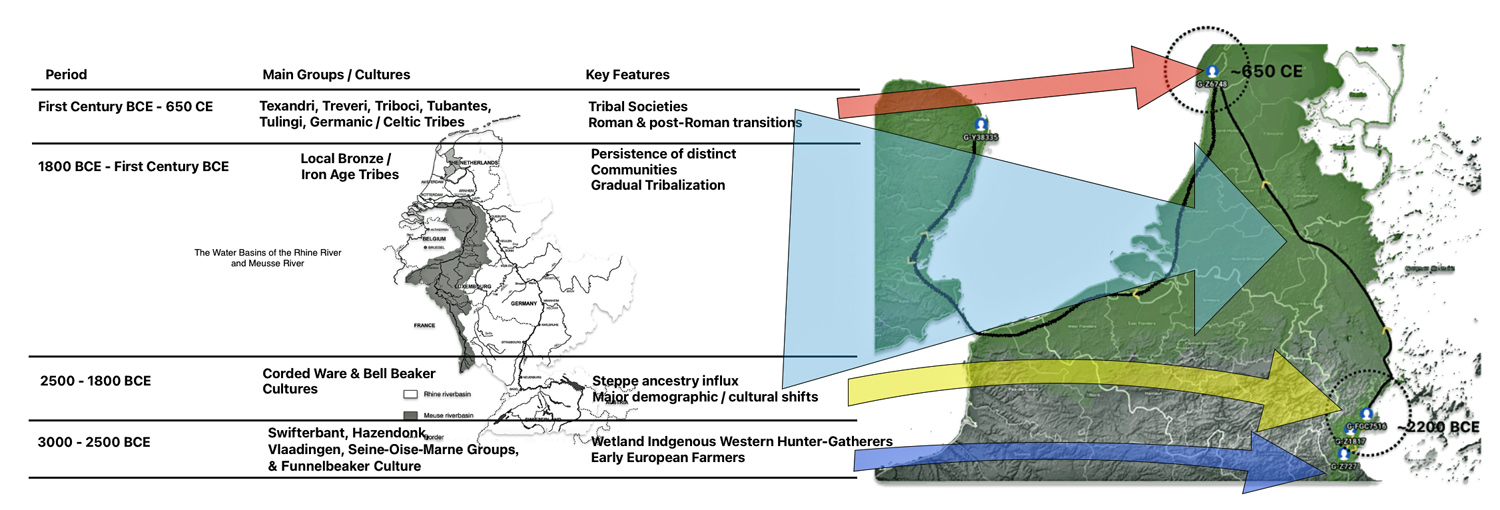


This story is the third of a four part story focusing on the examination of possible social-cultural influences that may explain the lack of identified subclades (ancestors) in the migratory path of the Griffis genetic paternal line that lived in the Meuse Rhine watershed area. This third part of the story focuses on possible influences, notably patrilineal and matrilocal practices of in coming migratory groups, leading up to and during the bronze age.
The 2,850 year Gap between G-FGC7516 and G-Z6748: This phylogenetic gap was associated with haplogroup G-FGC7516. This common ancestor was born around 2200 BCE. The next genetic ancestor on the Griff(is)(es)(ith) YDNA line was associated with the genetic SNP mutation defining the G-Z6748 haplogroup, 2,850 years later. This gap represents about 95 generations.
There are a number of social, cultural and demographic factors that may have contributed to conditions that either limited the proliferation of G haplogroup subclades or were unfavorable for the preservation or detection of intermediate lineages over nearly three millennia for the Griff(is)(es)(ith) genetic line. The following factors can collectively explain why there is an absence of documented subclades during this time period:
- the convergence of early bronze age male bottlenecks;
- the impact of patrilineal and patrilocal social kinship structures in various migrating cultures that hindered G haplogroup proliferation;
- the long tradition of the Meuse Rhine watershed characterized as an area of social and cultural diversity; and
- border overlaps between various social groups along the Rhine River.
The Meuse-Rhine Water Basin as a Cultural and Geographical Crossroads Through Time
The Rhine-Meuse basin was not simply a transitional area, but an active frontier where contact, negotiation, and preservation of distinct cultural identities shaped the archaeological record and the evolution of traditions over time. Waterways facilitated connections, anchoring traditions and contacts both within the region and with distant areas. Despite episodes of external influence or migration, local adaptation and continuity remained central, producing a unique archaeological signature for the Rhine-Meuse basin over millennia.
In a research paper entitled “Archaeology from the Dutch Twilight Zone,” the archeologists David Fontijn, Patrick Valentijn, and Harry Fokkens explore the unique archaeological landscape of the Netherlands. They particularly focus on how local prehistoric communities shaped their environments and defined themselves in relation to wider European interaction networks during the Neolithic, Bronze Age, and Iron Ages.
The article delves into the Rhine-Meuse basin as a cultural meeting point for larger prehistoric networks, analyzing how social and cultural traditions intersected and changed over time. The archeologists introduce the concept of the “Dutch Twilight Zone” which captures the idea of the Netherlands as a liminal space, a cultural and geographic crossroads where different traditions and societies met and intermingled during prehistory (see illustration one). [1]
Illustration One: Looking at the Area of the Phylogenetic Gap in the Griff(is)(es)(ith) Genetic YDNA Lineage in the Context of Early Bronze Age Regional Achealogical Traditions

“(T)he Netherlands forms an interesting research area. On distribution maps it is generally placed outside or between large exchange and communication networks: the Nordic and the Atlantic spheres or traditions. Apparently the Netherlands constitutes a kind of marginal zone in between: a twilight zone. On the other hand the Netherlands, especially the Lower Rhine basin, is often referred to as a place of origin of developments, especially with respect to Bell Beakers. There is therefore a kind of paradoxical situation: it is in between, yet central.
“At the Rhine-Meuse delta two kinds of ‘borders’ seem to have coincided: a cultural border creating a social barrier and a traffic-geographical border creating a physical barrier. Neither was impenetrable, and indeed they were traversed in certain situations.” [2]
The archeologists substantiate the characterization of the Rhine-Meuse basin as a cultural meeting point for large prehistoric networks through several key archaeological observations:
Distinct Material Traditions: The authors note that while two large interaction networks (cultural and traffic-geographic) converged in the Rhine-Meuse region, major aspects of their respective traditions often remained separate. For example, metals from the southern ‘Atlantic’ sphere seldom entered the north, and ‘Nordic’ types rarely moved south. This points to a strong but structured interaction where contact did not necessarily lead to cultural blending.
Seafaring and Maritory Zones: The paper suggests that the strict division and nature of interactions were influenced by different coastal and tidal regimes north and south of the Rhine-Meuse area. Building on Stuart Needham’s concept of regional “maritories” (maritime territories) [3] , the researchers argue that frequent contacts within these zones were facilitated by coastal seafaring, fostering complex but localized exchange networks while retaining their respective cutlural patterns. (see illustration two).
illustration Two: Model of North Sea Maritories

Persistence of Local Cultural Traits: Archaeological evidence, such as the distribution of pottery types (e.g., biconical urns and Hilversum pottery) and burial traditions, demonstrates how local identities were maintained even as the area formed part of long-distance exchange systems. This persistence of distinct traditions alongside evidence for larger scale exchange and contact is taken as a hallmark of intersecting networks, “these regionally speciic archaeological cultures, were part of larger interregional exchange
networks“. [4]
Archaeological Findings and the Broader Region: Fokkens’ landscape-scale research documents how communities adapted to the region’s unique environment, and how influences from both the Atlantic and Nordic worlds can be discerned in settlement patterns, burial practices, and material culture.
“The Rhine-Meuse basin seems to have acted as a transition zone. Here we find evidence for exchanges between the two cultural traditions in the form of the occasional Funnel Beaker pot that occurs in Vlaardingen contexts, and Funnel Beaker knob-butted hammer axes in Stein contexts. However, the two networks do not seem to mix or amalgamate, they remain quite separate. There were no borders, yet cultural differences
are apparent.” [5]
Frontier and Border Zone: The Rhine-Meuse corridor, due to its geography, marked a natural boundary between different cultural worlds: the Atlantic to the southwest and the Nordic to the northeast. Evidence for this includes vessel forms, trade goods, and hoards that demonstrate both contact and separation. [6]
Selective Adoption and Exchange: Objects and practices such as Beaker pottery, metalwork, and funerary customs reveal selective adoption of external influences, combining local traditions with elements from wider European networks, rather than wholesale cultural assimilation.
“Against this cultural background around 2600 cal BC Bell Beakers appeared. First they occurred in Single Grave and Vlaardingen contexts, but after 2400 cal BC distinct regional groups developed. They seem to unify the existing cultural palette, but this is probably only supericial. The problem is that everyone focuses on burial contexts where Beakers seem to resemble each other in style, but if we look at settlement contexts, we can see that they were introduced in existing regional contexts. These regional traditions continued under a thin layer of Beaker ‘veneer’.” [7]
“(A)rchaeologists are far too ‘simple’ in their thinking about issues of social and cultural identity. No archaeologist today would speak of a monolithic, bounded archaeological culture reflecting ‘a people’. Nonetheless, in practice many still appear to maintain the notion that ethnicity has something to do with a totality of differences in ‘objective’ cultural traits. This is true despite an already established tradition of anthropological and sociological theory stressing that ethnicity is about situational self definition based on perceived cultural differences.” [8]
It is within this general context of a ‘Dutch twilight zone’ that perhaps we can understand why there are a number of factors that can explain the lack of identified subclades between haplogroups G-FGC7516 and G-Z6748.
“(T)he Dutch twilight zone appears to have been a transitional zone between two large interaction networks that ‘on the ground’ can be surprisingly easily distinguished; not only in regional cultural traditions, but also in the distribution of metal, house styles and burial traditions. The Rhine-Meuse delta appears to have been a border zone. It is as if people in the southern Netherlands felt part of a different world, travelled more frequently to the south and the west, and preferred to interact with the ‘Atlantic’ world. Over land the Meuse valley was probably one of the connecting routes, but coastal travel and cross channel travel probably was also ‘normal’. People from the northern uplands, on the other hand, looked more to the east and the north. Their burial and housing traditions were part of the Northern world and they probably ‘recognized’ more in the regionally different cultural traditions of the north than they did in the south.“ [9]
The Most Recent Common Ancestor Associated with the Beginning of the Phylogenetc Gap
For roughly 95 generations, the genetic YDNA ancestors of the Griff(is)(es)(ith) line lived and migrated within the ‘Dutch twilight zone’. The beginning of the phylogenetic gap starts with haplogroup G-FGC7516 (see illustration three). The genetic ancestor associated with this haplogroup had a 68 percent chance of being born between 2558 BCE and 1879 BCE. It is estimated that he was born around 2195 BCE which is around the advent of the bronze age.
Illustration Three: Scientific Details for haplogroup G-FGC7516

The Most Recent Common Ancestor of haplogroup G-FGC7516 lived in the general area of western Rhine River valley in what is currently known as the northern area of the Rhineland Palatinate of Germany (see illustration four). Around 2100 BCE, the primary cultural groups present in this area were societies that included early Celts and proto-Germanic peoples. Archaeological evidence from along the Rhine indicates significant settlement by these groups from 3000 to 1800 BCE, with the population engaging in farming, pottery, and early metallurgy during what archaeologists call the Neolithic and transitional Early Bronze Age.
Illustration Four: Location of MRCA of Haplogroup G-FGC7516 at the Beginning of the Phylogenetic Gap

Distinct Celtic and Germanic identities had not yet formed as seen in later history. Instead, there was a mosaic of local Neolithic farming communities connected to these larger continental traditions.
The region maintained its importance due to its location along river trade routes and fertile land, facilitating a mix of local developments with influences arriving from the broader European context. During this period, the region was influenced by broader European prehistoric cultures, notably under the ‘thin cultural layer of veneer‘ from the Bell Beaker culture and the remnants of Corded Ware culture. These societies were ancestral to both Celtic and Germanic populations, but had not yet developed distinct Celtic or Germanic ethnic or linguistic identities by this time. [10]
Bronze Age Population Male Bottlenecks and Their Explanation
Patrilineal (father-to-son inheritance) and patrilocal or virolocal (women move to husband’s home) social systems leave distinct signatures on Y-chromosome diversity. Because men remain in their ancestral communities, dominant Y-chromosome lineages that are associated with dominant cultural groups become more homogeneous within local geograohical areas. Subordinate Y-chromosome lineages that are associated with minority cultural or social groups become less frequent. Meanwhile, incoming women from outside the dominant groups bring mitochondrial DNA diversity, but that does not affect the paternal lineages.
One of the most significant explanations for the lack of diversity and absence of Most Common Recent Ancestors (MCRAs) between haplogroups G-FGC7516 and G-Z6748 involves a well-documented genetic bottleneck that occurred during the transition from the Neolithic to the Bronze Age. This is tied to the the confluence of effects from the Corded Ware and Bell Beaker Cultures. Research has revealed a pronounced decline in male effective population sizes worldwide between roughly 3000 BCE and 1000 BCE that was not observed in female lineages. [11]
This genetic bottleneck would naturally result in the elimination of many Y-chromosome lineages, leaving fewer surviving male lines to develop subclades. This phenomenon, absent in female mitochondrial DNA, points to cultural and social dynamics rather than environmental factors. The bottleneck peaked at different times in the world. In Europe, it peaked around 3000 BCE or about 160 generations ago.
The bottleneck in Y-chromosome diversity coincided with significant cultural changes that affected the reproductive success among males. The decline in the male effective population size during this period was approximately one-twentieth of its original level in various regions of the world. This dramatic reduction would have eliminated numerous intermediate branches that might otherwise have existed in this time frame.
As mentioned in a prior story, two-thirds of all European men descend from just three haplogroup lineages identified as I1, R1a, and R1b in the late Neolithic Period. The descendants of the G2a haplogroup, such as the Griff(is)(es)(ith) YDAN lineage, experienced similar bottlenecks but did not experience as dramatic a subsequent proliferaion of lineages as did the I1, R1a, and R1 haplogroups in the bronze age. [12]
There are various explanations for this bottleneck. Earlier studies proposed that intergroup warfare between patrilineal clans caused repeated extinctions of male lineages. This hypothesis, supported by computer simulations, suggested that violent competition during the Neolithic/Bronze Age transition (when small-scale farming clans dominated) led to the loss of Y-chromosome diversity. [13] However, critics noted that even high rates of violence alone could not fully explain an observed 17:1 female-to-male effective population size ratio. [14]
Research linked the bottleneck to wealth accumulation during the Neolithic transition to agriculture. As societies shifted to agro-pastoralism, material resources enabled dominant males (and their sons) to monopolize reproductive success, drastically reducing genetic diversity among male lineages. [15] This “socially successful male” model aligns with archaeological evidence of emerging hierarchies but does not explicitly address the timing or severity of the bottleneck. [16]
A 2024 study by Léa Guyon and other researchers offers an alternative explanation centered on cultural evolution rather than violence. [17] The major factors associated with this hypothesis include:
- Patrilineal groups splitting into sub-clans of related males, homogenizing Y-chromosome lineages within groups;
- Expansions of some patrilineal groups and extinctions of others, amplified by patrilocal residence (male lineages staying localized while females migrated); and
- The bottleneck coincides with the spread of patrilineal inheritance systems followed by a recovery as bilateral kinship systems emerged.
This patrilineal system model replicates the genetic bottleneck using ethnographically documented non-violent social processes, showing that male effective population size could drop 20-fold within 100 generations through social dynamics alone.
Table One: Key Contrasts Between the Bronze Age Male Bottleneck Theories
While earlier theories emphasized conflict or inequality, the patrilineal systems hypothesis provides a parsimonious explanation that aligns with global genetic patterns and anthropological data associated with Neolithic social transitions.
G2a haplogroup lineages, initially common from earlier Neolithic populations, became marginalized as patrilineal and patrilocal social structures associated with the Corded Ware and Bell Beaker cultures favored rapid expansion of dominant male lineages (R1b) and reduced local Y-chromosome diversity for haplogroup G2a lineages. The decline of G2a subclades, such as the descendants of the most common recent ancestor of G-FGC7516, were the result of the successive generational effects of competition with dominant clans and marginalization and replacement of G2a clans (see table two).
Table Two: Mechanisms Influencing Haplogroup Decline through Successive Generations of Patrilineal and Patrilocal Descent
| Social Influence | Description |
|---|---|
| Homogeneity within emerging dominant YDNA groups | Patrilineal descent meant G lineages became concentrated within specific clans and villages, reducing overall genetic variability but increasing homogeneity in each group. [18] |
| Female exogamy | Women migrated between groups, so mitochondrial DNA was mixed, but Y-DNA (such as G2a) remained fixed within patrilocal communities. [19] |
| Cultural hitchhiking and competition | Patrilineal societies caused certain haplogroups like G to either rapidly expand (if dominant) or be outcompeted. Intergroup competition or population bottlenecks could lead to extinction of entire G lineages if their male clans were wiped out or marginalized. [20] |
| Lineal fission | New clans or sub-clans often form by splitting along lines of paternal descent. This process clusters paternally related men together in the new group, compounding the concentration of specific Y-chromosome lineages and further restricting genetic diversity within each group. [21] |
| Patrilineal Power Dynamics | Social factors such as differences in social status among clans can promote the expansion of certain lineages if high-status men have more descendants, eventually dominating the group’s Y-chromosome pool and suppressing less prevalent lineages. [22] |
| Marginalization and replacement | Through demographic processes and male-biased migrations, G2a haplogroup’s frequency dropped as R1b and other steppe-derived lineages swept into the region and took over social structures, further exacerbated by patrilocal residence and patrilineal descent rules that favor the propagation of dominant male lines. [23] |
| Group extinction dynamics | If an entire clan or group becomes extinct (whether through competition, social dynamics, or other means), all the unique Y-chromosome lineages in that group are lost. Because clans are internally homogeneous for the Y chromosome, this means whole branches of Y-chromosome diversity can disappear, even if the overall male population size does not change dramatically. [24] |
The Rhine River: The Corded Ware and Beaker Ware Cultures in the Muese-Rhine Watershed
The Rhine river formed an important boundary between two cultural zones, with the Corded Ware culture (c. 3100-2350 BCE) roughly to the east and the Bell Beaker culture (c. 2800-1800 BCE) spreading from the west and south. These cultures met at the Rhine, creating a dynamic contact zone that facilitated cultural exchange, technological innovation, and had effects on the composition of YDNA among the social groups. The Bell Beaker culture expanded eastward into Corded Ware territory from about 2400 BCE, marking a period of cultural contact and technological exchange. [25] Both of these cultures expanded throughout Europe (see illustration five).
Illustration Five: The Corded Ware and Bell Beaker Expansions

The Rhine contact zone acted as a demographic and cultural frontier where G haplogroups, once dominant among Neolithic farmers, faced steep decline due to Steppe-derived male-driven expansions. However, localized admixture in regions like the Rhine-Meuse delta allowed for fragmented survival of G lineages, particularly where pre-existing populations maintained ecological or social resilience. This dynamic underscores the interplay between migration, technological change, ecological barriers and regional adaptability in shaping genetic landscapes during the Neolithic-Bronze Age transition.
As indicated, the most recent common ancestor of haplogroup G-FGC7516 and his descendants lived during this time period in the vicinity of the middle region of the Rhine River. During this time period, the Meuse-Rhine watershed region was characterized by the interaction of the Corded Ware and Beaker Ware ‘archaeological cultures‘. The G2a haplogroup was representative of the YDNA admixture for both the Corded Ware and Beaker cultures (reference illustration six below).
Illustration Six: Corded Ware and Bell Beaker Cultures

“Archaeologists note that Corded Ware was not a “unified culture,” as Corded Ware groups inhabiting a vast geographical area from the Rhine to Volga seem to have regionally specific subsistence strategies and economies. There are differences in the material culture and in settlements and society. At the same time, they had several shared elements that are characteristic of all Corded Ware groups, such as their burial practices, pottery with “cord” decoration and unique stone-axes.” [26]
“The Bell Beaker phenomenon was not an ethnic culture like most other archeological cultures of the period, but rather represents a huge multicultural trade network inside which a variety of new artefacts, customs and ideas were exchanged and diffused, notably metalwork in copper, bronze and gold and archery.” [27]
As indicated in part two of this story, the Muese Rhine river watershed witnessed the limited adoption of Corded Ware pottery culture. It was introduced through haplogroup R1b-U106 (a steppe-associated lineage) to the region. The Funnelbeaker culture dominated much of north-central Europe, including the Rhine-Meuse region, from roughly 4300–2800 BCE. The Corded Ware culture appeared in the early third millennium BCE (around 2900–2650 BCE), eventually replacing the Funnelbeaker culture in this area.
Illustration Seven: Corded Ware Culture and the Griff(is)(es)(ith) Phylogenetic Gap

Settlement Pattern–New Results from the Central European Low Mountain Range. Proceedings of the Prehistoric Society 2009; 75: 125–142
“We should observe that Corded Ware cultures co-existed for several hundred years with late Neolithic cultures … often residing in the close neighborhood, whether Globular Amphorae cultures in Poland or Bernburger cultures in southern Germany. What we observe in the archaeological record is, therefore, a gradual process of acculturation and integration which meant that, after 2400 BC, former strict cultural boundaries were being gradually dissolved and a new shared material culture appeared … . Bell Beaker groups had by now also emerged on the scene, introducing metallurgy and further complicating the mix of cultures and people. … (I)t took nearly a thousand years until all regions in northern and central Europe had adopted a shared social and cultural outlook that in all probability also included shared languages.” [28]
In the Meuse Rhine River watershed area, the adoption of Corded Ware pottery did not coincide with a significant influx of steppe ancestry. Individuals in these settlements exhibited Corded Ware Y-chromosome lineages but retained minimal steppe genetic input. This contrasts with other parts of Europe, where Corded Ware expansion brought substantial steppe ancestry. [29]
Illustration Eight: Distribution of the Bell Beaker Phenomenon

The Bell Beaker culture emerged later, around 2600–2500 BCE in the Lower Rhine area, arising through a fusion of local populations and Corded Ware-associated migrants (see table three). This new group then expanded rapidly, replacing or assimilating earlier Corded Ware groups and spreading across northwest Europe. The Bell Beaker culture is associated with its distinctive bell-shaped pottery, copper daggers, and new burial customs. [30]
Table three provides a rough correlation between the Griff(is)(es)(ith) YDNA lineage with the population events in the Meuse- Rhine Region. The ancestors that were associated haplogroups that lived earlier than 2500 BCE may have lived in an area southwest of the Meuse Rhine area.
Table Three: Key Population Events in the Rhine-Meuse Region
| Time Period | Griff(is)(es)(ith Haplogroup | Major Event | Genetic Impact |
|---|---|---|---|
| 6500–4000 BCE | G-L497, G-CTS9737, G-Z1900, G-Z690 | Early Neolithic farmer expansion | Limited in Rhine-Meuse; hunter-gatherer continuity along with Neolithic farming groups |
| ~3000–2500 BCE | G-Z1817, G-Z727 | Corded Ware complex arrives (incorporating Neolithic groups) | Little steppe ancestry; Corded Ware Y-chromosome present |
| ~2500 BCE | G-Z1817, G-Z727, G-FGC477 | Formation of Bell Beaker groups (incorporating local & Corded Ware groups) | Major admixture, new expansive population |
| Post-2500 BCE | G-FGC7516 | Bell Beaker expansion | Disruption of local continuity, major population replacement in northwest Europe |
Over successive generations, the interaction between the Corded Ware and Bell Beaker cultures along the Rhine during the Late Neolithic and Early Bronze Age (2200–1800 BCE) likely had an influence on impeding the growth and distribution of G2a haplogroup lineages through patrilineal and patrilocal customs of the Corded Ware and Bell Beaker groups. In marginal or ecologically distinct zones (e.g., wetlands of the Rhine-Meuse delta), local populations with members of the haplogroup G2a may have resisted full assimilation, as seen in the prolonged coexistence of Funnelbeaker and Corded Ware groups. [31] This could explain sporadic G2a haplogroup survival, such as the Griff(is)(es)(ith) paternal line, in areas less dominated by Steppe migrations.
A study by Ralph Großmann underlines that the relationships between Corded Ware and Bell Beaker phenomena were complex, involving shared practices and hybrid identities rather than sharp cultural divisions. While the Corded Ware and Bell Beaker complexes of the third millennium BCE are often seen as distinct in terms of burial rituals and material culture, there are significant overlaps and interrelations between them, particularly in regions where their cultural spheres were geographically adjacent. [31a]
In regions like the Rhine and Thuringia Basins, burial practices and vessel decorations from the two cultures display notable similarities and overlap, especially where communities interacted closely in space and time. Overlaps are most pronounced near river confluences, suggesting that these were hubs of cultural interaction and exchange. The evidence points to more fluid and negotiable social identities in these regions, with possible hybrid or multiple cultural affiliations rather than strictly bounded group identities. [31b]
The Corded Ware Culture: Effects of a Patriachical Society
“For the Corded Ware complex it has been suggested that initial migrations were dominated by males, who married in women probably from residing Neolithic populations, although at present it is debated whether the genetic evidence for male-dominated migrations contributing to these groups is compelling. There is also evidence that the individual groups most likely practiced patrilocality and exogamy at a community level.” [32]
Rendition of Corded Ware Male

https://commons.wikimedia.org/wiki/File:Cees_de_steentijdman1.jpg
Archaeological and burial evidence of the Corded Ware culture points to a patriarchal society, with male burials often more elaborate and associated with weapons, suggesting the prominence of warrior elites. The society appears to have been stratified, with increasing social differentiation and competition for prestige goods and raw materials such as flint, stone, and amber. [33]
Genetic and archaeological evidence indicates the culture was formed through the interaction and amalgamation of local Neolithic populations (such as the Globular Amphora culture) with incoming steppe groups related to the Yamnaya culture. [34] Women in some regions, especially southern Germany, may have been highly mobile, possibly due to exogamous marriage practices with the incoming steppe groups. The Corded Ware culture displayed significant regional variation in pottery styles and burial customs, leading to the identification of several regional groups (e.g., Protruding Foot Beaker culture, Single Grave, Battle Axe, cultures). [35]
“… (P)astoral economies historically tend to dominate agrarian economies, as they are both more mobile and more warlike in their behaviour. Such a pattern of economic and social dominance, reflected in taking wives from farming cultures while sending young males in organised war-bands to settle in new territories, would explain both the genetic and linguistic dominance of the Yamnaya steppe migrations, the results of which we can observe to this day.” [36]
An innovative research paper by Kristia Kristiansen and colleagues integrate recent breakthroughs in genetics, stable isotope analysis, archaeology, and linguistics to re-examine how the Corded Ware Culture formed in Europe after 3000 BCE. They have documented that migration was central to the formation of the Corded Ware Culture, with ancient DNA evidence confirming a large-scale movement of Yamnaya pastoralists from the Pontic-Caspian steppe into Europe after 3000 BC. These migrations did not result in mere population replacement. The formation of Corded Ware societies was driven by complex local interactions between the incoming Yamnaya and indigenous Neolithic groups. [37]
PATRILINEAL AND PATRILOCAL OR VIROLOCAL SOCIAL SYSTEMS LEAVE DISTINCT SIGNATURES ON Y-CHROMOSOME DIVERSITY
Patrilineal and patrilocal (virolocal) social structures leave distinct, observable signatures on human Y-chromosome diversity. Patrilineal and patrilocal/virolocal systems lead to reduced Y-chromosome diversity within groups and lineages, with distinct genetic clustering matching societal divisions.
Corded Ware societies emerged through the blending of Yamnaya migrants and local Neolithic populations. This process involved not just biological – genetic mixing, but also the exchange of cultural practices, farming techniques, and language. [38]
The integration between the migratory groups and the indigenous Neolithic groups was facilitated by exogamic marriages, particularly unions between Yamnaya men and Neolithic women. This role or mechanism of exogamic marriage created a social foundation for new dialects and material cultural forms as pottery skills and linguistic influences were exchanged. It also had a diminishing effect on Neolithic YDNA G2a subclades such as the Griff(is)(es)(ith) paternal line. Illustration nine depicts the model of the social processes associated with exogamy that transformed Yamnaya culture to Corded Ware culture (labled “A”) and its subsequent migratory effects as Corded Ware culture lead to further adaptation and transformation (labeled “B”).
Illustration Nine: Social Processes of Exogamy Transforming Yamnaya to Corded Ware Culture and Its Subsequent Migration

An article by Quentin Bourgeois and Erik Kroon argues that a Corded Ware identity reflects the sharing of world views, practices, and ideas—not just common genetic backgrounds. Burial practices serve as a crucial lens for understanding the cultural transmission and social networks in Corded Ware communities. Their analysis of 1,161 Corded Ware burials across north-western Europe shows that men’s burials were much more similar across vast distances and regions, whereas women’s burial practices remained distinctly local. [39]
Illustration Ten: Distribution map of the Corded Ware burials in Bourgeois & Koon Study

Male burials featured standard positions (semi-flexed on the right side, head west and facing south) and similar grave goods, whereas female burials had more local variations. The striking similarity in male burials indicates that male burial ritual was the main vector for transmitting Corded Ware identity and funeral customs across different communities. This international character of male burials suggests that men played a central role in maintaining and spreading shared cultural practices. [40]
The differences and similarities in burial rites point to a complex society where the role of gender was significant. The uniformity in male burials, despite regional diversity, supports the theory that the Corded Ware society was male-focused, aligning with recent ancient DNA studies showing male-dominated migration patterns. [41]
Migration introduced new forms of social organization, reflected in burial customs and property transmission (individual rather than collective), with Corded Ware dominance surfacing in the centuries leading into the Bronze Age. While there was cooperation and intermarriage, evidence also indicates episodes of conflict and local diversity in the outcomes, with variation in material culture and genes depending on region. [42]
The Corded Ware culture is widely regarded as a major vector for the spread of Indo-European languages in Europe, particularly Proto-Germanic and Proto-Balto-Slavic. Its social and burial practices influenced subsequent cultures, such as the Bell Beaker culture, and contributed to the development of individualized chiefdoms and early Bronze Age societies.
An article by Kroon and other researchers highlights that the introduction of the Corded Ware Culture during the Late Neolithic on the Dutch West Coast was not a uniform process, but rather varied significantly from site to site. A core finding is the remarkable continuity of ceramic technological traditions across the region, suggesting that social practices and local technological knowledge persisted even as new material styles were introduced. [43]
The study used ceramics as a proxy for understanding cultural and social changes, applying geochemical, mineralogical, and morphological analyses to pottery from three Late Neolithic sites in the Dutch coastal area. The authors compared three hypotheses for how Corded Ware culture might have spread: migration, diffusion, and local network interactions.
There is strong evidence for continuity in ceramic production techniques across the transition to Corded Ware culture, indicating local populations maintained their methods despite adopting new styles. The adoption of Corded Ware material culture reflected a local process of cultural integration, rather than a wholesale replacement or abrupt change. The impact of Corded Ware culture introduction was site-dependent, varying in degree and manner across the studied locations. [44]
The results challenge views that see the Corded Ware phenomenon solely as a result of migration or large-scale population replacement. The study demonstrates that archaeological changes in material culture (such as pottery types) may not always indicate deep social rupture, but might instead reflect complex and regionally specific adaptations. These insights from the study emphasize the relevance of technological traditions as markers of social continuity during periods of apparent cultural change in prehistory.
Table Four: Summary of Key Features of Corded Ware Culture [45]
| Feature | Description |
|---|---|
| Pottery | Beakers and amphorae (e.g. jars with two handles) with corded decoration |
| Burial | Single inhumations under barrows; Gendered body orientation: Males were typically placed on their right side with their heads positioned towards the west; Females were typically placed on their left side with their heads positioned towards the east; and Both genders, regardless of their orientation, faced towards the south. |
| Weapons | Stone battle axes, flint arrowheads, some copper items |
| Economy | Primitive agriculture, animal husbandry, possible horse domestication and likely with an emphasis on cattle and sheep. |
| Social Structure | Individualized, patriarchal, emerging social hierarchy: the society appears to have been stratified, with increasing social differentiation and competition for prestige goods and raw materials such as flint, stone, and amber. |
| Land Use | Depending on region, may have lived in villages, hamlets, and farmsteads, with houses that were usually small and divided into two or three spaces. |
| Mobility | Use of wheeled vehicles; evidence of long-distance trade and semi-nomadic pastoralism |
| Regional Diversity | Multiple local variants; influenced by earlier and neighboring cultures. It displayed significant regional variation in pottery styles and burial customs, leading to the identification of several regional groups (e.g., Single Grave, Battle Axe, Fatyanovo cultures). |
| Kinship Patterns | Archaeological and burial evidence points to a patriarchal society, with male burials often more elaborate and associated with weapons, suggesting the prominence of warrior elites. |
| Language Impact | Spread of Indo-European languages: associated with the diffusion of Proto-Germanic and Proto-Balto-Slavic speakers, and some believe that the people of the Corded Ware Culture spoke a steppe language that contributed to some of the contemporary Indo-European languages. |
The Bell Beaker Culture: Continued Impact of Patrilineal and Matrilocal Cultural Social Practices
Before the arrival of Bell Beaker groups, the Corded Ware culture—descendants of steppe populations with significant Yamnaya ancestry—became established in the Netherlands and across northern Europe. These people brought distinctive genetic markers (such as Y-chromosome haplogroup R1b-M269) into the region. When Bell Beaker practices spread, they often did so among populations already rich in steppe-related ancestry, especially in the central and northern Netherlands. [46]
Around 2500 BCE, a significant demographic shift occurred with the emergence of Bell Beaker-associated populations. These groups arose through the fusion of local Rhine-Meuse inhabitants (contributing 9–17% of ancestry) and Corded Ware-associated migrants of both sexes. This new population expanded rapidly from the Rhine-Meuse region, disrupting the long-standing local continuity. [47]
The interaction between the dominant Corded Ware and Bell Beaker cultures along the Rhine during the Late Neolithic and Early Bronze Age (2200–1800 BCE) likely had an influence on limiting the growth and distribution and G haplogroup lineages, particularly the descendants of the most common recent ancestor of G-FGC7516.
Depiction of a Bell Beaker Man

The ‘Rhine contact zone’ facilitated the transfer of copper metallurgy (linked to Bell Beaker networks) and agricultural practices. While these exchanges promoted cultural hybridization, they did not necessarily correlate with significant genetic retention of G2a haplogroup lineages, which were more tied to earlier Neolithic demographics and social practices.
An interesting study by Karl-Göran Sjögren and Volker Heyd and other researchers provides a cross-disciplinary analysis of kinship and social structure in Late Copper Age Bell Beaker communities through archaeological, genetic, isotopic, and anthropological examinations of two cemeteries in southern Germany (Alburg and Irlbach). The study involved the research of archeologists, historians, anthropologists and molecular biologists.
The study demonstrates that Bell Beaker communities organized themselves around male lines of descent, practiced female exogamy, and used burial customs that highlighted the social centrality of boys and men—prefiguring characteristics of later, historically documented Indo-European societies. The study fundamentally shifts our understanding of how family ties, inheritance, and social cohesion were constructed among early Europeans. [48]
Anthropometric analysis of the skeletons enabled the determination of sex and age at death. Strontium and oxygen isotope ratios in tooth enamel were determined to find out if individuals grew up at similar or different geographical locations. This, combined with the sequence analysis of DNA fragments from bones, provided evidence for a patrilocal society in both communities. Whereas males shared a single Y-haplotype there was a much higher maternal genetic diversity, with 23 mitochondrial haplotypes in 34 individuals.
The reconstructed pedigrees were consistent with monogamy combined with exogamy, as six of eight non-locals were women. successive generations of males remained in these communities and women came from elsewhere. In this way property such as farming grounds could be conserved and inbreeding was prevented. The single Y-haplotype, with a Steppe-pastoralist origin from Eurasia, is still the dominant type in central and western Europe today.
“By combining the various sciences, and applying them to the 42 graves of our two late Bell Beaker culture cemeteries, (the researchers proposed) a model characterized by six social principles:
- The basic kinship units are nuclear families. By this we simply imply a small family group rather than an extended family group. ...
- These nuclear family groups are based on patriarchal, patrilinear and patrilocal residency
lines. … - The marriage system is based on female exogamy and likely monogamous. …
- The inheritance system is likely based on male primogeniture. …
- Nuclear families likely formed independent households. … (and)
- Families/households formed alliances through kinship and the observed exogamic practices and foster children further forged such alliances, likely linking families into clans. Alliances were thus regional rather than closely local, and they could have formed larger political and ethnic entities to be mobilized in periods of unrest, or during periods of expansion.” [49]
Illustration eleven provides a schematic depiction of how Bell Beaker patrilineal based new settlements were established and consolidated through the marriage of Corded Ware men and Neolithic females from outside groups. In the context of the expansionist kinship system revealed by the study, the concept of foster sons also plays a significant role, both in the Bell Beaker communities discussed in their study and in later Indo-European societies. Foster sons acted as living links between families and communities, cementing the cooperative and expansionist orientation of Bell Beaker society.
Illustration Eleven: Bell Beaker Kinship and Social Organization

The study notes that such patterns—male-centered descent, the preferential burial of young boys, and exogamous marriage patterns—reflect kinship mechanisms that later appear in Indo-European societies, where fosterage of sons becomes a well-attested tradition (see table five).
Table Five: Role and Utilization of Foster Sons in Bell Beaker Culture [50]
| Role | Utilization |
|---|---|
| Fosterage as Alliance-Building | Foster sons (“fosterage”) involved sending young boys to be raised by families outside their birth group, often with allied families or communities. This practice built social and political ties, extended trust networks, and reinforced alliances between distinct lineages or groups. |
| Socialization and Integration | Foster sons would become closely affiliated with their host families, forming almost familial bonds with their non-biological “parents” and siblings. This system allowed boys to gain social capital, language skills, and knowledge of other communities, making them valuable cultural and diplomatic bridges. |
| Expansionist Strategy | By fostering sons out to other communities, Bell Beaker groups could strengthen inter-community relationships, reduce the risk of conflict, and facilitate trade and cooperation. This practice also helped to integrate and stabilize rapidly expanding social networks as these communities spread across Europe. |
| Elite Status and Selectivity | The archaeological bias for burying male youths may be a reflection of this practice. Communities invested more in the status and commemoration of boys, especially those with ties (by blood or fosterage) that reinforced the kin-group’s reach and alliances. |
The study by Karl-Göran Sjögren, Volker Heyd and other researchers provide cogent aguments based on empirical research regarding the influence of Bell Beaker kinship social patterns on migration and admixture of YDNA haplogroups. Their study focused on Bell Beaker settlements in what are close contemporary areas of lower Bavaria Germany (see illustration twelve). These settlements were southwest of the Meusse Rhine River watershed area where Griff(is)(es)(ith) YDNA descendants lived during the time period that is being discussed in this story.
Illustration Twelve: Location of Two Bell Beaker Culture Cemetery Sites

One might question the validity of generalizing the conclusions of this and other related studies for their apllicability to the Muese Rhine Watershed area. As stated, the Bell Beaker culture represented a huge multicultural trade network with many local regional variations. It is possible and probable, despite the distance of roughly 420 miles between the two geographical areas, that the socio-cultural characterteristics may have been very similar between the two geographic areas. [51]
“A wide range of regional diversity persists within the widespread late Beaker culture, particularly in local burial styles (including incidences of cremation rather than burial), housing styles, economic profile, and local ceramic wares (Begleitkeramik). Nonetheless, according to Lemercier (2018) the mature phase of the Beaker culture represents ‘the appearance of a kind of Bell Beaker civilization of continental scale’.“ [52]
The Bell Beaker culture of the Meuse-Rhine region was dynamic and characterized by social hierarchies, diverse burial and material practices, long-distance exchange, and interaction with neighboring groups, all within a context of local adaptation. [53]
Skeletal Remains of Adult and Child at Altwies, Luxembourg

A study by Nicoletta Zelda and associates revisited two exceptional Beaker period adult–child graves, one in Altwies (Luxembourg) and the other in Dunstable Downs (Britain), using ancient DNA analysis. Altwies is located within the
Meuse-Rhine watershed area.
The research advances understanding of Beaker period social structure, family relationships, and funeral rites, showing both the importance of biological kin and the potential roles of substitute parents within extended families. [54]
Genetic analysis suggests that at least some Bell Beaker communities in Western Eurasia practiced a form of patrilineal descent. For instance, the Dunstable Downs burial paired a paternal aunt and her niece, indicating the importance of paternal kin—possibly reflecting inheritance, descent, or social status passed through the male line. Grave orientation in Altwies also followed the sex of the child, not the biological mother, further supporting a patrilineal or patricentric system. [55]
The use of shared burials for adults and children likely had symbolic meaning, possibly highlighting family status, lineage, or emphasizing transgenerational links within communities. These practices also mark the transition from collective to individual burials, underlining a shift in attitudes toward family, children, and social identity. [56]
The inclusion of substitute parents (such as a paternal aunt) in burials indicates that extended family members took on caregiver roles, sometimes substituting for biological parents in both social life and burial practices. This suggests that Beaker social systems were flexible and valued non-nuclear familial bonds, especially on the paternal side. [57]
The similarities in grave goods, burial postures, and arrangement across geographically distant sites (e.g., Luxembourg and Britain) point to widely held, highly formalized burial rituals. These reflect community-wide standards of mourning and memorializing, indicating coordinated cultural beliefs and behaviors across Beaker regions—independent of local variation. [58]
Regional Variations of the Beaker Culture in the Meuse Rhine Watershed Area
The genetic profiles of Dutch Bell Beaker individuals show admixture not only from incoming steppe-related groups but also from earlier European Neolithic farmers and indigenous hunter-gatherers. This created a heterogeneous genetic makeup, visible in the variety of mitochondrial and Y-chromosome haplogroups found in Beaker-era remains, and evidenced by studies showing a mix of ancestries within local sites. [59]
Regional backgrounds played a crucial role in shaping the development of the Bell Beaker culture in the Meuse Rhine watershed area. Instead of a single, straightforward evolution, the transition to Bell Beaker culture occurred differently across various Dutch regions, reflecting their unique cultural and settlement histories. [60]
The Netherlands sat at a crossroad between different Late Neolithic cultures: the Single Grave Culture (a variant of the Corded Ware), the Vlaardingen Culture to the west, and continued contact with regions to the south and east. This location fostered the blending of traditions—forms, decorated pottery, and burial customs—resulting in Dutch Bell Beaker culture that sometimes bridged or combined elements from neighboring regions rather than simply copying them. [61]
Where some Dutch regions, particularly in the central and east, show continuity from Single Grave to Bell Beaker traditions, the west and south (with more influence from the Vlaardingen culture) witnessed abrupt transitions as external Beaker elements were introduced and reshaped local traditions. These varied pathways demonstrate that cross-cultural interaction, involving migration, exchange, and local adaptation, was central to Beaker diversity in the Meuse Rhine watershed area. [62]
Cross-cultural interactions, including the movement of clans, intermarriage, trade, and the selective adoption of foreign elements, fueled the diversity of the Beaker phenomenon in the Netherlands, with each region reflecting the unique ways that local and external traditions blended. [63]
Beakers, more than any artifact series in Dutch prehistory, are “international” in character, reflecting the Netherlands’ position in broader European trade and communication networks. The multiplicity of Beaker forms and practices found locally document these wide-ranging cultural influences. [64]
Social dynamics were shaped by competition among descent groups and individuals for prestige, status, power, and wealth. This competition fostered a moderate degree of social ranking and the emergence of local elites, but did not reach the full social stratification seen in later chiefdoms or state structures. Leadership was likely in the hands of local elites who controlled the production and distribution of valuable goods, such as the characteristic bell-shaped pottery. Personal prestige and status were important, as reflected in burial practices and grave goods.
A study by Marc Vander Linden challenges the traditional interpretation of third millennium BCE European societies as being dominated by rigid social hierarchies, especially in the context of the Bell Beaker culture. Rather than societies strictly organized around elites competing for prestige, Vander Linden’s research suggests that the Bell Beaker period saw the emergence of more fluid and dynamic social structures. These were marked by increased mobility and the widespread circulation of people, ideas, and material culture. The evidence from southern France indicates that the Bell Beaker culture fostered integration and connectivity between different groups, promoting collaboration and the formation of wider social networks. This perspective puts less emphasis on the accumulation and display of wealth by a small group of elites. [64a]
The study urges archaeologists to reconsider the evidence for social hierarchy and the narrative of bronze-age societies progressing linearly toward greater stratification. Instead, the Bell Beaker phenomenon may represent an alternative model of community building and interaction, centered on shared practices and social cohesion. Vander Linden’s interpretation broadens the understanding of prehistoric European social organization, highlighting the role of networks, exchange, and integration rather than just competition and hierarchy. This can impact how scholars interpret similar patterns in other regions and periods, questioning the assumed inevitability of hierarchical development in early complex societies.
As summarized in table six, the Bell Beaker culture in the Meuse-Rhine watershed area is characterized by several key features of social organization and culture, as revealed by archaeological and recent scientific research.
Table Six: Notable Features of Bell Beaker Culture in the Meuse Rhine Watershed Area
| Feature | Description |
|---|---|
| Hybrid Identities and Cultural Contact | The Meuse-Rhine watershed was a region where different groups met and interacted, especially at river confluences. This led to overlapping characteristics in burial and material culture, such as vessel decoration styles shared between Bell Beaker and Corded Ware groups. The result was a fluid social identity and occasional hybridization. [65] |
| Trade and Mobility | While many groups practiced sedentary farming, others maintained mobile lifestyles, possibly as traders or pastoralists. This diverse settlement pattern likely contributed to the rapid spread of Bell Beaker goods and culture across Europe. The Bell Beaker people were part of extensive exchange networks, moving raw materials such as copper over long distances. The Rhine-Meuse area served as an essential network node, facilitating interactions between different cultural groups, and the spread of both population and ideas. Bell Beaker people relied on and innovated sea-based and coastal routes to expand their culture widely across Europe, with a particular focus on the Atlantic littoral and the Mediterranean basin. [66] |
| Settlement Patterns & Landscape | Bell Beaker groups typically lived in small settlements, rather than large, centralized societies. Typical Bell Beaker settlements housed small villages of 30 to 50 inhabitants. Archaeological evidence suggests that the Bell Beaker people inhabited both sedentary farming settlements and maintained mobile elements. The settlement structure in the region adapted to the local landscape—such as river valleys and higher ground, mirroring an ability to blend new ideas with existing traditions. [67] |
| Kinship Patterns | Social life was organized around descent groups, with kinship (biological or mythical) being the main organizing principle. These groups likely had a clan structure, often exogamous and patrilineal, emphasizing descent from a common ancestor. [68] |
| Social Structure | The presence of specialized craft goods suggests an economy that valued certain occupations, such as metalworking. Some settlements likely functioned as specialized production or trade centers for particular goods. Emerging social hierarchy: the society appears to have been stratified, with increasing social differentiation and competition for prestige goods and raw materials such as flint, stone, and amber. [69] |
| Burial | Bell Beaker burial styles included single, crouched inhumations in individual graves, often with a bell-shaped pot, flint arrowheads, and a stone wrist guard as grave goods, and typically located on well-drained soil. Burial orientation varied by region and sex, with males in Continental Europe generally on their left side and females on their right, both facing east. Graves could be flat or covered by circular mounds, with some evidence suggesting extended family burials and a focus on kin relationships. [70] |
| Burial & Symbolic Practices | Not every person received a Bell Beaker burial, which suggests that burial with bell beaker ceramics and goods was a selective, perhaps prestigious, rite reserved for particular individuals or events. [71] |
| Pottery | Regional diversity of Bell Beaker ceramics in the northwestern Mediterranean (Spain, France, Italy). This diversity, evident in decorative styles and burial contexts, enables researchers to construct detailed chronological sequences and to trace the arrival, adoption, and adaptation of Bell Beaker elements within local societies. [72] |
Challenges of Poor Skeletal Preservation in the Meuse Rhine Watershed Area
The Meuse-Rhine watershed is not an ideal environment for long-term skeletal preservation due to its high humidity and waterlogged conditions. DNA is vulnerable to degradation from microbial action, hydrolysis, and oxidation, all of which are exacerbated in damp environments. Many archaeological sites in the region contain only small, morphologically unidentifiable bone fragments, rather than complete skeletons. Environmental factors like soil properties, temperature, and exposure to humidity are significant factors in how well bone and DNA are preserved. [73]
Despite widespread poor skeletal preservation in the Meuse-Rhine watershed due to adverse environmental conditions, significant ancient DNA (aDNA) data have been successfully recovered. Researchers have overcome the challenges of poor preservation by targeting denser bone elements like the petrous bone and teeth, where DNA is better protected. The region’s archaeological record, though subject to decay from its riverine and wetland environments, has yielded substantial genetic information that has reshaped the understanding of European prehistory. [74]
Archaeologists and paleogeneticists have successfully extracted extensive aDNA from the Meuse-Rhine area, demonstrating that usable genetic material is available even in poorly preserved skeletal remains. The dense petrous part of the temporal bone and the cementum of teeth are known to protect DNA from environmental decay far better than other skeletal elements. For example, a 2025 study was able to assemble genome-wide data for 109 people dating from 8500–1700 BCE from the Rhine-Meuse area. The success of this study in collecting a large dataset confirms that despite poor overall preservation, high-yield specimens can be found. [75]
The ancient DNA data recovered from the Meuse-Rhine area have provided groundbreaking insights into the region’s population history, particularly for the periods of 8500–1700 BCE. Genetic analysis revealed a high proportion of hunter-gatherer ancestry persisting in the Rhine-Meuse area for three millennia longer than in many other parts of continental Europe. The data document a unique demographic transition. Unlike other regions that saw a near-complete turnover with the arrival of farmers, the Rhine-Meuse area experienced persistent hunter-gatherer presence and an exceptional pattern of interaction with incoming populations.
The genetic analysis also showed that the arrival of the Bell Beaker complex in the western Netherlands was unique. The local lowland population that adopted the pottery had very little steppe ancestry, unlike their counterparts elsewhere in Europe. [76]
“The spread of CW (Corded Ware) influence to the wider Rhine-Meuse area was more complex than in many areas of central and eastern Europe. In the uplands, where skeletal material tends to be poorly preserved and no ancient DNA data are available, the complete CW package emerged; marked by the construction of CW burial mounds, the general absence of settlements, and sparse pottery finds.” [77]
“The arrival of the BB (Bell Beaker) complex around 2500 BCE marked another major cultural transition, as settlements spread across the wetlands and coastal areas, replacing Vlaardingen/CW settlements, though generally not using the same sites. The BB economy was similar to the previous CW one and consisted of predominantly farming mixed with low-intensity hunting and gathering. In the sandy uplands, there was a continuation of the barrow ritual, but with distinct BB characteristics and material culture replacing the CW repertoire. BB groups were also well attested south of the Rhine, as evident in BB burial mounds on the sandy soils of the southern Netherlands and Belgium. BB settlement sites remain just as elusive in this area as CW settlements. However, the presence of ploughland dated to the Late Neolithic suggests that the lack of settlement evidence is not the result of nomadism but rather of settlements in lower lying places where there is little chance for detection by archaeologists.“ [78]
While there have been technological inovations in extracting aDNA from poorly preserved remains, a challenge still exists in finding skeletal remains of individuals who represent YDNA haplogroups, such as various subclades in the G2a hapklogroup, that have been marginalized through time.
The Next Part of this Story
The fourth part of this story discusses the enduring social, cultural and demographic factors that may have contributed to the continued lack of subclade development for the Griff(is)(es)(ith) paternal YDNA line during and after the bronze age up to the end of the phylogenic gap around 650 CE.
The lack of identified YDNA subclades documenting the migratory path in the Meuse Rhine watershed area can be partly attributed to three major demographic factors that limited the subsequent growth of G2a subclades, particularly the Griff(is)(es)ith) paternal line:
- the persistence and admixture of I2 and C1 hunter-gatherer haplogroups with G2a farming haplogroups in the late neolithic;
- the enduring impact of R1b Bell Beaker migrating groups into the area in the post Neolithic and early Bronze age; and
- the continued dominance of R1b social and cultural factors on G2a subclade growth.
Source:
Feature Banner: The banner at the top of the story features a map of the phylogenetic gaps discussed in the story. The map was generated by taking a snapshop from the FamilyTreeDNA GlobetrekkerTM video of the migratory path of my YDNA descendants over time. The map shows the migratory path of selected most common recent ancestors and their respective estimated dates of birth. The table in the middle of the banner points to the influence of the Corded Ware and Bell Beaker cultures. The illustration on the right provides a schematic depiction of how Bell Beaker patrilineal based new settlements were established and consolidated through the marriage of Corded Ware men and Neolithic females from outside groups. This social process had a negative impact on the proliferation of G2a YDNA subclades.
[1] David Fontijn, Patrick Valentijn, and Harry Fokkens, Archaeology from the Dutch Twilight Zone, in Sophie Bergerbrant and Serena Sabatini (ed), Counterpoint: Essays in Archaeology and Heritage Studies in Honour of Professor Kristian Kristiansen, Oxford: Archaeopress, 2013, 531-540 , https://www.academia.edu/6072124/Archaeology_of_the_Dutch_Twilight_Zone
[2] David Fontijn, Patrick Valentijn, and Harry Fokkens, Archaeology from the Dutch Twilight Zone, Page 539
[3] Needham, Stuart, Encompassing the Sea: ‘Maritories’, and Bronze Age maritime interactions, 12-37, in Peter Clark, ed, Bronze Age Connections Cultural Contact in Prehistoric Europe, Oxford: Oxbow Books, 2006 https://dokumen.pub/qdownload/bronze-age-connections-cultural-contact-in-prehistoric-europe-1842173480-9781842173480.html
[4] David Fontijn, Patrick Valentijn, and Harry Fokkens, Archaeology from the Dutch Twilight Zone, in Sophie Bergerbrant and Serena Sabatini (ed), Counterpoint: Essays in Archaeology and Heritage Studies in Honour of Professor Kristian Kristiansen, Oxford: Archaeopress, 2013, 533 , https://www.academia.edu/6072124/Archaeology_of_the_Dutch_Twilight_Zone
[5] David Fontijn, Patrick Valentijn, and Harry Fokkens, Archaeology from the Dutch Twilight Zone, Page 533
[6] Fokkens, Harry, The Periodization of the Dutch Bronze Age: A Critical Review, in Metz, W.H. Beek, B.L. van Steegstra, H (eds) Patina. Essays presented to Jay Jordan Butler on the occasion of his 80th birthday (pp.241-262), Metz, Van Beek & Steegstra
https://www.researchgate.net/publication/28646850_The_periodisation_of_the_Dutch_Bronze_Age_a_critical_review
[7] David Fontijn, Patrick Valentijn, and Harry Fokkens, Archaeology from the Dutch Twilight Zone, Pages 533-534
[8] David Fontijn, Patrick Valentijn, and Harry Fokkens, Archaeology from the Dutch Twilight Zone, Page 535
[9] David Fontijn, Patrick Valentijn, and Harry Fokkens, Archaeology from the Dutch Twilight Zone, Page 535
See also
Kooijmans, Leendert P Louwe, The Mesolithic/Neolithic transformation in the lower Rhine basin, Chapter Four in Peter Bogucki, Case Studies in european History, Boca Raton: CRC Press, 1993, Page 124 Figure 9 Chrono-stratigraphical scheme for the Neolithic period in the Lower Rhine Basin and adjacent areas. https://doi.org/10.1201/9781003419822-7 https://www.taylorfrancis.com/books/edit/10.1201/9781003419822/case-studies-european-prehistory-peter-bogucki?refId=a55e84a0-38cf-4a19-94b4-a9326a40545f&context=ubx , https://www.academia.edu/92961345/The_Mesolithic_Neolithic_transformation_in_the_lower_Rhine_basin
Louwe Kooijmans L.P. , 1998. Understanding the Meso/Neolithic Frontier in the Lower Rhine Basin, 5300-4300 cal BC. In M. R. Edmonds and C. C. Richards (eds.), Understanding the Neolithic of North-Western Europe: 407-427. Glasgow: Cruithne Press. https://archive.org/details/understandingneo0000unse/page/420/mode/2up
[10] Olalde I, Brace S, Allentoft ME, Armit I, Kristiansen K, Booth T, Rohland N, Mallick S, Szécsényi-Nagy A, Mittnik A, Altena E, Lipson M, Lazaridis I, Harper TK, Patterson N, Broomandkhoshbacht N, Diekmann Y, Faltyskova Z, Fernandes D, Ferry M, Harney E, de Knijff P, Michel M, Oppenheimer J, Stewardson K, Barclay A, Alt KW, Liesau C, Ríos P, Blasco C, Miguel JV, García RM, Fernández AA, Bánffy E, Bernabò-Brea M, Billoin D, Bonsall C, Bonsall L, Allen T, Büster L, Carver S, Navarro LC, Craig OE, Cook GT, Cunliffe B, Denaire A, Dinwiddy KE, Dodwell N, Ernée M, Evans C, Kuchařík M, Farré JF, Fowler C, Gazenbeek M, Pena RG, Haber-Uriarte M, Haduch E, Hey G, Jowett N, Knowles T, Massy K, Pfrengle S, Lefranc P, Lemercier O, Lefebvre A, Martínez CH, Olmo VG, Ramírez AB, Maurandi JL, Majó T, McKinley JI, McSweeney K, Mende BG, Modi A, Kulcsár G, Kiss V, Czene A, Patay R, Endrődi A, Köhler K, Hajdu T, Szeniczey T, Dani J, Bernert Z, Hoole M, Cheronet O, Keating D, Velemínský P, Dobeš M, Candilio F, Brown F, Fernández RF, Herrero-Corral AM, Tusa S, Carnieri E, Lentini L, Valenti A, Zanini A, Waddington C, Delibes G, Guerra-Doce E, Neil B, Brittain M, Luke M, Mortimer R, Desideri J, Besse M, Brücken G, Furmanek M, Hałuszko A, Mackiewicz M, Rapiński A, Leach S, Soriano I, Lillios KT, Cardoso JL, Pearson MP, Włodarczak P, Price TD, Prieto P, Rey PJ, Risch R, Rojo Guerra MA, Schmitt A, Serralongue J, Silva AM, Smrčka V, Vergnaud L, Zilhão J, Caramelli D, Higham T, Thomas MG, Kennett DJ, Fokkens H, Heyd V, Sheridan A, Sjögren KG, Stockhammer PW, Krause J, Pinhasi R, Haak W, Barnes I, Lalueza-Fox C, Reich D. The Beaker phenomenon and the genomic transformation of northwest Europe. Nature. 2018 Mar 8;555(7695):190-196. doi: 10.1038/nature25738. Epub 2018 Feb 21. Erratum in: Nature. 2018 Mar 21;555(7697):543. doi: 10.1038/nature26164. PMID: 29466337; PMCID: PMC5973796. (MedPub) https://pmc.ncbi.nlm.nih.gov/articles/PMC5973796/
Iñigo Olalde, Selina Brace, Morten E. Allentoft, Ian Armit, et al, The Beaker phenomenon and the genomic transformation of northwest Europe, Nature, 21 February 2018, https://reich.hms.harvard.edu/sites/reich.hms.harvard.edu/files/inline-files/nature25738_Olalde_0_1.pdf
[11] Guyon, L., Guez, J., Toupance, B. et al. Patrilineal segmentary systems provide a peaceful explanation for the post-Neolithic Y-chromosome bottleneck. Nat Commun 15, 3243 (2024). https://doi.org/10.1038/s41467-024-47618-5
Dussault, Joseph, How a few Bronze Age forefathers gave rise to most of Europe’s men, 10 Jun 2024, The Christian Science Monitor, https://www.csmonitor.com/Science/2015/0522/How-a-few-Bronze-Age-forefathers-gave-rise-to-most-of-Europe-s-men
[12] Spencer, Rob, Data Source and SNP Dates, Discussion, SNP Tracker, https://scaledinnovation.com/gg/snpTracker.html
Batini, C., Hallast, P., Zadik, D., Maisano Delser, P., Benazzo, A., Ghirotto, S., Arroyo-Pardo, E., Cavalleri, G.L., de Knijff, P., Myhre Dupuy, B., Eriksen, H.A, King, T.E., López de Munain, A., López-Parra, A.M., Loutradis, A., Milasin, J., Novelletto, A., Pamjav, H., Sajantila, A., Tolun, A., Winney, B., and JOBLING, M.A. (2015) Large-scale recent expansion of European patrilineages shown by population resequencing. Nature Comm., 6, 7152. doi:10.1038/ncomms8152, (PubMed) https://pubmed.ncbi.nlm.nih.gov/25988751/
Hallast, P., Batini, C., Zadik, D., Maisano Delser, P., Wetton, J.H., Arroyo-Pardo, E., Cavalleri, G.L., de Knijff, P., Destro Bisol, G., Myhre Dupuy, B., Eriksen, H.A, Jorde, L.B., King, T.E., Larmuseau, M.H., López de Munain, A., López-Parra, A.M., Loutradis, A., Milasin, J., Novelletto, A., Pamjav, H., Sajantila, A., Schempp, W., Sears, M., Tolun, A., Tyler-Smith, Van Geystelen, A., Watkins, S., Winney, B., and JOBLING, M.A. (2015) The Y-chromosome tree bursts into leaf: 13,000 high-confidence SNPs covering the majority of known clades. Mol. Biol. Evol., 32, 661–673. doi: 10.1093/molbev/msu327 , (PubMed). https://pubmed.ncbi.nlm.nih.gov/25988751/
Zeng, T.C., Aw, A.J. and Feldman, M.W., 2018. Cultural hitchhiking and competition between patrilineal kin groups explain the post-Neolithic Y-chromosome bottleneck. Nature communications, 9(1), p.2077.
[13] Karmin M, Saag L, Vicente M, Wilson Sayres MA, Järve M, Talas UG, Rootsi S, Ilumäe AM, Mägi R, Mitt M, Pagani L, Puurand T, Faltyskova Z, Clemente F, Cardona A, Metspalu E, Sahakyan H, Yunusbayev B, Hudjashov G, DeGiorgio M, Loogväli EL, Eichstaedt C, Eelmets M, Chaubey G, Tambets K, Litvinov S, Mormina M, Xue Y, Ayub Q, Zoraqi G, Korneliussen TS, Akhatova F, Lachance J, Tishkoff S, Momynaliev K, Ricaut FX, Kusuma P, Razafindrazaka H, Pierron D, Cox MP, Sultana GN, Willerslev R, Muller C, Westaway M, Lambert D, Skaro V, Kovačevic L, Turdikulova S, Dalimova D, Khusainova R, Trofimova N, Akhmetova V, Khidiyatova I, Lichman DV, Isakova J, Pocheshkhova E, Sabitov Z, Barashkov NA, Nymadawa P, Mihailov E, Seng JW, Evseeva I, Migliano AB, Abdullah S, Andriadze G, Primorac D, Atramentova L, Utevska O, Yepiskoposyan L, Marjanovic D, Kushniarevich A, Behar DM, Gilissen C, Vissers L, Veltman JA, Balanovska E, Derenko M, Malyarchuk B, Metspalu A, Fedorova S, Eriksson A, Manica A, Mendez FL, Karafet TM, Veeramah KR, Bradman N, Hammer MF, Osipova LP, Balanovsky O, Khusnutdinova EK, Johnsen K, Remm M, Thomas MG, Tyler-Smith C, Underhill PA, Willerslev E, Nielsen R, Metspalu M, Villems R, Kivisild T. A recent bottleneck of Y chromosome diversity coincides with a global change in culture. Genome Res. 2015 Apr;25(4):459-66. doi: 10.1101/gr.186684.114. Epub 2015 Mar 13. PMID: 25770088; PMCID: PMC4381518, (PubMed) https://pubmed.ncbi.nlm.nih.gov/25770088/
[14] Guyon, L., Guez, J., Toupance, B. et al. Patrilineal segmentary systems provide a peaceful explanation for the post-Neolithic Y-chromosome bottleneck. Nat Commun 15, 3243 (2024). https://doi.org/10.1038/s41467-024-47618-5
CRNS, Social change may explain decline in genetic diversity of the Y chromosome at the end of the Neolithic period, 24 April 2024, Phys.Org, https://phys.org/news/2024-04-social-decline-genetic-diversity-chromosome.html
Zeng, T.C., Aw, A.J. & Feldman, M.W. Cultural hitchhiking and competition between patrilineal kin groups explain the post-Neolithic Y-chromosome bottleneck. Nat Commun9, 2077 (2018). https://doi.org/10.1038/s41467-018-04375-6
[15] Guyon, L., Guez, J., Toupance, B. et al. Patrilineal segmentary systems provide a peaceful explanation for the post-Neolithic Y-chromosome bottleneck. Nat Commun 15, 3243 (2024). https://doi.org/10.1038/s41467-024-47618-5
[16] Guyon, L., Guez, J., Toupance, B. et al. Patrilineal segmentary systems provide a peaceful explanation for the post-Neolithic Y-chromosome bottleneck. Nat Commun 15, 3243 (2024). https://doi.org/10.1038/s41467-024-47618-5
Zeng, T.C., Aw, A.J. & Feldman, M.W. Cultural hitchhiking and competition between patrilineal kin groups explain the post-Neolithic Y-chromosome bottleneck. Nat Commun9, 2077 (2018). https://doi.org/10.1038/s41467-018-04375-6
S. Brunel, E.A. Bennett, L. Cardin, D. Garraud, H. Barrand Emam, A. Beylier, B. Boulestin, F. Chenal, E. Ciesielski, F. Convertini, B. Dedet, S. Desbrosse-Degobertiere, S. Desenne, J. Dubouloz, H. Duday, G. Escalon, V. Fabre, E. Gailledrat, M. Gandelin, Yves Gleize , Sébastien Goepfert , Jean Guilaine , Lamys Hachem, Michael Ilett, François Lambach , Florent Maziere, Bertrand Perrin, Suzanne Plouind , Estelle Pinard, Ivan Praud, Isabelle Richard , Vincent Riquier , Réjane Roure, Benoit Sendraf, Corinne Theveneth, Sandrine Thiol , Elisabeth Vauquelin, Luc Vergnaud, Thierry Grangea,, Eva-Maria Geigl, and Melanie Pruvos, Ancient genomes from present-day France unveil 7,000 years of its demographic history, Proc. Natl. Acad. Sci. U.S.A.117 (23) 12791-1279 https://doi.org/10.1073/pnas.1918034117(2020). https://www.pnas.org/doi/10.1073/pnas.1918034117
[17] Guyon, L., Guez, J., Toupance, B. et al. Patrilineal segmentary systems provide a peaceful explanation for the post-Neolithic Y-chromosome bottleneck. Nat Commun 15, 3243 (2024). https://doi.org/10.1038/s41467-024-47618-5
[18] Léa Guyon, Jérémy Guez, Bruno Toupance, Evelyne Heyer, Raphaëlle Chaix. Patrilineal segmentary systems provide a peaceful explanation for the post-Neolithic Y-chromosome bottleneck. Nature Communications, 2024; 15 (1) DOI: 10.1038/s41467-024-47618-5
CNRS. “Social change may explain decline in genetic diversity of the Y chromosome at the end of the Neolithic period.” ScienceDaily. ScienceDaily, 26 April 2024. www.sciencedaily.com/releases/2024/04/240424111621.htm
Zeng TC, Aw AJ, Feldman MW. Cultural hitchhiking and competition between patrilineal kin groups explain the post-Neolithic Y-chromosome bottleneck. Nat Commun. 2018 May 25;9(1):2077. doi: 10.1038/s41467-018-04375-6. PMID: 29802241; PMCID: PMC5970157 https://pmc.ncbi.nlm.nih.gov/articles/PMC5970157
Raphaëlle Chaix, Frédéric Austerlitz, Tatyana Khegay, Svetlana Jacquesson, Michael F. Hammer, Evelyne Heyer, Lluís Quintana-Murci, The Genetic or Mythical Ancestry of Descent Groups: Lessons from the Y Chromosome, The American Journal of Human Genetics, Volume 75, Issue 6, 2004, Pages 1113-1116, ISSN 0002-9297,
https://doi.org/10.1086/425938 .
(https://www.sciencedirect.com/science/article/pii/S0002929707600780 )
[19] Kristiansen, Kristian & Allentoft, Morten & Frei, Karin & Iversen, Rune & Johannsen, Niels & Kroonen, Guus & Pospieszny, Lukasz & Price, T. & Rasmussen, Simon & Sjögren, Karl-Göran & Sikora, Martin & Willerslev, Eske. (2017). Re-theorising mobility and the formation of culture and language among the Corded Ware Culture in Europe. Antiquity. 91. 334-347. 10.15184/aqy.2017.17. https://www.researchgate.net/publication/315990713_Re-theorising_mobility_and_the_formation_of_culture_and_language_among_the_Corded_Ware_Culture_in_Europe
Kristiensen , Kristien, The Formation of Language and Culture in Temperate Europe after the Steppe Migrations 3000–2800 BC, Särtryck ur: Årsbok 2017 KVHAA
Stockholm 2016 (isbn 978-91-7402-456-2, issn 0083-6796 https://www.vitterhetsakademien.se/download/18.542301d218418c937a71a612/1669133849334/Kristiansen_ÅB_17.pdf
Corded Ware Culture, Wikipedia, This page was last edited on 16 July 2025, https://en.wikipedia.org/wiki/Corded_Ware_culture
Gunnarsdóttir, Ellen Dröfn, Nandineni, Madhusudan R., Li, Mingkun. et al. Larger mitochondrial DNA than Y-chromosome differences between matrilocal and patrilocal groups from Sumatra. Nat Commun 2, 228 (2011). https://doi.org/10.1038/ncomms1235
“Corded Ware from East to West .” Ancient Europe, 8000 B.C. to A.D. 1000: Encyclopedia of the Barbarian World. . Encyclopedia.com. (July 18, 2025). https://www.encyclopedia.com/humanities/encyclopedias-almanacs-transcripts-and-maps/corded-ware-east-west
[20] Zeng TC, Aw AJ, Feldman MW. Cultural hitchhiking and competition between patrilineal kin groups explain the post-Neolithic Y-chromosome bottleneck. Nat Commun. 2018 May 25;9(1):2077. doi: 10.1038/s41467-018-04375-6. PMID: 29802241; PMCID: PMC5970157 https://pmc.ncbi.nlm.nih.gov/articles/PMC5970157
[21] CNRS, New Study Challenges Old Theories on Y Chromosome Diversity Loss, 1 May 2024, SciTech Daily, https://scitechdaily.com/new-study-challenges-old-theories-on-y-chromosome-diversity-loss/
Léa Guyon, Jérémy Guez, Bruno Toupance, Evelyne Heyer, Raphaëlle Chaix. Patrilineal segmentary systems provide a peaceful explanation for the post-Neolithic Y-chromosome bottleneck. Nature Communications, 2024; 15 (1) DOI: 10.1038/s41467-024-47618-5
[22] Léa Guyon, Jérémy Guez, Bruno Toupance, Evelyne Heyer, Raphaëlle Chaix. Patrilineal segmentary systems provide a peaceful explanation for the post-Neolithic Y-chromosome bottleneck. Nature Communications, 2024; 15 (1) DOI: 10.1038/s41467-024-47618-5
Mittnik A, Massy K, Knipper C, Wittenborn F, Friedrich R, Pfrengle S, Burri M, Carlichi-Witjes N, Deeg H, Furtwängler A, Harbeck M, von Heyking K, Kociumaka C, Kucukkalipci I, Lindauer S, Metz S, Staskiewicz A, Thiel A, Wahl J, Haak W, Pernicka E, Schiffels S, Stockhammer PW, Krause J. Kinship-based social inequality in Bronze Age Europe. Science. 2019 Nov 8;366(6466):731-734. doi: 10.1126/science.aax6219. Epub 2019 Oct 10. PMID: 31601705. (PubMed) https://pubmed.ncbi.nlm.nih.gov/31601705/
[23] Léa Guyon, Jérémy Guez, Bruno Toupance, Evelyne Heyer, Raphaëlle Chaix. Patrilineal segmentary systems provide a peaceful explanation for the post-Neolithic Y-chromosome bottleneck. Nature Communications, 2024; 15 (1) DOI: 10.1038/s41467-024-47618-5
Mittnik A, Massy K, Knipper C, Wittenborn F, Friedrich R, Pfrengle S, Burri M, Carlichi-Witjes N, Deeg H, Furtwängler A, Harbeck M, von Heyking K, Kociumaka C, Kucukkalipci I, Lindauer S, Metz S, Staskiewicz A, Thiel A, Wahl J, Haak W, Pernicka E, Schiffels S, Stockhammer PW, Krause J. Kinship-based social inequality in Bronze Age Europe. Science. 2019 Nov 8;366(6466):731-734. doi: 10.1126/science.aax6219. Epub 2019 Oct 10. PMID: 31601705. (PubMed) https://pubmed.ncbi.nlm.nih.gov/31601705/
CNRS. “Social change may explain decline in genetic diversity of the Y chromosome at the end of the Neolithic period.” ScienceDaily. ScienceDaily, 26 April 2024. www.sciencedaily.com/releases/2024/04/240424111621.htm
Zeng TC, Aw AJ, Feldman MW. Cultural hitchhiking and competition between patrilineal kin groups explain the post-Neolithic Y-chromosome bottleneck. Nat Commun. 2018 May 25;9(1):2077. doi: 10.1038/s41467-018-04375-6. PMID: 29802241; PMCID: PMC5970157 https://pmc.ncbi.nlm.nih.gov/articles/PMC5970157
[24] mvea, About 7,000 years ago, something weird happened to men: the genetic diversity of their Y chromosomes collapsed. It was as if there was only one man left to mate for every 17 women. The collapse may have been the result of generations of war between patrilineal clans structured around male ancestry, Reddit, https://www.reddit.com/r/science/comments/8nrxzy/about_7000_years_ago_something_weird_happened_to/
Zeng TC, Aw AJ, Feldman MW. Cultural hitchhiking and competition between patrilineal kin groups explain the post-Neolithic Y-chromosome bottleneck. Nat Commun. 2018 May 25;9(1):2077. doi: 10.1038/s41467-018-04375-6. PMID: 29802241; PMCID: PMC5970157. https://pmc.ncbi.nlm.nih.gov/articles/PMC5970157/
[25] Iñigo Olalde, Selina Brace, Morten E. Allentoft, Ian Armit, et al, The Beaker phenomenon and the genomic transformation of northwest Europe, Nature, 21 February 2018, https://reich.hms.harvard.edu/sites/reich.hms.harvard.edu/files/inline-files/nature25738_Olalde_0_1.pdf
Morten E. Allentoft, Martin Sikora, Karl-Göran Sjögren, Simon Rasmussen, Morten Rasmussen, Jesper Stenderup, Peter B. Damgaard, Hannes Schroeder, Torbjörn Ahlström, Lasse Vinner, Anna-Sapfo Malaspinas, Ashot Margaryan, Tom Higham, David Chivall, Niels Lynnerup, Lise Harvig, Justyna Baron, Philippe Della Casa, Paweł Dąbrowski, Paul R. Duffy, Alexander V. Ebel, Andrey Epimakhov, Karin Frei, Mirosław Furmanek, Eske Willerslev, Population genomics of Bronze Age Eurasia. Nature 2015; 522: 167–172. https://doi.org/10.1038/nature14507 https://www.researchgate.net/publication/278327861_Population_genomics_of_Bronze_Age_Eurasia
Haak, W., Lazaridis, I., Patterson, N. et al. Massive migration from the steppe was a source for Indo-European languages in Europe. Nature 522, 207–211 (2015). https://doi.org/10.1038/nature14317
[26] Corded Ware Culture, Wikipedia, This page was last edited on 9 June 2025, https://en.wikipedia.org/wiki/Corded_Ware_culture
[27] Hay, Maciamo, Bell Beaker phenomenon (c. 2900-1800 BCE), Eupedia, https://www.eupedia.com/genetics/bell_beaker_phenomenon.shtml
[28] Kristiansen, Kristian, The Formation of Language and Culture in Temperate Europe after the Steppe Migrations 3000–2800 BC, Särtryck ur: Årsbok 2017 KVHAA Stockholm 2016 (isbn 978-91-7402-456-2, issn 0083-6796), Page 124 , https://www.vitterhetsakademien.se/download/18.542301d218418c937a71a612/1669133849334/Kristiansen_ÅB_17.pdf
[29] Iñigo Olalde, Selina Brace, Morten E. Allentoft, Ian Armit, et al, The Beaker phenomenon and the genomic transformation of northwest Europe, Nature, 21 February 2018, https://reich.hms.harvard.edu/sites/reich.hms.harvard.edu/files/inline-files/nature25738_Olalde_0_1.pdf
[30] Kristiansen, Kristian & Allentoft, Morten & Frei, Karin & Iversen, Rune & Johannsen, Niels & Kroonen, Guus & Pospieszny, Lukasz & Price, T. & Rasmussen, Simon & Sjögren, Karl-Göran & Sikora, Martin & Willerslev, Eske. (2017). Re-theorising mobility and the formation of culture and language among the Corded Ware Culture in Europe. Antiquity. 91. 334-347. 10.15184/aqy.2017.17. https://www.researchgate.net/publication/315990713_Re-theorising_mobility_and_the_formation_of_culture_and_language_among_the_Corded_Ware_Culture_in_Europe
Corded Ware Culture, Wikipedia, This page was last edited on 16 July 2025, https://en.wikipedia.org/wiki/Corded_Ware_culture
Gunnarsdóttir, Ellen Dröfn, Nandineni, Madhusudan R., Li, Mingkun. et al. Larger mitochondrial DNA than Y-chromosome differences between matrilocal and patrilocal groups from Sumatra. Nat Commun2, 228 (2011). https://doi.org/10.1038/ncomms1235
“Corded Ware from East to West .” Ancient Europe, 8000 B.C. to A.D. 1000: Encyclopedia of the Barbarian World. . Encyclopedia.com. (July 18, 2025). https://www.encyclopedia.com/humanities/encyclopedias-almanacs-transcripts-and-maps/corded-ware-east-west
[31] Bourgeois, Quentin, Kroon, Erik, Olerud, Louise, Parallel societies: Evidence for the co-existence of Late Funnel Beaker West and Early Corded Ware communities, in Daniela Hofman, Doris Mischka and Silviane Scharl (eds), Local groups and large-scale networks during the late fourth and early third millennium BC in central Europe, Leiden: Sidestone Press, 2025, Pages 291-311, https://www.researchgate.net/publication/390237123_Parallel_societies_Evidence_for_the_co-existence_of_Late_Funnel_Beaker_West_and_Early_Corded_Ware_communities
Funnel Beaker Culture, Wikipedia, This page was last edited on 15 July 2025, https://en.wikipedia.org/wiki/Funnelbeaker_culture
[31a] Großmann, Ralph, Interrelations between corded ware and bell beaker phenomena? Material cultures and identities in the 3rd millennium BC, in Martin Furholt, Ralph Großmann, Marzena Szmyt, eds, Transitional landscapes? The 3rd millennium BC in Europe: proceedings of the International Workshop “Socio-Environmental Dynamics over the Last 12000 Years: the Creation of Landscapes III (15th-18th April 2013)” in Kiel https://www.academia.edu/38915210/R_Großmann_Interrelations_between_corded_ware_and_bell_beaker_phenomena_Material_cultures_and_identities_in_the_3rd_millennium_BC
[31b] Großmann, Ralph, Interrelations between corded ware and bell beaker phenomena? Material cultures and identities in the 3rd millennium BC
[32] The quote is from:
Sjögren, Karl-Goran, Iñigo Olalde, Sophie Carver, Morten E. Allentoft, Tim Knowles, Guus Kroonen, Alistair W. G. Pike, Peter Schröter, Keri A. Brown, Kate Robson Brown, Richard J. Harrison, Francois Bertemes, David Reich, Kristian Kristiansen, Volker Heyd, Kinship and social organization in Copper Age Europe. A cross-disciplinary analysis of archaeology, DNA, isotopes, and anthropology from two Bell Beaker cemeteries, PLoS ONE 15(11): e0241278, 2020, doi.org/10.1371/journal.pone.0241278
See also:
Kristiansen K et al. , Re-theorising mobility and the formation of culture and language among the Corded Ware Culture in Europe. Antiquity 2017; 91: 334–347 https://www.cambridge.org/core/journals/antiquity/article/retheorising-mobility-and-the-formation-of-culture-and-language-among-the-corded-ware-culture-in-europe/E35E6057F48118AFAC191BDFBB1EB30E
Sjögren K-G, Price TD, Kristiansen K, Diet and mobility in the Corded Ware of central Europe. PLoS One 2016; 11:e0155083 10.1371/journal.pone.0155083 (PubMed) https://pubmed.ncbi.nlm.nih.gov/27223117/
Goldberg A, Günther T, Rosenberg NA, Jakobsson M, Ancient X chromosomes reveal contrasting sex bias in Neolithic and Bronze Age Eurasian migrations. Proc Natl Acad Sci USA 2017; 114/10: 2657–2662. 10.1073/pnas.1616392114 (PubMed) https://pubmed.ncbi.nlm.nih.gov/28223527/
Zeng TC, Aw AJ, Feldman MW, Cultural hitchhiking and competition between patrilineal kin groups explain the post-Neolithic Y-chromosome bottleneck. Nature Comm. 2018; 9: 2077 10.1038/s41467-018-04375-6 (PubMed) https://pubmed.ncbi.nlm.nih.gov/29802241/
Sjögren K-G, Price TD, Kristiansen K, Diet and mobility in the Corded Ware of central Europe. PLoS One 2016; 11:e0155083 10.1371/journal.pone.0155083
(PubMed) https://pubmed.ncbi.nlm.nih.gov/27223117/
Lazaridis I, Reich D, Failure to replicate a genetic signal for sex bias in the steppe migration into central Europe. Proc Natl Acad Sci USA 2017; 114/20: E3873– E3874. 10.1073/pnas.1704308114 (PubMed) https://pubmed.ncbi.nlm.nih.gov/28476764/
Goldberg A, Günther T, Rosenberg NA, Jakobsson M, Reply to Lazaridis and Reich: Robust model-based inference of male-biased admixture during Bronze Age migration from the Pontic-Caspian Steppe. Proc Natl Acad Sci USA 2017; 114/20: E3875– E3877. 10.1073/pnas.1704442114 (PubMed) https://pubmed.ncbi.nlm.nih.gov/28476765/
Haak W et al. , Ancient DNA, Strontium isotopes, and osteological analyses shed light on social and kinship organization of the Later Stone Age. Proc Natl Acad Sci USA 2008; 105: 18226–18231. 10.1073/pnas.0807592105 (PubMed) https://pubmed.ncbi.nlm.nih.gov/19015520/
Knipper C et al. , Female exogamy and gene pool diversification at the transition from the Final Neolithic to the Early Bronze Age in central Europe. Proc Natl Acad Sci USA 2017; 114: 10083–10088. 10.1073/pnas.1706355114 (PubMed0)https://pubmed.ncbi.nlm.nih.gov/28874531/
[33] Corded Ware culture, Wikipedia, This page was last edited on 23 June 2025, https://en.wikipedia.org/wiki/Corded_Ware_culture
Olalde I, Altena E, Bourgeois Q, Fokkens H, Amkreutz L, Deguilloux MF, Fichera A, Flas D, Gandini F, Kegler JF, Kootker LM, Leijnse K, Kooijmans LL, Lauwerier R, Miller R, Molthof H, Noiret P, Raemaekers DCM, Rivollat M, Smits L, Stewart JR, Anscher TT, Toussaint M, Callan K, Cheronet O, Frost T, Iliev L, Mah M, Micco A, Oppenheimer J, Patterson I, Qiu L, Soos G, Workman JN, Edwards CJ, Lazaridis I, Mallick S, Patterson N, Rohland N, Richards MB, Pinhasi R, Haak W, Pala M, Reich D. Long-term hunter-gatherer continuity in the Rhine-Meuse region was disrupted by local formation of expansive Bell Beaker groups. bioRxiv [Preprint]. 2025 Mar 25:2025.03.24.644985. doi: 10.1101/2025.03.24.644985. PMID: 40196638; PMCID: PMC11974744. (PubMed) https://pubmed.ncbi.nlm.nih.gov/40196638/
Kristiansen K, Allentoft ME, Frei KM, Iversen R, Johannsen NN, Kroonen G, et al. Re-theorising mobility and the formation of culture and language among the Corded Ware Culture in Europe. Antiquity. 2017;91: 334–347. doi: 10.15184/aqy.2017.17
Kershaw K. The one-eyed god: Odin and the (Indo-) GermanicMännerbund. J Indo-European Stud Monogram. 2000; 36.
Bourgeois Q, Kroon E. The impact of male burials on the construction of Corded Ware identity: Reconstructing networks of information in the 3rd millennium BC. PLoS One. 2017 Oct 12;12(10):e0185971. doi: 10.1371/journal.pone.0185971. PMID: 29023552; PMCID: PMC5638321. (PubMed) https://pmc.ncbi.nlm.nih.gov/articles/PMC5638321/
[34] “The Globulara Amphora culture could possibly have been in contact with the Yamnaya, but that the interaction would mostly have been at the cultural level with very limited migration.“
Globular Amphora Culture, Wikipedia, This page was last edited on 12 June 2025, https://en.wikipedia.org/wiki/Globular_Amphora_culture
See also:
Schroeder H, Margaryan A, Szmyt M, Theulot B, Włodarczak P, Rasmussen S, Gopalakrishnan S, Szczepanek A, Konopka T, Jensen TZT, Witkowska B, Wilk S, Przybyła MM, Pospieszny Ł, Sjögren KG, Belka Z, Olsen J, Kristiansen K, Willerslev E, Frei KM, Sikora M, Johannsen NN, Allentoft ME. Unraveling ancestry, kinship, and violence in a Late Neolithic mass grave. Proc Natl Acad Sci U S A. 2019 May 28;116(22):10705-10710. doi: 10.1073/pnas.1820210116. Epub 2019 May 6. PMID: 31061125; PMCID: PMC6561172. (PubMed) https://pmc.ncbi.nlm.nih.gov/articles/PMC6561172/
Francesca Tassi, Stefania Vai, Silvia Ghirotto, Martina Lari, Alessandra Modi, Elena Pilli, Andrea Brunelli, Roberta Rosa Susca, Alicja Budnik, Damian Labuda, Federica Alberti, Carles Lalueza-Fox, David Reich, David Caramelli and Guido Barbujani, Genome diversity in the Neolithic Globular Amphorae culture and the spread of Indo-European languages, 22 November 2017, Proceedings of the Royal Society Biological Sciences, .https://doi.org/10.1098/rspb.2017.1540
Mikhail M. Charniauski et al. (eds.), Eastern exodus of the globular amphora people: 2950-2350 BC. Poznań, Adam Mickiewicz University, Institute of Prehistory 1996, Baltic-Pontic studies 4.
Manfred Woidich, The Western Globular Amphora Culture. A New Model for its Emergence and Expansion, eTopoi Journal of Ancient Sdtudies, , Vol 3, 2014, 67 -85, https://www.topoi.org/wp-content/uploads/2014/08/182-704-1-SM.pdf
[35] Bourgeois, Quentin,, Kroon, Erik, The impact of male burials on the construction of Corded Ware identity: Reconstructing networks of information in the 3rd millennium BC, 12 Oct 2017, PLOS One, e0185971., 10.1371/journal.pone.0185971, https://www.researchgate.net/publication/320362274_The_impact_of_male_burials_on_the_construction_of_Corded_Ware_identity_Reconstructing_networks_of_information_in_the_3rd_millennium_BC
Virginia García‐Díaz, The Domestic Shpere of the Corde Ware Culture, PhD Thesis, Leiden University, 1981, https://collectie.huisvanhilde.nl/pdf/The_domestic_sphere_of_the_corded_ware_culture.pdf#:~:text=The%20Corded%20Ware%20Culture%20(CWC)%20was%20a,Funnelbeaker%20(Trechterbekercultuur%20or%20TRB%20in%20Dutch)%20groups.
Corded Ware Culture, Wikipedia, This page was last edited on 16 July 2025, https://en.wikipedia.org/wiki/Corded_Ware_culture
Großmann, Ralph, Interrelations between Corded Ware and Bell Beaker Phenomena?Material Cultures and Identities in the 3rd Millennium BC, in Martin Furholt, Ralph Großmann, Marzena Szmyt, Transitional Landscapes? The 3rd Millennium BC in Europe, Gedruckt mit unterstützung der deutschen forschungsgemeinschaft (DfG), 2016, Pages 129 – 143, https://www.academia.edu/38915210/R_Großmann_Interrelations_between_corded_ware_and_bell_beaker_phenomena_Material_cultures_and_identities_in_the_3rd_millennium_BC
Sjögren Karl-Göran, Douglas Price T, Kristiansen Kristiansen. Diet and Mobility in the Corded Ware of Central Europe. PLoS One. 2016; 33. https://doi.org/10.1371/journal.pone.0155083 PMID: 27223117
[36] Kristiansen K, Allentoft ME, Frei KM, et al. Re-theorising mobility and the formation of culture and language among the Corded Ware Culture in Europe. Antiquity. 2017;91(356):334-347. doi:10.15184/aqy.2017.17 https://www.cambridge.org/core/journals/antiquity/article/retheorising-mobility-and-the-formation-of-culture-and-language-among-the-corded-ware-culture-in-europe/E35E6057F48118AFAC191BDFBB1EB30E
See also:
Kristiansen, Kristian, The Formation of Language and Culture in Temperate Europe after the Steppe Migrations 3000–2800 BC, Särtryck ur: Årsbok 2017 KVHAA Stockholm 2016 (isbn 978-91-7402-456-2, issn 0083-6796) https://www.vitterhetsakademien.se/download/18.542301d218418c937a71a612/1669133849334/Kristiansen_ÅB_17.pdf
Kristiansen, Kristian, The Formation of Language and Culture in Temperate Europe after the Steppe Migrations 3000–2800 BC, Särtryck ur: Årsbok 2017 KVHAA Stockholm 2016 (isbn 978-91-7402-456-2, issn 0083-6796) https://www.vitterhetsakademien.se/download/18.542301d218418c937a71a612/1669133849334/Kristiansen_ÅB_17.pdf
Furholt, M. Mobility and Social Change: Understanding the European Neolithic Period after the Archaeogenetic Revolution. J Archaeol Res 29, 481–535 (2021). https://doi.org/10.1007/s10814-020-09153-x
“Corded Ware from East to West .” Ancient Europe, 8000 B.C. to A.D. 1000: Encyclopedia of the Barbarian World. . Encyclopedia.com. (July 18, 2025). https://www.encyclopedia.com/humanities/encyclopedias-almanacs-transcripts-and-maps/corded-ware-east-west
[37] Kristiansen, Kristian & Allentoft, Morten & Frei, Karin & Iversen, Rune & Johannsen, Niels & Kroonen, Guus & Pospieszny, Lukasz & Price, T. & Rasmussen, Simon & Sjögren, Karl-Göran & Sikora, Martin & Willerslev, Eske. (2017). Re-theorising mobility and the formation of culture and language among the Corded Ware Culture in Europe. Antiquity. 91. 334-347. 10.15184/aqy.2017.17. https://www.researchgate.net/publication/315990713_Re-theorising_mobility_and_the_formation_of_culture_and_language_among_the_Corded_Ware_Culture_in_Europe
[38] Kristiansen, Kristian, The Formation of Language and Culture in Temperate Europe after the Steppe Migrations 3000–2800 BC, Särtryck ur: Årsbok 2017 KVHAA Stockholm 2016 (isbn 978-91-7402-456-2, issn 0083-6796), Page 124 , htpps://www.vitterhetsakademien.se/download/18.542301d218418c937a71a612/1669133849334/Kristiansen_ÅB_17.pdf
[39] Bourgeois, Quentin & Kroon, Erik, The impact of male burials on the construction of Corded Ware identity: Reconstructing networks of information in the 3rd millennium BC, 12 October 2017, PLOS ONE, 12, 10.1371/journal.pone.0185971, https://www.researchgate.net/publication/320362274_The_impact_of_male_burials_on_the_construction_of_Corded_Ware_identity_Reconstructing_networks_of_information_in_the_3rd_millennium_BC
[40] Bourgeois, Quentin & Kroon, Erik, The impact of male burials on the construction of Corded Ware identity: Reconstructing networks of information in the 3rd millennium BC
[41] Bourgeois, Quentin & Kroon, Erik, The impact of male burials on the construction of Corded Ware identity: Reconstructing networks of information in the 3rd millennium BC
[42] Kristiansen, Kristian et al. (2017). Re-theorising mobility and the formation of culture and language among the Corded Ware Culture in Europe. Antiquity. 91. 334-347. 10.15184/aqy.2017.17. https://www.researchgate.net/publication/315990713_Re-theorising_mobility_and_the_formation_of_culture_and_language_among_the_Corded_Ware_Culture_in_Europe
Kristiansen, Kristian, The Formation of Language and Culture in Temperate Europe after the Steppe Migrations 3000–2800 BC, Särtryck ur: Årsbok 2017 KVHAA Stockholm 2016 (isbn 978-91-7402-456-2, issn 0083-6796), Page 124 , https://www.vitterhetsakademien.se/download/18.542301d218418c937a71a612/1669133849334/Kristiansen_ÅB_17.pdf
[43] Kroon EJ, Huisman DJ, Bourgeois QP, et al., The introduction of Corded Ware Culture at a local level: an exploratory study of cultural change during the Late Neolithic of the Dutch West Coast through ceramic technology. Journal of Archaeological Science: Reports, Volume 26, August 2019, Article number 101873, https://www.sciencedirect.com/science/article/pii/S2352409X19301634 ; https://scholarlypublications.universiteitleiden.nl/handle/1887/77826
[44] Kroon EJ, Huisman DJ, Bourgeois QP, et al., The introduction of Corded Ware Culture at a local level: an exploratory study of cultural change during the Late Neolithic of the Dutch West Coast through ceramic technology.
[45] Corded Ware Culture, Wikipedia, This page was last edited on 9 June 2025, https://en.wikipedia.org/wiki/Corded_Ware_culture
Kristiansen K, Allentoft ME, Frei KM, Iversen R, Johannsen NN, Kroonen G, et al. Re-theorising mobility and the formation of culture and language among the Corded Ware Culture in Europe. Antiquity. 2017; 91: 334–347. https://doi.org/10.15184/aqy.2017.17
Allentoft ME, Sikora M, Sjögren K-G, Rasmussen S, Rasmussen M, Stenderup J, et al. Population genomics of Bronze Age Eurasia. Nature. 2015; 522: 167–172. https://doi.org/10.1038/nature14507 PMID: 26062507
Haak W, Lazaridis I, Patterson N, Rohland N, Mallick S, Llamas B, et al. Massive migration from thesteppe was a source for Indo-European languages in Europe. Nature. 2015; 522: 207–211. https://doi org/10.1038/nature14317 PMID: 25731166
Vander Linde M. Polythetic networks, coherent people: a new historical hypothesis for the Bell Beaker phenomenon. In: Czebreszuk J, editor. Similar but different; Bell Beakers in Europe. Leiden: Sidestone Press; 2004. pp. 35–62.
Goldberg A, Günther T, Rosenberg NA, Jakobsson M. Ancient X chromosomes reveal contrasting sex bias in Neolithic and Bronze Age Eurasian migrations. Proc Natl Acad Sci U S A. National Academy of Sciences; 2017; 114: 2657–2662. https://doi.org/10.1073/pnas.1616392114 PMID: 28223527
Sjögren K-G, Douglas Price T, Kristiansen K. Diet and Mobility in the Corded Ware of Central Europe. PLoS One. 2016; 33. https://doi.org/10.1371/journal.pone.0155083 PMID: 27223117
Bourgeois, Quentin & Kroon, Erik. (2017). The impact of male burials on the construction of Corded Ware identity: Reconstructing networks of information in the 3rd millennium BC. PLOS ONE. 12. e0185971. 10.1371/journal.pone.0185971 https://www.researchgate.net/publication/320362274_The_impact_of_male_burials_on_the_construction_of_Corded_Ware_identity_Reconstructing_networks_of_information_in_the_3rd_millennium_BC
Bourgeois Q, Kroon E. Emergent Properties of the Corded Ware Culture: An Information Approach. In: Kristiansen K, Kroonen G, Willerslev E, eds. The Indo-European Puzzle Revisited: Integrating Archaeology, Genetics, and Linguistics. Cambridge University Press; 2023:81-92.
Furholt, Martin, Corded Ware and Bell Beakers – A Practice-based Perspective on Local Communities, Transregional Interaction and Social Heterogeneity in Late Neolithic Europe, in Martin Furholt, Ralph Großmann, Marzena Szmyt, Transitional Landscapes? The 3rd Millennium BC in Europe, Gedruckt mit unterstützung der deutschen forschungsgemeinschaft (DfG), 2016, Pages 111 – 126
Corded Ware Culture, Wikipedia, This page was last edited on 21 June 2025, https://en.wikipedia.org/wiki/Corded_Ware_culture
Bourgeois Q, Kroon E. Emergent Properties of the Corded Ware Culture: An Information Approach. In: Kristiansen K, Kroonen G, Willerslev E, eds. The Indo-European Puzzle Revisited: Integrating Archaeology, Genetics, and Linguistics. Cambridge University Press; 2023:81-92.
Furholt, Martin, Corded Ware and Bell Beakers – A Practice-based Perspective on Local Communities, Transregional Interaction and Social Heterogeneity in Late Neolithic Europe, in Martin Furholt, Ralph Großmann, Marzena Szmyt, Transitional Landscapes? The 3rd Millennium BC in Europe, Gedruckt mit unterstützung der deutschen forschungsgemeinschaft (DfG), 2016, Pages 111 – 126
Großmann, Ralph, Interrelations between Corded Ware and Bell Beaker Phenomena?Material Cultures and Identities in the 3rd Millennium BC, in Martin Furholt, Ralph Großmann, Marzena Szmyt, Transitional Landscapes? The 3rd Millennium BC in Europe, Gedruckt mit unterstützung der deutschen forschungsgemeinschaft (DfG), 2016, Pages 129 – 143
Beran, Jonas, Empires and Revolutions in the 3rd Millennium: Supra-Regional Rule and Extra Economic Compulsion as a Causative Background of Widespread Cultural Phenomena in Martin Furholt, Ralph Großmann, Marzena Szmyt, Transitional Landscapes? The 3rd Millennium BC in Europe, Gedruckt mit unterstützung der deutschen forschungsgemeinschaft (DfG), 2016, Pages 101 – 110
Hay, Maciamo, Corded Ware Culture (c. 3000-2350 BCE), Eupedia, https://www.eupedia.com/genetics/corded_ware_culture.shtml
Diaz, García V., The domestic sphere of the Corded Ware Culture: a functional analysis of the domestic implements of three Dutch settlements, 2017, February 23, https://scholarlypublications.universiteitleiden.nl/access/item%3A2885952
[46] Olalde I, Brace S, Allentoft ME, Armit I, Kristiansen K, Booth T, Rohland N, Mallick S, Szécsényi-Nagy A, Mittnik A, Altena E, Lipson M, Lazaridis I, Harper TK, Patterson N, Broomandkhoshbacht N, Diekmann Y, Faltyskova Z, Fernandes D, Ferry M, Harney E, de Knijff P, Michel M, Oppenheimer J, Stewardson K, Barclay A, Alt KW, Liesau C, Ríos P, Blasco C, Miguel JV, García RM, Fernández AA, Bánffy E, Bernabò-Brea M, Billoin D, Bonsall C, Bonsall L, Allen T, Büster L, Carver S, Navarro LC, Craig OE, Cook GT, Cunliffe B, Denaire A, Dinwiddy KE, Dodwell N, Ernée M, Evans C, Kuchařík M, Farré JF, Fowler C, Gazenbeek M, Pena RG, Haber-Uriarte M, Haduch E, Hey G, Jowett N, Knowles T, Massy K, Pfrengle S, Lefranc P, Lemercier O, Lefebvre A, Martínez CH, Olmo VG, Ramírez AB, Maurandi JL, Majó T, McKinley JI, McSweeney K, Mende BG, Modi A, Kulcsár G, Kiss V, Czene A, Patay R, Endrődi A, Köhler K, Hajdu T, Szeniczey T, Dani J, Bernert Z, Hoole M, Cheronet O, Keating D, Velemínský P, Dobeš M, Candilio F, Brown F, Fernández RF, Herrero-Corral AM, Tusa S, Carnieri E, Lentini L, Valenti A, Zanini A, Waddington C, Delibes G, Guerra-Doce E, Neil B, Brittain M, Luke M, Mortimer R, Desideri J, Besse M, Brücken G, Furmanek M, Hałuszko A, Mackiewicz M, Rapiński A, Leach S, Soriano I, Lillios KT, Cardoso JL, Pearson MP, Włodarczak P, Price TD, Prieto P, Rey PJ, Risch R, Rojo Guerra MA, Schmitt A, Serralongue J, Silva AM, Smrčka V, Vergnaud L, Zilhão J, Caramelli D, Higham T, Thomas MG, Kennett DJ, Fokkens H, Heyd V, Sheridan A, Sjögren KG, Stockhammer PW, Krause J, Pinhasi R, Haak W, Barnes I, Lalueza-Fox C, Reich D. The Beaker phenomenon and the genomic transformation of northwest Europe. Nature. 2018 Mar 8;555(7695):190-196. doi: 10.1038/nature25738. Epub 2018 Feb 21. Erratum in: Nature. 2018 Mar 21;555(7697):543. doi: 10.1038/nature26164. PMID: 29466337; PMCID: PMC5973796. (PubMed) https://pmc.ncbi.nlm.nih.gov/articles/PMC5973796/
Bell Beaker Culture, Wikipedia, This page was last edited on 19 August 2025, https://en.wikipedia.org/wiki/Bell_Beaker_culture
[47] Olalde I, et al., Long-term hunter-gatherer continuity in the Rhine-Meuse region was disrupted by local formation of expansive Bell Beaker groups. bioRxiv [Preprint]. 2025 Mar 25:2025.03.24.644985. doi: 10.1101/2025.03.24.644985. PMID: 40196638; PMCID: PMC11974744. (PubMed) https://pubmed.ncbi.nlm.nih.gov/40196638/
[48] Sjögren, Karl-Goran, Iñigo Olalde, Sophie Carver, Morten E. Allentoft, Tim Knowles, Guus Kroonen, Alistair W. G. Pike, Peter Schröter, Keri A. Brown, Kate Robson Brown, Richard J. Harrison, Francois Bertemes, David Reich, Kristian Kristiansen, Volker Heyd, Kinship and social organization in Copper Age Europe. A cross-disciplinary analysis of archaeology, DNA, isotopes, and anthropology from two Bell Beaker cemeteries, PLoS ONE 15(11): e0241278, 2020, doi.org/10.1371/journal.pone.0241278 (pubMed) https://pmc.ncbi.nlm.nih.gov/articles/PMC7668604/
[49] Sjögren, Karl-Goran, et al, Kinship and social organization in Copper Age Europe. A cross-disciplinary analysis of archaeology, DNA, isotopes, and anthropology from two Bell Beaker cemeteries, PLoS ONE 15(11): e0241278, 2020, doi.org/10.1371/journal.pone.0241278 (pubMed) https://pmc.ncbi.nlm.nih.gov/articles/PMC7668604/
[50] Sjögren, Karl-Goran, et al, Kinship and social organization in Copper Age Europe. A cross-disciplinary analysis of archaeology, DNA, isotopes, and anthropology from two Bell Beaker cemeteries, PLoS ONE 15(11): e0241278, 2020, doi.org/10.1371/journal.pone.0241278 (pubMed) https://pmc.ncbi.nlm.nih.gov/articles/PMC7668604/
[51] The cemetery of Alburg is located in the city of Straubing, Lower Bavaria, Germany. The cemetery of Irlbach is located in the County of Straubing-Bogen also in Lower Bavaria, Germany. The cemetaries are close to each other on or near the Danube River. If we arbitrarily chose Liège, Belgium as an anchor point for where Griff(is)(es)(ith) YDNA descendants may have lived in the initial stages of this phylogenetic gap, the distance from the cemetaries is approximately 670 kilometers or about 420 miles .
[52] Bell Beaker Culture, Wikipedia, This page was last edited on 11 August 2025, https://en.wikipedia.org/wiki/Bell_Beaker_culture
Reference in quote:
Lemercier, Olivier (December 2018). “Think and Act: Local Data and Global Perspectives in Bell Beaker Archaeology”. Journal of Neolithic Archaeology. 20 (Special Issue 4): 77–96. doi:10.12766/jna.2018S.5 , https://www.academia.edu/38019997/LEMERCIER_O_2018_Think_and_Act_Local_Data_and_Global_Perspectives_in_Bell_Beaker_Archaeology_Journal_of_Neolithic_Archaeology_20_2018S_p_77_96
[53] Bell Beaker Culture, Wikipedia, This page was last edited on 8 June 2025, https://en.wikipedia.org/wiki/Bell_Beaker_culture
Hay, Maciamo, Bell Beaker phenomenon (c. 2900-1800 BCE), Eupedia, https://www.eupedia.com/genetics/bell_beaker_phenomenon.shtml
David Reich and Thomas Booth , Prehistoric pop culture: Deciphering the DNA of the Bell Beaker Complex, 5 Apr 2015, Current Archaeology , Issue 388, https://archaeology.co.uk/articles/features/prehistoric-pop-culture-deciphering-the-dna-of-the-bell-beaker-complex.htm
Olalde I, Brace S, Allentoft ME, Armit I, Kristiansen K, et al, The Beaker phenomenon and the genomic transformation of northwest Europe. Nature. 2018 Mar 8;555(7695):190-196. doi: 10.1038/nature25738. Epub 2018 Feb 21. Erratum in: Nature. 2018 Mar 21;555(7697):543. doi: 10.1038/nature26164. PMID: 29466337; PMCID: PMC5973796 (PubMed) https://pubmed.ncbi.nlm.nih.gov/29466337/
Waals, Johannes D. van der, and Willem Glasbergen. “Beaker Types and Their Distribution in the Netherlands.” Palaeohistoria 4 1955: 5–47
Mathieson, I., Alpaslan-Roodenberg, S., Posth, C. et al. The genomic history of southeastern Europe. Nature 555, 197–203 (2018). https://doi.org/10.1038/nature25778
Vander Linden, Marc, The Bell Beaker Phenomenon in Europe: A Harmony of Difference. Cambridge: Cambridge University Press, 2024, 10.1017/9781009496872.
Corded Ware Culture, Wikipedia, This page was last edited on 9 June 2025, https://en.wikipedia.org/wiki/Corded_Ware_culture
Großmann, Ralph, Interrelations between Corded Ware and Bell Beaker Phenomena?Material Cultures and Identities in the 3rd Millennium BC, in Martin Furholt, Ralph Großmann, Marzena Szmyt, Transitional Landscapes? The 3rd Millennium BC in Europe, Gedruckt mit unterstützung der deutschen forschungsgemeinschaft (DfG), 2016, Pages 129 – 143, https://www.academia.edu/38915210/R_Großmann_Interrelations_between_corded_ware_and_bell_beaker_phenomena_Material_cultures_and_identities_in_the_3rd_millennium_BC
Haak W, et al. Massive migration from the steppe was a source for Indo-European languages in Europe. Nature. 2015;522:207–211. doi: 10.1038/nature14317. https://pubmed.ncbi.nlm.nih.gov/25731166/
Czebreszuk J. Bell Beakers from West to East. In: Bogucki PI, Crabtree PJ, editors. Ancient Europe, 8000 B.C. to A.D. 1000: An Encyclopedia of the Barbarian World. Charles Scribner’s Sons; 2004. pp. 476–485
Czebreszuk J. Bell Beakers in Europe. Adam Mickiewicz University; 2004.
Fokkens H, Nicolis F. Background to Beakers. Inquiries into regional cultural backgrounds of the Bell Beaker complex. Leiden: Sidestone Press; 2012
Bell Beakers from West to East, encyclopedia.com, Ancient Europe, 8000 B.C. to A.D. 1000: Encyclopedia of the Barbarian World. . Encyclopedia.com. 17 Jun. 2025, https://www.encyclopedia.com/humanities/encyclopedias-almanacs-transcripts-and-maps/bell-beakers-west-east
Bell Beaker Culture, Wikipedia, This page was last edited on 21 June 2025, https://en.wikipedia.org/wiki/Bell_Beaker_culture
Kan, Razib, The two Indo-European revolutions and Germania’s rise, 29 February 2024, Razib Kan’s Unsupervised Learning, https://www.razibkhan.com/p/the-two-indo-european-revolutions
Olalde, I., Brace, S., Allentoft, M. et al. The Beaker phenomenon and the genomic transformation of northwest Europe. Nature 555, 190–196 (2018). https://doi.org/10.1038/nature25738
Olalde I, et al, The Beaker phenomenon and the genomic transformation of northwest Europe. Nature. 2018 Mar 8;555(7695):190-196. doi: 10.1038/nature25738. Epub 2018 Feb 21. Erratum in: Nature. 2018 Mar 21;555(7697):543. doi: 10.1038/nature26164. PMID: 29466337; PMCID: PMC5973796 (PubMed) https://pmc.ncbi.nlm.nih.gov/articles/PMC5973796/
Hay, Maciamo, Bell Beaker phenomenon (c. 2900-1800 BCE), Eupedia, https://www.eupedia.com/genetics/bell_beaker_phenomenon.shtml
Reich, David and Tom Booth, Prehistoric pop culture: Deciphering the DNA of the Bell Beaker Complex, 5 Apr 2018, https://archaeology.co.uk/articles/features/prehistoric-pop-culture-deciphering-the-dna-of-the-bell-beaker-complex.htm
Bell Beaker, 10 Mar 2022, Archaeology News, https://archaeologymag.com/encyclopedia/bell-beaker/
Beierie, Tom, Tradtion Summary: Bell Beaker, eHRAF Archaeology, https://ehrafarchaeology.yale.edu/traditions/e050/summary
Volker Heyd, Harry Fokkens, Kristian Kristiansen, and Karl-Göran Sjögren , Archaeological background of the Beaker Complex, David Reich Research Supplementary Information, doi:10.1038/nature25738, https://reich.hms.harvard.edu/sites/reich.hms.harvard.edu/files/inline-files/41586_2018_BFnature25738_MOESM2_ESM.pdf
Prehistory of the Netherlands, Wikipedia, This page was last edited on 15 May 2025, https://en.wikipedia.org/wiki/Prehistory_of_the_Netherlands
Vander Linden, Marc, For Whom the Bell Tolls: Social Hierarchy vs Social Integration in the Bell Beaker Culture of Southern France (Third Millennium BC), 1 Oct 2006, Cambridge Archaeological Journal, 16 , 317 – 332, DO – 10.1017/S0959774306000199 ,
https://www.researchgate.net/publication/231793847_For_Whom_the_Bell_Tolls_Social_Hierarchy_vs_Social_Integration_in_the_Bell_Beaker_Culture_of_Southern_France_Third_Millennium_BC
[54] Zedda Nicolettta, Meheux K, Blöcher J, Diekmann Y, Gorelik AV, Kalle M, Klein K, Titze AL, Winkelbach L, Naish E, Brou L, Valotteau F, Le Brun-Ricalens F, Burger J, Brami M. Biological and substitute parents in Beaker period adult-child graves. Sci Rep. 2023 Oct 31;13(1):18765. doi: 10.1038/s41598-023-45612-3. PMID: 37907573; PMCID: PMC10618162. (PubMed) https://pubmed.ncbi.nlm.nih.gov/37907573/
See also:
Press Release , The Grave’s Embrace: New research sheds light on Bronze Age family relationships, 29 Jan 2024, Johannes Gutenberg Universität Mainz , https://press.uni-mainz.de/the-graves-embrace-new-research-sheds-light-on-bronze-age-family-relationships/
[55] Zedda N, et al. Biological and substitute parents in Beaker period adult-child graves. Sci Rep. 2023 Oct 31;13(1):18765. doi: 10.1038/s41598-023-45612-3. PMID: 37907573; PMCID: PMC10618162. (PubMed) https://pubmed.ncbi.nlm.nih.gov/37907573/
[56] Zedda N, et al. Biological and substitute parents in Beaker period adult-child graves. Sci Rep. 2023 Oct 31;13(1):18765. doi: 10.1038/s41598-023-45612-3. PMID: 37907573; PMCID: PMC10618162. (PubMed) https://pubmed.ncbi.nlm.nih.gov/37907573/
[57] Zedda N, et al. Biological and substitute parents in Beaker period adult-child graves. Sci Rep. 2023 Oct 31;13(1):18765. doi: 10.1038/s41598-023-45612-3. PMID: 37907573; PMCID: PMC10618162. (PubMed) https://pubmed.ncbi.nlm.nih.gov/37907573/
[58] Zedda N, et al. Biological and substitute parents in Beaker period adult-child graves. Sci Rep. 2023 Oct 31;13(1):18765. doi: 10.1038/s41598-023-45612-3. PMID: 37907573; PMCID: PMC10618162. (PubMed) https://pubmed.ncbi.nlm.nih.gov/37907573/
[59] Olalde I, Brace S, Allentoft ME, et al., The Beaker phenomenon and the genomic transformation of northwest Europe. Nature. 2018 Mar 8;555(7695):190-196. doi: 10.1038/nature25738. Epub 2018 Feb 21. Erratum in: Nature. 2018 Mar 21;555(7697):543. doi: 10.1038/nature26164. PMID: 29466337; PMCID: PMC5973796. (PubMed) https://pmc.ncbi.nlm.nih.gov/articles/PMC5973796/
[60] Grossmann, Ralph. “R. Großmann, Interrelations between Corded Ware and Bell Beaker Phenomena? Material Cultures and Identities in the 3rd Millennium BC.” Furholt u. a. 2016 M. Furholt/R. Großmann/M. Szmyt (Hrsg.), Transitional Landscapes? The 3rd Millennium BC in Europe: Proceedings of the International Workshop “Socio-Environmental Dynamics over the Last 12000 Years: the Creation of Landscapes III (15th-18th April 2013)” in Kiel., vol. 9, 2016. https://www.academia.edu/38915210/R_Großmann_Interrelations_between_corded_ware_and_bell_beaker_phenomena_Material_cultures_and_identities_in_the_3rd_millennium_BC
Beckerman, Sandra. “Dutch Beaker Chronology Re-Examined. .” Palaeohistoria 2011/2012, Vol 53-54., 2011/2012, Groningen: University of Groningen. 25-64. https://www.academia.edu/2304446/Dutch_beaker_chronology_re_examined
Harry Fokkens, Background to Dutch Beakers: A Critical Review of the Dutch Model, in Harry Fokkens & Freanco Nicolis, eds, Background to Beakers Inquiries into regional cultural backgrounds of the Bell Beaker Complex, Sidestone, 2012 https://www.academia.edu/5507545/Background_to_Dutch_Beakers
[61] Fokkens, Harry, Background to Dutch Beakers. A critical review of the Dutch model, in Harry Fokkens & Franco Nicolis, eds, Background to Beakers Inquiries in regional cultural backgrounds of the Bell Beaker Complex, Leiden: Sidestone Press, 2012, 9-36, https://woolmerforest.org.uk/E-Library/B/Background%20to%20Beakers%20-%20Inquiries%20in%20regional%20cultural%20backgrounds%20of%20the%20Bell%20Beaker%20Complex.pdf
[62] Fokkens, Harry, Background to Dutch Beakers. A critical review of the Dutch model, in Harry Fokkens & Franco Nicolis, eds, Background to Beakers Inquiries in regional cultural backgrounds of the Bell Beaker Complex
Davidski, Dutch Beakers: like no other Beakers, 19 Jan 2019, EuroGenes Blog, https://eurogenes.blogspot.com/2019/01/dutch-beakers-like-no-other-beakers.html
[63] Fokkens, Harry, Background to Dutch Beakers. A critical review of the Dutch model, in Harry Fokkens & Franco Nicolis, eds, Background to Beakers Inquiries in regional cultural backgrounds of the Bell Beaker Complex
Davidski, Dutch Beakers: like no other Beakers, 19 Jan 2019, EuroGenes Blog, https://eurogenes.blogspot.com/2019/01/dutch-beakers-like-no-other-beakers.html
[64] Olalde I, et al., The Beaker phenomenon and the genomic transformation of northwest Europe. Nature. 2018 Mar 8;555(7695):190-196. doi: 10.1038/nature25738. Epub 2018 Feb 21. Erratum in: Nature. 2018 Mar 21;555(7697):543. doi: 10.1038/nature26164. PMID: 29466337; PMCID: PMC5973796. https://pmc.ncbi.nlm.nih.gov/articles/PMC5973796/
[64a] Vander Linden M. For Whom the Bell Tolls: Social Hierarchy vs Social Integration in the Bell Beaker Culture of Southern France (Third Millennium bc). Cambridge Archaeological Journal. 2006; 16(3):317-332. doi: 10.1017/S0959774306000199, https://www.cambridge.org/core/journals/cambridge-archaeological-journal/article/abs/for-whom-the-bell-tolls-social-hierarchy-vs-social-integration-in-the-bell-beaker-culture-of-southern-france-third-millennium-bc/CB0BA59778DC57F42C4ECD5FD667786C ; also found at: https://www.academia.edu/840057/For_Whom_the_Bell_Tolls_Social_Hierarchy_vs_Social_Integration_in_the_Bell_Beaker_Culture_of_Southern_France_Third_Millennium_small_BC_small_
Linden MV. What linked the Bell Beakers in third millennium BC Europe? Antiquity. 2007; 81(312): 343-352. doi: 10.1017/S0003598X00095223, https://www.cambridge.org/core/journals/antiquity/article/abs/what-linked-the-bell-beakers-in-third-millennium-bc-europe/52D01B1D5AA2631C4D4FB06A6CF151E7
Racimo, F., Sikora, M., Vander Linden, M., Schroeder, H. and Lalueza-Fox, C., 2020. Beyond broad strokes: sociocultural insights from the study of ancient genomes. Nature Reviews Genetics, 21, 355-366 , https://eprints.bournemouth.ac.uk/33588/1/Review%20ancient%20DNA%20-%20Fernando%2C%20Martin%2C%20Marc%2C%20Hannes%2C%20Carles.pdf
[65] David Fontijn, Patrick Valentijn, and Harry Fokkens, Archaeology from the Dutch Twilight Zone, in Sophie Bergerbrant and Serena Sabatini (ed), Counterpoint: Essays in Archaeology and Heritage Studies in Honour of Professor Kristian Kristiansen, Oxford: Archaeopress, 2013, 531-540 , https://www.academia.edu/6072124/Archaeology_of_the_Dutch_Twilight_Zone
Großmann, Ralph, Interrelations between Corded Ware and Bell Beaker Phenomena?Material Cultures and Identities in the 3rd Millennium BC, in Martin Furholt, Ralph Großmann, Marzena Szmyt, Transitional Landscapes? The 3rd Millennium BC in Europe, Gedruckt mit unterstützung der deutschen forschungsgemeinschaft (DfG), 2016, Pages 129 – 143, https://www.academia.edu/38915210/R_Großmann_Interrelations_between_corded_ware_and_bell_beaker_phenomena_Material_cultures_and_identities_in_the_3rd_millennium_BC
Bell Beaker Culture, Wikipedia, This page was last edited on 21 June 2025, https://en.wikipedia.org/wiki/Bell_Beaker_culture
[66] “Bell Beaker people took advantage of transport by sea and rivers, creating a cultural spread extending from Ireland to the Carpathian Basin and south along the Atlantic coast and along the Rhône valley to Portugal, North Africa, and Sicily, even penetrating northern and central Italy“
Bell Beaker Culture, Wikipedia, This page was last edited on 11 August 2025, https://en.wikipedia.org/wiki/Bell_Beaker_culture
Van de Noort, Robert, Exploring Agency Behind the Beaker Phenomenon The navigator’s tale, in Harry Fokkens & Franco Nicolis, eds, Inquiries in Regional Cultural Backgrounds of the Bell Beaker Complex, leden: Sidestone Press, 2021, 61-80 , https://www.sidestone.com/openaccess/9789088900846.pdf
[67] “ People of the Bell Beaker tradition are characterized as being sedentary agriculturalists with supplementary animal husbandry, living in small villages of probably not more than thirty to fifty inhabitants, with a form of social organization based on classes. Settlements were located on good agricultural soils, near a source of water such as a river estuary, commanding a valley route, or sited in a strong defensive position, such as the walled and fortified communities of Zambujal and Vila Nova de São Pedro. These fortified settlements, of which Zambujal is a good example, may have functioned as production and trade centers, manufacturing raw products into finished goods which were then traded. The fortifications were therefore necessary to protect the area from raiding activities of other groups. “
“Bell Beaker houses tend to be circular or oval in shape, up to 7 m. in diameter, and sometimes accompanied by adjacent structures which may have served as animal pens. Rectangular houses of relatively large size (6 by 20 m.) have also been noted for Bell Beaker areas in the Netherlands and in Great Britain. In these closely set posts served to support roof and walls. Generally round or oval houses were made of adobe bricks or flat stones, as at Zambujal, and were probably occupied by a single nuclear family. Differences in wealth and status seem to be indicated by the size and complexity of the individual dwellings.“
Beierle, John, Traditional Summary: Bell Beaker, Bell Beaker E050, eHRAF Archaeology, https://ehrafarchaeology.yale.edu/traditions/e050/summary
See also:
Czebreszuk, Janusz, “Bell Beakers from West to East .” Ancient Europe, 8000 B.C. to A.D. 1000: Encyclopedia of the Barbarian World. . Encyclopedia.com. 14 Aug. 2025 https://www.encyclopedia.com/humanities/encyclopedias-almanacs-transcripts-and-maps/bell-beakers-west-east#:~:text=This%20area%20has%20yielded%20many,combined%20into%20a%20unique%20whole.
Bell Beaker Culture, Wikipedia, This page was last edited on 29 August 2025, https://en.wikipedia.org/wiki/Bell_Beaker_culture
David Reich Lab, Supplementary Information, doi:10.1038/nature25738, https://reich.hms.harvard.edu/sites/reich.hms.harvard.edu/files/inline-files/41586_2018_BFnature25738_MOESM2_ESM.pdf
[68] See the various citations that are referenced in prior sections of this story.
[69] ” On the basis of the analysis of settlement patterns, house types, and mortuary goods, Bell Beaker social organization seems to have been distinguished by two major features: (1) occupational status determined by craft specialization, and (2) the division of society into classes of non-elites and elites, the latter based on wealth and the ability to control the distribution of high-status objects in the society. With the spread of the beaker tradition into western Europe, accompanied by the widespread use of copper and gold in societies where they were previously unknown, the development of new technologies and the increased need for novel luxury items formed the basis for the eventual establishment of chiefdoms with their characteristically ranked or hierarchical societies. ”
” A form of loose political control in Bell Beaker society was maintained by the wealthy elite, who, could summon on demand both a labor and a protective military force as needed. This form of political power approached that which we would call a chiefdom, or at least an organization very similar to it. “
Beierle, John, Traditional Summary: Bell Beaker, Bell Beaker E050, eHRAF Archaeology, https://ehrafarchaeology.yale.edu/traditions/e050/summary
[70] “… (S)ingle burial, communal burial, and reuse of Neolithic burial sites are found throughout the Bell Beaker zone. This overturns a previous conviction that single burial was unknown in the early or southern Bell Beaker zone, and so must have been adopted from Corded Ware in the contact zone of the Lower Rhine, and transmitted westwards along the exchange networks from the Rhine to the Loire, and northwards across the English Channel to Britain.”
Bell Beaker Culture, Wikipedia, This page was last edited on 11 August 2025, https://en.wikipedia.org/wiki/Bell_Beaker_culture
See also:
Zedda, N., Meheux, K., Blöcher, J. et al. Biological and substitute parents in Beaker period adult–child graves. Sci Rep 13, 18765 (2023). https://doi.org/10.1038/s41598-023-45612-3
Sjögren, Karl-Goran, et al, Kinship and social organization in Copper Age Europe. A cross-disciplinary analysis of archaeology, DNA, isotopes, and anthropology from two Bell Beaker cemeteries, PLoS ONE 15(11): e0241278, 2020, doi.org/10.1371/journal.pone.0241278 (pubMed) https://pmc.ncbi.nlm.nih.gov/articles/PMC7668604/
Torben Sarauw, Male symbols or warrior identities? The ‘archery burials’ of the Danish Bell Beaker Culture, Journal of Anthropological Archaeology, Volume 26, Issue 1, 2007, Pages 65-87, ISSN 0278-4165, https://doi.org/10.1016/j.jaa.2006.05.001.
https://www.sciencedirect.com/science/article/pii/S0278416506000365
[71] ” Despite the fact that many thousands of graves have been excavated, it is not clear that there were any institutionalized high status groups in Bell Beaker Europe. The reason for this is that the complex as it is known from graves is characterized by a striking uniformity in the set of grave goods. This does not exclude the existence of apparently important individuals … or other seemingly high status individuals buried with gold objects in Central Europe and Iberia. It is also important to recognize the possibility of an ascertainment bias: the Beaker burials that are best characterized, some of which discovered underneath burial mounds, may represent an exclusive segment of society. Some archaeologists have suggested that the burials of the Beaker Complex represent a social elite that introduced new customs and technologies. It is plausible that the majority were buried without elements of the Beaker package and therefore are less recognizable in archaeological context. ”
David Reich Lab, Supplementary Information, doi:10.1038/nature25738, https://reich.hms.harvard.edu/sites/reich.hms.harvard.edu/files/inline-files/41586_2018_BFnature25738_MOESM2_ESM.pdf
See also:
Beierle, John, Traditional Summary: Bell Beaker, Bell Beaker E050, eHRAF Archaeology, https://ehrafarchaeology.yale.edu/traditions/e050/summary
Clément, Nicolas, The prestige of warriors: Bell Beaker archers’ equipment in Central Europe, Préhistoires Méditerranéennes [En ligne], 8 | 2020, mis en ligne le 29 janvier 2021, consulté le 28 août 2025. URL : http://journals.openedition.org/pm/2167 ; DOI : https://doi.org/10.4000/pm.2167
[72] Lemercier, Olivier (December 2018). “Think and Act: Local Data and Global Perspectives in Bell Beaker Archaeology”. Journal of Neolithic Archaeology. 20 (Special Issue 4): 77–96. doi:10.12766/jna.2018S.5 , https://www.academia.edu/38019997/LEMERCIER_O_2018_Think_and_Act_Local_Data_and_Global_Perspectives_in_Bell_Beaker_Archaeology_Journal_of_Neolithic_Archaeology_20_2018S_p_77_96
Lemercier, Olivier, Historical model of settling and spread of Bell Beakers Culture in the mediterranean France, Symposium of the Northeast Frontier of Bell Beakers – Poznan (Poland) – 26-29 May 2002. Session : What’s new in the study of Bell Beakers after Riva del Garda. https://shs.hal.science/halshs-00087311/file/Historical_Model_Bell_Beakers_-_2004.pdf
Vander Linden, Marc, ‘Bell Beaker Pottery and Society’, in Chris Fowler, Jan Harding, and Daniela Hofmann (eds), The Oxford Handbook of Neolithic Europe (2015; online edn, Oxford Academic, 5 Dec. 2014), https://doi.org/10.1093/oxfordhb/9780199545841.013.031
Favrel, Quinten, Around Maritime beaker: the vases à cordon, linear beakers and épicampaniforme productions in north‑western France, 16 Jan 2020, OpenEdition Journals, https://journals.openedition.org/pm/2163?lang=en
Drenth, Erik and Mom, Vincent, Continuity and change: on a computer-aided classification of Late Neolithic and Early Bronze Age pottery from the Netherlands, 1. Jan 1955, Computer Applications to Archaeology 2009 Williamsburg, Virginia, USA. March 22-26, 2009, https://www.researchgate.net/publication/242457506_Continuity_and_change_on_a_computer-aided_classification_of_Late_Neolithic_and_Early_Bronze_Age_pottery_from_the_Netherlands
J. D. Van Der Waals, J.D., W. Glasbergen, Beaker Types and their Distribution in the Netherlands, Paleohistoria, 4 , 1955, 1- 630https://ugp.rug.nl/Palaeohistoria/article/view/24772/22220
[73] Dalal, Vasundhra; Pasupuleti, Nagarjuna; Chaubey, Gyaneshwer; Rai, Niraj; Shinde, Vasant Advancements and Challenges in Ancient DNA Research: Bridging the Global North–South Divide. Genes 2023, 14, 479. https://doi.org/10.3390/genes14020479
Briggs, Lisa, Ancient DNA Research in Maritime and Underwater Archaeology: Pitfalls, Promise, and Future Directions, in Maritime and Underwater Archaeology: Pitfalls, Promise, and Future Directions’, Open Quaternary, 6(1), p. 3. https://openquaternary.com/articles/10.5334/oq.71
Aja Golob, Pia Kravanja, Monica Concato, Tamara Leskovar, Irena Zupanič Pajnič,
Searching for alternative high DNA-yielding bone types for DNA analysis of aged skeletal remains, Forensic Science International, Volume 362, 2024, 112184,
ISSN 0379-0738, https://doi.org/10.1016/j.forsciint.2024.112184 .
(https://www.sciencedirect.com/science/article/pii/S0379073824002652 )
Latham Krista E, Miller Jessica J. DNA recovery and analysis from skeletal material in modern forensic contexts. Forensic Sci Res. 2018 Oct 8;4(1):51-59. doi: 10.1080/20961790.2018.1515594. PMID: 30915417; PMCID: PMC6427720 (PubMed) https://pmc.ncbi.nlm.nih.gov/articles/PMC6427720/
Gaeta Raffaele. Ancient DNA and paleogenetics: risks and potentiality. Pathologica. 2021 Apr;113(2):141-146. doi: 10.32074/1591-951X-146. PMID: 34042097; PMCID: PMC8167392 (PubMed) https://pmc.ncbi.nlm.nih.gov/articles/PMC8167392/
Iñigo Olalde, Eveline Altena, Quentin Bourgeois, Harry Fokkens, Luc Amkreutz, Marie-France Deguilloux, Alessandro Fichera, Damien Flas, Francesca Gandini, Jan F. Kegler, Lisette M. Kootker, Kirsten Leijnse, Leendert Louwe Kooijmans, Roel Lauwerier, Rebecca Miller, Helle Molthof, Pierre Noiret, Daan C. M. Raemaekers, Maïté Rivollat, Liesbeth Smits, John R. Stewart, Theo ten Anscher, Michel Toussaint, Kim Callan, Olivia Cheronet, Trudi Frost, Lora Iliev, Matthew Mah, Adam Micco, Jonas Oppenheimer, Iris Patterson, Lijun Qiu, Gregory Soos, J. Noah Workman, Ceiridwen J. Edwards, Iosif Lazaridis, Swapan Mallick, Nick Patterson, Nadin Rohland, Martin B. Richards, Ron Pinhasi, Wolfgang Haak, Maria Pala, David Reich, Long-term hunter-gatherer continuity in the Rhine-Meuse region was disrupted by local formation of expansive Bell Beaker groups, bioRxiv 2025. 03.24.644985; doi: https://doi.org/10.1101/2025.03.24.644985
Fokkens, H., Steffens, B. J. W. & van As, S. F. . Farmers, fishers, fowlers, hunters: knowledge generated by development-led archaeology about the Late Neolithic, the Early Bronze Age and the start of the Middle Bronze Age (2850–1500 cal BC) in the Netherlands. Ned. Archeol. Rapp. 53, 978–990 (2016) https://www.academia.edu/31484011/Farmers_fishers_fowlers_hunters_Knowledge_generated_by_development_led_archaeology_about_the_Late_Neolithic_the_Early_Bronze_Age_and_the_start_of_the_Middle_Bronze_Age_2850_1500_cal_BC_in_the_Netherlands
[74] Iñigo Olalde,et alLong-term hunter-gatherer continuity in the Rhine-Meuse region was disrupted by local formation of expansive Bell Beaker groups, bioRxiv 2025. 03.24.644985; doi: https://doi.org/10.1101/2025.03.24.644985
Ibrahim, Jamal, Vlad Brumfeld, Yoeseph Addadi, Sarah rubin, Steve Weiner, Elisabetta Boaretto, The petrous bone contains high concentrations of osteocytes: One possible reason why ancient DNA is better preserved in this bone, Published: October 25, 2022, https://doi.org/10.1371/journal.pone.0269348
Hansen HB, Damgaard PB, Margaryan A, Stenderup J, Lynnerup N, Willerslev E, et al. (2017) Comparing Ancient DNA Preservation in Petrous Bone and Tooth Cementum. PLoS ONE 12(1): e0170940. https://doi.org/10.1371/journal.pone.0170940
Hansen HB, Damgaard PB, Margaryan A, Stenderup J, Lynnerup N, Willerslev E, Allentoft ME. Comparing Ancient DNA Preservation in Petrous Bone and Tooth Cementum. PLoS One. 2017 Jan 27;12(1):e0170940. doi: 10.1371/journal.pone.0170940. PMID: 28129388; PMCID: PMC5271384 (PubMed) https://pmc.ncbi.nlm.nih.gov/articles/PMC5271384/
Renaud G, Schubert M, Sawyer S, Orlando L. Authentication and Assessment of Contamination in Ancient DNA. Methods Mol Biol. 2019;1963:163-194. doi: 10.1007/978-1-4939-9176-1_17. PMID: 30875054 (PubMed) https://pubmed.ncbi.nlm.nih.gov/30875054/
[75] Iñigo Olalde,et alLong-term hunter-gatherer continuity in the Rhine-Meuse region was disrupted by local formation of expansive Bell Beaker groups, bioRxiv 2025. 03.24.644985; doi: https://doi.org/10.1101/2025.03.24.644985
[76] Iñigo Olalde,et alLong-term hunter-gatherer continuity in the Rhine-Meuse region was disrupted by local formation of expansive Bell Beaker groups, bioRxiv 2025. 03.24.644985; doi: https://doi.org/10.1101/2025.03.24.644985
[77] Iñigo Olalde,et alLong-term hunter-gatherer continuity in the Rhine-Meuse region was disrupted by local formation of expansive Bell Beaker groups, bioRxiv 2025. 03.24.644985; doi: https://doi.org/10.1101/2025.03.24.644985
[78] Iñigo Olalde,et alLong-term hunter-gatherer continuity in the Rhine-Meuse region was disrupted by local formation of expansive Bell Beaker groups, bioRxiv 2025. 03.24.644985; doi: https://doi.org/10.1101/2025.03.24.644985